All-Time Favorites: Sigh No More

What music takes you back to your middle school / high school years? Whether it was punk rock, hip hop, or even (horror of horrors!) the soundtrack to High School Musical, we all carry soundtracks of the past with us. Some songs fill us with nostalgia, reminding us of bright memories and the adventure of growing up. Other songs awaken a familiar ache, because at one time they gave voice to the angst, hurt, love, and longing that came with being a teenager. My teenage soundtrack was largely composed by one band: a British folk rock group called Mumford & Sons.

Chances are, you’re familiar with several of their songs. Made up of banjo player Winston Marshall, keyboardist Ben Lovett, bassist Ted Dwayne, and lead vocalist Marcus Mumford, this band exploded onto the music scene in the United States and the U.K. following the release of their debut album, Sigh No More. While folk music had been making a resurgence for quite some time, Mumford & Sons sailed into uncharted waters by melding traditional folk sounds with stadium rock. While some people saw them as impostors – modern rockers naively trying to rip off a past era – their rousing acoustic tunes struck a chord with a new generation, who were searching for something earthy and authentic in an increasingly commercialized music scene. Traditional or not, the music was raw and heartfelt.

As a teenager who was wrestling with some deep insecurities, questioning the faith that I’d been raised in, and yearning for acceptance from a community, I resonated with the things that Mumford & Sons were singing about. I loved Marcus Mumford’s rough, gravelly vocals, the driving beats and aggressive guitar-strumming that made you want to dance and shout along, and the lyrics that grappled honestly with familiar struggles – heartache, failure, doubt, and a longing for something different. Something lasting and beautiful and real. After all these years, the music still brings me back to that place.

If you haven’t checked their music out yet, Sigh No More is the place to start. I love albums that have to be listened to as a whole – records that invite you on a journey towards a final destination, where each song has an important place in the overarching narrative. While I have no idea if Mumford & Sons intended it, and while you could land on a totally different interpretation, there seems to be a distinct progression in the songs – a journey from a place of light through deep darkness and into a new, weightier light. Like many of the lament psalms in the Bible, there is movement from a place of confidence (orientation) to a place of disillusionment (disorientation) to a place of deeper understanding and hope (re-orientation). Though none of the band’s members would identify as Christians, the story that their songs tell is a profoundly spiritual one, with beautiful echoes of the great story of redemption that Christians call “the gospel.” More than just entertainment, this is music that asks tough questions about the stuff of our everyday lives, challenging us to re-examine our personal stories. It’s a search for what matters, and we are invited to join the search.

Orientation

round white compass

The album’s opener, “Sigh No More,” kicks off with a quote from William Shakespeare’s Much Ado About Nothing: “Serve God, love me, and mend.” Here at the start, love is something lasting and liberating, and there’s a sense of purpose which comes from the belief that human beings and their relationships were created for something:

Love, it will not betray you
Dismay or enslave you, it will set you free
Be more like the man you were made to be

After this comes another hope-filled anthem, “The Cave,” a song about supporting someone who is walking through suffering. Once again, there is a sense of purpose which waits to be discovered: “‘Cause I need freedom now / And I need to know how / To live my life as its meant to be.” There’s also an acknowledgement of a Creator who has given order to things: “You can understand dependence when you know the maker’s land.”

The third song on the record, “Winter Winds,” tells the story of a romance that is both joy-filled and difficult. Here, for the first time, there is distance between the songwriter and the beliefs that formerly sustained him, distance within a relationship, and a much more dismal outlook on the road ahead:

The shame that sent me off from the God that I once loved
Was the same that sent me into your arms
And pestilence has won when you are lost and I am gone
And no hope, no hope will overcome

However, the song ends with a confident assertion that things will get better someday: 

But if your strife strikes at your sleep
Remember spring swaps snow for leaves
You’ll be happy and wholesome again  
When the city clears and sun ascends.

Disorientation

grayscale photo of man wearing black shirt

In the fourth track, “Roll Away Your Stone,” the songwriter begins to wrestle with his own demons. He’s gone looking for things that might satisfy and has come up empty. He’s scared of what he sees within himself, and recognizes that his choices have affected his perception of the world: “Darkness is a harsh term, don’t you think? / And yet it dominates the things I see.” Following these reflections, he offers one of the most beautiful summaries of the gospel that I’ve ever come across:

It seems that all my bridges have been burnt
But you say that’s exactly how this grace thing works
It’s not the long walk home that will change this heart
But the welcome I receive with the restart

Despite this recognition of the transformative power of grace, the song ends with a cryptic accusation, followed by the songwriter’s refusal to surrender his soul to someone. The listener is left wondering whether the singer is pushing back against the darkness that he has already described, or whether he is resisting the offer of grace and choosing to go his own way, regardless of the consequences.

Next comes “White Blank Page.” From here on, the music becomes noticeably darker and more somber. The songwriter has been rejected by someone he loves, and he vents his anger and sorrow. He doesn’t have answers anymore, and in his despair, he cries out to God for guidance: “Lead me to the truth and I / Will follow you with my whole life.” Track 6, “I Gave You All,” depicts another broken relationship. The song contains multiple references to Shakespeare’s tragedy King Lear, in which, after losing his grip on reality, an elderly monarch begins to lose all that is precious to him. Like the play, this song explores themes of truth and falsehood, sight and blindness. 

By the time we get to track 7, “Little Lion Man,” the songwriter has hit rock bottom. Standing in the rubble of a shattered relationship, he acknowledges that he has wounded someone deeply, and admits his inability to fix the mess: “But it was not your fault but mine / It was your heart on the line / I really f—ed it up this time / Didn’t I, my dear?” Here, hope of restoration is absent. As gritty and painful as the song is, I am moved every time I hear the quiet change of rhythm and the beautiful harmonies before the final chorus. In the midst of such a raw confession, there’s a soft note of grace in the music itself.

Two more songs round out the middle section of the record. In “Timshel,” a song which draws inspiration from John Steinbeck’s novel East of Eden, the members of the band speak to someone who is confronting an imminent death. They offer assurance and comfort, promising to stay with the person through the struggle. Yet, once again, there’s a painful acknowledgment, this time that the songwriter can’t change his friend’s situation: “I can’t move the mountains for you.” In “Thistle and Weeds,” the singer describes the toll that greed and other corrupting influences have had on a relationship. He depicts the world as a place hostile to love – “The sky above us shoots to kill” – and urges his lover to avoid temptations that would continue to hurt her – “Plant your hope with good seeds / Don’t cover yourself with thistle and weeds.” This imagery is drawn from Jesus’ parable of the sower, which is told in the Gospel of Matthew.

Re-Orientation

silhouette of two arrows

Like “Sigh No More,” “Awake My Soul” begins with a confession. However, while the earlier song excused faults with a Shakespearean line about humanity’s folly – “Man is a giddy thing” – in this track, the songwriter confronts his failures head-on:

How fickle my heart and how woozy my eyes
I struggle to find any truth in your lies
And now my heart stumbles on things I don’t know 
My weakness I feel I must finally show 

After acknowledging his weakness, confusion, and self-deception, the songwriter turns his gaze upward. Once more, there’s a statement of belief in a higher purpose:

Awake, my soul
For you were made to meet your maker 

Compared to the songs before it, “Awake My Soul” is bright and upbeat, a decisive turn towards hope. After coming to the end of himself, the songwriter has begun to look beyond himself for direction. This track is followed by “Dust Bowl Dance,” which tells the tale of a young man who has committed a crime in the dust bowl region of America during the Great Depression. Rather than hiding the deed, the man admits his guilt and is resolved to accept the consequences. 

The final song on the album, “After the Storm,” brings together the threads woven throughout the record. The singer has walked through heartbreak and come to terms with his own shortcomings. He recognizes his need for help – “On my knees and out of luck, I look up” – and returns to the truths that have sustained him in the past – “Now I cling to what I knew.” With striking honesty, he shares his continuing doubts, his regret regarding past mistakes, and his fear of death. He cannot feel at home in a world that has beat him down again and again. But then comes the chorus, a breathtakingly beautiful vision of a coming redemption. The lyrics echo Revelation 21:3-4 (“God himself will be with them as their God. He will wipe away every tear from their eyes”) and 1 John 4:18 (“There is no fear in love, but perfect love casts out fear”), offering a vision of love restored and hope that has been tempered by hardship:

But there will come a time, you’ll see
With no more tears
And love will not break your heart
But dismiss your fears
Get over your hill and see what you find there
With grace in your heart and flowers in your hair

Conclusion

yellow and black road in between green trees under white clouds during daytime

Altogether, Sigh No More is a musical masterpiece and a deeply insightful exploration of love, loss, and longing. In their rough, honest way, Mumford & Sons have pushed me to ask questions about my beliefs and to seek answers that face up to the difficulties of life. While I still have many questions, I’ve found peace, hope, and guidance in a narrative that extends beyond my own – the great Story of what God did to forgive sinners, overcome evil, and put things right again through his Son, Jesus Christ. Mumford & Sons have picked up the trail of truths in this tale: the fact that human love was designed by God, the recognition that healing begins with a painful acknowledgement of our mistakes, the need to accept our mortality, and the assurance that there is a deeper purpose behind our individual stories. I hope they stay on the trail and keep following where it leads. With the journey comes a promise: “You will seek me and find me when you seek me with all your heart” (Jeremiah 29:13).

WANTED: Just as We Are

What makes a story resonate with us? Why do certain books, movies, and pieces of music have the power to fill us with longing, to make us cry, or to overwhelm us with joy?

In my experience, the tales that have moved me the most have been stories that artfully depicted things that were deeply broken being set right again. Stories that don’t depict the messiness of human struggles and suffering don’t stick with me, because the world that I live in is a messy one. Stories that wallow in doom and gloom don’t hit home either, because they fail to take seriously the deep longings that our hearts have for healing, restoration, and redemption. Real darkness and real light are needed in the stories we tell, because both of these things exist in the stories that we’re living in.

“Reconciliation” is a word that captures this idea of brokenness – particularly broken relationships between people – being mended. It’s a word that has deep meaning and significance in the narratives of the Bible, and it’s also an integral part of some of my all-time favorite works of art – Gavin O’Connor’s beautiful film Warrior and books like Alan Paton’s Cry, the Beloved Country and Shusaku Endo’s Silence. It pops up over and over again in countless stories that we encounter, everything from Pride and Prejudice to Star Wars. What does reconciliation involve? And why is it such a major component of so many of the stories we tell? I think tales about reconciliation resonate with us because they stir up a deep ache that we all share: the longing for the fractures and fault lines in our relationships – both with other people and with our Creator – to be healed.

Facing the Wreckage

wrecked car on ground

Reconciliation is a process that begins with the recognition that something has gone wrong. The hurt that exists in a relationship has to be exposed in all its ugliness and painfulness, and the person or persons who caused that hurt have to acknowledge the fallout that their actions have caused. When we’re honest, we all recognize the capacities that we have to intentionally or unintentionally wound other people, even those who we love most. We don’t love others (or God) like we should. Sometimes we’re downright cruel to them. The process of fixing what’s been torn in our relationships isn’t easy. It’s messy, awkward, frightening, and often deeply painful, like a visit to the dentist. In his book Life Together, Dietrich Bonhoeffer described the acknowledgement of wrongdoing and its consequences as a kind of death:

Confession in the presence of a brother is the profoundest kind of humiliation. It hurts, it cuts a man down, it is a dreadful blow to pride… In the confession of concrete sins the old man dies a painful, shameful death before the eves of a brother. Because this humiliation is so hard we continually scheme to avoid confessing to a brother.

I hate having to apologize to the people I’ve wronged. It hurts. It means shining a flashlight beam on the skeletons in my closet – dragging what’s dark and ugly in me out into the light of day. But the pain that results from this honesty is the first step toward restoration. Andy Gullahorn and Jill Phillips express this reality beautifully in their song “Any Other Way”:

Gaining back the trust we lost
Was harder than just losing it
But if we want to change at all
The pain was a prerequisite

Similarly, C.S. Lewis captured the weightiness of reconciliation powerfully in his story The Voyage of the Dawn Treader. In that story, in order to be transformed from a terrifying dragon back to his human form, Eustace Scrubb has to endure the claws of Aslan, the Great Lion and King of Narnia, ripping his scaly hide away. Redemption begins when we take an honest, hard look at the cracks in our hearts, and then allow the light to expose them. In some way or another, we’re all outlaws – on the run with guns blazing, dogged by memories of deeds that we can’t take back, trying desperately to cover our tracks. We can’t slow down, because when we do, the same old ghosts are there beside us. Can we really face the ruin that we’ve left in our wake?

Receiving the Kiss of Welcome

white printer paper on brown wooden table

My favorite passage in the Bible is Jesus’ parable of the prodigal son. In the story, a rebellious young man decides to return home after recklessly squandering his inheritance and dishonoring his father. He plans to make a formal apology upon his return and plead for a second chance. But he’s startled when his dad acts in a way that he never anticipated:

And he arose and came to his father. But while he was still a long way off, his father saw him and had compassion, and ran and embraced him and kissed him. (Luke 15:20). 

I have a really hard time receiving grace. It’s easier for me to forgive others than to forgive myself. When I mess up, I tend to beat myself up about it. I struggle to fix the mistakes that I’ve made, worried that I haven’t done enough to right my wrongs. Like the young man in the parable, I want to come to others and to God with a solemn and carefully planned apology, afraid of lessening the love of those who care about me. Yet, in this simple story, Jesus blows my narrow ideas about what his love looks like out of the water, revealing it to be something deeper and stronger than I could have dared to hope. In his book The Ragamuffin Gospel, Brennan Manning explains the power of this simple story:

I am moved that the father did not cross-examine the boy, bully him, lecture him on ingratitude, or insist on any high motivation. He was so overjoyed at the sight of his son that he ignored all the canons of prudence and parental discretion and simply welcomed him home. The father took him back just as he was.

What a word of encouragement, consolation, and comfort! We don’t have to sift our hearts and analyze our intentions before returning home. Abba just wants us to show up. We don’t have to tarry at the tavern until purity of heart arrives. We don’t have to be shredded with sorrow or crushed with contrition. We don’t have to be perfect or even very good before God will accept us. We don’t have to wallow in guilt, shame, remorse, and self-condemnation. Even if we still nurse a secret nostalgia for the far country, Abba still falls on our neck and kisses us. 

With all that we’ve done and failed to do, forgiveness and a reconciled relationship with the Creator are extended to us where we are, not where we wish that we were. God’s grace, embodied in the death of Jesus Christ for the sins of the world, is truly amazing. However, believing that God really loves us, and that his love for us doesn’t at all depend on us, can be pretty tough for some of us. Can we stop running from the law? Can we lay down our weapons and give up the fight to earn the love of God and other people? If we do, we might just find that the One who’s been tracking us all along isn’t out for our blood. He’s already taken the bullet for us, paying for our release with his blood. He’s on a rescue mission. We’re wanted: just as we are.

Embracing the Outlaw

two wooden dummy hugging figures

What do we do when we become reconciled to God? What do we do when we encounter the shocking kiss of welcome? Simple: we pass it on. Jesus said as much to his followers: “A new commandment I give to you, that you love one another: just as I have loved you, you also are to love one another” (John 13:34). St. Paul said it too: “All this is from God, who reconciled us to himself and gave us the ministry of reconciliation…” (2 Corinthians 5:18). We don’t love people because they’re lovable or successful or beautiful or anything else. We love people simply because God loves them. We even love our enemies because, amazingly, God loves his enemies too (Matthew 5: 43-45). No human being on this earth is beyond the reach of his grace.

How do we love others? Like Jesus did – in many small, concrete ways. We show them that they are valued by caring for their spiritual, physical, and emotional needs. We love them patiently, in spite of their failures. We love them unconditionally. While before we were hostile to others and to God, we can extend radical forgiveness and welcome to others because we’ve been radically forgiven and welcomed. As those who have been reconciled to God, we can become ambassadors of that reconciliation to the rest of the world. We’re outlaws on the hunt for other outlaws, carrying an unbelievable message of undeserved pardon and unearned freedom. Can we see ourselves in their eyes?

We serve a God who loves outlaws – no matter what they’ve done and no matter where they’re at. And doggone it, that’s one heck of a message to share, partner.

All-Time Favorites: Light for the Lost Boy

I first heard Andrew Peterson’s music when I was in high school. I remember listening to the album Counting Stars and being struck by the quiet beauty of the music and the thoughtful poetry of the lyrics. As someone who loved literature, I was stoked to find words that seemed like they’d been carefully crafted to engage the imagination. Over the years, as I’ve listened to more of Peterson’s music, I’ve continued to appreciate his commitment to honest storytelling. Whether they’re reflections on his own journey or reflections on stories in Scripture, Peterson’s songs ring with authenticity – a heart and mind seeking to know God better. In this post, I’ll be reviewing my favorite album by one of my favorite songwriters: Light for the Lost Boy. Of all Peterson’s albums, this one has impacted me the most, and I think it’s his best collection of songs. Here’s why you should give it a listen…

Loss and Longing

Compared to the albums that came before it, Light for the Lost Boy sounds and feels different. While earlier records like Resurrection Letters: Vol. II and Counting Stars were full of bright, organic-sounding folk melodies, Light for the Lost Boy contains darker, grittier rock instrumentation. The somber musical tone of the album undergirds the weighty themes that its songs grapple with: the loss of innocence and the longing for restoration. These themes are evoked by the recurring image of a little boy lost in the woods, which ties the songs together and reappears in different forms throughout the album. At various points the lost boy is a character from a novel, Peterson’s children, and Peterson himself as a kid and then as an adult. This image of a lost boy also occurs in three novels that Peterson references and interweaves with his own story: Marjorie Kinnan Rawlings’ The Yearling, J.M. Barrie’s Peter Pan, and Cormac McCarthy’s The Road. The album’s opener, “Come Back Soon,” begins with two haunting images that set the stage for what is to come:

I remember the day of the Tennessee flood
The sound of the scream and the sight of the blood
My son, he saw as the animal died
In the jaws of the dog as the river ran by
I said, “Come back soon.”

It was there on the page of the book that I read
The boy grew up and the yearling was dead
He stood at the gate with the angel on guard
And wept at the death of his little boy heart
I said, “Come back soon.”

While Light for the Lost Boy explores heavy realities – the brokenness of the human heart and the effects of the Fall on our bodies and the earth – it’s also suffused with a glow of hope, lit up with longing for restoration. Songs like “Carry the Fire” express this longing beautifully:

And we dream in the night
Of a king and a kingdom
Where joy writes the songs
And the innocent sing them

Story-Weaving

opened book

One of the things that I appreciate most about this album (and Peterson’s music in general) is the way that he nods to works of art that have influenced his own faith and songwriting. Light for the Lost Boy is full of thoughtful, subtle allusions to some beautiful works of literature: The Road and The Yearling and Peter Pan, poetry by Alfred Tennyson and Gerard Manley Hopkins, and writing by C.S. Lewis and G.K. Chesterton. Even though I’ve been familiar with the album for years, I’ve continued to discover new things to appreciate in the music and the lyrics. It was super cool to revisit songs like “Carry the Fire” and “Don’t You Want to Thank Someone” this summer after having read The Road and Chesterton’s Orthodoxy, and to discover references to these works that I’d never picked up on before. “Come Back Soon” took on new meaning when I realized that the song references Romans 8:22 and Isaiah 55:12. It’s a mark of great songwriting when a lyric can surprise you with new insights after such a long time. 

Light Along the Road

lighted lantern lamp

Like Rich Mullins’ classic A Liturgy, a Legacy, & a Ragamuffin Band, Andrew Peterson’s Light for the Lost Boy has grown on me as I’ve grown up, becoming more meaningful with time and experience. Last spring, I was diagnosed with a deformity of the brainstem area called craniocervical instability. This condition is shared by my mom, my little brother, and my little sisters, three of whom have already had spinal fusion surgery. The process of waiting to be diagnosed was pretty scary, and during this time I found that the words of Peterson’s song “You’ll Find Your Way” kept popping into my head. The lyrics, which were based on Jeremiah 6:16 and written to Peterson’s son, brought comfort as I pondered an uncertain future:

When I look at you, boy
I can see the road that lies ahead
I can see the love and the sorrow
Bright fields of joy
Dark nights awake in a stormy bed
I want to go with you
But I can’t follow

So keep to the old roads
Keep to the old roads
And you’ll find your way

As I struggled to trust God and bucked under the weight of uncertainty that I felt him saddling me with, the words of this song kept pointing me back to him, reminding me of the well-worn truths that have given my family hope in the midst of the suffering that we’ve faced. On the other side of the diagnosis, the hope-filled truth in the song “Day by Day,” drawn from 2 Corinthians 4:16-17, hits me harder than it did before:

Don’t lose heart
Though your body’s wasting away
Your soul is not, it’s being remade
Day by day by day

I still remember the day years ago when I heard “Don’t You Want to Thank Someone,”the concluding song on the album, for the first time.  I remember listening to it in the laundry room of our old house and getting chills at the thundering crescendo of the bridge. The beauty of the music got to me, but it was more than that. At the same time, the lyrics both prompted me to wonder at the beauty of the world and woke up an ache inside me for something beyond it:

‘Cause I can see the world is charged
It’s glimmering with promises
Written in a script of stars
And dripping from the prophet’s lips

But still my thirst is never slaked
I am hounded by a restlessness
I am eaten by this endless ache
But still I will give thanks for this’

Cause I can see it in the seas of wheat
I can feel it when the horses run
It’s howling in the snowy peaks
And it’s blazing in the midnight sun
Just behind a veil of wind
A million angels waiting in the wings
A swirling storm of cherubim
Making ready for the reckoning
How long? How long?

Listening to these words, I experienced a bit of the longing that we all feel at some time or another: the longing for what’s been broken – in our hearts and bodies, in our relationships, and in our planet – to be healed and set right. It’s a longing for God to reach down and crush the evil that has ripped this world apart. It’s a longing for the dawn to break. Great works of art – whether they’re books, movies, paintings, or pieces of music – have the power to stir this longing in us. If we allow the beauty that we experience in them and in the world around us to break through our defenses of busyness and distraction, we may feel the weight of the lostness that we all too easily cover up and ignore. We may find beauty pointing us toward a place that we’ve never been to, but that still seems to call us back like home. As we wander through these woods, I’m so thankful that we have poets and fellow Christ-followers like Andrew Peterson to help light the way.

Sucker-Punched by Beauty Ninjas

On an overcast day, I sat on a step by my family’s deck, looking out at the tree line past the roofs of nearby houses. I’d been sitting there for a while when I looked down to my right and saw a bird sitting on the step next to me. It looked like a sparrow, with brown and white feathers and beady black eyes. It stared up at me, and I stared back at it. After our staring contest had gone on for a long time, I got up slowly and walked up the steps to look at it from a different angle, wondering if it might be hurt or relieving itself. All of a sudden, my step-mate pumped its little wings and took off like a dart, flying away across our backyard. I returned to the step and sat down again, amazed. What had made this bird sit next to me for so long when it could’ve left at any moment?

The weirdness wasn’t done yet. A couple minutes later, a bright green hummingbird flew up, hovered a short distance from my face, and then zipped past. Shortly after that, another brown-and-white bird (or maybe the same one I’d met earlier) flew over and landed on a post of the deck railing a few feet away. It waited there for a bit and then took off. In the span of a few minutes, I’d been repeatedly up close with critters who normally wouldn’t dare to get anywhere near me. Having one of these encounters was really cool. Having two of them back-to-back was amazing. Having three of them was suspicious, like maybe I was being investigated by the bird mafia. Wonderstruck, I breathed out a prayer. “Thank you, God. That was magic.”

Last year, my family moved from the suburban house that we were renting to a place of our own in the countryside of Caledonia, Michigan. While our neighborhood still looks and feels pretty suburban, it’s smack-dab in the middle of nowhere. The land around us is a sea of corn fields and cow pastures, where farms and roads and roadkill are the only signs of human life. Sometimes, when you step outdoors, you can catch the smell of manure in the wind. Some aspects of life in this new place have been challenging to adjust to. I miss the bustle of city life and the community that I was part of at college. I’ve struggled to feel content where I’m at. But sitting on that step, I caught an unexpected glimpse of beauty in my neighborhood, and it blew me away.

It wasn’t an isolated incident. Over the past couple months at our new home, I’ve been repeatedly surprised by moments of beauty in the outdoors that have stopped me in my tracks. Maybe to you folks who have grown up in the countryside, this stuff is normal, like breakfast cereal. But to someone like me who has only ever lived in the suburbs and the city, it was wild, like breakfast cereal covered in hot sauce. There was the time when I went for a walk and came across a doe and her two fawns in a wheat field. For a few magical moments, they were oblivious to my presence, and I watched one of the fawns scampering in circles around its mother on wobbly legs. There was the time when I walked by the same spot at night and saw the whole field lit up by dozens and dozens of fireflies. There was the time when I looked out of a truck window on a highway bridge and saw sunlight washing across a field like a wave from the sea. And then there was Wednesday evening, when I watched dark storm clouds rumbling into town and then saw a blazing bolt of lightning slice open the sky on the horizon.

As I thought about these experiences, I was reminded of some passages in G.K. Chesterton’s Orthodoxy (Which, if you haven’t read it yet, you need to check out pronto). Chesterton was a stout Catholic philosopher with a crackling wit who had a way of getting you to stop and think about seemingly ordinary stuff in ways you never had before. Orthodoxy is his most famous work, and in one part of the book, he writes about the power that children’s stories have to wake us up to the magic of the ordinary:

…we all like astonishing tales because they touch the nerve of the ancient instinct of astonishment. This is proved by the fact that when we are very young children we do not need fairy tales; we only need tales. Mere life is interesting enough…These tales say that apples were golden only to refresh the forgotten moment when we found that they were green. They make rivers run with wine only to make us remember, for one wild moment, that they run with water.

Chesterton’s onto something here. It’s so easy to allow truly magical things to become mundane and uninteresting. It’s easy for me to say “Wow!” when I catch a glimpse of soaring mountain peaks, crashing ocean waves, or yawning canyons. These things are pretty rare sights in my neck of the woods (As close as Lake Michigan may come to an ocean, it ain’t the real deal). But it’s a lot harder to be wowed by dirt, or grass, or a stick, or a bird. I see this stuff all the time, and often I’m in such a rush to get somewhere that I miss noticing them altogether. Chesterton’s words and the moments of beauty that have recently taken me by surprise have reminded me that the landscape I see around me is no less magical, no less worthy of my wonder, than the big stuff that I see only on rare occasions. I’m surrounded by ecosystems, clouds, sunlight, waters, and winds that make my daily survival possible, that provide me with food, water, clean air, and a place to call home.  I’m surrounded by plants, bugs, and woodland creatures whose inner workings are total mysteries to me (Maybe not as much to you biology majors. I majored in the social sciences, so…)

According to the Christian Bible, the natural world isn’t just a mechanical backdrop for human activity that God set up and then left to do its own thing. The environment around us is full of God’s presence. Its workings are continually sustained by the Creator. Colossians 1:16-17 says this about Jesus Christ: “For by him all things were created, in heaven and earth…all things were created through him and for him. And he is before all things, and in him all things hold together.” According to Psalm 104, God takes it upon himself to make sure that the creatures of the earth are provided for: “You cause the grass to grow for the livestock and plants for man to cultivate, that he may bring forth food from the earth and wine to gladden the heart of man…Here is the sea, great and wide, which teems with creatures innumerable, living things both small and great…These all look to you, to give them their food in due season “(Psalm 104: 14, 25, 27). Every provision that happens in nature, whether it’s a bee pollinating a flower, a lion dragging down a gazelle, or a robin snagging a worm on your front lawn, is enabled by the Creator’s loving hand. God is intimately attuned to and involved in every beautiful thing that happens in our environment, no matter how small it seems.

And while the things we see happening outdoors every day may seem monotonous and inevitable, they shouldn’t. Rather than allowing himself to be bored by the repetition that he saw in nature, G.K. Chesterton marveled at it, seeing it as evidence of God’s continual, creative action:

It is possible that God says every morning, ‘Do it again’ to the sun; and every evening, ‘Do it again’ to the moon. It may not be automatic necessity that makes all daisies alike; it may be that God makes every daisy separately, but has never got tired of making them. It may be that He has the eternal appetite of infancy; for we have sinned and grown old, and our Father is younger than we. The repetition in Nature may not be a mere recurrence; it may be a theatrical encore. For grown-up people are not strong enough to exult in monotony. But perhaps God is strong enough to exult in monotony.

God never created a single thing out of necessity. Everything we see around us is the purposeful handicraft of an artist whose motive is self-giving love. All of creation, right down to the dirt and dust and dandelions, is a hymn that God is composing to tell us about himself. Psalm 19:1 says: “The heavens declare the glory of God, and the sky above proclaims his handiwork.” Creation doesn’t just tell us that God is powerful and in control. It also tells us that the maker of whales, thunder, and galaxies loves us, that he’s looking out for us, and that he wants us to experience joy as we explore the beauty of the world that he’s made. Each beautiful part of nature that we experience is, at bottom, a love letter from God to us. Singer-songwriter Rich Mullins captured this idea really well in his song “Pictures in the Sky”:

Lord Jesus, you are the one
Who made the heavens
You’ll take me there someday
But until that time they’ll hang around 
To say that you love me

We live in a world that, as poet Gerard Manley Hopkins put it, is “charged with the grandeur of the glory of God.” Every once in a while, we’re confronted by startling beauty that wallops us and takes our breath away. Nature isn’t passive or tame. It’s full of beauty ninjas – sunsets and fireflies and lightning bolts and millions of other things – that are designed by God to sneak up on us and sucker-punch us into gratitude when we least expect it. In her book Gilead, author Marilynne Robinson writes: “Wherever you turn your eyes the world can shine like transfiguration. You don’t have to bring a thing to it except a little willingness to see.”

Ultimately, at the end of time, the Bible says that the world we call home is going to pass away. Because of this reality, we can’t get too comfortable here or make the stuff of this planet – whether that stuff is money and possessions, romantic relationships, temporary pleasures, achievements, or political causes – our ultimate end-goal. We were made for something deeper and richer than these things: a relationship of intimacy with the God of the universe. However, the scriptures also tell us that the things we experience on our planet are good gifts from God, and that God plans to create a new heavens and a new earth – not some trippy, immaterial paradise in the clouds, but a real, physical world of soil and stone and sea and sky, healed of all the evil and sickness and destruction that have ravaged it. The beauty that we witness all around us on this earth is a signpost that points us toward that far green country, and toward the King who waits for us there. While we await the kingdom that is coming, we can fulfill the sacred task of noticing the beauty that God has made and giving him thanks for it. Who knows? A love letter from God might be sitting right next to us, covered in feathers.

All-Time Favorites: The Ragamuffin Album

If you could get everybody on planet earth to check out one work of art – whether it be a book, a movie, a piece of music, a painting, or a replica of a famous monument made out of dry pasta – what would you share? For me, the answer comes quickly: that work of art would be an album of music called A Liturgy, a Legacy, & a Ragamuffin Band by a guy named Rich Mullins. I enjoy lots of different music (most everything outside of death metal and polka), and there are many songs that I find beautiful, inspiring, or thought-provoking. But this album has stuck with me in a unique way, becoming more meaningful with time. God brought the music of Rich Mullins into my life at a time when I needed to be confronted by grace – to have the reality of God’s unconditional love for me driven into my heart. A Liturgy, a Legacy, & a Ragamuffin Band  has prompted me to wonder more at the mystery and magic of the wild world around me, to rest more in the grace that hangs around despite my hang-ups, and to yearn more for the renewed world that is coming. In summary, it has drawn me into a deeper relationship with my God. This blog post is basically an excuse for me to geek out about something I find really cool. It’s an invitation to you music junkies out there to check out what is, in my opinion, one of the most beautiful collections of songs ever crafted, and also a brief roadmap to help you understand a bit of the story and significance behind the songs. Here goes nothin’!

Background:

This image has an empty alt attribute; its file name is 44cf2-img_2115.jpg
Photo of Rich Mullins from An Arrow Pointing to Heaven by James Bryan Smith

Born in Indiana in 1955, Rich Mullins was best known for his song “Awesome God.” He was a singer-songwriter who didn’t fit the traditional image of a Christian music star – a quirky, unkempt, cigarette smoking, raspy-voiced single guy who lived like a vagabond and wrestled with alcoholism. While his life was often a very messy and painful struggle to overcome loneliness and addiction, it was also a headlong pursuit of the God whose love amazed Mullins  and refused to let him go. Wherever he went, Rich Mullins touched peoples’ lives with his brutal honesty about his own struggles, his desire to live out Jesus’ teachings in simple and unconventional ways, his gift for creating community, and his profound understanding of grace. His songs grapple with feelings of loneliness, sorrow, confusion, and failure, but also contain achingly beautiful pictures of the difference that a relationship with Jesus Christ can make in our brokenness. After achieving fame and fortune as a Christian music star, Mullins decided to live on the average working American’s salary, asking a friend to give away the rest of his earnings to churches and charities. He never found out how much money he actually made during his lifetime. Later in his life, he pursued a degree in music education and left the Christian music scene to live on a Navajo reservation in New Mexico, where he hoped to teach music and the Christian faith to children. He died unexpectedly in a car accident on September 19, 1997, only 41 years old.

A Liturgy, a Legacy, & a Ragamuffin Band was Mullins’ seventh album, released four years before his death. For the project, Mullins assembled a ragtag group of skilled musicians, both pros and amateurs, some of whom had never met each other and none of whom was a Christian music star. The process of forming the band and creating the album was very informal and unorthodox. In the documentary Rich Mullins: A Ragamuffin’s Legacy (2014)guitarist Rick Elias remembers of the band: “It was like a roaming bunch of pirates…it was this circus of individuals. I swear sometimes it’d be like Rich would be driving down the road and we’d just see a hitchhiker and offer him a position in the band.” Mullins dubbed the group the Ragamuffin Band, taking the name from a book called The Ragamuffin Gospel by a pastor named Brennan Manning which he shared with other members of the group. Manning, a recovering alcoholic, emphasized the radical and unconditional nature of God’s love, which is extended to us where we are, in the midst of our failures and screw-ups. The Ragamuffins worked hard to come together as a band, and according to band member Jimmy Abegg, the deeply collaborative nature of their songwriting process was a huge part of what made the album’s music so rich and inventive.

A Liturgy, a Legacy, & a Ragamuffin Band is Mullins’ masterpiece, and it was ranked third in CCM Magazine’s book CCM Presents: The 100 Greatest Albums in Christian Music. The album is a brilliant interweaving of musical styles, blending Americana, Celtic, and rock elements. It also incorporates unusual instrumentation – everything from an electric guitar, a squeezebox, an organ, and African drums to Rich Mullins’ hammered dulcimer and Irish whistle (That might sound like a crazy hodgepodge, but it makes for some surprisingly epic sound). This instrumentation evokes the diversity of the American landscape, including the music of the Irish immigrants who were Mullins’ ancestors.

While each song on the album is great, another big part of the album’s beauty is its structure. It’s a concept album, which means the songs were all written around a central, guiding theme. According to Rich Mullins and his producer, Reed Arvin, “Cuts 2-6 on this album loosely follow the pattern of a liturgy, a tool used for collective worship. In it there is proclamation, praise, confession of sin, affirmation of faith, and celebration of grace. Cuts 7-12 are a consideration of our ‘secular’ heritage, issues and ideas that play themselves out in the history of our country” (From the Ragamuffin album booklet). This juxtaposition of liturgy and legacy is the album’s focus – the intersection between the timeless truths and worship practices of the Christian faith and the gritty, difficult realities of life in contemporary America. The work is both epic and intimate, combining sweeping orchestration with vulnerable, down-to-earth lyrics, echoing the combination of brilliance and brokenness that characterized Mullins’ life (I’m indebted to Andrew Peterson’s Rabbit Room article, “A Legacy of Love: My Rich Mullins Story” for this insight).

Behind The Songs:

This image has an empty alt attribute; its file name is 7ea62-img_2141.jpg
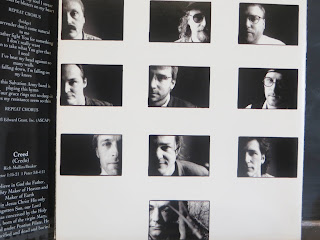
Pictures of Ragamuffin Band members from album booklet

Here in America functions as an introduction to the album, opened by a comment from a band member that reminds the listener of what the Ragamuffin Band was – a bunch of flawed and nervous dudes trying their best to make something meaningful. The song is a meditation on the beauty of the American landscape and the wondrous reality that the God of ancient Israel still cares for his people in modern America.

The Liturgy section of the album begins with 52:10, which functions as the Entroit (Proclamation). The song’s lyrics are taken from verse 10 of chapter 52 of the Book of Isaiah: “The Lord has bared his holy arm before the eyes of all the nations, and all the ends of the earth shall see the salvation of our God.” With thundering drums, rolling piano, and a haunting melody, the song’s music sets the mood for words that extol God as the mighty ruler and redeemer of the earth. Next comes The Color Green, which is the Gloria in Excelsis (Praise). According to Mullins, this Celtic number imagines an Irishman traveling to a morning church service, only to discover that he has already experienced God’s presence in the natural world along the road there. After that comes Hold Me Jesus, the Dona Nobis Pacem (Confession of sin). It was written by Mullins as a prayer during a particularly rough, late-night struggle with temptation while on tour in Amsterdam, and is a raw, vulnerable admission of personal brokenness:

Surrender don’t come natural to me
I’d rather fight you for something I don’t really want
Than take what you give that I need
And I’ve beat my head on so many walls
Now I’m falling down, I’m falling on my knees

And the salvation army band was playing this hymn
And your grace rings out so deep
It makes my resistance seem so thin
So hold me, Jesus
‘Cause I’m shaking like a leaf
You have been King of my Glory
Won’t you be my Prince of Peace?

This song, which became one of Rich Mullins’ greatest hits, has had a deep impact on me over time, reminding me of God’s persistent grace in the midst of my own battle with sin and feelings of distance from God. I’ve prayed its words after some of my darkest and most discouraging failures, and found hope through them. Next on the album, Creed serves as the Credo (Affirmation of faith). Undergirded by Mullins’ brilliant and rhythmic hammered dulcimer, the song’s lyrics are the words of the Apostle’s Creed, an ancient summary of Christian beliefs from around the time of Jesus. The chorus of the song references a line from G.K. Chesterton’s Orthodoxy about the power of these simple truths of the faith: “I will not call it my philosophy; for I did not make it. God and humanity made it; and it made me.” Rounding out the liturgy is Peace (a Communion Blessing from St. Joseph’s Square), which is the Agnus Dei (Celebration of grace). This song celebrates the unity that followers of Jesus have through the sacrifice of our Savior’s blood and body on the cross, symbolized in the wine and broken bread of the Eucharist celebration (the name of this ritual meal means “thanksgiving”).

Next comes the Legacy. This section begins with a brilliant interlude of Celtic music called 78 Eatonwood Green, which was an address that Mullins stayed at on a visit to Ireland. Hard begins a series of songs focused on the challenges of applying the liturgy’s truths to daily life. Facetiously describing himself as a “good midwestern boy” with “values that would make the White House jealous,” Mullins suggests the danger of pridefully comparing ourselves to other people, rather than realizing that we consistently fail to measure up to the standard of love, faith, and prayer that Jesus taught and lived. “Ain’t it hard to be like Jesus?” he asks. I’ll Carry On reflects on how the Christian life calls us away from what is familiar to a hard road, which involves holding onto simple truths and acknowledging the painful weight of our heritage. Christmas Morning is a simple but beautiful duet of piano and Irish whistle that connects a child’s excitement to wake to Christmas gifts with the wondrous truth that God sent his son as a gift to the world. How to Grow Up Big and Strong was written by a singer-songwriter named Mark Heard, who died in 1992. The number is a tribute to him, and seems to be a reflection on our human tendency to build our identities around strength and power, which all too often leads to the ravages of war. Rounding out the album, Land of My Sojourn is an epic conclusion to the album. Tracing a journey across the American landscape, the song contains some of the most beautiful poetry that Mullins ever wrote. It captures the theme that ties together the album – the tension between our sense of wonder at the beauty and promise of our country and our disappointment at its brokenness, which prompts a longing for something beyond this land – a healed and restored creation:

Nobody tells you, when you get born here
How much you’ll come to love it
And how you’ll never belong here
So I’ll call you my country
And I wish that I could take you there with me

Conclusion:

I believe that God sometimes uses works of art to grip our hearts, rock our world, and change us in surprising ways. A Liturgy, a Legacy, & a Ragamuffin Band has certainly drawn me closer to God, and it continues to do so. The music of Rich Mullins has encouraged me to live with greater wonder, on the lookout for magic, beauty, and goodness breaking through the shadows around me. While we await the restored creation to come, we can still marvel at the goodness of God’s handiwork in the places, creatures, and people that surround us – in the sights and sounds of America, in the joy of a kid on Christmas morning, and even in the color green. Mullins’ music has also filled me with a deeper yearning for things that have been busted up to be healed and set right – things in my own heart and body, in my relationships with God and others, and in my country. I am a sojourner, living in the tension between the “already, but not yet,” praising God for the place I call home and yet realizing that it will someday pass away. I want to be who I was meant to be, and while I know that I’ll continue to mess up and make mistakes in this life, I’ll carry on toward the vision of true humanity that Jesus taught and lived. The path is a hard one, deeply painful at times. But it’s worth it. Most of all, I’m grateful to Rich Mullins for the reminder that God loves ragamuffins like you and me, in the midst of all our brokenness. Jesus loved us enough to step into our messy world and give his life for us. Though I all too often forget it, he holds me even when I can’t hold onto him. I’ve encountered and re-encountered grace through this beautiful music. I hope you can too.

For further info on the story of Rich Mullins, check out:
Rich Mullins: A Ragamuffin’s Legacy, a 2014 documentary directed by David Leo Schultz (available on Amazon Prime)
Rich Mullins: An Arrow Pointing to Heaven by James Bryan Smith

What We Do When the Lights Go Out

What are you afraid of?

On any given day, the list of reasons to be worried can seem overwhelming. Sickness. Debt. Loneliness. Failure. Political injustice. Death. We navigate a landscape of murky shapes and looming shadows, picking our way through the charred rubble of past losses, heartbreaks, and catastrophes. Bewildered by what we’ve encountered and unsure of what’s ahead, we tread lightly, welcoming distractions and clutching at any convenience that might temporarily keep our anxiety at bay. But the peace that these things promise is fragile. After a while, the same old anxiety comes creeping back to dog our steps. We find that we’re in fear’s stomping ground, and we’re on the run.

This summer, God’s brought some things into my path that’ve made more apparent my own struggle against fear. Of any sin, this may be the one I’m best at. I’m a habitual worrier. I worry about what other people think of me, falling into the trap of trying to win people’s approval by how I act. I worry about not measuring up – about letting God and those around me down and not doing enough to fix my mistakes. As a recent college grad, I worry about finding a new, intimate community and work that makes a difference. And as a member of a family battling chronic, degenerative illness, I worry about what health struggles my future may hold.

How do we deal with fear when it comes after us? On the one hand, fear is sometimes a very natural response to perilous surroundings. God hardwired people with fight-or-flight instincts that help us survive, and when we cross paths with an avalanche, a flaming thanksgiving dinner that got left in the oven too long, a stampede of startled buffalo, or a spider hiding in a corner (whatever size said spider may be), we’re pretty jazzed and grateful that they kick into gear. There are also physical health issues and trauma that can prompt chronic anxiety and make it much tougher to fight without medical care or counseling. As someone who has battled an anxiety disorder before, I know a bit about how painfully hard this can be. On the other hand, if we allow fear to dominate our decisions, it can be paralyzing, preventing us from experiencing all kinds of adventures that pop up in our day-to-day lives. The simple fear of looking awkward can keep us from initiating a conversation with someone, trying something new, telling people what we really think and feel, or just being willing to drop our guard and be ourselves. So when fear’s howl echoes in the darkness, when the lights around us start to dim and then go out, how do we keep the old sinking feeling from gnawing at our gut? How do we stand our ground when the ground under our feet seems to be giving way?

Over and over in the Bible, God commands people to not be afraid. My brother Josiah told me recently that it’s the most repeated command in Scripture. “Do not be afraid.” Full stop. While the command smacks up against our natural inclinations, fear is presented as something incompatible with faith. Why? Worry denies that God is present and that his plans for us are good. It refuses to believe that he will come through on his promises to protect and provide for his people. Where fear spreads, trust can’t take root. However, along with this command, God’s people are also commanded repeatedly to fear their Creator – to approach him with awe, respect, and reverence. We serve a God who continually eludes and busts through the boxes of tameness and respectability that we try to stuff him into – a God who is completely holy, completely other than we are, and frighteningly wrathful against the evil that has warped and wounded his world. We serve a God who shakes mountains and manifests his presence in blazing fire, who “has thunder in his footsteps and lightning in his fists,” as songwriter Rich Mullins once wrote.

How can these two commands be reconciled? In the Bible, we learn that the fear of God is supposed to be a response to God’s redemptive love for his people (Deuteronomy 10:12-13). We approach God with awe-filled respect when we recognize that in spite of our resistance, and even though he has every right to blast us off the face of this planet, he has chosen to extend mercy to us and love us for the long haul, for better or for worse. The same God who rattles the earth and topples kingdoms in his righteous anger became a weak and vulnerable human being, working and weeping and walking alongside us, living the true and beautiful life we couldn’t live and then dying in our place to cancel the punishment that our destructive rebellion deserved. Now, amazingly, we’re invited to address the Maker of heaven and earth as “Abba,” an intimate Hebrew term used by children to address their papa. How crazy is that?! We’re invited into a eternal relationship of intimacy with God that “casts out fear” (1 John 4:18). This is how the fear of God liberates us from all other fears. This is what John Newton meant when he wrote, “Twas grace that taught my heart to fear, and grace my fears relieved.” When we know in our bones that the scariest being there is, the only One who judges our eternal destinies and rightly deserves to be feared, loves us deeply and is actually fighting tooth and nail for our good, all other fears lose their stranglehold on our lives. Their claws are removed. If the Creator of all things truly loves us as much as he says he does, and if he really did for us what the Bible says he did, then in the deepest sense possible we are safe, now and forever. Perhaps the best description of God’s character that I’ve ever read outside of the Bible is found in Mr. Beaver’s description of the lion Aslan to Lucy in C.S. Lewis’s The Lion, the Witch, and the Wardrobe: “Who said anything about safe? ‘Course he isn’t safe. But he’s good. He’s the King, I tell you.”

In light of these realities, how do we confront fear on the ground, in the thick of the daily grind, where our faith so often gets tossed around in stormy weather? This is where I’m at, and often this adventure that I’m on feels like a long, slow, uphill slog. I’m braver than I used to be, but a lot less brave than I wish I was. Fears that I’ve wrestled with for years still haunt my tracks.

One weapon that God gives us against anxiety is prayer. “do not be anxious about anything,” writes the apostle Paul, “but in everything by prayer and supplication with thanksgiving let your requests be made known to God” (Philippians 4:6). Rather than letting our fears ricochet around in our brains until we’re spent, we’re invited to talk honestly with God about them, whether they seem earth-shattering or small and insignificant. Wild. Even though he knows our concerns and dilemmas better than we do, God still wants to hear us open up to him about them. This exhortation comes with a promise: “And the peace of God, which surpasses all understanding, will guard your hearts and your minds in Christ Jesus” (Philippians 4:7). The struggle may not disappear. Courage and peace may not come quickly. But the promise is there nonetheless. God will give us the peace of heart that we need to keep going. Full stop.

A second weapon against fear is remembrance. Again and again, when we’re tempted to resign ourselves to despair, we have the opportunity to remind ourselves and those around us of the great story that we’re living within – the story of the God who came near, who met us where we were at, who walked out of our town into the deepest gloom imaginable and then came back three days later with the dawn.

Telling the tale to one another, and hearing it ourselves, is a sacred and vital task.
One of my all-time favorite stories is a novel called Watership Down by Richard Adams. It’s the tale of a group of rabbits who set out from their warren, which is doomed to be bulldozed by humans for a housing development, to find a new home in the wilderness. While a story about traveling bunnies may not seem all that exciting, the book is filled with suspense, surprising twists, and hare’s-breadth escapes (pardon the pun), and it ends up being an epic adventure yarn comparable to The Lord of the Rings (Really, it’s that good. Check it out!). I recently listened to a talk on the book given by author Jeffrey Overstreet, and I’m indebted to him for the following reflections. In the book, the skittish nature of rabbits and their status as prey is the result of a curse placed upon them by the sun god Frith, in response to the wily mischief of a mythical rabbit trickster named El-ahrairah. Throughout their journey, to ward off fear and find courage as they trek through the unknown, the rabbits ask one member of their company, Dandelion, to tell them stories of El-ahrairah’s fabled adventures. In one of these stories, El-ahrairah travels to the dark realm of the fearsome black rabbit of Inle (who represents death), trying to strike a bargain so that his people can be saved from predators that have surrounded their burrows. After a painful struggle, the black rabbit tells El-ahrairah that his people have been delivered. El-ahrairah returns home to find his warren safe at last, but also discovers that a lot of time has passed and none of the rabbits there remember being rescued from their enemies. Reflecting on the experience, El-ahrairah tells the sun god Frith: “I have learned that with creatures one loves, suffering is not the only thing for which one may pity them. A rabbit who does not know when a gift has made him safe is poorer than a slug, even though he may think otherwise.”

Day by day, as we’re faced with a dark and twisting landscape that tempts us to worry about the future, we can either let fear control us or rehearse to ourselves and others the story that has the power to free us from our fears, once and for all – the story of the Gift who made us safe.