Brokenness, Beauty, and the Ballad of Samwise Gamgee

There’s a great moment near the end of The Lord of the Rings: The Two Towers that I’ve been pondering recently. The scene is set in Osgiliath, a military outpost on the edge of the noble kingdom of Gondor. Osgiliath is under siege, targeted by dragons that are dive-bombing it from the sky and ripping its ramparts to pieces. As soldiers scurry for cover, two hobbits – Frodo Baggins and Samwise Gamgee – huddle together by a flight of stairs. Months ago, these hobbits had left their homes in the Shire, bearing a dark and powerful ring toward the distant land of Mordor. They had known then that their road would be a difficult and dangerous one. However, nothing could have prepared them for the horrors they would face along the way.

Leaning against a wall, Frodo groans in despair: “I can’t do this, Sam.” Sam rises and murmurs in agreement: “I know. It’s all wrong. By rights we shouldn’t even be here.” Then, staring out at the battle raging in Osgiliath, he starts thinking aloud:

It’s like in the great stories, Mr. Frodo. The ones that really mattered. Full of darkness and danger they were. And sometimes you didn’t want to know the end, because how could the end be happy? How could the world go back to the way it was when so much bad had happened? But in the end, it’s only a passing thing, this shadow. Even darkness must pass. A new day will come, and when the sun shines it’ll shine out the clearer. Those were the stories that stayed with you, that meant something, even if you were too small to understand why.

Here’s a challenge: take a moment to think about the stories that, in Sam’s words, have “stayed with you” over the years and “meant something” to you. What do those stories have in common? Sam’s words in Osgiliath are a great description of many stories that I love deeply – tales like J.K. Rowling’s Harry Potter series, Leif Enger’s Peace Like a River, Richard Adams’ Watership Down, Cormac McCarthy’s The Road, and of course, J.R.R. Tolkien’s The Lord of the Rings trilogy. Each of these books depicts ordinary folk who are both faced with great evil and swept into a wondrous adventure to strange lands. Additionally, each of them reminds me of another story that has stayed with me over the years: the Bible.

Throughout my life, no story has impacted me as deeply as the stories of the Bible have. As a Christian, I believe that the narratives of this ancient book are God’s words to humanity – which means, of course, that I think they actually happened. This isn’t to say that I find them easy to believe. Honestly, more often than not, I find them strange and fantastical. I’ve wrestled with doubts about the existence of God and the validity of Christianity since middle school (the time when most crises of faith, including puberty, seem to begin). Sometimes, my doubts have been paralyzing, tossing me to and fro like a ship in a storm. Other times, they’ve been present but less palpable, rumbling at the back of my mind like distant thunder.

Yet, as difficult as they are to believe, the stories of Scripture have imbued my life with purpose, offering hope and guidance amidst life’s changing seasons. When I think about my continued faith in Christ, I find myself circling back to Samwise Gamgee’s definition of lasting and meaningful stories. The Bible fulfills this definition better than any other story I know. Additionally, I would argue that many great tales – the kind that really matter – contain echoes of the Biblical story, which J.R.R. Tolkien himself described as “the true myth.” Whether you agree with me or think I’m nuts, this blog post is an invitation to re-examine the stories of Scripture through the eyes of that most eloquent of hobbits: Samwise Gamgee.

“Full of Darkness and Danger They Were”
According to Samwise, great stories are marked by deep suffering. This suffering isn’t the natural order of things, but rather a departure from the way things used to be. Often, it’s so deep that the characters start to wonder if it can possibly be overcome: “How could the world go back to the way it was when so much bad had happened?” The world that we call home is a deeply broken place. While we may not agree on the scope or significance of the world’s brokenness, its reality confronts us every day: war, hatred, oppression, poverty, greed, corruption, pollution, disease. In the darkness of great tales – the fearsome Black Riders of The Lord of the Rings, the Death Eaters of Harry Potter, the armies of Thanos in the Avengers movies – we glimpse the darkness of our own story.

While we all recognize the world’s brokenness, the stories that we tell make sense of this reality differently. Some stories deny the weightiness of suffering. In religions like Zen Buddhism, enlightenment is reached by detaching oneself from earthly hardships, longings, and concerns. Similarly, many religious people (including some Christians) look forward to an afterlife that is divorced from the stuff of earth – an immaterial paradise beyond the clouds. While we may not agree with these attitudes, you and I are surrounded by an entertainment culture that constantly promotes distraction and escapism as antidotes to suffering.

In his book Long Journey Home, Os Guinness tells the story of a man named Issa, who was one of Japan’s most beloved haiku poets. Issa was well-acquainted with suffering. Before turning thirty years old, he witnessed the death of five of his children. Later, his young wife died as well. Heartbroken, Issa sought counsel from an elder monk, who gave him this advice: “The world is dew.” The monk reminded Issa that his religion required detachment from earthly matters, including the loss of loved ones. Pondering the monk’s words, Issa penned this poem: “The world is dew, / the world is dew – / and yet, / and yet…” In these lines, we don’t hear cold indifference to suffering. We hear the longing of a grieving father and husband – the groaning of a wounded soul. While Issa’s faith made no allowance for the weight of sorrow, his own story was inescapably scarred by it.

Some stories refuse to downplay the world’s darkness and choose instead to resign themselves to it. In these tales, pain and death are intrinsic parts of life. While we can try to alleviate suffering, there isn’t a higher answer for our struggles and sorrows – at least, not one that we can know. Life is hard, and we’ve got to get used to it. This attitude resonates with what we see in nature, which – as Alfred, Lord Tennyson put it in his poem “In Memoriam A.H.H.” – is “red in tooth and claw.” In his song “For What It’s Worth,” J Lind describes a familiar scene from a Planet Earth documentary:

Turn it up, this is my favorite part
Watch how the tiger catches the deer in the dark
Its teeth were sharpened by the Darwinian arc
Of a million years

For most of us, this image is routine. While the deer might have a few objections, we don’t question the morality of the tiger’s hunt. However, faced with images of human suffering in the third stanza of J Lind’s song, we start to feel differently:

Look it up, or look across the street
Flies on their faces and nothing on their feet
These little ones will be lucky if they breathe
For a couple years

Faced with extreme examples of human suffering – things like debilitating poverty, starvation, and the death of children – something inside us starts to protest. Though they are everyday realities, these things feel unnatural and wrong in the deepest sense of both words. As philosopher George Steiner puts it in his book Errata, we’re ambushed by the sense that “Something…has gone hideously wrong,” that “Reality could, should have been, otherwise.” While we might encourage resignation in theory, we tend to deny it in practice, especially when we’re confronted with death. To a mother who has lost a child, the statement that suffering is an intrinsic part of life rings incredibly hollow. 

Though we all know that death awaits us, we still kick and scream when it claims those we love. Reminded of our mortality, we resonate with the words of poet Dylan Thomas: “Do not go gentle into that good night. / Old age should burn and rave at close of day. / Rage, rage against the dying of the light.” For as long as anyone can remember, humans have believed in some form of an afterlife. It could be argued that these beliefs are a coping mechanism – a way to manage our fears of the unknown. But what if they’re actually an instinct pointing toward something true about our world? What if death feels unnatural because it is? What if we can’t imagine disappearing because we were never meant to disappear?

Some stories promote human effort as the solution to the world’s problems. These tales can be found not only in philosophies of secular humanism, but also in religions that advocate merit-based salvation. Sure, our lives are messy now. But it’s nothing we can’t fix. Give us enough time, and we’ll get things straightened out. This position sounds eminently hopeful. Surely, humanity has come a long way throughout history. However, from where I’m standing, the world looks just as broken as it has always been. Old sins have given way to new ones: weapons of mass destruction, rampant greed and materialism, wars sparking massive refugee movements, pollution and deforestation, the normalization of abortion. From the swords of Rome to the cannons of the colonizers to the tanks and bombs of World War II, we humans have proven ourselves incapable of fixing the mess we’re in. 

I know my own heart too well to put my faith in humanity. As N.T. Wright says in his book Simply Christian, “The line between justice and injustice, between things being right and things not being right, can’t be drawn between ‘us’ and ‘them.’ It runs right down through the middle of each one of us.” My heart is fractured by the same selfishness and complacency that I see in the world. Despite my best efforts to do good, I still compromise on my convictions, make stupid choices, and hurt the people I love. I resonate with the wayward spaceman in J Lind’s song “The Astronaut (Part II)”:

Behold the astronaut, so far from home
He washed up on a shore unknown
He’d build a tower out of stone
But all he sees is sand

Mistaking confidence for competence
He calls himself an optimist
And builds until the sand is wet
And running through his hands

Like Samwise Gamgee, the story of the Bible depicts suffering and death as realities that are both weighty and unnatural. In the Book of Genesis, God designs the first humans to live in harmony with himself, with each other, and with the earth (Genesis 1:16-29). However, he also gives them free will, warning them that rebellion against the created order will bring death into the world (Genesis 2:16-17). The sin of Adam and Eve is more than just a naughty deed. It’s a symbolic act of defiance – a refusal to submit to the Creator of the cosmos. The Bible tells us that all of the world’s brokenness – shame, toil, pain, dysfunctional relationships, exile, and death – can be traced to that fateful choice (Genesis 3:8-24), which humans have been repeating ever since. In the wake of Adam and Eve’s disobedience, the story of the Bible is a long train wreck – a grisly account of people destroying each other, neglecting the earth, and refusing to heed God’s warnings. 

This is the fallout from the fall. We were created to live under our Maker’s authority. Left to our own devices, we rupture and fall apart. There’s a reason why we shiver when the Black Riders arrive in the Shire, when Voldemort’s servants slink into Hogwarts, and when Thanos’ spaceship touches down on planet earth. In the opening pages of the Bible, we’re told that there has been an invasion. Something, indeed, has gone horribly wrong.

“When the Sun Shines”
In his monologue at Osgiliath, Samwise Gamgee says that great stories are marked not only by deep suffering, but also by intense beauty. The kind of beauty that Sam describes isn’t tame. It’s powerful and persistent – a light made all the more vibrant by the darkness that threatens to extinguish it: “A new day will come, and when the sun shines it’ll shine out the clearer.” Each of us has experienced the thrill of losing ourselves in a well-told tale, whether we found ourselves strolling the grassy slopes of the Shire, touching snow-covered branches where the back of a wardrobe should be, or hearing the whistle of a train puffing into Platform 9 & 3/4. The wonder we feel when lost in a story is an echo of a truth that we all too easily forget: despite its darkness, our world remains far more beautiful than it needs to be.

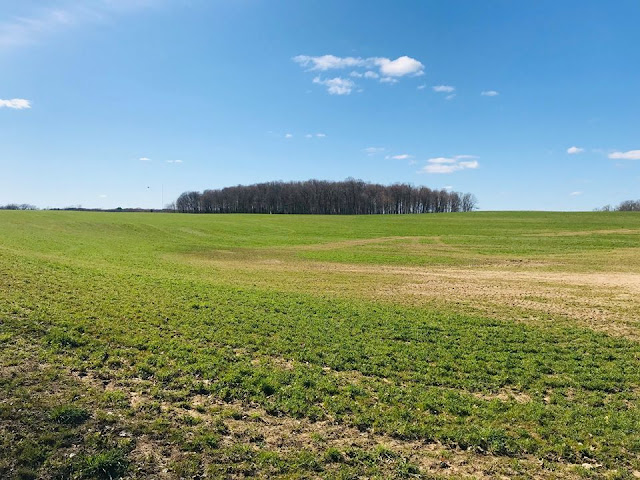
I hope you’ve been getting outside during this quarantine. Even in the frozen tundra of Michigan, where it sometimes feels like it’s “always winter, but never Christmas,” the earth is coming alive again. Recently, on a walk through the farmlands surrounding my home, I was repeatedly ambushed by the arresting beauty of Springtime: the rich smell of furrowed soil, the new grass gleaming green in afternoon sunlight, the yawning sea of electric blue sky. As I walked, each bend in the dirt road became a doorway to a strange new land.

We’ve all encountered beautiful landscapes that took our breath away. According to author G.K. Chesterton, this is one of the reasons why fantasy stories – in particular fairy tales – resonate with us. By beckoning us into unfamiliar territory, where the rules of our universe are upended and anything can happen, stories of magic invite us to re-examine the strangeness and beauty of the people, landscapes, and creatures that surround us. In his book Orthodoxy, Chesterton put it this way: 

“We all like astonishing tales because they touch the nerve of the ancient instinct of astonishment. This is proved by the fact that when we are very young children we do not need fairy tales: we only need tales. Mere life is interesting enough… These tales say apples were golden only to refresh the forgotten moment when we found out that they were green. They make rivers run with wine only to make us remember, for one wild moment, that they run with water.”

If you’re anything like me, encounters with intense beauty fill you with a fierce appreciation for the planet you call home – a feeling that life, as Chesterton described it, “is not only a pleasure but a kind of eccentric privilege.” It’s the sense of being given a lavish (even downright excessive) gift that you could never hope to repay. It’s wondering, “Why on earth do I get to live in a world of sunrises and sunsets, of wolves and whales, of music and mountains, of constellations and the color green?” G.K. Chesterton had a similar response to the world’s beauty:

“The test of all happiness is gratitude; and I felt grateful, though I hardly knew to whom. Children are grateful when Santa Claus puts into their stockings gifts or toys or sweets. Could I not be grateful to Santa Claus when he put in my stockings the gift of two miraculous legs? We thank people for birthday presents of cigars and slippers. Can I thank no one for the birthday present of birth?”

Faced with intense beauty, we don’t turn inward. Whether we’re listening to the drumbeat of thunder and rain, feeling the warmth of sand between our toes, savoring the tang of fresh coffee, or smelling the salty spray of seawater, experiences of intense beauty pull us out of ourselves, reawakening awe and appreciation for the miracle of ordinary life.

One of the most startling things about beauty is its resilience. Despite all the struggles, sicknesses, and sorrows that surround us, people are still singing songs and telling tales that celebrate life’s beauty. During the summer and fall of 2017, I had the opportunity to live and study in an urban slum community in a Southeast Asian country. My neighbors were scavengers who made their living by picking through the city’s trash for recyclable materials. Their lives were very hard. Yet, when I think back on the time I spent with them, I’m flooded with memories of beauty: friends swapping stories over coffee and cigarettes, mothers cooking delicious meals, families decorating their homes with items salvaged from trash heaps, neighbors singing karaoke music late into the night. These creative activities weren’t coping mechanisms. In the midst of their poverty, my neighbors affirmed G.K. Chesterton’s description of life as a gift to be cherished: “The goodness of the fairy tale was not affected by the fact that there might be more dragons than princesses; it was good to be in a fairy tale.”

In his song “For What It’s Worth,” J Lind describes similarly striking celebrations of life’s beauty among the people of India:

And the women laugh from their cages in Bombay
As the children clap from Calcutta-bound freight trains
And their song is lost to the chaos of the earth
But they still lift up holy hands for what it’s worth

Pondering the stark contrast between this brokenness and the beauty of the earth, Lind writes these words in his song “Letter to the Editor”:

No, I don’t want to love in spite of it
Like it’s just some sad mistake
No, I would rather love because of it
Oh, the contrast that creates
All of the colors found with every twist 
Of this kaleidoscopic fate
Yes, I’d like to learn to love it anyway

In the midst of deep suffering, simple acts of creativity and kindness “shine out the clearer,” as Samwise Gamgee puts it. More surprising than the brutal reality of my neighbors’ poverty was the fierce persistence of their joy. More shocking than the oppression of Nazi Germany was the resistance of ordinary men and women who risked their lives to rescue people they’d never met. More startling than the contemporary refugee crisis is the multitude of people who have opened their homes to strangers from distant lands, sacrificing their time, energy, and money to help foreigners feel welcome. Instead of extinguishing light, darkness only augments light’s beauty.

One of my favorite scenes from The Lord of the Rings: The Return of the King occurs on the molten slopes of Mount Doom, where Frodo Baggins and Samwise Gamgee are fighting to draw breath in a firestorm. Cradling an exhausted Frodo in his arms, with smoke and sulfur raining down around him, Sam sustains his friend with memories of their homeland: “Do you remember the Shire, Mr. Frodo? It’ll be Spring soon, and the orchards will be in blossom. And the birds will be nesting in the hazel thicket. And they’ll be sowing the barley in the lower fields. And they’ll be eating the first of the strawberries with cream. Do you remember the taste of strawberries?” Surrounded by the hellish fires of Mordor, Sam’s memories of the Shire burn with a deeper and holier light.

In sharp contrast to stories that encourage detachment from the earth or that view nature as an accidental byproduct of blind forces, the story of Scripture contends that our universe is ablaze with purpose. In the Book of Genesis, we meet a God who creates beautiful things – not out of necessity or boredom, but out of sheer joy. After speaking the earth into existence, God blesses each part of it and declares that it is “good” (Genesis 1:3-31). God commands the first humans to cultivate the earth, to build families, and to enjoy the bounty of creation (Genesis 1:26, 28-29). According to the Bible, every beautiful thing in the world – from the petals of a dandelion to the peaks of the Himalayas – is the handiwork of a master artist.

Though nature has been ravaged by humanity’s misdeeds, it still bears the mark of its Maker’s hand: “The heavens declare the glory of God; the skies proclaim the work of his hands” (Psalm 19:1). The world of Scripture is far more than a stagnant backdrop for human activity. It’s a place of magic – a land of wonders that thrums with life and praise: “Let the heavens rejoice, let the earth be glad; let the sea resound, and all that is in it. Let the fields be jubilant, and everything in them; let all the trees of the forest sing for joy (Psalm 96:11-12). Humanity is God’s masterpiece. We are made in our Creator’s image (Genesis 1:27), woven with all the intricacy of a beautiful tapestry: “For you created my inmost being; you knit me together in my mother’s womb. I praise you, for I am fearfully and wonderfully made” (Psalm 139:13-14). Additionally, acts of love and courage that fulfill God’s purposes are described as deeply beautiful: “How beautiful on the mountains are the feet of those who bring good news…who say to Zion, ‘Your God reigns!’ (Isaiah 52:7).

According to the Bible, we have every reason to be grateful. Our planet is indeed a gift that we could never hope to repay. In the pages of Scripture, we also find reason for the resilience of beauty: the Creator has not abandoned his world, but rather still holds each part of it together (Colossians 1:17). His love sustains world’s light: “The light shines in the darkness, and the darkness has not overcome it” (John 1:5). His presence still haunts the hollows of the earth. In Scripture, we glimpse a truth that great stories have always hinted at: the world outside our front doors has always been more wild and wondrous than Middle Earth, more strange and surprising than Narnia, more magical and mysterious than Hogwarts. If we listen closely, we might hear the grizzled voice of Gandalf the Grey whispering in our ears: “The world isn’t in your books and maps, it’s out there.”

“Even Darkness Must Pass”
At the heart of Samwise Gamgee’s description of great stories is this statement: “But in the end, it’s only a passing thing, this shadow. Even darkness must pass.” According to Sam, great stories depict the triumph of light over darkness. This isn’t to say that great stories can’t have sad endings (personally, I’m a sucker for sad movies). As we’ve seen already, acknowledgement of the world’s brokenness is a crucial part of any great story. However, the victory of good over evil is a common trope of many great stories, especially the fantasy tales, epic quests, and superhero sagas that kindle our imaginations. In the end, no matter the cost, Sauron’s ring must be destroyed. Voldemort, invincible though he seems, must be killed. There must be some way to reverse Thanos’ fateful snap. Even the Star Wars trilogies, which borrow Zen Buddhist ideas of an eternal balance between light and darkness, must end with the triumph of the Jedi over the Sith. G.K. Chesterton made a similar observation about children’s stories: “Fairy tales don’t teach children the dragons exist. Children already know that dragons exist. Fairy tales teach children the dragons can be killed.” 

Recently, I saw a video of an experiment in which little children were shown two versions of Disney’s Beauty and the Beast: the original version, and an alternate version that ended with the Beast’s death (if this experiment sounds sick and twisted to you, then you might be a Disney fan). The kids were asked which version they preferred, and why. Overwhelmingly, they preferred the original version (surprise!), which concluded with a wedding and a reunion of characters. This experiment confirms what we already know: from a young age, we’re hardwired for happy endings. However, we’re left wondering: Is our longing for happy endings simply wish-fulfillment, something that we all outgrow with time? Do we really have any reason to expect that our own stories will end happily?

Like many great stories, the Bible affirms the victory of goodness and life over evil and death. However, if this affirmation is to ring true, then the solution must be as multifaceted as the problem (if you ever had your heart broken by the ending of the TV show Lost, then you know exactly what I’m talking about). Here, in my opinion, is where the Bible outpaces the competition. In the death and resurrection of Jesus Christ, we encounter a climax that takes seriously both the weight of the world’s brokenness and the intensity of the world’s beauty. 

In Jesus’ trial by Jewish authorities and execution at the hands of Roman soldiers, we witness many consequences of human evil: betrayal, abandonment by friends, isolation, a corrupt justice system, torture, and mob brutality. In contrast to stories that downplay the world’s darkness, the cross affirms that humanity’s sin is incredibly costly. Evil deeds create wounds that can’t be glossed over or ignored. Injustice demands a reckoning, and the inevitable outcome of our rebellion against God is death (Romans 6:23). In contrast to tales that resign themselves to the world’s darkness, the cross affirms that there is a solution for sin and suffering – one that we can know. On the cross, the Son of God chooses to take our place, bearing the punishment that we deserve and offering us his track record of perfect obedience in return: “God made him who had no sin to be sin for us, so that in him we might become the righteousness of God” (2 Corinthians 5:21). And in contrast to stories that advocate human effort as the solution, the cross affirms that this rescue operation is entirely God’s initiative: “For God so loved the world that he gave his one and only Son, that whoever believes in him shall not perish but have eternal life” (John 3:16).

While confronting the world’s brokenness, the cross of Christ also declares creation’s beauty. In the person of Jesus, the Maker of time and space himself stepped into time and space, taking on flesh and bone. In doing so, God affirmed the value of the material world – the sacredness of the landscapes and bodies that we were always meant to inhabit. Rather than discarding his wounded creation, God reaffirms his statements in Genesis 1, which J Lind references in his song “It is Good”:

It is good, it is good
The water, the fire – the spirit, earth, and wind
It is good, it is good
And I would do it all again

Furthermore, in light of the cross, humanity has good reason for the kind of gratitude that G.K. Chesterton described. The Giver of earth has offered us another gift that we could never hope to repay: eternal life with God (John 3:16). We’ve been given the opportunity to become beautiful artwork – the people who we were always meant to be: “Therefore, if anyone is in Christ, the new creation has come” (2 Corinthians 5:17). Additionally, Jesus’ self-sacrificial death displays the resilience of beauty. For over two thousand years, this selfless act has inspired countless other acts of creativity and compassion. People are still paying it forward.

If the story ended there, we’d have an epic and deeply moving conclusion – something like the finale of Avengers: Endgame. Yet, what truly sets the Bible apart from other tales is what happened after Good Friday. While the cross squared off against the world’s brokenness, the resurrection proclaims the utter defeat of brokenness at the hands of beauty. For followers of Christ, sin and suffering will not have the last word. Death – the Great Invader – has been mortally wounded. If Christ is risen, then our bodies aren’t destined for decay: “By his power God raised the Lord from the dead, and he will raise us also” (1 Corinthians 6:14). According to Scripture, we aren’t looking forward to an escape from this earth. Rather, we’re looking forward to a renewed planet (Revelation 21:1) – a world of sunrises and sunsets, wolves and whales, music and mountains, constellations and the color green.

To many people, this resurrection hope seems incredibly naive – a fool’s hope at best. But as Andrew Peterson suggests in his book Adorning the Dark, “a fool’s hope may be the best kind.” Like Samwise Gamgee, those of us who have trusted in Christ have awoken in a warm bed after a difficult and dangerous road, laughing with bewildered joy: “Is everything sad going to come untrue? What’s happened to the world?”

“Their Joy Was Like Swords”

Near the end of J.R.R. Tolkien’s The Return of the King, there’s a moment when a minstrel rises to sing for the people of Gondor, who have gathered in the city of Minas Tirith. It is a time of great rejoicing. Against all odds, Mordor has crumbled, and Sauron has been overthrown. The Ring of Power has been destroyed once and for all, carried to its demise by two brave hobbits. Frodo Baggins and Samwise Gamgee are among the crowd, recently recovered from their grim ascent of Mount Doom. Addressing the people, the minstrel introduces his song: 

“‘Lo! lords and knights and men of valour unashamed, kings and princes, and fair people of Gondor, and Riders of Rohan, and ye sons of Elrond, and Dunedain of the North, and Elf and Dwarf, and greathearts of the Shire, and all free folk of the West, now listen to my lay. For I will sing to you of Frodo of the Nine Fingers and the Ring of Doom.”

Hearing these words, Samwise Gamgee is overwhelmed: 

“And when Sam heard that he laughed aloud for sheer delight, and he stood up and cried: ‘O great glory and splendour! And all my wishes have come true!’ And then he wept.” 

Why does Sam respond this way to the minstrel’s ballad? In the fortress of Osgiliath, Sam had found hope in the memory of great stories – “the ones that really mattered.”. In Minas Tirith, he hears his own story sung, and realizes with sudden joy that he has been living in one of those tales all along. Like the stories that “stayed with you” and “meant something,” Sam’s own story has been full of brokenness – of “darkness and danger” that threatened to snuff out the light. Yet, as in those stories, darkness has passed. A new day has come. Rather than being forgotten, Sam’s suffering has been woven into the song, making it all the more remarkable. His brokenness has been turned into beauty. According to Scripture, this redemption is the destiny of God’s people: “For this light momentary affliction is preparing for us an eternal weight of glory, beyond all comparison” (2 Corinthians 4:17).

After all these years, this is why I keep coming back to the Bible. In its pages, I glimpse what I believe to be the greatest story ever told – the tale of a world that, in songwriter Andrew Peterson’s words, was created good, has fallen, and will be redeemed again. And do you want to know the craziest part? When I pick up that ancient book and sit down to read, I see us there in its pages – you and me. I find myself nodding in agreement with G.K. Chesterton: “I had always felt life first as a story: and if there is a story there is a storyteller.” There’s a reason why great stories resonate with our hearts. These tales are, after all, only echoes of the story we’re living in. Like Samwise Gamgee, I can’t wait to hear how it ends:

“And all the host laughed and wept, and in the midst of their merriment and tears the clear voice of the minstrel rose like silver and gold, and all men were hushed. And he sang to them, now in the Elven-tongue, now in the speech of the West, until their hearts, wounded with sweet words, overflowed, and their joy was like swords, and they passed in thought out to regions where pain and delight flow together and tears are the very wine of blessedness.”

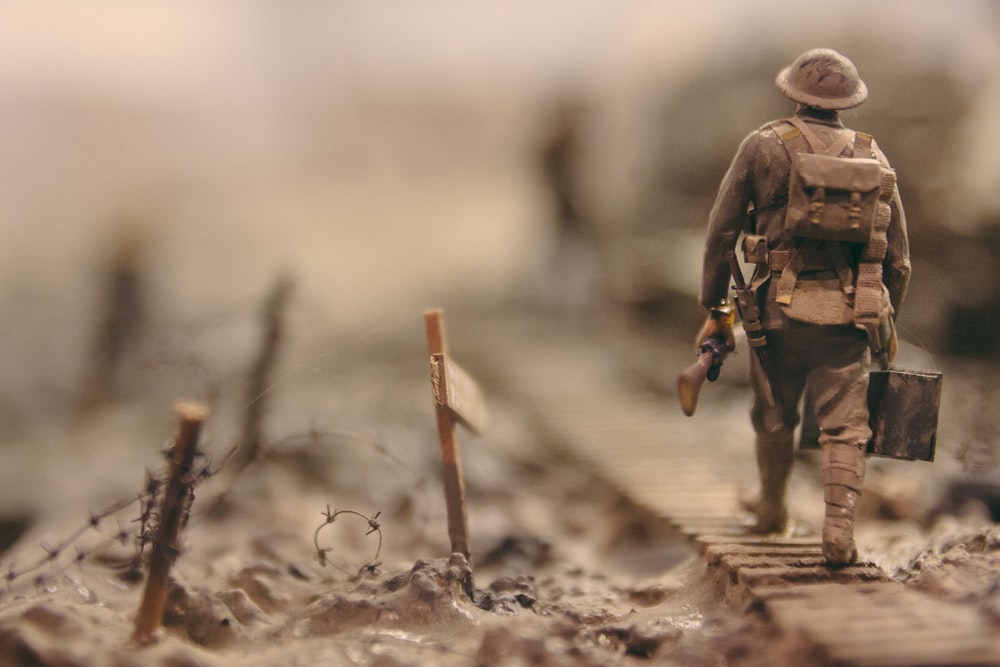
The War and the Waymaker: Echoes of Easter in 1917

What do World War I and Holy Week have in common?

Earlier this week, my dad and brothers and I watched Sam Mendes’ acclaimed war film 1917. It’s an amazing movie. The acting is terrific, the narrative is gripping, and the cinematography is unreal. If you’ve seen the film, then you know what I mean. 1917 was nominated for ten Oscars, and honestly, it’s worth seeing for its technical aspects alone. However, what struck me most about the movie wasn’t its film quality or even its storyline. What struck me most about it was its surprising echoes of the story of Easter.

The War

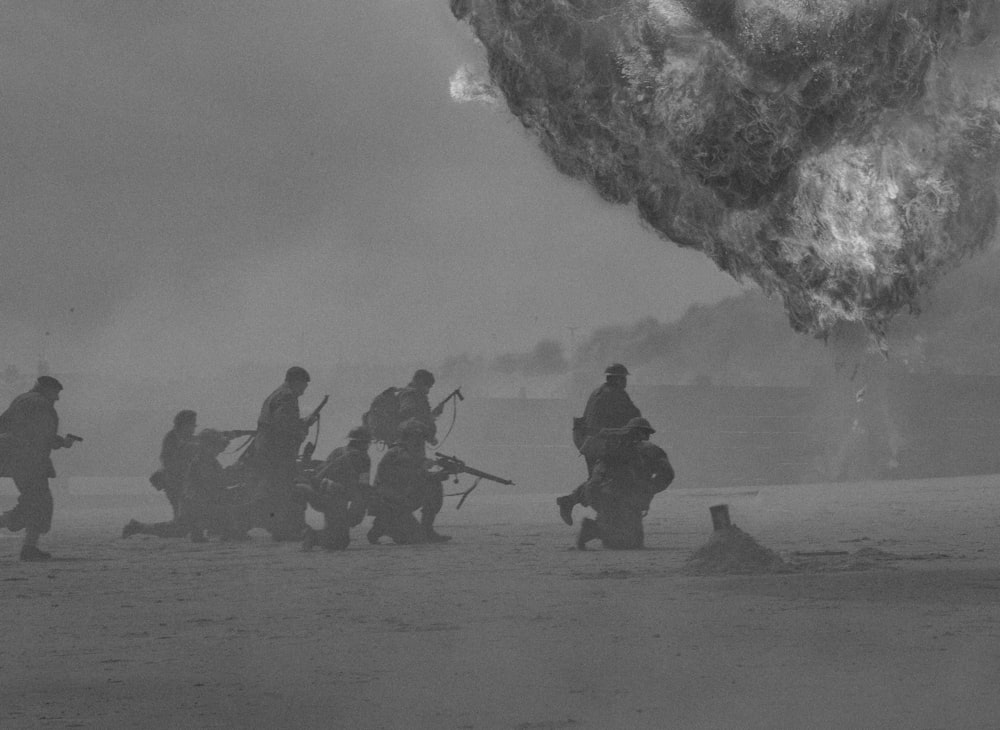
silhouette of soldiers

At the beginning of the film, a young British soldier named Blake is summoned to a meeting with a general. He’s told to bring a companion along, and he chooses his friend Schofield. When the pair arrive in the general’s tent, they receive grim news: German forces have withdrawn from a nearby front in order to lure their British foes into an ambush. The British troops are unaware of this tactic and are planning a full-scale assault the following morning. If this attack is not called off, they will walk straight into a trap. After telling Blake and Schofield this information, the general gives the men their assignment: they must travel across no-man’s land and through enemy territory to warn the endangered regiment. If they don’t deliver their message by sunrise, then 1,600 British soldiers – Blake’s brother among them – will be slaughtered.

Blake and Schofield recognize that this mission is extraordinarily dangerous. Yet, when their commander asks them if they have any questions, they answer with a salute. Shouldering their rifles, they hurry from the tent and begin their race against time.

Why do these men agree to such a perilous task? The answer is twofold. First, one of them has a personal stake in the journey. For Blake, it’s his best hope of rescuing his brother. Second, the men are following orders. As crazy as those orders sound, their duty as soldiers is to trust that their commander’s assessment of the situation is accurate. While their solemn salute may seem foolhardy, it’s actually deeply noble. They’re choosing to lay their lives on the line for others. Movie critic Brett McCracken says it well in his review of the film: “This resolute gesture, made with unmistakable dread in their eyes, captures the beauty of duty and simple obedience, of saying ‘yes’ to something costly and hard, simply because an authority above you gives the order. In a ‘follow your heart’ world where ‘do as you’re told’ deference to authority is tantamount to blasphemy, the moment feels radical and refreshing – and the rest of the film only builds on it.”

I won’t spoil the rest of the story, but I will say that the “unmistakable dread” in the soldiers’ eyes turns out to be well-founded. Their mission is even more dangerous and costly than they could’ve imagined. As they trek across the hellish, charred remains of no-man’s land and the war-torn countryside of Northern France, Blake and Schofield must stay alert for traps, environmental hazards, and the ever-watchful forces of the enemy.

Have you ever felt like a soldier? While most of us can only imagine what it would be like to walk in Blake’s and Schofield’s shoes, there are some aspects of the soldiers’ wartime quest that we can all relate to. We’ve all experienced some measure of dread – a sense of looming, imminent disaster. Whether by the death of loved ones or narrow escapes from death ourselves, many of us have also faced reminders of our own mortality (Just this week, my family and I were reminded of this fact through the death of a beloved friend to Covid-19). Additionally, all of us have grappled with suffering. For some, this suffering has resembled a soldier’s journey – a long, desperate slog with seemingly no end in sight. We’ve all known seasons of chaos – times when our hopes or plans were upended and we had no clue what tomorrow would bring. In this season of quarantine, many of us have felt the combined weight of these struggles more keenly than usual.

Early in 1917, there’s a moment when the main characters have narrowly escaped death. A frustrated and bewildered Schofield asks Blake, “Why on earth did you have to choose me?” Defensive, Blake retorts, “I didn’t know what I was picking you for. I thought they were going to send us back up the line, or for food, or something. I thought it was going to be something easy, alright? I never thought it would be this.”

The Bible is full of stories about people who were called by God into unexpected, confusing, and difficult circumstances. In the The Doctrine of the Word of God, theologian John Frame discusses the stories of Biblical figures like Noah, Abraham, Isaac, Jacob, Moses, and David. He makes this observation: “All these narratives and others begin with God’s personal speech, often saying something hard to believe or commanding something hard to do. The course of the narrative depends on the character’s response, in faith or unbelief… Faith, in both Testaments, is hearing the word of God and doing it.” According to Frame, faith in God is not passive. Faith requires us to act on our Creator’s orders, even when those orders are frightening or confusing. Very often, living in faith is a weighty and difficult task.

As I’ve reflected on 1917, I’ve found myself resonating with the soldiers’ feelings of confusion and disillusionment. As a follower of Jesus Christ, I reject the notion that God has promised his followers an easy, comfortable, pain-free life. Jesus taught the opposite; he warned his followers that their loyalty to him would cost them. “In this world you will have trouble,” he told his disciples (John 16:33). Another time, he said, “If the world hates you, keep in mind that it hated me first” (John 15:18). Again and again, Christ told people that obedience to him would result in persecution (Matthew 5:10-12, Luke 6:22, John 15:20). We shouldn’t be surprised by life’s obstacles. And yet, when our obedience to God is met with suffering, sorrow, or strife, the promise that God is working all things for good (Romans 8:28) can be incredibly difficult to believe. Andrew Peterson describes this struggle well in his song “No More Faith”:

I say faith is burden
It’s a weight to bear
It’s brave and bittersweet
And hope is hard to hold to
Lord, I believe
Only help my unbelief

We may understand that God works in mysterious ways. We may know that he tells us to trust him in difficult situations. We may even realize that struggle is intrinsic to the Christian life. Yet, despite knowing all of these truths, we can still be blindsided by suffering. I’ve grappled with my share of unexpected hardships. I’ve said goodbyes to some cherished dreams. I’ve faltered in my efforts to obey God’s commands, terrified of what obedience would cost me. I’ve grieved with friends and family whose lives are scarred by sorrow. Whether or not I’ve voiced my questions aloud, I’ve felt them rumbling like a fault line in my heart: God, why me? Why them? Did it have to be like this? Was there really no other way to accomplish your mission?

The Waymaker

Statue of Christ at the Abbey of Gethsemane in Bardstown, KY. Image credit: TripAdvisor


While pondering 1917 and my own questions regarding suffering, I was reminded of a familiar passage of the Easter narrative. Shortly before his crucifixion, Jesus spent time in the Garden of Gethsemane. There, in the dead of night, he prayed this prayer: “My father, if possible, let this cup pass from me; nevertheless, not as I will, but as you will.”

Like Blake and SchofieldJesus had been given a rescue mission – the salvation of a broken world. Unlike Blake and Schofield, Jesus knew what the outcome of his mission would be. His death had been planned before the creation of the world (Revelation 13:8). He was acting on orders – not out of compulsion, but out of a deep love for his heavenly father (John 17:20-23). The scriptures also tell us that he was acting out of a deep love for humanity – for you and for me (John 3:16-17, 17:20-23). However, while Jesus foresaw and accepted the cost of his obedience, he also groaned under the weight of his mission. In the Garden of Gethsemane, we don’t see a calm, collected, statuesque hero. We see Christ in agony. We see a man who is unable to sleep, sweating profusely, and pleading with his father to make another way (Luke 22:40-46). We see a man whose soul was “deeply grieved, to the point of death” (Matthew 26:38). In the eyes of Jesus, we glimpse our own anguish.

Because Christians believe that Jesus was God in human flesh, we easily forget that he was, in fact, fully human. Jesus’ prayers in the Garden of Gethsemane reveal a heart just like our own – a palpitating heart that strained under the burden of suffering. During his life, Jesus reckoned with the same temptations that haunt our tracks. By doing so, he gained the ability to sympathize with our weaknesses (Hebrews 2:18, 4:15). Scripture even makes the astonishing claim that Jesus – God himself – “learned obedience through what he suffered” (Hebrews 5:8). Jesus felt the weight of duty, the difficulty of obedience to God’s commands, as keenly as any of us ever have. The cry of Christ on the cross rings with a bewilderment even deeper than that of the soldiers in 1917: “My God, my God, why have you forsaken me?” (Matthew 27:46).

The reality of Christ’s suffering is deeply comforting to me. I may not grasp why God has given me a certain task. I may not understand why I’m afflicted with a particular sin or struggle. I may never know why my road is so hard. However, unlike Blake and Schofield, I’m not in uncharted territory. The path that I travel has been traveled before. Christ – the obedient soldier – has gone ahead of me to prepare the way. Because he was faithful to complete his mission, I have hope of completing mine. When I think of my Savior, I resonate with the words of Andrew Peterson’s song “Pillar of Fire”:

You’ve been there every step along that roadFrom a barn in BethlehemTo Hell and back againYou blaze the trail that leads me home

In his review of 1917, journalist Brett McCracken makes this insightful comment: “Not since Christopher Nolan’s Dunkirk has time itself been so foregrounded as a war film’s scariest foe. In both Dunkirk and 1917, the ostensible enemy (the German army) is largely unseen. Sure, we see their bullets, bombs, and bunkers, but we (mostly) don’t see their faces. This is because Mendes, like Nolan, wants audiences to focus on a more universal and terrifying villain: time, and its close cousin mortality.”

McCracken’s remarks highlight another facet of the stories surrounding Holy Week. The scariest foes in Christ’s narrative seem to be the Roman soldiers who executed him. However, there was a deeper and darker reality to the events preceding Easter. The accounts of Jesus’ final week are actually accounts of battle preparations. In the week leading up to his death, Jesus was bracing himself for combat with an unseen enemy, one that was much more terrifying than Roman soldiers. Easter, at its very heart, is a war story.

When Jesus arrived in Jerusalem on Palm Sunday, he walked straight into the eye of a storm. His dramatic, celebrated entrance on a donkey fulfilled Jewish expectations of the Messiah, the prophesied king who would fight for his people’s deliverance. Jesus’ followers expected him to free them from Roman oppression. However, their Messiah had come to face a far deadlier foe. On the cross, Christ would square off against sin itself, confronting the spiritual darkness that ravaged humanity from the inside like a cancer. He would shoulder the full weight of human evil and suffer the consequences of that evil on humanity’s behalf (2 Corinthians 5:21). He would do battle with death and the devil (Hebrews 2:14). In 1917, Blake and Schofield walk through a hellish landscape. But on Good Friday, Jesus walked into the very maw of Hell.

There are some horrifying moments in 1917. During these moments, Blake and Schofield are tempted to despair. In the eyes of everyone around them, their mission is a nearly suicidal race against the clock, a fool’s hope at best. As the sun set on Good Friday, Christ’s followers gave up hope. The Messiah was dead. Time had run out. God’s rescue mission had failed. And yet, for two thousand years, Christians have marked the Sunday after Good Friday not with mourning, but with music and dancing. Easter isn’t a grim reflection on death; it’s an unabashed celebration of life. If Christ really left his own grave on Easter Sunday, as Christians around the world believe, then sin, death, and the hosts of Hell have been defeated. For those who place their hope in the risen Christ, the dawn of resurrection is coming, just as surely as green things come after winter. In this life, the battle between good and evil rages around us. But in the scope of eternity, in the deepest and truest sense, God’s rescue mission is complete. The war has already been won.

Brett McCracken sums up the story of 1917 well when he writes: “1917 captures the beauty of men taking the fight to the villain of time by giving everything they can in the few moments they have… It’s a movie about seizing the moment, recognizing the urgency of the mission, and choosing costly obedience over self-preserving comfort.” Like Blake and Schofield, those of us who follow Christ have been given a mission. Our commander has entrusted us with a message of extraordinary importance: the good news of Jesus’ victory over sin and death. We’ve been instructed to journey across no-man’s land and into hostile territory, braving obstacles in our efforts to extend the rescue of the cross. Lives hang in the balance. There isn’t much time. However, the path that we walk has been traveled before. We follow in the footsteps of another soldier, one who blazed the trail and now walks alongside us. While our duty is heavy, we don’t have to shoulder it alone. The one who walks beside us says: “I am with you always, to the very end of the age” (Matthew 28:20).

The World We’re Made For

I can’t stop listening to “Where I’m From,” the new single from one of my favorite bands, Colony House. Here’s why:

The song begins with these lines:

Where I’m from
Illuminated lanterns glow
And never flicker
When storm winds blow

The singer, Caleb Chapman, is telling us about his homeland. The first image that he uses to describe it is one of safety and security: lights that provide direction through the storms of life. The singer’s home offers comfort and hope that no bitter wind can snuff out. Next, the singer describes some sensory experiences that remind him of his homeland:

The scent of cedar
The taste of citrus on my tongue
The sounds of silence
All feel like home

The singer’s home is a place of profound beauty – a rich landscape of smells, tastes, and sounds to be savored. It’s a place of wonder. Furthermore, it’s also a place of relationship:

I can see it in the eyes of my son
And the eyes of my daughter
Where I’m from

What is this home that the song is describing? The first and most obvious answer is this: it’s our home. It’s the earth beneath our feet, the world that we navigate each and every day. How long has it been since we noticed it? How long has it been since we felt gratitude for the security and stability that it provides – the way that it spins like a well-oiled machine through space, the way that our bodies adapt to changing seasons (and somehow survive puberty), the ways that soil and sky and seas cooperate to enable our day-to-day existence? How long has it been since we marveled at out own ability to see? How long has it been since we noticed the strange beauty in the faces of the people around us?

Next, these lines:

Where I’m from
The lost and broken sing along
In every language
A sacred song

Here is an image of unity amidst diversity. Home is a place where needy people, those who have been wounded by life’s struggles, find belonging. As a Christian, I hear in these lyrics a simple and beautiful description of the Church. I don’t mean a building – the word “church” was never meant to describe that. I mean the people of God – followers of Jesus Christ around the world who gather regularly to pray and worship together, singing a common song in spite of our cultural differences. These lines are also an echo of Revelation 7:9-10, a passage of the Bible which describes the apostle John’s vision of the afterlife:

“After this I looked, and there before me was a great multitude that no one could count, from every nation, tribe, people and language, standing before the throne and before the Lamb. They were wearing white robes and holding palm branches in their hands. And they cried out in a loud voice: ‘Salvation belongs to our God, who sits on the throne, and to the Lamb.'”

Together, these words and Colony House’s lyrics paint a picture of redeemed community. The unity that they depict is founded on gratitude for salvation – the great rescue that was made possible by Christ’s sacrifice. However, the beauty of this vision is tainted by a painful ache. Such glorious unity seems incredibly distant from the world that we inhabit. Our planet is wracked by toil and turmoil, division and despair, prejudice and pain. If we were made for this world, then why does it feel like a foreign country? If we’re truly at home here, then why do we still yearn for home? The singer echoes this tension:

Here, I labor on in the holy war
Find myself on the threshing floor
Praying somebody will stay with me
While I remain in between
Looking for light and the breaking of day
Somebody stay with me

With these lines, Colony House asks a question that continues to haunt each of our hearts, whether we recognize it or not. The question is this: Where do we belong? Is this busted-up yet beautiful land truly our land? If so, then why do we feel a sense of exile and disjointedness? Why, in the midst of life’s suffering, do we feel that something about our planet has gone horribly wrong, that it could and should have been otherwise? Catholic philosopher G.K. Chesterton asked a similar question in his book Orthodoxy:

How can we contrive to be at once astonished at the world and yet at home in it? How can this queer cosmic town, with its many-legged citizens, with its monstrous and ancient lamps, how can this world give us at once the fascination of a strange town and the comfort and honour of being our town?

Author and literature professor C.S. Lewis experienced this feeling of strangeness as well, and connected it to something that he described with the German word sehnsucht. Sehnsucht is defined by Lewis as “the inconsolable longing in the human heart for we know not what.” It’s the persistent, often unnoticed yearning that we feel when the clamor around us stops and the bustle slows down, the nagging ache in our bones that we can’t seem to get rid of, even in our moments of joy. According to Lewis, this ache is often aroused by experiences of deep beauty, and it brings both pleasure and pain. He described it like this:

“That unnameable something, desire which pierces us like a rapier at the smell of bonfire, the sound of wild ducks flying overhead, the title of The Well at the World’s Endthe opening lines of Kubla Khanthe morning cobwebs in late summer, or the noise of falling waves.” 

In Lewis’s eyes, the seemingly universal experience of sehnsucht-longing was evidence that humanity was in exile, that this rusting and ruined world was not the endgame, and that we were made for another place:

“If I find in myself desires nothing in this world can satisfy, the only logical explanation is that I was made for another world.”

If you’re like me, if you resonate with Lewis’s remarks and recognize the inconsolable longing within your heart, you may still find yourself feeling uneasy at the idea that this world is not humanity’s home. Many of the world’s religions envision the afterlife as an escape from this world, and frankly, many of the ways that people depict the afterlife in songs and movies are super trippy. Numerous religions have told us that our world is a cage that we must be liberated from, whether by achieving enlightenment and ascending out of our bodies, merging with a spirit realm, or strumming harps on repeat in a cloudy, colorless paradise that bears a sickening resemblance to cotton candy. Christian history isn’t exempt from these images and ideas. While I may feel out of place in this world, I also feel tied to it. My heart bucks against visions of heaven that are stripped of everything I love about this planet – rainy days and thunder, wolves and whales, laughter and storytelling and human touch, spaghetti and pizza (not the pineapple kind of pizza, of course – that abomination is destined for the other place). If you’re like me, you find your soul asking: Is this world just a bad rough draft, a mess to be crumpled up and discarded? If so, what the heck was the point?

So back to the question that Colony House is posing: Which one is it? Is this world our home, or isn’t it? The closing lines of the song begin by restating the singer’s feeling of distance and exile:

Where I’m from
I’ve stood outside these gates before
Trying to listen
And hear a voice

Then, the singer offers us an answer:

I can hear it in the middle of the rain
I can feel it when my heart starts to break
I was born to desire
Where I’m from

Did you catch it? For the singer, home isn’t just a place where he lives, or even just a place that he desires. It’s both. For Colony House, and for followers of Jesus Christ around the world, the answer to the question of whether we belong in this world or not is “Yes.” 

We were made to inhabit this earth. There’s a reason why we explore the edges of the maps, why we scribble songs and poems about the mountains, why we huddle together over coffee and donuts (and even pineapple pizza – thankfully, there is grace for our sins). This planet is our home. When God fashioned the earth, he called it “good.” It wasn’t a rough draft, as if God needed any practice; it was a finished work, made with a flourish, imbued with the Creator’s delight. If we deny this truth and view the world as a cage to be escaped from, we’re missing what God hand-crafted for our joy. This is our Father’s world, and we were made to run wild in it.

And yet, in another sense, we’re strangers in this world. Our planet is deeply broken, ravaged by thousands of years of war, greed, and environmental degradation. We may look for someone to blame, but we all know in our bones that evil and brokenness reside in our own hearts. The world’s a mess, and we are too. Nothing is untouched by the fallout from the Fall. The apostle Peter put it this way: “Dear friends, I urge you, as sojourners and exiles, to abstain from sinful desires, which wage war against your soul” (1 Peter 2:11). Exiles and sojourners are not at home. They feel the pain of distance from their native land. Likewise, those who follow Christ can’t be content to merely bide their time on this planet, to accept the way things are, or to follow the course that society is taking. Those who follow Christ are both wanderers and revolutionaries, just as their Savior was. They can never be truly at home in this world, but they’re also fighting tooth and nail for its redemption. 

This world in its deep brokenness is not our home. And yet, incredibly, in the final analysis and at the end of time, this world is our home. The apostle John’s vision at the end of Revelation doesn’t describe an airy, ethereal paradise. It describes a re-created earth – a planet full of the same things that make life on this planet something to be wondered at. It describes the healing and restoration of our physical bodies, not separation from them (Romans 8:11). It describes a renovation of the existing structure, a lost home recovered, a return to a land that we’ve missed for a long, long time. It describes a new creation: “But in keeping with his promise we are looking forward to a new heaven and a new earth, where righteousness dwells” (2 Peter 3:13). 

This is our hope. This is the promise that Colony House echoes so beautifully in their song. If we take their artwork as an end in itself, as cool sounds and cooler lyrics, we miss its beating heart. It is, after all, a signpost pointing beyond itself to a distant land, and a call to join in the journey towards that destination. It’s an invitation to come home.

Jesse’s Favorites of 2019

As the new year begins, one of my favorite things to do is look back on the books, movies, and music that were most impactful and thought-provoking for me throughout the past year. I love year-end favorites lists because they encourage thoughtful reflection on art and gratitude for the stories that shape us. In light of that: Hark ye! Here’s my personal list of 2019 favorites! Some of this stuff is old news, while some of it is new news. All of it is highly recommended. Shout-out to the folks at rabbitroom.com for inspiring this list with their own annual year-end favorites lists! Here we go…

Books:
Am I going to cheat on this list and include two whole series as single entries? You bet I am!

#4. So Brave, Young, and Handsome by Leif Enger
Haven’t finished this one yet, but the first quarter of it has blown me away. In a similar vein with Peace Like a River (another Leif Enger book that is one of my all-time favorites), this novel follows a man on the run from the law, draws elements from classic westerns, and sings the beauty of the American landscape. No other author has inspired me more with their prose, made me laugh more while reading, or made me more grateful to live in the Midwest.

#3. The Arrival by Shaun Tan
This was the biggest artistic surprise of the year for me. Told entirely in hand-drawn, black-and-white snapshots, the story is an exercise in empathy – an invitation to join a refugee in making sense of a foreign, fantastical world filled with strange creatures, places, signs, and symbols. The way that Tam explores cross-cultural issues through fantasy is brilliant, and made me wonder, How come I’ve never seen this kind of story before? After a year and four months working with refugees, I was filled with fresh wonder and gratitude for the people I work with and the cross-cultural work that I get to do.

#2. The Wingfeather Saga by Andrew Peterson
I’ve been big a fan of AP’s music for years, and don’t know how I went so long without checking his books out. They’re so good. God used the first book of this series, On the Edge of the Dark Sea of Darkness, to remind me how much I used to love telling stories and rekindle that creative fire this past summer. Brimming with fantastical creatures and strange lands, goofy lore and perilous adventure, they’re the kind of stories that I always dreamed of writing as a kid. My siblings and I read the first book together, and my sister has been working her way through the rest of the series since then.

#1. The Harry Potter Series by J.K. Rowling
I’m a little bit late to the party with this one. Believe it or not, 2019 was the year that my family discovered Harry Potter for the first time (I know. As a literature nerd, I’ve got utterly no excuse). What a story! Rowling’s tale of a boy wizard facing a great evil deserves to be ranked with the works of Tolkien and Lewis as some of the best Christian fantasy ever written. Yep, I said Christian fantasy. If you’re in doubt, let me know, and I’ll do my best to convince you. The Deathly Hallows in particular filled me with fresh wonder and gratitude for the story that it echoes: the true story of Jesus Christ’s triumph over sin and death. It’s clear that Rowling loved this story and sought to reflect some of its light in her  own tale, and I’m so glad she did!

Movies:
Honorable Mentions: Kubo and the Two Strings, Won’t You Be My Neighbor? ( the documentary, not the Tom Hanks film), Loving, Avengers: Endgame

#5. How to Train Your Dragon: The Hidden World
My siblings and I are big fans of the How to Train Your Dragon franchise, and this film concluded the trilogy perfectly. The movie’s bittersweet epilogue was a surprisingly beautiful articulation of some things that my own heart had been working through in the transition from college to a new phase of life – the struggle to let go and the realization that new joys often bloom from loss.

#4. The Breadwinner
Animated by the same folks who created The Secret of Kells and Song of the Sea, Nora Twomey’s adaptation of Deborah Ellis’ classic novel is a powerful, heartbreaking, and courageous account of a young girl in Taliban-controlled Kabul, Afghanistan. I’ve gotten to know several Afghani refugees over this past year, and this story helped me to see their stories in a new way. 

#3. Klaus
I’m not usually a fan of Christmas movies, but goodness, this one took me by surprise. If you haven’t seen it yet, get thee to Netflix before the Christmas season ends! If you want to know more about why I liked it so much, you can check out my blog review of the movie: “Breaking and Entering: Santa Claus and the Perilous Adventure of Christmas.”

#2. True Grit
Brilliantly scripted and terrifically acted from start to finish. This one’s gonna be on my all-time favorites list for a long time. Jeff Bridges is fantastic as Rooster Cogburn, the burned-out U.S. Marshall in need of a second chance, and young Hailee Steinfeld is every bit his equal as Maddie Ross, the outspoken kid who manages to see the potential beneath Rooster’s drunken exterior. This one inspired another blog post: “The Knucklehead, the Drunkard, and the Warrior Heart.”

#1. Beautiful Boy
This is the best movie that you’ve probably never heard of. It’s a brave, heartbreaking, and redemptive story of a young man’s recovery from drug addiction, based on the true story of a meth addict and the father who refused to give up on him. How Timothee Chalamet failed to win Best Supporting Actor at last year’s Academy Awards (or to even get nominated!?!) is something that utterly boggles my mind. I can’t remember seeing better acting, or being more moved by a film. It’s one of the most gut-wrenching stories that I’ve ever seen, but also one of the most hope-filled, healing pictures of recovery and God the Father’s unconditional love that I’ve ever seen. Please, please take some time to watch this if you haven’t. You can find it on Amazon Prime (Disclaimer: This is not a movie for kids. There’s a lot of profanity and some scenes of drug abuse. There’s also a brief sex scene that I had to fast-forward when I watched it).

Music:
Honorable Mentions: Graceland by Paul Simon, Albertine by Brooke Fraser, Finch in the Pantry by The Arcadian Wild, Hello Hurricane by Switchfoot, The Reckoning by Needtobreathe

#5. The Painted Desert by Andrew Osenga
Sucks you in with chill vibes and then sucker-punches you with brutal, healing honesty. One of my favorite lyrics from this past year is Osenga’s description of Jesus as “my bittersweet old friend.”

#4. The Joshua Tree by U2
I’d heard this classic rock album before, but 2019 was the year that I finally began chewing over the songs and exploring the stories behind them. After spending time with the album, I get why it has meant so much to so many. Along with the epic sounds (the opening build-up of “Where the Streets Have No Name” is one of my favorite musical moments ever), Bono’s passionate vocals and urgent, insightful lyrics are a love letter to the American landscape – both a lament for its brokenness and a hymn to its promise. The stuff that he was singing about in the 80s is just as relevant for our fractured political climate today.

#3. The Cymbal Crashing Clouds by Ben Shive
I don’t think I’ve ever encountered another songwriter whose tunes fit their lyrics so perfectly as Ben Shive’s do. Too many gobsmackingly wonderful lyrics in this record to count. Just a couple examples: “Who slipped the keys of the cherry-red Camaro in the pocket of the town drunk?” – “I was trying to find the pen and ink / the passages to pass between our souls / panning ordinary rivers on rumors of gold” – “Shrouded in steam and smoke / on a dark cloud he approaches / and the tails of his coal-black coat / are a train of lumbering coaches.” Wow, wow, wow.  

#2. Behold the Lamb of God by Andrew Peterson
A breathtaking re-telling of the old, old story of Christ’s birth, made even better by the collaboration of many talented Rabbit Room artists – Jess Ray, Andy Gullahorn, Jill Phillips, Ben Shive, and Andrew Osenga, to name a few. Peterson’s new album starts with the Israelite exiles in Egypt and culminates in the birth of the long-awaited Savior, weaving Old Testament longing with New Testament fulfillment. There’s even a genealogy song! My new favorite Christmas album by a long shot. I broke my rule about only listening to Christmas music after Thanksgiving for this on

#1. The Ill-Tempered Klavier by Ben Shive
I couldn’t imagine that this album could surpass The Cymbal Crashing Clouds, and I wasn’t as impressed by it initially, but it grew on me with repeat listens and ended up becoming my favorite album of the year. It’s an amazing collection of songs, each of them a wondrous work of art in its own right. Together, the tracks explore the passing of time, the process of aging, the struggle of loss, and the hope of new life. This album become my soundtrack for the end of 2019, and it inspired yet another blog post: “The Bittersweet Burden of Leaving and Letting Go.” It’s gonna be on my all-time favorites list for years to come.

Songs:
Honorable Mentions: “Someone You Loved” by Lewis Capaldi, “Do You Remember” by Ben Shive, “Rise Up” by Ben Shive, “EGBDF” by Ben Shive, “Enough to Let Me Go” by Switchfoot, “Deliver Us” by Andrew Peterson, “The Graduate” by The Arcadian Wild, “Looking for Some Light” by Colony House, “Song of Songs” by Pierce Pettis

5. “The Ghost of Tom Joad” – Bruce Springsteen. One of the best songs about poverty that I’ve ever heard. In addition to being a haunting lament, this folk song by Bruce Springsteen contains beautiful echoes of Christ’s identification with the poor.

4. “Somewhere” – Rich Mullins. Discovering a Rich Mullins song that I hadn’t heard yet was a wonderful feeling.

3. “To the Ends of the World” – Caleb. This one stopped me in my tracks. Such a simple and beautiful description of God’s pursuing love.

2. “The Other Side” – Andy Gullahorn and Jill Phillips. Like many other Andy Gullahorn songs, this one contains a beautiful and surprising twist partway through. It also has one of my all-time favorite lines in any song: “When that day comes, don’t look back / Love will be the bags you pack / for the other side.”

1. “A Last Time for Everything” – Ben Shive. A stunningly beautiful meditation on suffering and the promise of redemption. I wouldn’t change a single line in this song.

So there you have it! That’s the art that inspired me this past year. What were some of your year-end favorites? Feel free to let me know in a Facebook comment! Thanks for reading!

Walking the Way of the Cross: Glimpsing Christ in “A Hidden Life”

“I thought that we could build our nest high up – fly away like birds to the mountains…”

These are the first words that we hear in Terrence Malick’s new movie A Hidden Life. Shortly afterwards, we’re plunged into a world of startling beauty – the forested mountain slopes of Austria. Here, in the tiny village of St. Radegund, Franz and Fani Jagerstatter have labored for years to make a home for their family. Like others in their village, they scratch out a living by sowing and harvesting wheat, milking cows, weaving handmade fabrics, and selling vegetables. The work isn’t easy. However, for the young couple, the rhythms of family and community life are as fresh and life-giving as the land where they live.

But a storm is coming, and no paradise will remain untouched by it. The year is 1939. Adolf Hitler has risen to power. The Third Reich is beginning to exert its sinister reign of indoctrination and intimidation in Austria, and one by one the people of St. Radegund are falling prey to its influence. As a former soldier, Franz is ordered to show patriotism by serving in the Nazi military. However, as a follower of Jesus Christ, Franz harbors a deep conviction that Hitler’s regime is an evil one. As the allotted time for his service draws near, he is faced with an impossible choice: He can do what he believes is wrong to achieve security for himself and his family, or he can refuse to swear loyalty to Hitler and jeopardize the dream he and his wife have worked so hard to build. While others in the village are unsettled by Hitler’s rule, no one else has challenged the tide. If Franz and Fani take a stand, they will stand alone.

Over the years, I’ve seen many movies that I really enjoyed. I’ve seen other movies that have shaken me up in good ways, brought me to tears, or challenged me to ask important questions. Finally, I’ve seen only a small handful of movies that have spoken to me in a profound and deeply personal way. These are films that have prompted me to reflect on what matters most to me, and they are stories that I know I’ll be carrying with me for years to come. A Hidden Life falls into this third category. Not only that, but it’s at the top of the group. Without a doubt, it’s the most beautiful, emotionally resonant, and spiritually edifying movie that I’ve ever seen. This blog post is essentially a plea for you to hurry and see it before it leaves the theaters (it’s moving into the cheap seats now). You won’t be sorry that you did.

In a year that has turned out lots of great movies, it’s easy to see why A Hidden Life won’t be racking up Academy Awards, despite the fact that it’s based on a true story and despite the critical praise that it has received. While it’s set at the beginning of WWII, the film isn’t a typical war story. There are no battle scenes. The film is long (nearly 3 hours), slow-paced, and quiet. The conflict is primarily emotional and spiritual – one couple’s struggle to come to terms with what defying Hitler will mean for their family, their community, and their faith. While the film hints at the larger forces at work in Austria, it focuses on the impact that those forces had in one particular place.

And yet, despite these unusual features, the movie is riveting from start to finish. A big part of the credit is due to the actors who play Franz and Fani. While the film depicts a man’s crisis of faith, it’s also a love story – a movie about a husband and wife who choose, in a few big ways and many small ways, to honor and struggle alongside one another, come what may. The cast is uniformly excellent, but the relationship between these two characters is the story’s beating heart. The Jagerstatters aren’t extraordinary heroes. They’re simple, common people who are faced with difficult choices – people wrestling with the challenge of living out their faith in a harsh and hostile world. They’re people like us.

Another big part of the credit is due to director Terrence Malick. While most historical dramas focus on big events (like battles, strategies, arguments, protests, and court cases) and skip the stuff in between, A Hidden Life hones in on the moments between the big moments – the everyday rhythms of life and work where the Jagerstatters’ faith is lived out. Things like sowing seed, plowing soil, playing with children, greeting neighbors in town, or sitting together in silence are not deemed insignificant. Rather, they’re treated with reverence, because these are the moments that make up the majority our lives, and they’re anything but ordinary. No shot in the film is wasted; every scene is meaningful in the scope of the whole.

The film’s cinematography is also a wonder to behold. Frankly, I’ve never seen anything like it. Terrence Malick is well-known for his unusual camera work, whether it’s waiting days for the perfect lighting, shooting from unusual angles, or filming actors for long stretches of time and then using only a fragment of these shots (like a moment when the actors let down their guard and did something spontaneous). The images are incredibly rich, and I kept wanting to slow the film down even more to take in all of the details. It’s pretty remarkable that such a quiet story can be so gripping.

Finally, the lion’s share of the credit for the film goes to one person – Jesus Christ, whose story A Hidden Life is inspired by. Near the beginning of the movie, Franz talks with an elderly painter who is decorating the walls of St. Radegund’s cathedral. The painter reflects on the rising tide of Nazism, then tells Franz that he himself paints “the comfortable Christ” – the Jesus who St. Radegund’s villagers are used to seeing. He longs to paint “a true Christ,” but knows that the villagers aren’t ready to behold it yet. The reason, of course, is that the true Christ was “a man of sorrows, acquainted with grief” (Isaiah 53:3). The true Christ, who dared to take a stand against evil, was rejected by his community and executed by a tyrannical government. The true Christ lived a life of self-sacrificial love, and out of that love chose to walk the Via Dolorosa – the way of the cross. “Maybe someday,” the old painter muses to Franz, “I will have the courage to paint the true Christ.” Throughout the rest of the movie, Franz will struggle to come to terms with what it means to follow this Jesus – the wounded King who said these words: “If anyone would come after me, let him deny himself and take up his cross and follow me. For whoever would save his life will lose it, but whoever loses his life for my sake will find it” (Matthew 16:24-25).

A Hidden Life is a film that asks a lot of questions. What do we do when holding true to our convictions means putting our life on the line? Where is God in the midst of our suffering? While refusing to offer easy answers to these questions, the movie isn’t purely a meditation on suffering. It’s also saturated with hope – specifically, with the deep, rich resurrection hope of the Gospel. It dares to explore not only the hardships of following Christ, but also the reality that healing and beauty can bloom from places of sorrow. It looks honestly at a broken world and chooses to believe in God’s promise to make all things new again. And that hope is the aspect of this film that I’ll carry with me for years to come, and the aspect which makes it the year’s best movie for me. Don’t miss it!

Breaking and Entering: Santa Claus and the Perilous Adventure of Christmas

There’s a moment near the beginning of Klaus, a 2019 animated film about the origins of Santa Claus, that I can’t stop thinking about.

Here’s the scene: Jesper, a skinny and anxious post officer, is standing in the snow with a package in hand, peering through a foreboding iron gate at an even more foreboding house, and wondering to himself, How on earth did I end up here? Jesper’s life used to be awesome – a comforting cycle of naps and silk sheets and catered meals and servants answering his every whim. But that was before his Postmaster General father decided to teach him some discipline, exiling him to the Arctic port town of Smeerensburg and saddling him with the impossible task of delivering 6,000 letters there.

Jesper quickly discovered that the citizens of Smeerensburg had utterly no use for letters. Founded on a frozen wasteland at the edges of the maps, Smeerensburg had long been the battleground of two ceaselessly warring families – the Ellingboes and the Krums. For the town’s inhabitants, hating members of the opposing clan was a normal part of life. Bludgeoning each other with frying pans and rolling pins, dropping flower pots on each other’s heads, pushing each other off of ledges, and destroying each other’s houses were all common everyday activities. For months, Jesper had no opportunity whatsoever to deliver a single letter. That is, until he met Klaus – a hulking, reclusive, axe-wielding woodsman with a barn full of handmade toys. Klaus had found a drawing made by a boy who lived in a foreboding house, and wanted Jesper to deliver a gift to him. Discouraged and defeated, Jesper wanted nothing more than to pass up the offer and leave town for good. But Klaus was not a man to be argued with, and Jesper was terrified of what the woodsman’s massive hands and axe could do to him if he refused…

Standing outside the gate of the house, his eyes roving from the bear traps on the lawn to the spikes studding the roof to the guard dogs slumbering and slobbering on the porch, Jesper starts blurting out all the excuses he can muster. Without saying a word, the huge figure behind him pries apart the iron bars, lifts Jesper through, and then bends the bars back into place. The noise wakes the dogs, who come hurtling toward the terrified mailman with their fangs bared. Jesper braces for his impending death. Suddenly, Klaus stomps on a board beneath Jester’s feet. The impact launches the skinny postman skyward in a perfect arc, through the cold night air and down the chimney of the house.

You see where this is going? As the lights of the house come on and its disgruntled owner storms down the stairs, Jesper delivers Klaus’ package and frantically unbolts the door from the inside. He ducks outside just as a gun blast splits a hole in the door. Klaus pulls him into the shadows, shooing away the attack dogs with an imposing glance. The enraged house owner dashes out the front door with a still-smoking blunderbuss. Meanwhile, Klaus and Jesper creep to the window of the house and peek through. In the dim candlelight, a little boy begins unwrapping the mysterious package. He gasps in wide-eyed wonder at the beautiful handcrafted toy inside. Intrigued by the scene, Jesper glances at Klaus. The old man’s gaze is fixed on the boy. Illumined by the fire, his eyes shine with the same wonder and delight visible on the child’s face.

You can guess what comes next. As the legend of Klaus’ mysterious gift spreads, the children of Smeerensburg flock to Jesper’s post office to mail their own requests. Gradually, a partnership forms between the postman and the woodcarver. Klaus’ handcrafted toys bring Jesper the letters he desperately needs to meet his quota. In return, Jesper provides Klaus with a way to smuggle his toys into the lonely and shuttered houses of Smeerensburg’s children.

I won’t say anything more about the movie’s plot, because there are some great surprises along the way. You can find the film on Netflix if you’re interested. I’m not usually a fan of Christmas movies (except for It’s a Wonderful Life), but this film won me over with its beautiful animation, humor, and heart. In particular, that first scene of Jesper breaking and entering with Klaus’ gift moved me deeply in a way I wasn’t expecting.

The Christmas season means different things to different people. For some, it’s a time to savor nostalgia and appreciate beauty. For others, it’s a frantic shopping spree in the wake of Black Friday. For many, it’s an opportunity to gather with friends and family and celebrate togetherness. For those who have lost loved ones, the holiday can be a time of sorrow – a painful season of longing for what was. For Christians – Protestants, Catholics, and Orthodox alike – Christmas is a season of remembrance. As we give gifts to one another, we remember God’s greatest gift to us: Jesus the Christ, the long-awaited Savior sent to rescue humanity from sin and death.

As crazy as it sounds, Christians actually believe that this baby, who was born in a cattle trough to an impoverished Israeli woman, visited by outcast shepherds, and raised among a subjugated and oppressed people, was actually God in human flesh. Long ago, the God who the Israelites knew as Yahweh had promised to bless the nation of Israel and, through them, all the nations of the world. But there was a problem: God’s chosen people didn’t hold up their end of the bargain. Their leaders refused to listen to God’s commands, exploited the poor and vulnerable members of their society, and ultimately destroyed their own nation by foolish alliances with neighboring kings. Over time, the glorious kingdom of Israel became a smoldering ruin. Its people began to despair, questioning whether their God had abandoned them. Yet amazingly, in spite of their rebellion, Yahweh’s determination to bless Israel remained unchanged. Israel’s prophets foretold that a Savior would come one day, born in the tiny town of Bethlehem. This Savior would bring redemption for both Israel and the rest of the world – not merely liberation from physical struggles and oppressors, but a deeper rescue from the sin and evil that were devouring humanity from the inside like a cancer.

The stage was set. The people of Israel waited, yearned, and stoked the flames of their hope, desperate to keep the blaze alive. Yet nothing could have prepared them for what was coming. In history’s greatest plot twist, the infant born to heal our broken world turned out to be the Maker of that world. The God who made the stars had come to earth, put on human skin, and chosen to walk alongside his people. Like Jesper the postman, Christ had left a place of comfort and security to make an icy, uninviting town his home. Ultimately, the God who humanity had ignored and disgraced chose to stand in our place, to take the punishment that we deserved for our sin upon himself, and to suffer and die so that we might live. Because of Christ’s self-sacrificial death, we have all been freely offered forgiveness that we could never earn and eternal life that we could never deserve.

What on earth could have possessed the Creator of the cosmos to enter our dark and dangerous planet as a vulnerable child? What on earth could have motivated him to endure torture and death on a Roman cross? What on earth indeed. The answer, of course, is us. He did it for us, for you and for me. His motive was self-giving love. John 3:16 puts it this way: “For this is how God loved the world: He gave his one and only Son, so that everyone who believes in him will not perish but have eternal life. God sent his Son into the world not to judge the world, but to save the world through him.” Jesus, the Son of God, was a gift from God to humanity. He was a way for us to become who we were always meant to be, a way to fix the mess that we’ve made of our lives, and a way to restore our broken relationship with God. This baby born in a manger was the reason people started celebrating Christmas in the first place. After Jesus rose from the dead on Easter morning, he urged his followers to spread the news of his sacrificial death and resurrection life to the ends of the world: “But you will receive power when the Holy Spirit comes upon you; and you will be my witnesses in Jerusalem, and in all Judea and Samaria, and to the ends of the earth” (Acts 1:8).

This is why a short scene in an animated movie about Santa Claus stopped me in my tracks this Christmas. Believe it or not, I struggle to share the story of Jesus Christ – that utterly amazing story that I just described to you – with others. I believe that this story can heal broken hearts. I believe that Jesus Christ is the only hope for our broken world. Jesus himself made this claim: “I am the way, the truth, and the life. No one comes to the Father except through me” (John 14:6). Yet, all too often, when the opportunity to share this story arises, the fear of what others might think or say in response prevents me from saying what I know I should say. I’m afraid of making people uncomfortable and afraid of being uncomfortable myself. Sometimes, the ways that people respond to the difficult assertion that Jesus is the only way to God are downright hostile (Christians in many countries are ostracized, imprisoned, or killed for sharing their faith publicly). Like Jesper the postman, I balk at the prospect of delivering the package that I’ve been entrusted with. I start making excuses: It’s too dangerous. Look at the bear traps on the lawn, the guard dogs on the porch, the spikes on the roof! Too much could go wrong. What if I fumble over my words and look stupid? What if I alienate someone or cause tension in a friendship? Why does it have to be that person who’s so dang hard to talk to? What if people see me differently? What if they see no value at all in this thing that has given me so much hope? By the time I’ve reasoned myself out of it, the moment is gone.

Yet, there have been other moments when I have told the story. There have been moments when I’ve chosen to speak up and have given a fumbling explanation of what Jesus’ death and resurrection mean for the world. When that has happened, when the gift has been unwrapped and seen for what it is and then accepted, I’ve watched with wonder like the skinny postman at the window. I’ve seen the good news of Jesus Christ do its work on a heart. Honestly, it’s the most beautiful thing in the world. And do you know why Jesper’s story gets me? The wonder that I feel when someone encounters the grace of God is just a fragment of the delight that God feels every time it happens. Luke 15:7 puts it this way: “I tell you that in the same way there will be more rejoicing in heaven over one sinner who repents than over ninety-nine righteous persons who do not need to repent.” Like Klaus, God the Father stands just outside our window, yearning for us to take his gift and longing to witness our joy when we do. Like Klaus, he knows that the joy of the gift is worth the perilous adventure of breaking and entering. And get this: although he could do all of the work by himself, he lets us deliver the package. He invites us to watch at the window with him and share his joy. What a gift we have been given! What a tale we have been told! How can we not share something this good?

While most of us (hopefully) aren’t dropping flowerpots on each other’s heads on a daily basis, our world can be every bit as gray and frosty as Smeerensburg. Our towns are littered with smoldering grudges and petty feuds, fractured by distrust and prejudice, and filled with folks who hide in their shuttered houses. Yet, whether we like it or not, those of us who have chosen to follow Christ have become the post officers assigned to these towns. We’ve been given the perilous mission of delivering good news in an often harsh and hostile world. We’ve been challenged to steal past the bear traps and guard dogs and spikes, to slip through the defenses that people have built to protect themselves from truth and hope, to reach the human heart and use the chimney if necessary. Sure, it’s dangerous. But like the axe-wielding woodsman, the Giver of the gift is by our side all the way. He can’t wait to see people open his package. Don’t you want to be there to watch?

The Bittersweet Burden of Leaving and Letting Go

About a month ago, my little brother and I were driving through the hills of western Pennsylvania, watching the fiery colors of autumn flash by the windows. We had just left the home of one of my college roommates and were on our way to visit another roommate in Maryland. To pass the time, my brother popped the Fellowship of the Ring soundtrack into the car’s CD player. If you’ve been following this blog for a while, then you know that I’m a big Lord of the Rings fan. J.R.R. Tolkien’s stories are very close to my heart. So I was already feeling pretty darn wistful by the time the final track – “The Breaking of the Fellowship” – rolled around. As I listened to the melancholy strings and brass, I pictured Frodo and Sam leaving their companions and rowing away across the Anduin river. The time that my brother and I had spent with my friend in Pennsylvania had been wonderful, chock-full of laughter and goofiness and reminiscing. Now, like Frodo’s time with Aragorn, Legolas, and Gimli, it was at an end. I had wept when I said goodbye to my college roommates after graduation. Now, after saying goodbye again, I felt a familiar ache in the pit of my stomach. In spite of my attempts to elude and forestall it, farewell had tracked me down again, creeping up behind me with all the inevitability of autumn’s chill.

I’ve been thinking about goodbyes a lot recently. This autumn has been a season of changes for me and for my family, transitions mirrored in the tumbling leaves, swaying corn stalks, and honking geese winging their way southward across the sky near our home. Early in October, my little sister and her new husband hurried off to start their honeymoon as friends and family showered them with leaves. Later that month, my grandparents rented a U-haul and moved back home to Florida to resume the ministry that God was calling them to. As October drew to a close, I found myself saying goodbyes to two beloved friends on the East Coast. Throughout November, I said more goodbyes to residents who were graduating from the group home where I work. Recently, I’ve been repeat-listening to Ben Shive’s amazing album The Ill-Tempered Klavier, a collection of songs that reflect on love, loss, the passing of time, and the changes of growing old.

I’ve always hated saying goodbye, whether it’s parting with loved ones or watching the sky darken after sunset. Yet, in spite of my frustration, goodbyes remain a fact of life. I guess I’d better learn to make my peace with them. But how to do it? I’m in the thick of this struggle and don’t have all the answers yet. However, I hope that what I’m learning along the way can be an encouragement to you if, like me, you’ve wrestled with the bittersweet burden of leaving and letting go.

Nothing for the Ache

person looking out through window

Goodbye is an intruder who we were never meant to meet. In the opening chapters of Genesis, the first book of the Bible, we learn that the first humans were created to experience intimacy with each other and with their Maker. They were also given a shared calling to till the land and care for the creatures that God had entrusted them with. However, when Adam and Eve chose to rebel against God, they started to experience multifaceted brokenness: distance from their Creator, disunity in their relationship with each other, and exile from the garden they called home. Ultimately, humanity began to experience death, which is the ultimate goodbye. Loneliness and distrust had erupted into relationships that were once marked by harmony.

The painful goodbyes that we experience are the rubble of that ancient rebellion, the aftershock of an explosion which has reverberated through history into the present. We all long for lasting fulfillment. We yearn for relationships that will stand the test of time. But despite our best efforts and intentions, time continues its relentless forward march. Old friends move on, loved ones pass away, and trusted companions let us down. Thrills subside and highs give way to hangovers. All songs and tales must come to an end. Although our world has had thousands of years to get its act together, society continues to fall apart at the seams, ravaged by violence, oppression, deception, and greed. Scientists even predict that our expanding universe is over-stretching itself, chugging toward an inevitable heat death that will grind stars and planets to a halt. Whether or not we acknowledge these gloomy forecasts, we know the ache of loss all too well. It never seems to get easier. As the Lumineers sing, “Nobody knows how to say goodbye. It sounds so easy ’till you try.”

Despite the fact that we in America have more opportunities to distract, amuse, and comfort ourselves than ever before, the consistently high rates of drug abuse, divorce, and suicide in our nation testify to the truth that deep loneliness and heartache persist, rumbling underneath us like a fault line. Again and again, after trying and failing to make our pleasure and contentment last, we find that the things of this world don’t satisfy our longings. We feel the weighty truth expressed in the Book of Ecclesiastes: “All streams flow into the sea, yet the sea is never full. To the place where the streams come from, there they return again. All things are wearisome, more than one can say” (Ecclesiastes 1:7-8). We discover, as Ben Shive sings, that

There’s nothing for the ache,
the groaning of a heart about to break.
You’ll notice when you lie in bed awake,
feeling like you’re falling.

Beyond the Last Goodbye

man holding luggage photo

While we cannot escape goodbyes, the anger and sorrow that we feel when they come upon us are signposts pointing towards hope.  Despite their intransigence, loss and death are impostors that have wounded God’s good creation, and for all impostors there comes a reckoning. Goodbye will not have the last word. 

The same Bible that begins with a heartbreaking goodbye ends with a joyous reunion. In the Book of Revelation, we read about the promise of a new heavens and a new earth, where God will once again dwell with his people. Ironically, this coming renewal of all things was made possible by a farewell: Jesus Christ’s self-sacrificial death for sinners. When Jesus’ followers watched as their friend’s emaciated body was stowed in a tomb, they said goodbye to their hopes for a promised Messiah, the long-awaited prophet-king who would rescue them from sin and oppression. But when, on Easter Sunday, Jesus appeared to them again, as flesh-and-blood alive as he had ever been, they realized with bewildered joy that something had changed. Reality had been shaken by a seismic shift. Death itself had been mortally wounded. Resurrection – new life – was the destiny of God’s people. If Christ could rise from the dead, then all that had been broken by the Fall could be restored – in society, in the human heart, and in the very soil itself.

The hope kindled by Jesus’ resurrection reminds God’s people that even the passing of time will be redeemed. The apostle Paul tells us that “this light, momentary affliction is preparing for us an eternal weight of glory beyond all comparison, as we look not to the things that are seen but to the things that are unseen. For the things that are seen are transient, but the things that are unseen are eternal” (2 Corinthians 4:17-18). Like everything else in this world, our suffering will pass away. Beyond the last goodbye, just over the horizon, Jesus is preparing a lasting home for his people – a kingdom where truth and justice will soar like banners over a rampart. As someone wise once said, “Our future is as bright as the promises of God.”

Freed to Let Go

balloons flying in the sky

In light of this hope, how should we live in this land where goodbyes remain a fact of life? For starters, our relationship with our Creator and Savior has got to come first. This is a tough one for me. Jesus said this to his disciples: “He who loves father and mother more than me is not worthy of me. And he who loves son or daughter more than me is not worthy of me. And he who does not take up his cross and follow me is not worthy of me” (Matthew 10:37-38). If I’m honest with myself, I’ve got to admit that I invest a lot more time and energy in my relationships with other people than in my relationship with the One who made me. I care far more about what others think of me than about what God thinks of me. I try desperately to please people, and when inevitably I let them down or don’t measure up to my own expectations, I beat myself up on the inside. When relationships change or dissolve, I feel bitter and irritable, questioning why God’s plan for my life doesn’t match my ideals and why the people around me don’t either. I yearn for lasting community, for a place where I’m known and loved as I am. But to be honest, most of the time I just feel lonely. 

Whether by their own faults or by the unexpected changes of time, the people we love will let us down. Truth is, they were never meant to satisfy our deepest longings or alleviate the ache. They weren’t designed to carry the weight of our expectations, and expecting them to do so does them a deep disservice. Pastor Tim Keller once gave a lecture at my college’s chapel, and I remember him saying that if we build our identity on our relationships with others, then we end up placing a crushing burden on them and on ourselves. Too many marriages rupture because of selfishness – unrealistic and unreasonable expectations of what the other partner should be doing to make us happy. Singer-songwriter Jon Foreman of the band Switchfoot recognized this danger and discussed it in relation to his song “Enough to Let Me Go”:

In our barcode media, love is often portrayed as consumption. As consumers in a commercial-driven culture we can begin to view other souls as objects, or potential cures for our deepest fears and insecurities. “Perhaps if I found the right lover I would no longer feel this deep existential despair.” But of course no human soul could be the Constant Other, the face that will never go away. Only the infinite can fill that role. But the silence can be deafening. It’s a fearful thing to be alone… “I can’t live without you” – “I would die if you ever left me” – These are not the songs of love. These are the songs of consumption.

We were created to desire a relationship with our Creator, and no human relationship can satisfy that desire. If we expect people to fulfill our needs in an ultimate sense, then we’re setting ourselves up for crushing disappointment. Alternatively, if our self-worth is rooted in the love of God, which doesn’t change, then our love for others becomes the overflow of that faithful, self-sacrificial love. Resting in the unconditional love of God, we are freed to see people as they are – as broken, complicated souls capable of great evil and great goodness. We are freed to love people as they are and not as we want them to be, which is exactly how God loves us. Rather than stifling people, we are freed to give them space to grow and learn, freed to let them try and stumble and get up again on their individual journeys. Like a mother who watches her child leave home, we are freed to let them go, knowing that we can’t hold them forever and trusting that they are carried in the hands of God. Liberated from the burden of expectations, we can ask of others the question that Jon Foreman asks in his song: “Do you love me enough to let me go?”

Here There Be Dragons

red and multicolored dragon illustration

Living in the light of resurrection hope, we can savor each good thing that we experience in this world as a foretaste of the glory to come. Knowing that the destiny of this fractured world is not merely destruction, but re-creation, we can delight in sunrises and sunsets, whales and wolves, music and movies, constellations and cornfields. The good things that God has made will not be lost. Resurrection isn’t a helicopter air-lifting us out of this crumbling kingdom. It’s a seed planted in the heart of the earth, an antidote coursing through the soil and groundwater until all is green again. 

Art is a wonderful gift to creatures bound by time. By challenging us to pause and notice, to look for beauty in the seemingly ordinary, art draws our gaze past the gifts themselves to the Giver and Artist who fashioned them for our delight. This world isn’t just a backdrop for human activity. This world was made to be wondered at, to be adventured in. Here there be dragons. If we keep our eyes open, we’ll never run out of reasons to sing praises. “Earth’s crammed with heaven, ” wrote poet Elizabeth Barrett Browning, “and every common bush afire with God.” Rich Mullins recognized something similar when he sang: 

There’s more that dances on these prairies than the wind
and more that pulses in the ocean than the tide.
There’s a love that is fiercer than the love between friends,
more gentle than a mother’s when a baby’s at her side.

There’s a loyalty that’s deeper than mere sentiments
and a music higher than the songs that I can sing.
The stuff of earth competes for the allegiance
I owe only to the giver of all good things.

We’re finite beings with only so much time to give. We won’t get to do all the things that we’d like to do, or have the impact on the world that we might hope to have. There are only 24 hours in a day, and darn it, some of those hours require sleep (freshman year of college notwithstanding). Each day is a gift to be treasured, a song of intense beauty made all the more precious by its finitude. As Ben Shive sings, “Every day is the day to say goodbye.” Yet if no good thing is lost, then the acts of love that we undertake in the present will have eternal consequences, both for us and for those we serve. Seemingly small and insignificant acts of kindness may have stronger repercussions than we could ever have imagined. When we love people by telling them about Jesus, we’re both warning them about the reckoning that is coming and inviting them to join in the victory dance – the eternal celebration made possible by Christ’s death and resurrection. None of this love will go to waste. In Christ, we’re able to live like each day like its our last, while knowing in our bones that it isn’t. As Andy Gullahorn sings in his song “The Other Side,”

When that day comes, don’t look back.
Love will be the bags you pack
for the other side.

On and On and On

white clouds under blue sky at daytime

If we keep our eyes and hearts open, God has a way of ambushing us with hope, stoking the fires of our souls with small moments of magic that remind us of his promises and enable us to keep going. As my brother and I drove through the Pennsylvania autumn with “The Breaking of the Fellowship” thrumming in our speakers, the road leveled off and the hills before us gave way to an expanse of brilliant blue sky, framed like a photograph between walls of rock. Listening to the sawing of strings and the muffled thunder of drums, gazing up into that endless sky, I was reminded of a quote by C.S. Lewis that I had read a long time ago: “There are far, far better things ahead than any we leave behind.” While saying farewell to my friend in Pennsylvania had been painful, I was excited by the ways I’d seen God working in his life. The goodbyes that my college roommates and I had said to each other after graduation had made possible new beginnings for all of us – new work, new relationships, new adventures bringing new struggles and new joys. Like a shoot from a buried seed, new life had sprouted from loss.

There are moments when I wish I could turn back the clock, freeze the frame, and forestall the future. I struggle to believe that what’s ahead is better than what’s behind. Lord, help my unbelief. However, there are other moments when God pulls the curtain back a little bit, just enough to let me see some horizon. When that happens, I’m reminded that just as autumn’s chill is inevitable, springtime is inevitable too. I’m reminded that the Kingdom is coming, that through Christ it has already begun, and that no force of Hell can stop it. I’m reminded that, as Ben Shive sings, “Love is the reason the past is gone and the world turns on.” Hallelujah. Come, Lord Jesus.

I can think of no better way to end these ramblings than with yet another Ben Shive lyric:

Do you remember, when the morning fills the sky,
how all our darkest dreams surrender to the coming of the light?
And when I brush aside this curtain, I’ll find you shining like the dawn.
Beyond the ending of this world, we’ll go on and on and on.

“Happy-Sad”: Sing Street and the Magic of Music

It’s 1985 in Dublin, Ireland. For fifteen-year-old Conor Lawlor, life is falling apart at the seams. The country is in the midst of a recession. Unemployment is rampant, prompting many young people to flee across the sea to England in search of work. Conor’s parents are separating, and their constant shouting matches reverberate through the Lawlor household. Conor’s elder brother, Brendan, has dropped out of college and spends his days smoking hash. On top of all that, Conor has entered a new school, where he finds himself bullied by students and the principal alike. The lad’s future looks incredibly bleak. But then he meets a girl.

Raphina is very cool. She’s an aspiring model, a year older than Conor, and way out of his league. Nevertheless, Conor takes a risk and strikes up a conversation with her, inviting her to star in a music video that his band is making. There’s a catch, though: he doesn’t have a band. He’s never even written a song. But Raphina accepts the invitation, and that’s a cause worth starting a band for. There’s a lad at school named Darren who knows some other lads that can hold a tune. Gradually, a ragtag group of talented misfits is formed, dubbing themselves “Sing Street.” As they begin writing lyrics, composing melodies, and filming music videos, Conor starts to wonder if his reckless plan to win Raphina’s heart might actually work, and if the future might be brighter than he’d allowed himself to believe.

Do you remember what it felt like to be a teenager? For many of us, high school was a time marked by both hardship and hope. My teenage years were filled with emotional turmoil, loneliness, and insecurities. They were packed with attempts to impress others and, in doing so, to prove to myself and to them that I mattered. In many ways, they were years of deep darkness. However, those same years were also brimming with promise. It was a time when anything seemed possible, when the future was a bright horizon that seemed close enough to touch. Sing Street is a story that gets teenagers right, and it plunged me back into that mournful, magical time (many years ago for some, not so long ago for me). I enjoyed the moviethe first time I saw it. After re-watching it with others, I realized that it’s one of my all-time favorite stories. Alternately grim and jubilant, heartbreaking and hope-filled, it’s a deeply resonant story about the struggles of growing up, the adventure of falling in love, and the mysterious power of music.

One of Sing Street‘s many strengths is its well-written characters. Ferdia Walsh-Peelo shines as Conor, whose earnest, clumsy attempts at songwriting and romance are both touching and hilarious. Lucy Boynton is perfectly cast as Raphina, capable of conveying an uber-cool exterior with a well of deep emotion underneath. Jack Reynor is also great as Conor’s older brother, Brendan. A druggie and a dropout, he lives vicariously by giving his little brother sage advice on rock-and-roll, distracting himself from the failures that haunt him. His relationship with Conor is a strained one. However, the way that it develops is honest and ultimately deeply moving. Director John Carney made a bold move by casting unknown musicians rather than experienced actors as the members of the Sing Street band. It’s a move that pays off, both in the music that the kids create and the goofy, unpretentious ways that they interact with each other.

Then there are the songs. John Carney excels at making musicals rooted in realism (like Once, another great film about a band in Ireland). The songs occur in settings and circumstances that feel natural – taping recordings in someone’s living room, plunking out parts on a park bench, jamming at an end-of-year school disco. The members of Sing Street immerse themselves in the music of the 80’s. As they work to figure out who they are, their outfits and hairstyles change to match the tunes that they’re listening to. The songs that they create together are both tributes to the styles of the decade and fantastic tunes in their own right.

Sing Street has insightful things to say about the power of music and storytelling to affect our lives. For Conor, rock-and-roll is an escape – a way out of a day-to-day existence that is frequently brutal. However, over time, it also becomes an avenue toward community. There’s joy in discovering that the things that wake up your heart resonate with other people’s hearts too. There’s comfort in witnessing someone else affirm the hurts that you tend to hide. And there’s magic in hearing someone add a melody to your lyrics – a tune that you would never have thought of, but which feels like it was meant to be. As someone who has experienced these kinds of creative community, I was moved by the bonds that the kids in Sing Street form. The songs that Conor writes enable him to process the hardships that he’s facing and to glean meaning from them. At one point in the film, heartbroken and alone, he turns instinctively to his guitar, and finds solace in giving artistic shape to his sorrow. Sing Street filled me with gratitude for the simple gift of song, which I so often take for granted. What a gift! How amazing is it that the Bible, through which God reveals himself to us, is chock-full of songs – songs of praise and worship, songs about the beauty of the world, songs of lament, and even songs of romance? What a bewilderingly beautiful privilege it is to make music together!

There is much in Sing Street that is difficult to watch. If your conscience is unsettled by heavy profanity, scenes of bullying, and references to drug abuse, I wouldn’t recommend the movie to you. The lives of Conor, his family members, and his friends are difficult and deeply broken. The choices that they make are sometimes messy. Near the middle of the film, Raphina tells Conor that he needs to learn to be “happy-sad” – to come to terms with the sorrow that he feels rather than fleeing from it. It’s a great picture of joy, which goes beyond mere happiness and persists in the midst of suffering. It’s the kind of truth that we see in the Biblical psalms of lament, where songwriters groan and question and plead with God to change things, and then still choose to believe that God is good, that the horizon of the future bends toward redemption, even if it doesn’t look like it. The way that the movie ends captures this truth beautifully.

Sing Street is a film for those who know what it feels like to ache for redemption. It’s a movie for those who recognize that their world is falling apart at the seams and who yearn for a new start. It’s a story for misfits and dreamers who long to set sail for a country across the sea – a place where light and hope dwell. In its music, I can hear the echoes of that country. I hope that you can hear them too.

Stories to Share in the Autumn

Happy First Day of Autumn! Fall brings lots of wonderful stuff with it: leaves changing colors, thunderstorms, Halloween and Thanksgiving, ghost stories, pumpkins and cider and harvest. As a new season begins, here are a few great stories to hunker down with and share with others!

Books:
Peace like a River by Leif EngerAfter committing a terrible crime and then escaping jail, 16-year-old Davy Land has become an outlaw hunted by the police. Refusing to abandon their older brother to arrest and imprisonment, siblings Reuben and Swede leave their small midwestern town and set off on a cross-country expedition to find Davy and bring him home. While locating their fugitive brother seems like an impossible task, the siblings have one extraordinary asset: their widower father, Jeremiah, who believes wholeheartedly in miracles and seems to conjure them wherever he goes.

The Guernsey Literary and Potato Peel Pie Society by Mary Shaffer and Annie BarrowsAutumn is a great time for mysteries and love stories, and this book is a fantastic blend of both. After receiving a letter from a stranger, author Juliet Ashton finds herself swept up in a strange, fascinating tale revolving around the British island of Guernsey, which was occupied by the Nazis during WWII. Along the way, she meets a motley crew of war survivors whose lives were intertwined by stories, and finds her own story changing in ways she never expected.

Music:
Light for the Lost Boy by Andrew PetersonAndrew Peterson is one of the most gifted storytellers that I know, and this album is his best work. While each song is a beautiful work of art, the album’s strength is in the cohesive story that it tells about the loss of innocence, the passing of time, and the yearning for redemption.

The Cymbal Crashing Clouds by Ben ShiveThis album’s Beach Boys-inspired tunes and poetic lyrics find beauty in the mundane, challenging us to take a closer look at the world around us and to see the mysterious hand of the Creator at work in it. Check out these lyrics from the opening track, “Listen!”:

Shrouded in steam and smoke
On a dark cloud he approaches
And the tails of his coal-black coat
Are a train of lumbering coaches

He passes unseen like a ghost
But he thunders like a herd of horses
And he calls to the heavenly host
To join with their airy voices

Listen!

TV:
Over the Garden Wall – 
One of my roommates shared this Cartoon Network mini-series with me (looking at you, Dylan), and I shared it with my family, and now it’s one of our favorite stories to share with others. It tells the story of two brothers, Wyrt and Greg, who find themselves lost in the Unknown, a strange land where few things are as they seem. It’s a spooky, hilarious, and ultimately moving tale.

Sherlock – If mysteries and ghost stories are your cup of tea, and for some inexplicable reason you haven’t seen this show yet, get thee to Netflix and check it out! This show manages to be modern and surprising while also remaining faithful to the spirit of Sir Arthur Conan Doyle’s classic detective stories, which is an impressive feat. Brilliant filming, scriptwriting, and acting from start to finish.

Finding Fellowship

One of my earliest memories is of my dad reading to my brothers and me before bedtime. I remember laying propped up on my elbows, listening as Dad worked his way through old paperback copies of Watership Down and The Fellowship of the Ring. As he read, my head swirled with images of dark forests where strange beasts lurked, of weary travelers marching with swords and shields slung over their shoulders, of dragon caves buried deep in the bones of the mountains. Though some of the details in the stories went over my head, I still felt them stirring something inside me: a wild longing to pack my bags, lace up my tennis shoes, and take off into the unknown with a band of trusty companions. I wanted to be part of something bigger than myself. I wanted to pick up a sword and fight alongside the good guys (and I spent many hours trying to do so by attacking my brothers with a plastic lightsaber). I wanted to join the fellowship on their quest.

However, looking back on the years that followed those early tales, I’ve realized that most of my life has actually been a quest for fellowship.

My search for intimate community played itself out in different ways as I grew up. In elementary school, it was an effort to connect with other kids through storytelling: wacky skits and puppet shows and a hand-drawn fantasy game that my friends and I played at recess (my own version of Dungeons & Dragons, where battles for the fate of the world were decided by a paperclip spun around the pointy end of a pencil). In middle school, it was an inseparable friendship with a buddy at church, built around skateboarding and comic art and goofiness, and then a slow drifting apart as his parents divorced and I started struggling with anxiety and depression. In high school, it was a restless attempt to win people’s approval with my performance in academics, sports, theater, and choir. In college, it was the unexpected discovery of a different kind of community, which was strengthened by vulnerability – a group of broken people who gradually became family. Now, post-college, it’s been a process of saying goodbyes, meeting new friends, and wondering what community might look like in the months and years to come.

What does true fellowship involve? Why do some friendships thrive while others fall apart or disappear? What does it look like to cultivate community in uncharted territory? These questions have been on my mind a lot recently. I don’t have all the answers yet (a shocking turn of events), but I’ve learned a couple lessons along the journey through the wisdom of others and my own knuckle-headed attempts to love and be loved. I hope these ramblings can be food for thought and an encouragement to you wherever you’re at in your own quest for community. Here goes nothin’…

The Given Life

woman holding green leafed seedling

“My friends ain’t the way I wish they were
They are just the way they are.”
– Rich Mullins, “Brother’s Keeper”

Many books, movies, and songs portray intimate friendship as something that happens instantaneously, like awkwardness in a gathering of middle schoolers. You cross paths with someone whose interests, personality, and values seem to align perfectly with yours, clean as a cookie cutter, and before you know it, you’re inseparable.

We all long for close relationships with people who really understand us. We yearn for unbreakable, Frodo-and-Sam-type bonds with friends who will stick by us through thick and thin, come hell or high water. However, while there may be some instances where this kind of friendship springs up quickly and easily, often it seems to elude us. Old friendships dissolve with time and distance, or we’re hurt and neglected by people we trusted, or the relationships that we do have never seem to move beyond superficial things. All of a sudden we feel lost and lonely, wondering if anyone around us really knows or values us. While I’ve experienced seasons of deep, strong friendship, I’ve also experienced painful seasons of loneliness. Some of those seasons were the result of my own foolish choices, while others were the result of things outside my control. When storms hit and wash away familiar ground, how do we cope?

Once, while leading a Bible study in my college dorm, I compared the friendship of King David and Jonathan (1 Samuel 19-20) to the friendship of Frodo and Sam in The Lord of the Rings, hoping to make a point about the importance of finding friends who would remain loyal through life’s hardships. One of the members of the group, a guy named Paul, made a comment that has stuck with me ever since. He said that rather than searching for friends like Frodo and Sam, he had chosen to focus on being that kind of friend to others. His words rang true, touching on the critical distinction between true fellowship and the type of friendship that our culture tends to elevate.

Whether we realize it or not, we’re constantly pressured to be self-centered in our selection of friends. If we’re not careful, our society’s worship of efficiency, status, and comfort all too easily creeps into our relationships. We befriend people who agree with our opinions, who elevate our social status, who make us feel comfortable, and who tell us what we want to hear. On the other hand, we avoid like the plague people who challenge our views, who have nothing to offer us, who irritate us, and who make us feel awkward. We’re taught to chase after friendships that are idealized, where conflicts and sharp edges are smoothed over with the ease and glitter of a Hallmark rom com. In the long run, the result of this selfishness is discontentment. When old friends drift away and the people around us don’t meet our expectations, we become bitter. We start comparing our dwindling, imperfect circles of friends to the perpetually smiling faces on our TV screens, aching for what we don’t have.

What we tend to forget in these periods of discontentment is that the world is a whole lot bigger than us. As poet Wendell Berry put it, “We live the given life, not the planned.” Life has a way of throwing curveballs at us and confounding our plans with plot twists.We can’t pick-and-choose the people who enter our lives any more than we can pick-and-choose where we’re born, who are parents are, or what Hogwarts house we’re in (unless you’re a certain lad with a lightning-shaped scar, of course). Even in the communities that we choose to involve ourselves in, we find ourselves surrounded by people we didn’t put there – strangers whose temperaments, beliefs, and ways of life are often super different from our own. Every day, we rub shoulders with people whom we had no intention of meeting or knowing.

Fellowship isn’t selfish. It’s selfless. It’s not about figuring out what we can get from the people who fit neatly into our personal plans and projects. It’s about figuring out what we can give to the people who are already around us, whether we want them to be there or not. Jesus didn’t tell us to love the people who make us feel good. He told us to love our neighbors. And neighbors are often really good at making us want to flee our neighborhoods and go into hermitage. Likewise, real flesh-and-blood communities have a way of curb-stomping our dreams. As author Parker Palmer once wrote, community is the “place where the person you least want to live with always lives.”

When we stop thinking about what we can get from others and start thinking about what we can give, we can find contentment with the people who surround us at any given time. We can rest as seasons change and storms roll in, recognizing that relationships often change in surprising ways. Instead of expecting people to match our ideals,  we can approach people’s flaws and quirks with grace, remembering that our own lives have rough edges and broken places too. We can cultivate the soil of community, waiting patiently for the rain to fall and keeping at the work even when it doesn’t.

As a kid listening to The Fellowship of the Ring, I didn’t realize that the members of Tolkien’s fellowship didn’t choose to end up on their quest together. Sam, who was the gardener of the Baggins estate, joined Frodo at Gandalf’s request. The unlikely pair happened to run into Merry and Pippin and the rest of their companions en route to their destination. In my own life, some friendships that felt like they were destined to last forever have disappeared over time. On the other hand, some relationships that weren’t nearly as clean-cut have flourished. While my siblings and I often drove each other nuts growing up, they’ve gradually become some of my closest friends. Fellowship isn’t predictable or instantaneous. It takes time and work, and it grows gradually along the road with folks we just so happen to meet along the way.

The Small Stuff

Stormtrooper minifigure walking on the sand

“A journey of a thousand miles begins with a single step.”
– Confucius

In the summer and fall of my senior year of college, I had an amazing opportunity to live and study in an urban community on the island of Java, Indonesia. Although my neighbors were very poor, they managed to be extraordinarily generous and hospitable with what they had. When they weren’t working, people offered to help neighbors with their work, shared meals, and spent hours chatting, smoking cigarettes, and drinking sugary instant coffee together on their doorsteps (I mentioned that I liked black coffee once, and a neighbor told me that was what old people drank). Free time wasn’t a luxury to be hoarded; it was a gift to be shared. By watching their example and participating in their community, I learned a lot about the power of presence and time in relationship-building. Simply by making themselves available to be with each other, people created numerous opportunities for deep relationships to grow.

In a society where ways to distract ourselves from reality are everywhere, where it’s easy to be physically present without being attuned to what’s going on, the simple gifts of time and attentiveness are a big step towards fellowship. Hospitality, the act of opening our homes and helping people feel welcome there, is often said to be a lost art. As an art, it takes creativity and practice, and when done rightly, it’s beautiful and countercultural. One of the things that I admire most about my mom is her ability to make others feel welcome and cared for, whether it’s by crafting a delicious meal, setting up a space that feels inviting, or engaging visitors in conversation. These things seem small, but they’re deeply meaningful, and they add up over time. Fellowship is the product of many small actions and interactions.

My college years contained some crazy shenanigans. There was the time when my roommate Ben and I happened across a couple police officers while wearing ski masks. The annual school ball where another one of my roommates (who shall remain nameless….Dylan….) danced so passionately that he ripped his dress pants right up the back (fortunately Ben happened to have a spare trench coat handy). The time when my roommate Luke and I pretended to be Sherlock Holmes and Watson all around campus. The time when my friends threw me a Pride and Prejudice-themed birthday party and forced me to wear a giant paper dress. The five months of my time overseas when my roommates replaced me with a stuffed bear dressed in my clothing. These are wonderful memories that I’ll never forget. However, looking back, what I miss most about my college experience isn’t the crazy escapades. It’s the small stuff. It’s the many hours that my friends and I spent walking to classes together, grabbing meals in the cafeteria, watching movies, celebrating each other’s birthdays, and just sitting around talking in our apartments.

In The Lord of the Rings, the vast majority of the hobbits’ journey to Mordor didn’t consist of battles with Ringwraiths, orcs, and giant spiders. It consisted of walking. Lots and lots of walking. Walking though fields, walking through forests, walking through swamps, walking over mountains, walking through caves, walking through just about every kind of terrain imaginable. While all of this trekking through nature’s glories tends to be what makes casual readers of the books give up and/or fall asleep before they reach the good parts, it’s the many small moments between the big events that the adventurers’ bonds of loyalty were forged out of. And speaking of forging stuff…

The Hard Truth (a.k.a. The Virtues of Blacksmithing)

gray metal hand tool on gray bench

“You use steel to sharpen steel, and one friend sharpens another.” 
– Proverbs 27:17

My college roommates were really good at making me feel uncomfortable. Luke wasn’t afraid to be goofy or do things in public that were downright embarrassing. As a shy, self-conscious freshman, I found myself being dragged into some strange scenarios: being introduced by Luke to other freshmen as a taxidermy major, being yelled at by Luke in a crowded cafeteria until I relented and gave him a high-five, and listening to Luke belt out the Penn State fight song in public places at an unreasonable volume (I learned the lyrics to this song against my will). Ben was both a romantic soul and a great critical thinker who didn’t shy away from challenging statements that I’d made when he thought they were illogical or biased. As a result, we got into some pretty intense debates (you’re still wrong about Pride and Prejudice and ElihuBen). Dylan’s wild creativity and willingness to run with any scenario, no matter how ridiculous that scenario was, kept all of us on our toes.

Gradually, with time and extensive therapy, I came to see these unsettling actions as acts of love. Luke’s goofiness helped me meet new friends and chipped away at my self-consciousness, enabling me to drop my guard and be myself. Ben’s sharp thinking challenged me to evaluate my views, helping me recognize some of my biases and articulate my beliefs with more grace and thoughtfulness. His romantic encouragement also helped me work up the courage to go on dates. Dylan’s off-the-wall humor made me laugh more times than I can count. I’m a much different man than I was when I met these guys, and I can’t thank them enough for that.

At its heart, what distinguishes true fellowship from other kinds of friendship is a commitment to truth-telling. It’s easy to befriend someone who thinks like us, who echoes our opinions, and who laughs at our jokes. It’s a lot harder to befriend someone who gets under our skin, who asks us tough questions, or who calls us out when we start to make compromises. But we don’t grow through comfort. We grow through struggle. Steel has to be pummeled and subjected to blazing heat in order to be refined. True friends don’t tell us what we want to hear. They tell us what we need to hear, even though we may not want to hear it. Truth-telling can be uncomfortable and even painful in the moment, but it strengthens relationships over time. Your friend may feel insulted by your repeated attempts to warn him about the evils of being an Ohio State football fan. However, in the long run, he’ll be grateful for your advice when the world ends and Judgement Day rolls around.

There are different kinds of truth-telling, though. There are ways of telling someone a hard truth that tear them down, that make them feel small and inferior and incapable, and that highlight their shortcomings while glossing over our own. Our world has enough head-bashing and hypocrisy to go around. Alternatively, there are ways of telling someone a hard truth that build that person up, that are motivated by caring and focused on their well-being. This is what the apostle Paul described as “speaking the truth in love” (Ephesians 4:15). Truth and love are inseparable. According to pastor Tim Keller, “Love without truth is sentimentality; it supports and affirms us but keeps us in denial about our flaws. Truth without love is harshness; it gives us information but in such a way that we cannot really hear it.”

Singer-songwriter Rich Mullins once said, “What I look for in friendship is someone who will beat you up. You get in a big fight and then the winner rides the other guy home on the bike.” I’m so grateful for friends like Ben, Luke, and Dylan who weren’t afraid to beat me up in love. When I said goodbye to them after graduation, what I told each of them was that they’d helped me believe the crazy truth of God’s love for me a little bit more, which is the best gift I can imagine. In their friendship, I glimpsed the love of the God who welcomes me unconditionally, just as I am, and who also continually challenges me to become the person I was made to be – more loving, more just, more merciful, more courageous. More like Jesus Christ.

The Great Reunion

body of water surrounded green plants during daytime

“Do not be too sad, Sam. You cannot always be torn in two. You will have to be one and whole, for many years. You have so much to enjoy and to be, and to do.”
– Frodo Baggins, The Return of the King

For me, one of the most moving scenes in The Lord of the Rings movies happens right before the end of The Return of the King. Frodo, Sam, Merry, and Pippin have returned home from their world-saving quest and are sitting in the Green Dragon pub in Hobbiton, sipping mugs of ale. For a few moments, they stare at each other in silence, a wordless understanding of the adventures that they’ve shared passing between them. Then, all at once, they lift their mugs and tap them together. Every time I see that scene, I’m reminded of three men who I never intended to meet – Luke, Ben, and Dylan. I was in a bad place when I entered college – anxious, self-conscious, lonely, and broken by sin that I wanted desperately to hide. While I didn’t realize it then, I can see now that God gave me the ragtag band of companions I had always longed for. I found brothers who took me as I was, who walked with me through many small moments and several big adventures, and who told me the story of grace and redemption that I needed to hear. In the midst of my brokenness, I found a fellowship.

I’ve had to say my goodbyes. I hate doing it, and will until the day I die. I miss old friends deeply, and don’t have a clue where the road ahead will lead. But what I’ve learned, and what I hope you remember, is that life is unpredictable, and all the more beautiful for that; that community, with all of its messiness, is a gift; that our friendships are echoes of a greater Love, which doesn’t disappear, but pursues us wherever we go; and that there is a Great Reunion coming, where “goodbye” will be a forgotten word. When that time comes, if you’re in town and if there happens to be a pub in heaven, I hope you’ll stop by.