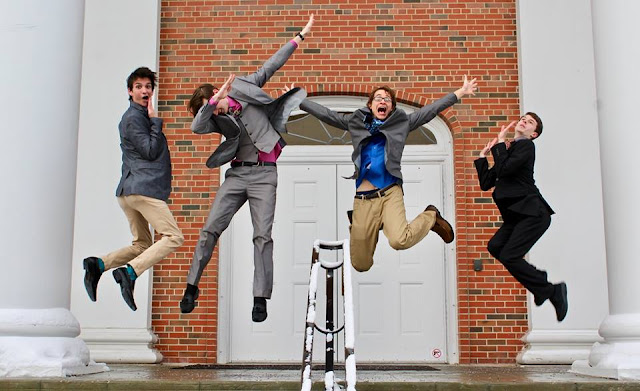
One of my earliest memories is of my dad reading to my brothers and me before bedtime. I remember laying propped up on my elbows, listening as Dad worked his way through old paperback copies of Watership Down and The Fellowship of the Ring. As he read, my head swirled with images of dark forests where strange beasts lurked, of weary travelers marching with swords and shields slung over their shoulders, of dragon caves buried deep in the bones of the mountains. Though some of the details in the stories went over my head, I still felt them stirring something inside me: a wild longing to pack my bags, lace up my tennis shoes, and take off into the unknown with a band of trusty companions. I wanted to be part of something bigger than myself. I wanted to pick up a sword and fight alongside the good guys (and I spent many hours trying to do so by attacking my brothers with a plastic lightsaber). I wanted to join the fellowship on their quest.
However, looking back on the years that followed those early tales, I’ve realized that most of my life has actually been a quest for fellowship.
My search for intimate community played itself out in different ways as I grew up. In elementary school, it was an effort to connect with other kids through storytelling: wacky skits and puppet shows and a hand-drawn fantasy game that my friends and I played at recess (my own version of Dungeons & Dragons, where battles for the fate of the world were decided by a paperclip spun around the pointy end of a pencil). In middle school, it was an inseparable friendship with a buddy at church, built around skateboarding and comic art and goofiness, and then a slow drifting apart as his parents divorced and I started struggling with anxiety and depression. In high school, it was a restless attempt to win people’s approval with my performance in academics, sports, theater, and choir. In college, it was the unexpected discovery of a different kind of community, which was strengthened by vulnerability – a group of broken people who gradually became family. Now, post-college, it’s been a process of saying goodbyes, meeting new friends, and wondering what community might look like in the months and years to come.
What does true fellowship involve? Why do some friendships thrive while others fall apart or disappear? What does it look like to cultivate community in uncharted territory? These questions have been on my mind a lot recently. I don’t have all the answers yet (a shocking turn of events), but I’ve learned a couple lessons along the journey through the wisdom of others and my own knuckle-headed attempts to love and be loved. I hope these ramblings can be food for thought and an encouragement to you wherever you’re at in your own quest for community. Here goes nothin’…
The Given Life

“My friends ain’t the way I wish they were
They are just the way they are.”
– Rich Mullins, “Brother’s Keeper”
Many books, movies, and songs portray intimate friendship as something that happens instantaneously, like awkwardness in a gathering of middle schoolers. You cross paths with someone whose interests, personality, and values seem to align perfectly with yours, clean as a cookie cutter, and before you know it, you’re inseparable.
We all long for close relationships with people who really understand us. We yearn for unbreakable, Frodo-and-Sam-type bonds with friends who will stick by us through thick and thin, come hell or high water. However, while there may be some instances where this kind of friendship springs up quickly and easily, often it seems to elude us. Old friendships dissolve with time and distance, or we’re hurt and neglected by people we trusted, or the relationships that we do have never seem to move beyond superficial things. All of a sudden we feel lost and lonely, wondering if anyone around us really knows or values us. While I’ve experienced seasons of deep, strong friendship, I’ve also experienced painful seasons of loneliness. Some of those seasons were the result of my own foolish choices, while others were the result of things outside my control. When storms hit and wash away familiar ground, how do we cope?
Once, while leading a Bible study in my college dorm, I compared the friendship of King David and Jonathan (1 Samuel 19-20) to the friendship of Frodo and Sam in The Lord of the Rings, hoping to make a point about the importance of finding friends who would remain loyal through life’s hardships. One of the members of the group, a guy named Paul, made a comment that has stuck with me ever since. He said that rather than searching for friends like Frodo and Sam, he had chosen to focus on being that kind of friend to others. His words rang true, touching on the critical distinction between true fellowship and the type of friendship that our culture tends to elevate.
Whether we realize it or not, we’re constantly pressured to be self-centered in our selection of friends. If we’re not careful, our society’s worship of efficiency, status, and comfort all too easily creeps into our relationships. We befriend people who agree with our opinions, who elevate our social status, who make us feel comfortable, and who tell us what we want to hear. On the other hand, we avoid like the plague people who challenge our views, who have nothing to offer us, who irritate us, and who make us feel awkward. We’re taught to chase after friendships that are idealized, where conflicts and sharp edges are smoothed over with the ease and glitter of a Hallmark rom com. In the long run, the result of this selfishness is discontentment. When old friends drift away and the people around us don’t meet our expectations, we become bitter. We start comparing our dwindling, imperfect circles of friends to the perpetually smiling faces on our TV screens, aching for what we don’t have.
What we tend to forget in these periods of discontentment is that the world is a whole lot bigger than us. As poet Wendell Berry put it, “We live the given life, not the planned.” Life has a way of throwing curveballs at us and confounding our plans with plot twists.We can’t pick-and-choose the people who enter our lives any more than we can pick-and-choose where we’re born, who are parents are, or what Hogwarts house we’re in (unless you’re a certain lad with a lightning-shaped scar, of course). Even in the communities that we choose to involve ourselves in, we find ourselves surrounded by people we didn’t put there – strangers whose temperaments, beliefs, and ways of life are often super different from our own. Every day, we rub shoulders with people whom we had no intention of meeting or knowing.
Fellowship isn’t selfish. It’s selfless. It’s not about figuring out what we can get from the people who fit neatly into our personal plans and projects. It’s about figuring out what we can give to the people who are already around us, whether we want them to be there or not. Jesus didn’t tell us to love the people who make us feel good. He told us to love our neighbors. And neighbors are often really good at making us want to flee our neighborhoods and go into hermitage. Likewise, real flesh-and-blood communities have a way of curb-stomping our dreams. As author Parker Palmer once wrote, community is the “place where the person you least want to live with always lives.”
When we stop thinking about what we can get from others and start thinking about what we can give, we can find contentment with the people who surround us at any given time. We can rest as seasons change and storms roll in, recognizing that relationships often change in surprising ways. Instead of expecting people to match our ideals, we can approach people’s flaws and quirks with grace, remembering that our own lives have rough edges and broken places too. We can cultivate the soil of community, waiting patiently for the rain to fall and keeping at the work even when it doesn’t.
As a kid listening to The Fellowship of the Ring, I didn’t realize that the members of Tolkien’s fellowship didn’t choose to end up on their quest together. Sam, who was the gardener of the Baggins estate, joined Frodo at Gandalf’s request. The unlikely pair happened to run into Merry and Pippin and the rest of their companions en route to their destination. In my own life, some friendships that felt like they were destined to last forever have disappeared over time. On the other hand, some relationships that weren’t nearly as clean-cut have flourished. While my siblings and I often drove each other nuts growing up, they’ve gradually become some of my closest friends. Fellowship isn’t predictable or instantaneous. It takes time and work, and it grows gradually along the road with folks we just so happen to meet along the way.
The Small Stuff

“A journey of a thousand miles begins with a single step.”
– Confucius
In the summer and fall of my senior year of college, I had an amazing opportunity to live and study in an urban community on the island of Java, Indonesia. Although my neighbors were very poor, they managed to be extraordinarily generous and hospitable with what they had. When they weren’t working, people offered to help neighbors with their work, shared meals, and spent hours chatting, smoking cigarettes, and drinking sugary instant coffee together on their doorsteps (I mentioned that I liked black coffee once, and a neighbor told me that was what old people drank). Free time wasn’t a luxury to be hoarded; it was a gift to be shared. By watching their example and participating in their community, I learned a lot about the power of presence and time in relationship-building. Simply by making themselves available to be with each other, people created numerous opportunities for deep relationships to grow.
In a society where ways to distract ourselves from reality are everywhere, where it’s easy to be physically present without being attuned to what’s going on, the simple gifts of time and attentiveness are a big step towards fellowship. Hospitality, the act of opening our homes and helping people feel welcome there, is often said to be a lost art. As an art, it takes creativity and practice, and when done rightly, it’s beautiful and countercultural. One of the things that I admire most about my mom is her ability to make others feel welcome and cared for, whether it’s by crafting a delicious meal, setting up a space that feels inviting, or engaging visitors in conversation. These things seem small, but they’re deeply meaningful, and they add up over time. Fellowship is the product of many small actions and interactions.
My college years contained some crazy shenanigans. There was the time when my roommate Ben and I happened across a couple police officers while wearing ski masks. The annual school ball where another one of my roommates (who shall remain nameless….Dylan….) danced so passionately that he ripped his dress pants right up the back (fortunately Ben happened to have a spare trench coat handy). The time when my roommate Luke and I pretended to be Sherlock Holmes and Watson all around campus. The time when my friends threw me a Pride and Prejudice-themed birthday party and forced me to wear a giant paper dress. The five months of my time overseas when my roommates replaced me with a stuffed bear dressed in my clothing. These are wonderful memories that I’ll never forget. However, looking back, what I miss most about my college experience isn’t the crazy escapades. It’s the small stuff. It’s the many hours that my friends and I spent walking to classes together, grabbing meals in the cafeteria, watching movies, celebrating each other’s birthdays, and just sitting around talking in our apartments.
In The Lord of the Rings, the vast majority of the hobbits’ journey to Mordor didn’t consist of battles with Ringwraiths, orcs, and giant spiders. It consisted of walking. Lots and lots of walking. Walking though fields, walking through forests, walking through swamps, walking over mountains, walking through caves, walking through just about every kind of terrain imaginable. While all of this trekking through nature’s glories tends to be what makes casual readers of the books give up and/or fall asleep before they reach the good parts, it’s the many small moments between the big events that the adventurers’ bonds of loyalty were forged out of. And speaking of forging stuff…
The Hard Truth (a.k.a. The Virtues of Blacksmithing)

“You use steel to sharpen steel, and one friend sharpens another.”
– Proverbs 27:17
My college roommates were really good at making me feel uncomfortable. Luke wasn’t afraid to be goofy or do things in public that were downright embarrassing. As a shy, self-conscious freshman, I found myself being dragged into some strange scenarios: being introduced by Luke to other freshmen as a taxidermy major, being yelled at by Luke in a crowded cafeteria until I relented and gave him a high-five, and listening to Luke belt out the Penn State fight song in public places at an unreasonable volume (I learned the lyrics to this song against my will). Ben was both a romantic soul and a great critical thinker who didn’t shy away from challenging statements that I’d made when he thought they were illogical or biased. As a result, we got into some pretty intense debates (you’re still wrong about Pride and Prejudice and Elihu, Ben). Dylan’s wild creativity and willingness to run with any scenario, no matter how ridiculous that scenario was, kept all of us on our toes.
Gradually, with time and extensive therapy, I came to see these unsettling actions as acts of love. Luke’s goofiness helped me meet new friends and chipped away at my self-consciousness, enabling me to drop my guard and be myself. Ben’s sharp thinking challenged me to evaluate my views, helping me recognize some of my biases and articulate my beliefs with more grace and thoughtfulness. His romantic encouragement also helped me work up the courage to go on dates. Dylan’s off-the-wall humor made me laugh more times than I can count. I’m a much different man than I was when I met these guys, and I can’t thank them enough for that.

At its heart, what distinguishes true fellowship from other kinds of friendship is a commitment to truth-telling. It’s easy to befriend someone who thinks like us, who echoes our opinions, and who laughs at our jokes. It’s a lot harder to befriend someone who gets under our skin, who asks us tough questions, or who calls us out when we start to make compromises. But we don’t grow through comfort. We grow through struggle. Steel has to be pummeled and subjected to blazing heat in order to be refined. True friends don’t tell us what we want to hear. They tell us what we need to hear, even though we may not want to hear it. Truth-telling can be uncomfortable and even painful in the moment, but it strengthens relationships over time. Your friend may feel insulted by your repeated attempts to warn him about the evils of being an Ohio State football fan. However, in the long run, he’ll be grateful for your advice when the world ends and Judgement Day rolls around.
There are different kinds of truth-telling, though. There are ways of telling someone a hard truth that tear them down, that make them feel small and inferior and incapable, and that highlight their shortcomings while glossing over our own. Our world has enough head-bashing and hypocrisy to go around. Alternatively, there are ways of telling someone a hard truth that build that person up, that are motivated by caring and focused on their well-being. This is what the apostle Paul described as “speaking the truth in love” (Ephesians 4:15). Truth and love are inseparable. According to pastor Tim Keller, “Love without truth is sentimentality; it supports and affirms us but keeps us in denial about our flaws. Truth without love is harshness; it gives us information but in such a way that we cannot really hear it.”
Singer-songwriter Rich Mullins once said, “What I look for in friendship is someone who will beat you up. You get in a big fight and then the winner rides the other guy home on the bike.” I’m so grateful for friends like Ben, Luke, and Dylan who weren’t afraid to beat me up in love. When I said goodbye to them after graduation, what I told each of them was that they’d helped me believe the crazy truth of God’s love for me a little bit more, which is the best gift I can imagine. In their friendship, I glimpsed the love of the God who welcomes me unconditionally, just as I am, and who also continually challenges me to become the person I was made to be – more loving, more just, more merciful, more courageous. More like Jesus Christ.
The Great Reunion

“Do not be too sad, Sam. You cannot always be torn in two. You will have to be one and whole, for many years. You have so much to enjoy and to be, and to do.”
– Frodo Baggins, The Return of the King
For me, one of the most moving scenes in The Lord of the Rings movies happens right before the end of The Return of the King. Frodo, Sam, Merry, and Pippin have returned home from their world-saving quest and are sitting in the Green Dragon pub in Hobbiton, sipping mugs of ale. For a few moments, they stare at each other in silence, a wordless understanding of the adventures that they’ve shared passing between them. Then, all at once, they lift their mugs and tap them together. Every time I see that scene, I’m reminded of three men who I never intended to meet – Luke, Ben, and Dylan. I was in a bad place when I entered college – anxious, self-conscious, lonely, and broken by sin that I wanted desperately to hide. While I didn’t realize it then, I can see now that God gave me the ragtag band of companions I had always longed for. I found brothers who took me as I was, who walked with me through many small moments and several big adventures, and who told me the story of grace and redemption that I needed to hear. In the midst of my brokenness, I found a fellowship.
I’ve had to say my goodbyes. I hate doing it, and will until the day I die. I miss old friends deeply, and don’t have a clue where the road ahead will lead. But what I’ve learned, and what I hope you remember, is that life is unpredictable, and all the more beautiful for that; that community, with all of its messiness, is a gift; that our friendships are echoes of a greater Love, which doesn’t disappear, but pursues us wherever we go; and that there is a Great Reunion coming, where “goodbye” will be a forgotten word. When that time comes, if you’re in town and if there happens to be a pub in heaven, I hope you’ll stop by.

