The acclaimed film critic Roger Ebert, whose reviews for the Chicago Sun-Times influenced generations of moviegoers, once described his appreciation for movies in this way:
We are all born with a certain package. We are who we are. Where we were born, who we were born as, how we were raised. We are kind of stuck inside that person, and the purpose of civilization and growth is to be able to reach out and empathize a little bit with other people, find out what makes them tick, what they care about. For me, the movies are like a machine that generates empathy. If it’s a great movie, it lets you understand a little bit more about what it’s like to be a different gender, a different race, a different age, a different economic class, a different nationality, a different profession, different hopes, aspirations, dreams and fears. It helps us to identify with the people who are sharing this journey with us. And that, to me, is the most noble thing that good movies can do and it’s a reason to encourage them and to support them and to go to them.
When I left the Christian faith in November of 2022, I didn’t know anyone else who shared my experience. It was a profoundly lonely time. My community was composed almost exclusively of believers, and while friends and family members worked hard to understand and empathize, our conversations were painful, and it often felt like we were talking past each other. Apostasy tends to be an emotionally fraught topic, both for religious adherents and for those who leave the fold. I yearned to connect with people who had walked a similar path. My spiritual deconstruction was the most painful, confusing, and frightening experience of my life. I needed to know that I wasn’t alone – that others had seen the same things I had seen, had navigated the same intellectual and emotional wilderness, and had found hope and healing along the way.
As I began exploring ex-Christian literature, I was surprised to find that religious deconstruction stories were incredibly widespread. According to the Pew Research Center, while the percentage of Americans who identify as Christian has dropped from 78% to 63% since 2007, the percentage of Americans who identify as atheist, agnostic, or “nothing in particular” has risen steadily from 16% to 29%. Experts predict that, within a few decades, Christians may make up less than half of the U.S. population – a shocking decline from the 90% Christian population of the early 1990s. Those of us who have jettisoned the safety and security of organized religion in our pursuit of truth may feel isolated, but we aren’t alone – not by a long shot.
As a passionate movie buff, I resonate deeply with Roger Ebert’s description of cinema as “a machine that generates empathy.” Movies have the power to change us, if we let them. We need more stories that bridge social divides, that challenge our entrenched views of the world, and that invite us into the lived experiences of those different from us. Yet, while deconversion is an increasingly pervasive cultural phenomenon, movies that depict journeys out of religion are tough to find.
Here, I’ve compiled a list of ten films which were deeply meaningful to me in the aftermath of my deconversion. These films are listed in alphabetical order. While only half of them deal with topics of spiritual deconstruction and religious trauma directly, all of them capture elements of the deconversion experience. Each title on this list is critically acclaimed and worth checking out for its artistic merits alone. Finally, while most of these films grapple with weighty subject matter, almost all of them are profoundly hopeful. These movies suggest that there’s a bigger world out there – that beyond the walls of dogma, beyond the grief and fear and existential angst unleashed by abandoning faith, there is a road to recovery and consolation in the tales we share.
If you’re a member of a religious tradition, I hope you can heed Roger Ebert’s call and approach this list as an exercise in empathy. By seeking to understand the factors that lead people to abandon faith and the mental and emotional toll of that decision, you can love your neighbors better. This list is intended primarily for apostates in need of encouragement, but movies should generate conversation, and conversations are always better when diverse perspectives are brought to the table!
Apostasy
Harrowing and unforgettable, Daniel Kokotajlo’s 2017 film Apostasy follows a family of Jehovah’s Witnesses in Oldham, England. When her eldest daughter becomes pregnant out of wedlock and stops attending services at the Kingdom Hall, Ivanna Whitling (played by Siobhan Finneran of Downton Abbey) is faced with an impossible choice: reject her own faith or lose a beloved child forever. A former JW himself, Kokotajlo approaches his film’s subject matter with unflinching honesty and remarkable compassion. The movie depicts the social ostracism that often accompanies deconversion from fundamentalist faiths, and it also explores the potentially devastating consequences of narratives that deny science and elevate religious duty above familial obligation.
Asteroid City
Early in the film Asteroid City, a character asks: “What’s the meaning?” That question is the beating heart of Wes Anderson’s latest comedic masterpiece. After witnessing something inexplicable during a scientific convention, a motley crew of junior space cadets and their parents find themselves quarantined near an atomic test site in the middle of the desert. There, surrounded by uncertainty, they begin to ask weighty questions about themselves and about their place in the universe. While Anderson’s films have long mingled offbeat humor with notes of existential angst, Asteroid City may be the storyteller’s most honest and searching exploration of the human condition yet. If, like me, you have wrestled deeply with the challenge of finding meaning in a world that all too often seems devoid of it, this film is for you. Late in the film, in what became my single favorite scene of 2023, a frightened character stares at the camera and murmurs, “I don’t understand the play.” The response that he receives has stuck with me ever since, offering hard-won hope in a breathtaking, bewildering cosmos that refuses to explain itself.
Barbie
You might be surprised to see this movie on this list, but Greta Gerwig’s record-smashing summer blockbuster is also a deeply layered work of art, open to a variety of interpretations. Much has already been said about Barbie‘s critique of patriarchy, which is a perennial feature of many religious traditions. However, the film also works as an allegory of deconversion. Stereotypical Barbie (played by Margot Robbie) has no desire to leave her home in Barbieland. She knows her place, enjoys her relationships, and finds comfort in the simplistic narratives that have been handed down to her. Yet, all of that changes when she begins to have original thoughts. As the story progresses, Barbie realizes that her world was far more insular than she could have imagined. Ultimately, she faces profoundly difficult questions: How do we adjust to freedom after leaving an environment in which we had no control? How do we reconstruct our identities when the foundations of those identities have collapsed? Listen to Billie Eilish’s haunting song “What Was I Made For?” through the lens of spiritual deconstruction, and (to quote Taylor Swift) it “hits different.”
Boy Erased
Based on a true story, Joel Edgerton’s Boy Erased examines the unique trauma faced by LGBTQ+ individuals whose senses of self have been hijacked by religious dogma. It also examines the practice of conversion therapy – a dangerous and discredited attempt to “cure” people of homosexual impulses (which has been declared illegal for licensed mental health providers but is still championed and utilized by many religious communities). Featuring a standout performance by Lucas Hedges, Boy Erased moves beyond anger at injustice and asks how recovery and reconciliation might be possible, even in the most heartbreaking of circumstances.
Cast Away
Reflecting on Robert Zemeckis’ tale of a shipwrecked FedEx executive after my own departure from Christianity, I continue to find new depths to appreciate in what has become my all-time favorite film. Cast Away is so much more than a survival story. As we watch Chuck Noland (played by Tom Hanks) return to society after four years of isolation on a remote island, we find ourselves asking with him: How do you move forward from a tragedy that has rendered your entire life unfamiliar? Those of us whose faith collapsed unexpectedly know how agonizing and disorienting a farewell to our old life can be. Everything around us looks different, and a return to old ways of living and seeing is impossible. Yet, with unparalleled beauty, the closing scenes of the film point us toward new beginnings.
Letting Go of God
Julia Sweeney, who rose to fame as a cast member of Saturday Night Live, has long been respected for her comedic chops. Yet, what she pulls off here is truly remarkable. In a one-woman stage show, Sweeney recounts her decades-long journey from Christianity to atheism, beginning with her Irish Catholic roots in Washington and transitioning to her life as a spiritual seeker in Los Angeles. At once hilarious and poignant, Sweeney’s story offers an intimate glimpse into the complex intellectual and emotional struggles faced by those leaving faith.
Room
Based on Emma Donoghue’s award-winning novel, Room introduces us to two people trapped in a living nightmare. Joy Newsome (played by Brie Larson), a victim of kidnapping, has spent five years building a life for her son, Jack, in the tiny shed that they call Room. For Jack, who has never been outside, Room represents the entire world – that is, until a daring escape frees him to experience what lies beyond for the very first time. While the suffering that Lenny Abrahamson’s film depicts is truly unimaginable, the movie takes on new meaning as an allegory of deconversion. Those who were raised within religious walls and taught to believe that those walls encapsulated reality will resonate with Jack’s fearful first steps into a broader world. Hopefully, they will also be encouraged by his discovery that, for all its wildness and unpredictability, that same world is worth embracing in all its fullness.
The Truman Show
If you were to ask me, “What movie best captures the experience of deconstruction?”, I would answer without hesitation: The Truman Show. Peter Weir’s 1998 psychological comedy-drama is a zany, mind-bending cinematic roller coaster ride. The story follows Truman Burbank (played by Jim Carrey), who is unaware that his idyllic life on Seahaven Island is actually a reality TV program. When bizarre events begin to puncture the fabric of Truman’s world, he embarks on a desperate quest to uncover the truth. Revisiting the film after my deconversion, I glimpsed my own angst and bewilderment in Truman’s frantic search for answers, recalling the knot in my stomach as, one by one, things that I had spent my lifetime believing turned out to be false. I know no better film about the human need to pursue and embrace truth, however painful or unsettling that truth may be.
Wild
Raw, bracing, and deeply poignant, Jean-Marc Vallée’s 1995 film is based on the true story of Cheryl Strayed, who overcame personal tragedies by hiking 1,100 miles of the Pacific Crest Trail. As we watch Strayed (played with unflinching authenticity by Reese Witherspoon) navigating wildernesses both external and internal, we are invited to reflect on the journey of life – the necessity, difficulty, and value of spiritual wandering. When life dashes our hopes and dreams, the simple act of moving forward can feel impossible. Yet, Strayed’s story illumines hope in the wasteland. Sometimes, this film suggests, the only way to find lasting peace is to venture into the unknown.
Yes, God, Yes
For many deconstructing adults (myself included), sexual awakening during puberty and young adulthood was marked by intense feelings of fear, confusion, and shame. These feelings didn’t arise naturally; rather, they were the product of centuries-old religious dogma that frames normal, healthy impulses and behaviors as a slippery slope to hellfire. In its examination of these doctrines, Karen Maine’s quirky coming-of-age tale of a hormonal teenager (played by Natalia Dyer of Stranger Things) at a Catholic youth retreat refuses to pull any punches. Yet, it is also suffused with compassion, spotlighting the awkward, messy humanity of each of its characters. Heartwarming and heartbreaking in equal measure, this film will resonate with anyone whose sexuality survived the bizarre, bruising gauntlet of fundamentalism.
When I started the blog that became wordsforwayfarers.com several years ago, I saw my writing as a kind of ministry. By exploring echoes of the Christian message in contemporary books, movies, songs, and albums, I hoped to demonstrate the relevance of Christianity to all of life. Many of my posts were targeted toward “wayfarers” – spiritual seekers with more questions than answers. I loved crafting these posts and believed that I was building God’s kingdom through my efforts. My faith had never felt stronger. But all that was about to change.
Last year, I began struggling with some intense spiritual doubt. This struggle wasn’t unprecedented. I’m a naturally skeptical person, and I had weathered seasons of questioning before, emerging from those seasons with a deeper and richer faith. I knew that questions were the lifeblood of faith, and I saw them as opportunities to grow and mature in my relationship with God. However, the questions that piled up in January of 2022 were different – weightier, sharper, and more relentless than any I’d grappled with before. Very quickly, I realized that my certainty in the central claims of Christianity – Biblical inspiration and the divinity of Christ – was gone. I was no longer sure what I believed.
Desperate to overcome my doubts, I dove headfirst into Christian apologetics research (based on the Greek world apologia, “apologetics” refers to the scholarly defense of religious doctrine from skepticism). Throughout 2022, I explored numerous books, articles, podcasts, lectures, and sermons, each of them dedicated to establishing the truth of Christianity. Many of the resources that I found were compelling, and I desperately wanted to believe them. Nevertheless, my research didn’t remove my doubts. In fact, it made them worse. The more arguments I studied, the more holes and inconsistencies I found in those arguments. Answers to bothersome questions sparked new questions which I hadn’t thought to ask, new objections which I hadn’t considered. It didn’t take long for me to realize that my faith was in crisis.
My battle with doubt wasn’t a purely intellectual exercise. Afraid that I might be prioritizing head knowledge over my relationship with Jesus, I did everything I could think of to draw near to God. I prayed for guidance and renewed faith, studied the scriptures, fasted from food, confessed sin, met with the pastors and elders of my church, went to Christian counseling, talked with a spiritual mentor, and pleaded with God for miraculous signs of his presence. Like my apologetics research, these activities failed to stop my spiral into skepticism. I was running after God as hard as I could, growing more exhausted with each step. So why did he seem to be farther and farther away?
If there was anything I felt sure of during this struggle, it was that I wanted to know the truth. Yet, as my doubts intensified, even that premise was called into question. Back in high school, I remember learning about confirmation bias – the universal human tendency to seek evidence which supports what we already believe and to ignore evidence which doesn’t. Human beings aren’t naturally objective creatures; our interpretation of the data is regularly skewed by our pre-existing assumptions, biases, and desires. This isn’t to say that we’re incapable of empathizing with contrary perspectives or of changing our worldviews when the evidence warrants it, only that doing so is very difficult. I started to wonder: Was my search for answers really motivated by a desire for truth? Or was I just seeking confirmation of what I already believed? If I was wrong about Jesus and the Bible, did I really want to know?
As I pondered this dilemma, I realized that my research only exacerbated the issue. All of the materials that I had explored in 2022 were Christian materials, designed to corroborate my faith. I had rarely engaged with skeptical positions on the doubts I was wrestling with, and even when I had, it was always through the medium of Christian resources critiquing those positions. If I were dialoguing with a non-Christian, I would’ve urged them to set aside their biases as much as possible, to read the Bible and other Christian books, and to seriously consider the possibility that they might be mistaken. Yet, I had never held myself to the same standard. If I explored the evidence against Christianity as tenaciously as I expected others to explore the evidence for it, what would I find? The prospect was unsettling. However, I wanted to know the truth. I was convinced that if Jesus really was “the way, the truth, and the life” (John 14:6), then an honest assessment of the evidence would inevitably lead me closer to him. I was wrong.
As I studied Christianity through a skeptical lens, my faith in Christ collapsed. It wasn’t just that skeptical scholars were raising objections which I had never considered. These scholars were tackling issues that Christian scholars often shied away from, facing those issues head-on. Furthermore, they were basing their critiques of Christianity not on unfounded assumptions, but rather on sound logic and detailed exegesis of scripture. When I stacked their arguments against those made by Christians and measured both against my study of the Bible, I couldn’t shake the feeling that the skeptics had a stronger case. I wanted nothing more than to hold onto my faith. The possibility of losing it had been my worst nightmare, something far too painful to seriously consider. But now, against all my hopes and predispositions, that nightmare was becoming a reality.
Late in November of 2022, there came a night when I discovered that I no longer believed Christianity was true. The realization was crushing. When I tried to tell my wife, Kelly, about what had happened, I couldn’t get the words out. It was as if there was a block inside my throat. Eventually, after ten minutes of trying to speak, I had to scribble the words on a notecard: I don’t think I can be a Christian anymore. Then I sobbed uncontrollably while Kelly tried to console me.
The decision to stop identifying myself as a Christian wasn’t a welcome one. My faith in Christ had been the center of my world, the most beautiful and inspiring thing I knew. Losing it felt like losing the sun. In the months following that fateful November night, I’ve experienced many waves of grief and regret. I’ve also begun to process my transition into unbelief with family and friends, many of whom are deeply saddened and concerned about that transition. Yet, my conviction that I can no longer call myself a follower of Jesus has only grown stronger.
Currently, I consider myself a hopeful agnostic. On the one hand, I’m very open to the possibility of a supernatural world and eager to make contact with it if it exists. On the other hand, I don’t know what to believe about spiritual matters anymore, and I’m not sure how much can actually be known about them. I think there are some really convincing arguments for the existence of a divine intelligence or higher power behind the universe. Honestly, I long for that to be the case. Yet, even if God does exist, I’m firmly convinced that I can’t believe the core teachings of Christianity: the unique inspiration of the Bible, the atoning death and resurrection of Christ, the trinity, the Christian vision of the afterlife, etc. If there’s anything I’m sure of right now, it’s that I have far more questions than answers. Additionally, I’m increasingly skeptical of religious and philosophical systems which claim to capture the whole picture – to comprehend the whole fabric of reality. My assessment of the human situation is much closer to Albert Einstein’s view:
We are in the position of a little child, entering a huge library whose walls are covered to the ceiling with books in many different tongues. The child knows that someone must have written those books. It does not know who or how. It does not understand the languages in which they are written. The child notes a definite plan in the arrangement of the books, a mysterious order, which it does not comprehend, but only dimly suspects. That, it seems to me, is the attitude of the human mind, even the greatest and most cultured, toward God. We see a universe marvelously arranged, obeying certain laws, but we understand the laws only dimly. Our limited minds cannot grasp the mysterious force that sways the constellations.
Since spiritual deconstruction is a complex and multilayered topic, I want to clarify several things about my experience. First, unlike many former Christians, I didn’t abandon faith because of disillusionment with the church. My deconstruction was driven solely by intellectual objections – doubts related to the reliability of the Bible, evidence for evolution, the morality of God in the Old Testament, the existence of hell, the hiddenness of God, and the person of Jesus. My experience of Christian fellowship has been almost uniformly positive. I have deep respect for the religious beliefs that many of my friends and family members hold, and I admire the many selfless, loving actions generated by those beliefs. Many of my most cherished values and convictions are rooted in my Christian upbringing. I was deeply and unconditionally loved within the church, and I treasure the relationships that were formed there. My experience of Christian community didn’t compel me to leave the church; it was one of the main reasons I didn’t want to leave.
Second, my apostasy wasn’t prompted by a personal moral failure. In the wake of my departure from Christianity, I’ve heard some Christians conjecture that my deconstruction was rooted in a prideful idolization of knowledge, a failure to trust God sufficiently, or a willful neglect of my relationship with Christ. I understand that these individuals’ theological frameworks require them to interpret my situation from a certain angle. I don’t expect to change their minds. All I can say in response is this: I pursued Christ as honestly and ardently as I knew how, wept and agonized over my doubts more times than I can remember, and confessed sins (both actual and potential) with all the transparency I could muster. As someone prone to self-criticism, I still feel shame about my decision to leave the church. I’ve wondered at times: Was my faith weaker than that of my fellow churchgoers? Did I do something to earn God’s disapproval, causing him to hide his face from me? Was my doubt really just selfishness in disguise? Yet, after reflecting on my struggle as objectively as I can, I honestly believe that my deconstruction was motivated by a genuine desire for truth. I left Christianity because I became convinced that it wasn’t true. I resonate deeply with Kenneth W. Daniels’ testimony in his book Why I Believed:Reflections of a Former Missionary:
Some of my readers might wonder, “Why did he do it? Why did he leave the riches of his faith for the despair and danger of unbelief? It couldn’t be that he sincerelybelieves Christianity to be untrue; there must be some deep underlying issues he’s dealing with, some flaw, some hidden agenda, some dashed expectation.” I have been asked this question directly, and my response has been this: you can dig as deeply as you like, and when you get to the bottom of it, you’ll find I believe what I believe because I think it’s true. There may indeed be some hidden issues that have driven me to this point, but if so, they are as hidden to me as to anyone else. I have shared freely with others and with God the matters I consider relevant to the question, but nothing definitive has turned up.
Third, I never expected to attain certainty in matters of faith. As a devout Christian, I believed that God’s ways were higher than my ways (Isaiah 55:8-9). I knew that not all of my questions would be answered, and I wasn’t demanding that God unravel all mysteries for my sake. I simply wanted to know whether I could be reasonably confident in the veracity of scripture and the divinity of Jesus, something I’m sure that most Christians wouldn’t find fault with. Lack of basic assurance in the central claims of Christianity is what sank my faith, not lack of certainty. Comedian Rhett McLaughlin summarizes my position well in his own testimony of deconstruction:
I understand that it is unreasonable to expect Christianity to be a set of scientifically verifiable principles. It is a faith, implying that some sort of believing without seeing is involved. And more specifically, Christianity is a relationship with Jesus, and relationships are not well- defined or experienced scientifically. However, I don’t think it insignificant that the deeper I have dug into Christianity with a thirst for the truth, the more difficult it has become to have faith. In fact, for me, it has become impossible.
Fourth, I have no desire to cut myself off from contact with Christians. While I no longer attend church, I haven’t stopped dialoguing with believers or pondering Christian ideas. My beloved wife, my family, and most of my closest friends still follow Jesus, and although they disagree with my opinions, we’ve had many respectful, constructive conversations about our differences. My commitment to loving them and their commitment to loving me haven’t changed in the slightest. I’ve continued reading scholarly books by Christian authors and listening to podcasts with religious subjects, not for purposes of spiritual edification, but so that I can discuss Christianity with more nuance and charity. I firmly believe that the pursuit of truth necessitates active dialogue with those who think differently than us.
Fifth and finally: Since leaving Christianity, I haven’t descended into depravity or despair. Within the evangelical church, there’s a popular notion that life outside Christian circles is marked by meaninglessness, hopelessness, and moral compromise. This may be true of some non-Christians, but it is by no means representative of the whole. Nonbelievers can live lives that are every bit as noble and fulfilled as those of their believing neighbors. My desire to pursue truth and my desire to live a moral life weren’t dampened by my deconstruction. That’s not to say that I’ve got life figured out. I don’t. I’m more aware than anyone of my damaging selfishness, insecurity, cowardice, and pride. It’s only to say that, in my case, the stereotypes that I heard in many churches growing up haven’t proven true. I must admit that I’ve been forced to discard certain moral convictions which I no longer find tenable, such as conservative evangelicalism’s condemnation of LGBTQIA+ relationships. However, things like kindness, compassion, justice, courage, and integrity still matter just as much to me as they always did.
I decided to share this post for several reasons. Primarily, I want to be forthright with readers about the perspective I’m writing from now, since Christian faith was so central to my earlier posts. Furthermore, I hope that this post inspires readers to consider unfamiliar perspectives. If you’re a Christian, I hope this post encourages you to empathize with people who have left the faith – to grasp how painful and unwanted that journey can be and to consider that some apostasy may be motivated by intellectual honesty. I have no desire whatsoever to undermine your faith. If you’re a skeptic, I hope this post convinces you that rich dialogue with Christians is possible and that a Christian upbringing can enrich a person’s life in many ways, even if that person later decides to abandon their Christian worldview. And if you’re a doubter on the road to deconstruction, I hope this post assures you that you’re not alone, that life doesn’t have to collapse after you leave the faith, and that truth is worth chasing. If this post accomplishes any of those goals, then it’ll have been well worth the effort.
As I said at the beginning of this post, I started blogging because I wanted to assist wayfarers on their spiritual search. I wanted to encourage those who were seeking answers to life’s biggest questions, and I thought I had those answers. Reflecting on the past year, I can see that I had it backwards. I was a wayfarer all along, every bit as prone to wandering and desperate for direction as those whom I sought to guide. In setting out to teach others, I discovered just how much I had yet to learn.
This blog isn’t finished. Not by a long shot. There’ll be more reviews of books and movies, more analyses of songs of albums, and more reflective essays. I don’t expect that my writing style will change all that much (although I hope to become more adept at trimming the boring parts). Yet, whatever religious or non-religious background you hail from, I hope you know that you’re welcome here. I hope you see these scribblings not as a map to unriddle life’s mysteries (something I can’t hope to provide), but rather as a journal of sorts – a subjective but well-intentioned account of my personal voyage into the unknown. I hope this blog can be a checkpoint on your own journey, as well – a place to linger, reflect, and warm your hands before moving on to whatever’s next for you. I don’t have answers anymore. Sometimes, that fact frightens me. But I’m sure glad we’re on this journey together, that morning comes after night, and that life’s as full of surprises as it ever was. In this great library, with its shelves of books from floor to ceiling, who knows what we might find?
One morning, at an old social work job of mine, I chatted with my friend and coworker, Will, about our mutual love of Bruce Springsteen’s music. Will told me that “Thunder Road” is the best song ever written, and I excitedly agreed with him: “It’s so good!” When Will mentioned that the song contained some of his favorite lyrics, I knew exactly which lines he was about to start quoting:
Don’t run back inside, darling, you know just what I’m here for So you’re scared and you’re thinking that maybe we ain’t that young anymore Show a little faith, there’s magic in the night You ain’t a beauty, but hey, you’re all right And that’s alright with me
If you weren’t listening closely enough, these lyrics might sound like an insult. Where does Springsteen get off calling his would-be lover plain-looking? Yet, in the context of the song, the Boss’s words carry immense weight. One stanza later, he describes himself in similar terms:
Well, I’m no hero, that’s understood All the redemption I can offer, girl, is beneath this dirty hood With a chance to make it good somehow
If you didn’t get the drift before, you’ve got it now. “You feel aged, tired, and ordinary, and I do too,” Springsteen says. “We’ve both got our flaws. But I’m taking you just as you are, warts and all.”By undermining the clichés of physical beauty that fill most of the love songs ever written, Springsteen highlights a deeper and richer beauty in the woman he loves.
When people listen to songs, they often focus on different things. Some people, like my older brother, tend to hear the music first – rhythm, melody, harmony, chord progressions, etc. Others, like me, tend to hear the lyrics first, paying close attention to metaphors and allusions and imagery and narrative arcs. A music producer might focus on textures and the layering of sounds, a superfan might hear nothing but confirmation of their idol’s greatness, and a Taylor Swift fan might hunt for tea. These differences impact our experiences with music, and they also make our conversations and debates about songs far more rewarding.
As a singer and percussionist, I geek out over well-crafted tunes. Yet words are my first love. A song might be catchy or musically inventive, but if its lyrics feel haphazard or undercooked, it generally won’t stick with me. The ten albums on my 2024 favorites list, however, showcase some of the best lyricism that I’ve ever encountered (as usual, most of them are albums from past years that I’ve recently caught up on). I’ve included a stanza from each record that I believe contains its most beautiful words, and I hope that my own writing can do these gifted songwriters justice. So, to paraphrase Springsteen’s “Thunder Road”: let’s get going!
Honorable Mention: The Black Parade by My Chemical Romance; Cannonballers by Colony House; Kind of Blue by Miles Davis; Ladies of the Canyon by Joni Mitchell; Unheard by Hozier; When We All Fall Asleep, Where Do We Go? by Billie Eilish
#10. Stick Season by Noah Kahan
I love so much about this album: its vivid sense of place, its unflinching self-examination, and its catchy folk-rock vibe, to name a few. Eager for inspiration, Kahan returned to his childhood home in New England, re-immersing himself in the joys and heartache that accompanied his journey to adulthood. It was clearly a painful process. Time may have passed, but not all of Kahan’s scars have healed. Yet, as bitter as the weather that menaces his hometown may be, he still approaches that fraught place with grace and love, seeking above all to remember and understand.
Kahan’s stories hum with authenticity. Like any skilled writer, he knows the value of “show, don’t tell,” and he employs that technique admirably here. The melodies on Stick Season‘s songs might be fairly predictable, but let me assure you that they also lend themselves to passionate belting on long car rides. Looking up Kahan on Wikipedia after my first listen, I noticed his list of musical inspirations: Hozier! Counting Crows! Paul Simon! Mumford and Sons! No wonder he’s such an honest and gifted songwriter. I think we’d probably be friends.
Favorite Lyric: As you promised me that I was more than all the miles combined You must have had yourself a change of heart like halfway through the drive Because your voice trailed off exactly as you passed my exit sign Kept on driving straight and left our future to the right
#9. Illinois by Sufjan Stevens
In 2003, Sufjan Stevens announced that he’d be composing an album for each of America’s fifty states. He released one inspired by his home state of Michigan, and two years later he released another centered on Illinois. Then he gave up.
Well, not exactly. Sufjan later revealed that the fifty states plan was a joke. Fans might’ve been disappointed if the singer-songwriter hadn’t already gifted them with one of the most mind-bending indie folk albums ever produced. Sufjan has two kinds of songs: the gentle, ethereal, rip-your-heart-out-through-your-ears laments of albums like Carrie and Lowell; and the zany, kaleidoscopic, open-up-a-new-chamber-inside-your-brain symphonies of albums like Illinois. “Phantasmagoria” is probably the best word to describe the latter.
How on earth to describe Illinois? Playing ten different instruments, Sufjan sings about historical events as far-flung as the 1893 World’s Fair, the Black Hawk War, UFO sightings, Abraham Lincoln’s debates with Stephen Douglas, and the murders committed by serial killer John Wayne Gacy, Jr. His song titles read like chapter headings in a Percy Jackson novel: “The Predatory Wasp of the Palisades Is Out to Get Us!”;”To the Workers of the Rock River Valley Region, I Have an Idea Concerning Your Predicament, and It Involves Tube Socks, a Paper Airplane, and Twenty-Two Able-Bodied Men”;”They Are Night Zombies!! They Are Neighbors!! They Have Come Back from the Dead!! Ahhhh!” Yet, somehow, Sufjan also keeps things intimate, grieving a deceased friend on “Casimir Pulasky Day” and yearning for personal transformation on “Chicago.” Illinois is the sound of a solitary life unfolding itself against the dazzling tapestry of the world.
Favorite Lyric: All the glory that the Lord has made And the complications when I see his face In the morning, in the window All the glory when he took our place But he took my shoulders and he shook my face And he takes, and he takes, and he takes
#8. Blood on the Tracks by Bob Dylan
Is Bob Dylan’s Blood on the Tracks the best breakup album of all time? I’d take that bet.
Every couple years, I deep dive into a songwriter’s discography by listening to every album they’ve ever released. Back in 2020, it was Bruce Springsteen. Later came Paul Simon. This year is Kendrick Lamar. 2024 was the year of Bob Dylan, and while I can’t say that I made it through all of his records (I lost steam after reaching The Basement Tapes), I’m definitely a fan now.
Most rankings of Dylan’s albums place Blood on the Tracks at or near the top, and I wholeheartedly concur. The album, which describes the painful unraveling of the legendary songwriter’s marriage, feels more intimate and cohesive than anything Dylan had released before. His ragged voice is grating to some (AKA my wife), but here it captures the rawness of fresh grief. Dylan also reins in the absurdist poetry of earlier records like Highway 61 Revisited and Blonde on Blonde, and his confessional tunes are all the better for it. If there’s a richer, more rewarding breakup album out there, then I haven’t heard it yet.
Favorite Lyric: Then she opened up a book of poems And handed it to me Written by an Italian poet From the thirteenth century And every one of them words rang true And glowed like burning coal Pouring off of every page Like it was written in my soul From me to you
#7. Hello Starling by Josh Ritter
In January of 2024, my wife and I watched the greatest songwriter of all time (and one of my artistic heroes) play a concert at Chicago’s Victoria Theater. It was a night of melodies and magic that I’ll never forget. I’d been a fan of Josh Ritter for years, and I knew many of his songs by heart. But I’d never listened through the album that he and his Royal City Band performed that night: 2003’s Hello Starling. Ritter wrote some of Starling‘s songs on tour in Ireland, and the whole record feels like a journey through that faraway landscape – wild and wistful, like a green expanse swept by rain. It may not be Ritter’s best work, but it was a joy to experience with the love of my life, and it’ll always have a special place in my heart.
Favorite Lyric: I felt your hand light on my sleeve As light as a bird that might offer a sinner reprieve We don’t know too much But love rains mysteriously And behind every cloud is a purpose only now we can see
#6. Good Kid, m.A.A.d. City by Kendrick Lamar
In a recent episode of his Dissect podcast, Cole Cuchna described Kendrick Lamar as the definitive poet of our generation. I’m inclined to agree with him. Good Kid, m.A.A.d. City was my third Kendrick album, and while it doesn’t quite reach the heights of the rapper’s subsequent record, To Pimp a Butterfly (my pick for the greatest album ever made), it’s still a musical masterpiece.
The album’s lyrics tell the story of a single day on the streets of Compton, California. Here, we follow a young Kendrick as he struggles to escape a life of poverty, drug use, and gang violence. His tale unfolds with the depth and specificity of a great novel, bolstered by a talented cast of voice actors who reenact the songwriter’s memories. The turning point of the album – a song called “Sing About Me, I’m Dying of Thirst” – is a 12-minute epic that immerses listeners into the hopes and fears of Kendrick’s friends in Compton. Facing the fallout of systemic injustice, the Pulitzer Prize-winning poet refuses to look away, and his loving gaze points us all toward the possibility of redemption.
Favorite Lyric: I count lives all on these songs Look at the weak and cry, pray one day you’ll be strong Fighting for your rights, even when you’re wrong And hope that at least one of you sing about me when I’m gone
#5. Lemonade by Beyoncé
A confession: Somehow, while living in the United States of America for most of my life, I’d never listened to Beyoncé’s music. Prior to this past year, I couldn’t have named a single song of hers. I knew her name, of course, but I figured she was one of those pop stars whose chart-topping hits carry minimal substance (looking at you, Taylor Swift). My goodness, how wrong I was. At long last, I’ve had an audience with Queen B, one that I should’ve had a long time ago. And the songs that I’ve heard so far measure up to the hype. Long may she reign!
Strange royalty references aside, Lemonade is one of the most inspiring concept albums that I’ve ever come across. On the surface, it tells the story of Beyoncé’s falling out and reconciliation with her husband, Jay-Z, after a period of infidelity. That tale alone would be a tear-jerker, but Beyoncé takes listeners on an odyssey of cultural redemption, framing her marital struggles within the legacy of slavery and racial injustice in America (the album’s blend of musical styles mirrors this vast scope). “The past and future merge to meet us here,” she says in the movie version of Lemonade. Black love in the present, according to Beyoncé, is inseparable from Black history, and this entanglement is both curse and gift. Only by confronting the wounds of our past can we find a way forward. And on a chart-topping pop album in 2016, Beyoncé pointed the way for us.
P.S. I liked Cowboy Carter, but Beyoncé should’ve won the Album of the Year Grammy for this record. Adele, Bieber, and Drake had nothing on her that year.
Favorite Lyric: We built sand castles that washed away I made you cry when I walked away And although I promised that I couldn’t stay, baby Every promise don’t work out that way
#4. If This Is the End by Noah Gundersen
Have you ever encountered a song or album that felt like a message in a bottle handwritten for you? If This Is The End was that kind of album for me this summer. I discovered Gundersen through his 2009 song “Jesus, Jesus,” which is still the most poignant song about religious doubt that I’ve ever heard. I listened to Ledges and Carry the Ghost, enjoying the first and struggling with the second, but I wasn’t prepared for the transparency and artistry of Gundersen’s most recent project.
In song after song, Gundersen channels his emotions with breathtaking immediacy. His phrasing is straightforward, complemented by tasteful instrumentation that beckons you into his stories. Yet the simple lyrics are freighted with meaning, layers and layers of it. They nail that elusive balance: general enough to resonate widely, specific enough to seem tactile and real. I can’t relate to Gundersen’s meditations on the perils of fame, but there are dozens of moments on this album that struck a chord with me. On If This Is the End, we witness a talented artist taking stock of his journey, making peace with his failures, and passing on wisdom to whoever cares to listen.
Favorite Lyric: Everything’s changing around you And now you’re changing too No one could blame you for being shy When everything is new
#3. Only God Was Above Us by Vampire Weekend
When it released in April of 2024, Vampire Weekend’s Only God Was Above Us was praised as a “return to form” by many music critics. After a five-year hiatus, the renowned alt-rockers from NYC had crafted an album that hearkened back to their earliest work, mingling textured indie rock with playful classical flourishes and eschewing the jam band sounds of their 2019 LP, Father of the Bride. Fans raved about the new record: “Vampire Weekend is back, baby!”
While I understood these opinions, I disagreed with them. My first reason for doing so was musical. By my lights, Vampire Weekend had never lost their “form,” so how could they return to it? Every one of their records was unique and represented a sonic leap forward, so attempts to boil their music down into an essence didn’t hold water (also, Father of the Bride slapped). My second reason was lyrical. As I spun Only God Was Above Us through spring and into summer, I made a discovery that blew my mind: Vampire Weekend’s latest album couldn’t be separated from their previous records, because those records (all five of them) told a unified story – a bildungsroman or coming-of-age tale about the loss of innocence and the passing of time. Reeling from this revelation, I did some research to see whether Vampire Weekend might’ve planned this narrative arc. Lo and behold, they had!
So followed a series of five essays in which I analyzed Vampire Weekend’s albums from a literary perspective (yes, I know that I’m a nerd). These essays were an absolute blast to write, and they deepened my appreciation for my favorite band. Many pop lyrics fall flat on closer examination, and others reward scrutiny with genuine insights. Yet how often can you explore an entire album as a literary text, tracing motifs and foreshadowing and thematic resonances between lyrics? And how often can you do that between multiple albums? The opportunity was too good to pass up. So no, Only God Was Above Us isn’t a return to form; it’s the fifth chapter in a sprawling, intricately crafted epic – a story that spawned one of my favorite writing projects to date. You can read that project here if you’re interested: https://wordsforwayfarers.com/2024/04/28/to-love-the-world-again-introducing-my-vampire-weekend-series/
Favorite lyric: Capricorn The year that you were born Finished fast And the next one wasn’t yours Too old for dying young, too young to live alone Sifting through centuries for moments of your own
#2. Ghosteen by Nick Cave and the Bad Seeds
On July 14, 2015, singer-songwriter Nick Cave was notified that his 15-year-old son, Arthur, had taken LSD and fallen to his death from a cliff near the family’s home in Brighton, England. For decades, Cave had been renowned as a pioneer of aggressive post-punk and gothic rock. In the aftermath of his son’s death, Cave’s music underwent a dramatic transformation, one that reflected a seismic shift in his posture toward the world. His recent book, Faith, Hope, and Carnage, recounts that journey. And his 2019 album Ghosteen puts it to music.
I checked out Ghosteen after hearing that it was the best-reviewed album of the 2010s, tied with Kendrick Lamar’s To Pimp a Butterfly (one of my all-time favorite records). On a whim, I downloaded the album from Apple Music, put on my headphones, and went for a run. I had no idea what to expect, and I couldn’t have prepared myself for what I heard. Ghosteen is first and foremost an expression of profound, unimaginable grief. Cave has described the album as a kind of seance – an attempt to communicate with his son beyond the grave and to receive absolution for his own shortcomings as a father. The album’s cover reflects its lyrics, which are chock-full of mythic, fantastical imagery – kings and queens, fiery horses, flying ships, stairways to the sky, black trees, dragons in the sea. This fairytale tapestry becomes a language that Cave can use to make sense of his sorrow, broken occasionally by vivid images of mundane family life – Cave’s wife at the kitchen table right before the tragic news arrived, the hotel stay where Cave’s son was conceived, drives to the sea in the wake of Arthur’s death. As he expresses his loss and longing, inviting listeners along for the ride, Cave wrestles with God and finds solace in the unutterable mysteries of the human condition.
Despite its heavy subject matter, Ghosteen remains suffused with hope and light. Few works of art have filled me with so much wonder at my place in the cosmos, the fragile and fleeting glory of life on planet Earth. This, Cave suggests, is the antidote to our deepest sorrows – a turning outward, an opening up of the heart. His album eschews traditional melodies, rhythm, and song structures, opting instead for swelling, shimmering ambience that carries his words like ocean tides. On the song “Fireflies,” Cave sings, “We are photons released from a dying star / And I am here, and you are where you are.” Listening to the music of Ghosteen, one can almost feel the breath of that interstellar transit, flickering like candlelight in the expanse.
Favorite Lyric: For we are not alone it seems So many riders in the sky The winds of longing in their sails Searching for the other side
#1. Nurture by Porter Robinson
If I was shocked that a Christmas movie topped my 2024 list of favorite films (!), I’m only slightly less surprised that an electronic dance music album topped my year-end list of favorite music. I have an excuse, though. Porter Robinson’s Nurture isn’t like other EDM projects. Not only is it stylistically distinct, but it’s also the most moving and resonant record that I’ve ever heard.
In 2014, Porter Robinson changed electronic music forever with his debut album Worlds, which melded EDM beats with fantasy-inspired textures and emotive storytelling. More famous and respected than ever before, Porter suddenly found himself mired in writer’s block. His inability to release songs coincided with a debilitating mental health spiral, and his brother was diagnosed with cancer around the same time. Porter had inspired a new wave of songwriting, but now he feared that he might never be able to make music again. He wouldn’t release another album for seven years.
Nurture captures the sound of healing – an artist emerging from a period of deep darkness and learning to love music again. According to Porter, the album represented a thematic departure from Worlds: “I didn’t want to keep writing about faraway dreamscapes. I wanted the album to be about the beauty of the real world, because that’s what gets us through.” This shift is audible in Nurture‘s sonic palette, which glistens with wind, water, birdsong, and other ambient noise. Porter found hope and inspiration by spending time in nature, by traveling to Japan (the J-pop influence is unmistakeable on this record), by falling in love, and by allowing himself the freedom to experiment. He’d been white-knuckling the songwriting process; when, at long last, he finally released his grip, a masterpiece emerged.
While I admired its musical brilliance, Nurture stopped me in my tracks for a very personal reason. I suffer from obsessive-compulsive disorder, and after listening carefully to Porter’s lyrics, I had a feeling that he might’ve been diagnosed with OCD too (he was). Many of the hardships that he sings about are intimately familiar to me: the dread of passing time, the constant apologizing and reassurance-seeking, the hunger to discover life’s meaning, the grisly and self-critical intrusive thoughts, the artistic perfectionism, and more. Like Porter, I’ve broken down in tears when writing more than once, terrified that I might’ve lost my gift. That’s why the song “dullscythe,” which might sound like musical chaos to some people, chokes me up. In the first half of the song, Porter flicks through dozens of beats, samples, and instruments, second-guessing each and every production decision. Dissonant sounds intensify, as jarring and unpredictable as the obsessions that knife through the songwriter’s brain. Then, finally, a melody emerges, and the discordant parts swirl together into a shimmering whole. He did it, I think to myself. He found the song! And then the tears come, because if Porter’s broken pieces can merge into something beautiful, then maybe mine can too.
Favorite Lyric: Then somebody somewhere finds The warmth of summer in the songs you write Maybe it’s a gift that I couldn’t recognize Trying to feel alive
Every year for the past five or six years, I’ve compiled a list of the ten best films I saw in that year. Usually, when people make similar lists, they focus on movies that were released in a given year. However, since I’m too poor to attend the cinema regularly (*sobs quietly*), I’m always playing catch-up on great films. So no, this list won’t include critically acclaimed titles from 2024 like Flow, A Real Pain, The Brutalist, Conclave, The People’s Joker, Good One, No Other Land, or All We Imagine as Light – stories that I can’t wait to see when their DVDs finally arrive at my local library like long-lost explorers returning from distant lands with tales of adventure (*sobs quietly again*).
This situation isn’t ideal for a cinephile, but it has its perks. Since I’m never up-to-speed on current cinema, I tend to watch older movies that friends and film critics have raved about. This means that I avoid seeing a lot of bad movies, and it also means that I’m usually impressed by the movies I see. 2024 was no exception. I’ve recommended many films on this blog, but I don’t think I’ve ever assembled a list as quirky, eclectic, and downright strange as this one.
Musicals, romances, ghost stories, medieval quests, time-traveling escapades, psychological thrillers, and… a Christmas movie?! The stories on this list might seem, at first blush, to have little in common. Nevertheless, I glimpse two threads running through them all: love and time. Each of the following films explores, in some way, the impact of time on human relationships – not just our romantic and familial bonds, but our relationships to the selves we construct, the art we create, the ambitions we pursue, and the legacies we leave. It can be difficult to find time to appreciate great movies in our increasingly frantic and fragmented world – to thoughtfully engage with their concepts, characters, and craftsmanship as we would with great works of literature. Yet the films that I’ve assembled here might just change your perception of the currents of time that swirl around you everyday, opening you up to the inestimable value of the attachments you form and the life you lead. In that sense, you could say they’re… (*cough*)… well worth your time.
And now that I’ve made that joke, I’ll see myself out.
Honorable Mention: Bottle Rocket, Children of Men, The Florida Project, The Game Changers, God’s Own Country, The Last Repair Shop, Moonrise Kingdom, Phantom Thread, The Royal Tenenbaums, The Theory of Everything
#10. The Green Knight Directed by David Lowery (2021)
I thoroughly enjoyed this film the first time around, but I liked it even more after learning about the 14th-century Arthurian tale that inspired it. David Lowery’s retelling of Sir Gawain’s quest is simultaneously a show of reverence and an act of deconstruction. Here is a movie that revels in its medieval setting, that brings legendary characters to vivid life (the slow, branch-crackling entrance of the Green Knight into King Arthur’s court is a wondrous thing to behold), and that honors the strangeness of its source material.
Yet, as the spooky narration in the film’s opening scene tells us, we’re about to find ourselves in unfamiliar territory: “This is not that king, nor is it his son.” In other words, this story isn’t the familiar one we’ve been told. Arthur’s kingdom is darker, colder, and dirtier than his mythology might have suggested (and, in this film, swept by palpable weather), his lands blighted by poverty and internecine warfare. Gawain himself (played with gusto by Dev Patel) is no “white knight,” and his headstrong, fumbling shot at glory forces us to reexamine inherited notions both of what makes a man and what counts as heroism. As the story progresses, we realize that the Green Knight himself might not be the jolly, fanciful trickster of legend. His axe, which hangs over this film like a reminder of mortality, might have deeper and more troubling wisdom to impart by the time Gawain reaches the Green Chapel.
In other news, my man-crush on Dev Patel continues.
#9. Inside Llewyn Davis Directed by Joel and Ethan Coen (2013)
I’ve been a fan of the Coen brothers for a long time, and I’m also a sucker for films about songwriters, so I was primed to enjoy this one. Yet InsideLlewyn Davis defies the tropes of the aspiring-musician-drama at every turn, confronting us with a lonely, cynical, smart-mouthed loser whose quest for glory goes hopelessly awry again and again and again. If that description doesn’t sell you on this movie, let me assure you that the story’s bleakness only amplifies its hilarity. Oscar Isaac’s comedic chops are on full display, only outshone by his live guitar performances (this is one of those soundtracks you listen to front-to-back on repeat). The film’s blunt coda may befuddle you, but it perfectly encapsulates the absurdity of Llewyn’s predicament, deepening our grasp of everything that came before. Film critic A.O. Scott makes this point in his review of Llewyn for the New York Times: “We are, as a species, ridiculous: vain, ugly, selfish and self-deluding. But somehow, some of our attempts to take stock of this condition – our songs and stories and moving pictures, old and new – manage to be beautiful, even sublime.”
#8. Take Shelter Directed by Jeff Nichols (2011)
One of those great indie films that seems simple but has layers and layers to it. Is it a psychological thriller? An exploration of American masculinity and mental health? A meditation on the perils of ableism? (see Ross Showalter’s amazing review, “The Storm Around Us,” at Bright Wall Dark Room). An apocalyptic parable of Biblical proportions? Why not all of the above? Michael Shannon and Jessica Chastain both deliver performances of extraordinary power and subtlety. Didn’t think I liked the ending until I read a bunch of interpretations on it, and now I think it’s just about perfect. Jeff Nichols always surprises me, and this is my favorite of his films.
#7. About Time Directed by Richard Curtis (2013)
Bring tissues to this one. An offbeat romantic comedy with a heaping dose of wisdom and a wide-open heart, About Time asks a perennial question – If you could go back in time, what would you do differently? – in ways I’ve never seen before. Sure, the movie has its fair share of corny lines and predictable beats. But it’s sincere from start to finish, and my God, what a finish! Don’t let Bill Nighy’s grave visage fool you – the old gent has tricks up his sleeve, and his low-key turn as Domhnall Gleeson’s father may have you blubbering by the time the credits roll.
#6. Portrait of a Lady on Fire Directed by Céline Sciamma (2019)
Of all the films on this list, Céline Sciamma’s tale of secret romance in late 18th-century Brittany is the one I’m most keen to revisit. Like the pictures that Noémie Merlant’s Marianne paints for her elusive patron, Portrait of a Lady on Fire draws its power from lovingly layered details. The slow-burning mystery of the film’s opening scenes says it all: we’re in the hands of a master craftswoman. Many films have explored the intensely visual relationship between love and art, creator and creation, painter and muse. But few have delved as deeply into the female gaze, as numerous essays inspired by this film will attest. There are no men present in Adèle’s coastal town, and that absence is crucial to the movie’s singular account of seeing and being seen – experiences which, perhaps, are synonymous with love itself.
#5. All of Us Strangers Directed by Andrew Haigh (2023)
Has a more tender film than this oneever been made? If so, I haven’t seen it yet. Adapted from a 1987 novel by Taichi Yamada, and loosely inspired by director Andrew Haigh’s own life in England, All of Us Strangers is a ghost story with a heartfelt twist. After meeting a flirtatious stranger in his nearly-empty apartment building (played by Paul Mescal) a reclusive screenwriter (played by Andrew Scott) returns to his childhood home, only to discover that his deceased parents are inside, waiting for him. What follows is a breathtakingly intimate meditation on grief, family ties, coming out, and reconciliation. Paul Mescal is quickly becoming one of my favorite actors (does anyone do vulnerability better?), and Andrew Scott’s unflinchingly honest lead performance proves that he can do it all (I wasn’t sure I’d ever see him as anything other than Sherlock‘s psychopathic James Moriarty, one of the all-time great screen villains; but I was wrong!).
#4. C’mon C’mon Directed by Mike Mills (2021)
What a beautiful movie!
I mean beautiful in every sense of the word: beautifully shot – the crystal-clear, black-and-white palette utilized by cinematographer Robbie Ryan utterly transfigures the streets and citizens of cities like Detroit, Los Angeles, NYC, and New Orleans; beautifully directed – Mike Mills gives his cast abundant space to play and to discover moments of luminous verity; beautifully acted – a lovely, understated performance from Joaquin Phoenix and a star-making turn from twelve-year-old Woody Norman; beautifully scored by Bryce and Aaron Dessner of The National; and beautifully imagined – weaving fictional narrative with actual interview footage and literary excerpts, paying focused attention to children’s perceptions of the world, finding heartbreak and humor in universal struggles of parenting, and meditating on the fleeting, precious glory of the world. Beautiful, beautiful, beautiful.
#3. Almost Famous Directed by Cameron Crowe (2000)
Not since Sing Street has a musical coming-of-age story delighted me so much. Cameron Crowe’s tale of a starry-eyed adolescent journalist “kidnapped” (?) by a rock band explores the glory and the cost of stardom with playfulness and poignancy. The entire cast is note-perfect, but it’s Patrick Fugit (poor lad) who steals the show with his earnest lead performance. In a world fixated on appearances, Almost Famous brims with heart, and it makes me feel a whole lot better about being – as Phillip Seymour Hoffman’s Lester Bangs puts it – “uncool.”
#2. Eternal Sunshine of the Spotless Mind Directed by Michel Gondry (2004)
The legends are true; this movie is as brilliant as everybody says it is. A mind-bending mix of romance, comedy, and science fiction, Eternal Sunshine of the Spotless Mind traverses the rocky terrain of making love last. Its lead characters (played by a never-better Jim Carrey and an arresting Kate Winslet) earn our sympathies by remaining – from opening shot to end credits – thoroughly flawed and achingly human. Eternal Sunshine features some of the most imaginative cinematography and visual effects I’ve ever seen, and it struck a deep chord with me when I first saw it early in 2024. The film’s closing dialogue is brave and profound; has the word “okay” ever meant so much?
#1. The Holdovers Directed by Alexander Payne (2023)
Here it is, folks: my favorite film discovery of 2024. And (will wonders never cease?) it’s a Christmas movie! Like a certain green-furred hermit, I’m not on friendly terms with the Yuletide genre. Most Christmas movies are, in my humble opinion, mind-numbingly predictable, nauseatingly sentimental, infuriatingly commercial, or (most often) a combination of all three. Exceptions to the rule – like Klaus, It’s a Wonderful Life, and Die Hard – are as rare as a digestible fruitcake. Yet, against all odds, Alexander Payne’s Holdovers grew my cynical heart three whole sizes, launching itself into my all-time top ten list the moment I finished it.
There’s a lot to love about this movie: its wistful recreation of life in 1970 New England, its irreverent and whip-smart script by David Hemingson, its evocative soundtrack, its utterly believable characters, and so much more. The unlikely bond that forms between its three protagonists – Paul Giamatti’s disgruntled history teacher, Dominic Sessa’s troublesome student, and Da’Vine Joy Randolph’s grieving (and Oscar-winning) cook – unfolds with remarkable patience and nuance, setting up the emotional piledriver that concludes the film. I can’t remember the last time a movie made me weep with its depiction of goodness, not its hardships or sorrows. But I’m a blubbering mess each time that final interaction between Giamatti and Sessa rolls around. The hope offered by Holdovers is hard-won, and I’m so, so thankful for that. Glib assurances won’t do in these dark times; Giamatti’s parting words to the boy he has grown to love just might.
P.S. Old Mr. Hunham would be tickled that his pitch for Marcus Aurelius’ Meditations worked. I’m 15 pages in and it slaps.
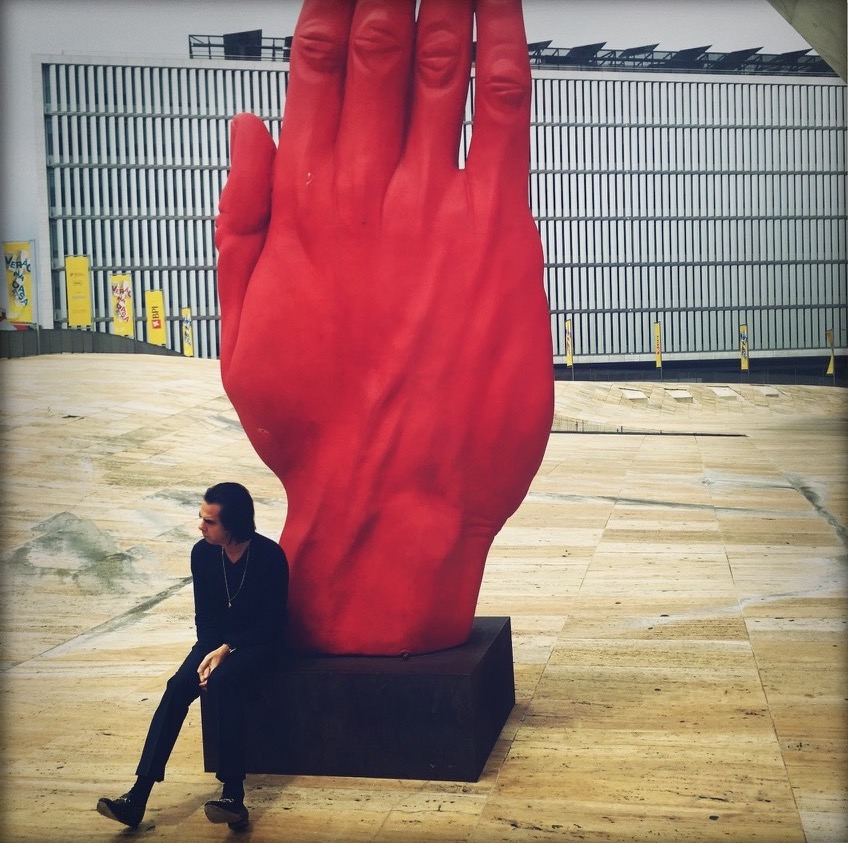
In September of 2018, singer-songwriter Nick Cave began a project called The Red Hand Files, in which he invited fans to write to him. “You can ask me anything,” Cave told them. “There will be no moderator.” A flood of letters ensued, and Cave has now published more than three hundred of them on his website. Many of these messages are deeply personal, confessing private fears, longings, frustrations, and sorrows. Their candor echoes the honesty of Cave’s music, which has long explored the trials and tribulations of the human condition, but it’s also traceable to another source. In July of 2015, after taking LSD, Cave’s fifteen-year-old son, Arthur, fell to his death from a cliff in Brighton, England. Cave’s subsequent journey through despair (an experience documented on his magnificent 2019 album, Ghosteen) inspired his desire for deeper transparency and fellowship with his audience. In this way, shared heartache generated community. Listeners felt safe to share their broken hearts with Cave because they knew that the songwriter’s heart was broken too.
Nick Cave. Image Credit: theredhandfiles.com
Some of the letters that Cave received were focused on the state of the world. In April of 2022, a listener named Valerio wrote:
Following the last few years I’m feeling empty and more cynical than ever. I’m losing faith in other people, and I’m scared to pass these feelings to my little son. Do you still believe in Us (human beings)?
Cave’s response drew hard-earned wisdom from a deep well of loss:
Dear Valerio,
You are right to be worried about your growing feelings of cynicism and you need to take action to protect yourself and those around you, especially your child. Cynicism is not a neutral position — and although it asks almost nothing of us, it is highly infectious and unbelievably destructive. In my view, it is the most common and easy of evils.
I know this because much of my early life was spent holding the world and the people in it in contempt. It was a position both seductive and indulgent. The truth is, I was young and had no idea what was coming down the line. I lacked the knowledge, the foresight, the self-awareness. I just didn’t know. It took a devastation to teach me the preciousness of life and the essential goodness of people. It took a devastation to reveal the precariousness of the world, of its very soul, to understand that it was crying out for help. It took a devastation to understand the idea of mortal value, and it took a devastation to find hope.
Unlike cynicism, hopefulness is hard-earned, makes demands upon us, and can often feel like the most indefensible and lonely place on Earth. Hopefulness is not a neutral position either. It is adversarial. It is the warrior emotion that can lay waste to cynicism. Each redemptive or loving act, as small as you like, Valerio, such as reading to your little boy, or showing him a thing you love, or singing him a song, or putting on his shoes, keeps the devil down in the hole. It says the world and its inhabitants have value and are worth defending. It says the world is worth believing in. In time, we come to find that it is so.1
Usually, when I compile my annual favorites lists of books, movies, and music, I’m not thinking too much about the state of the world. These lists are an opportunity to revisit works of art that kindled my imagination, to ponder why those projects resonated with me, and to recommend beautiful creations to others. This time, however, is different. 2024 was a hard, hard year, for me personally and for the country I call home. In many ways, society feels more vulnerable than ever, and the same questions that haunted Valerio dog my own steps. When everything around us appears to be falling apart, where can we turn for hope? Should we even be looking for hope in the first place?
Cave’s answer to this question (contained in his response to Valerio) seems to be no, but not for the reasons we might expect. According to Cave, hope isn’t something we look for – a fragile, birdlike feeling that flits away from our grasp. It’s something we do – the action of a warrior bracing herself for battle. Like love and faith, hope is a choice. We tend to view hopefulness as a cheery state of mind, but hope is more like a soldier on the front lines, doggedly contending with forces of decay. It’s a response to desperation, not the absence of it, and thus it’s contingent on continuing hardship. As Reverend Ernst Toller says in the movie First Reformed: “Wisdom is holding two contradictory truths in our mind, simultaneously: hope and despair. A life without despair is a life without hope. Holding these two ideas in our head is life itself.” Hope, this relentless struggle in the cavernous jaws of the world, is most necessary when feelings of hope seem hardest to find.
Hope may be glimpsed in extraordinary feats of heroism, but according to Cage, it’s most often expressed in the mundane (“everyday deeds of ordinary folk that keep the darkness at bay,” as Gandalf the Grey once put it). Simple actions like the tying of a child’s shoes, the singing of a song, or the reading of a bedtime story become deeply significant when viewed as acts of resistance to a looming, ever-present darkness. Our lives, it seems, are only as humdrum as we allow them to be. Here be dragons, and the seemingly innocuous stories that we tell ourselves are brimming with great and perilous import. Author and philosopher G.K. Chesterton captured this idea well when he wrote: “Fairy tales do not tell children the dragons exist. Children already know that dragons exist. Fairy tales tell children the dragons can be killed.”
As I glance over my list of favorite books from 2024, I find that its titles are imbued with hopefulness – that unassuming struggle for goodness that Cave describes. One of them has the word “hope” in its title, and the rest express hope through their quests for truth, their celebrations of beauty, and their visions of human flourishing. Most of these books aren’t new (I’m always playing catch-up when it comes to great literature), but they shone like beacons in a dark and dreary year. I’ve warmed my hands and spirits beside their flames, and I hope that you can too. May you carry their light into the wilderness. May you choose hope.
Honorable Mentions: – Aurora Leigh by Elizabeth Barrett Browning – Beowulf by Seamus Heaney – Night Comes: Death, Imagination, and the Last Things by Dale C. Allison, Jr. – The Great Agnostic by Susan Jacoby – Piranesi by Susanna Clarke – When Stars Are Scattered by Omar Mahmood Mohamed & Victoria Jamieson – Yes to Life in Spite of Everything by Victor Frankl
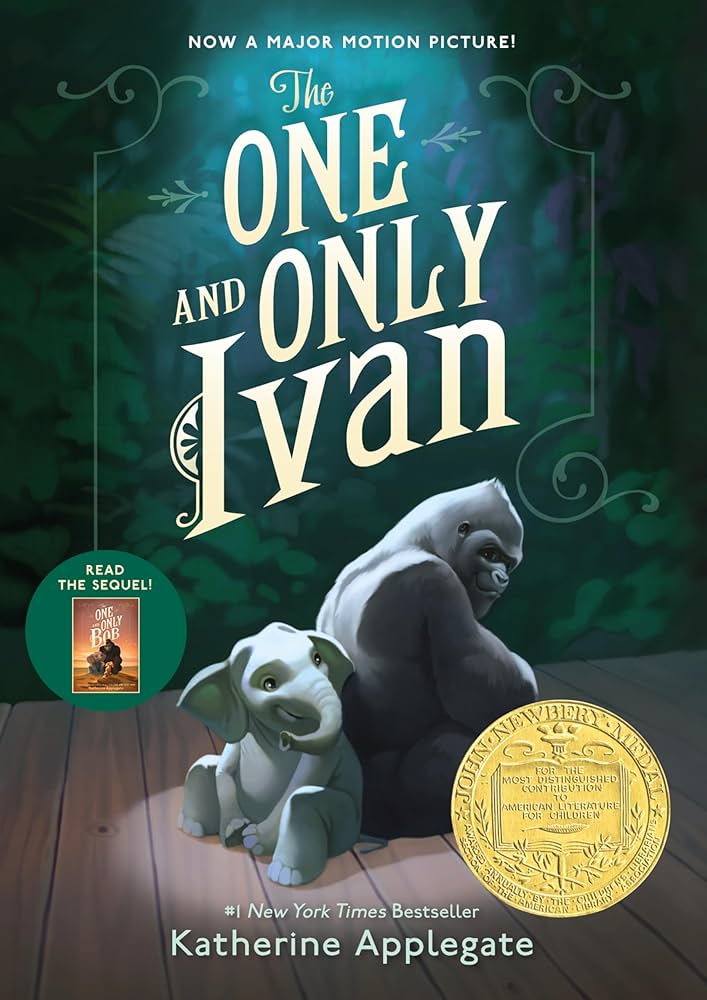
#10: The One and Only Ivan by Katherine Applegate
“It is never too late to be what you might have been.”
This George Eliot quote is the beating heart of The One and Only Ivan, Katherine Applegate’s Newberry Medal-winning tale of an aging silverback gorilla in captivity. Trafficked at a young age and raised by humans, Ivan has almost forgotten life outside the plexiglass boundaries of his domain. He spends his days observing shoppers at the Exit 8 Big Top Mall and Video Arcade, finger painting, and talking with his animal companions, Bob (a dog) and Stella (an elephant). But when a talkative kid elephant shows up at the mall, Ivan is forced to recall things he’d rather forget, to assume responsibilities he would’ve never imagined, and to confront the possibility of a future beyond his walls.
Children’s stories told by animals are a dime a dozen these days, but I’ve never read one that imagines its narrator’s voice so delightfully. Ivan’s sparse, straightforward diction is enchanting, and his offbeat perspective is unforgettable. Based on a real-life gorilla at Zoo Atlanta, Applegate’s story is an exercise in empathy – an invitation to view our world through the eyes of another creature. Animal rights issues and questions about humanity’s relationship to nature are handled in fascinating ways. Apes are my favorite animals, so I’m a little biased, but I found this story heartbreaking and heartwarming in equal measure, and it was the best story that I read aloud to my 5th and 6th grade students last year. No surprise: they loved it too.
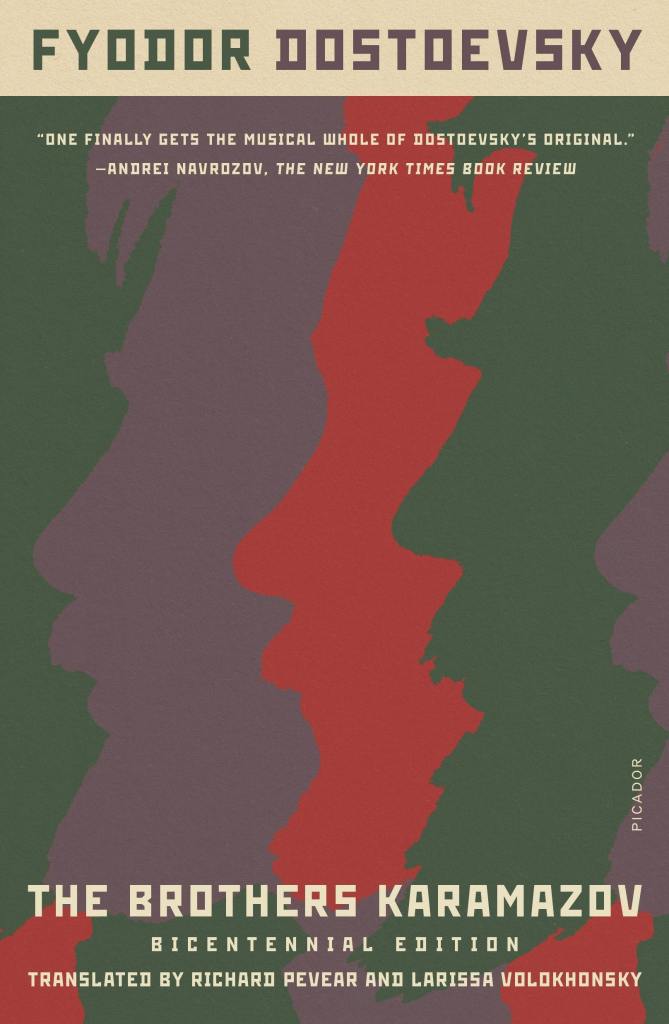
#9. The Brothers Karamazov by Fyodor Dostoevsky
I knew I’d have to get around to this tome eventually, and I’m so glad I did. What can I say about it that hasn’t already been said? It’s a masterpiece. I’d read excerpts quoted in other books and expected philosophical profundity, but I wasn’t prepared for the murder mystery that unfolds throughout the second half of the novel. Here, every detail becomes significant, and Dostoevsky’s mastery of plot is on full display. Even though I knew what had happened to sleazy ol’ Fyodor Pavlovich Karamazov and what the outcome of the trial would be (Dostoevsky tells you beforehand!), I still found myself riveted by the climactic courtroom scene. The social and psychological analysis of Russian culture that the author weaves into the defense attorney’s closing speech was icing on the cake (or gilding on the gavel…?).
Those things said, I can’t help but take issue with Dostoevsky’s portrayal of atheism, which, while certainly compassionate (Ivan Karamazov’s depiction of child suffering is one of the most powerful critiques of God ever posed, and his existentialist monologue about “the sticky leaves that come out in spring” is my favorite passage of the book), also relies on some frustrating and harmful stereotypes that link religious skepticism with madness, lawlessness, and the occult. Alyosha Karamazov might be Dostoevsky’s hero, and I like his earthbound, open-hearted theology a whole lot; but in this brutal, beautiful, and bewildering world of ours, my sympathies lie with Ivan.
On an unrelated note, this book gave me a fascinating new lens with which to appreciate Christopher Nolan’s film The Dark Knight (thanks for the insight, Thug Notes!), and it also inspired my recent essay on Vampire Weekend’s glorious third album, Modern Vampires of the City.
#8: The House of Silk by Anthony Horowitz
ll right, here come the superlatives: Hands-down, this was the best mystery novel I’ve ever read and the best audiobook listening experience I’ve ever had. Whoever convinced Derek Jacobi (one of my favorite Shakespearean actors) to narrate this book deserves a raise. Jacobi’s rich, weathered voice brings out all the music in Anthony Horowitz’s prose, which in turn sounds like it was pulled straight from the foggy, lamplit streets of Victorian London.
Prior to reading The House of Silk, the only Horowitz books that I’d read were the Alex Rider spy novels that I burned through way back in elementary school. I knew he was a prolific murder mystery writer, and I assumed the sheer quantity of his output meant that his stories might be undercooked. Boy, was I wrong. On my wife’s recommendation, I picked up this Sherlock Holmes novel, which Horowitz wrote on special commission from the Sir Arthur Conan Doyle foundation (what a job to receive!). Horowitz pulls off a high-wire act here, simultaneously honoring his character’s legacy and subverting the tropes of Doyle’s stories in some surprising ways. By the book’s mind-bending denouement, when the pieces of the puzzle finally click into place, you know you’re in the hands of a master storyteller.
Hats off to my wife for her excellent taste in books. If you’re looking for a spooky, scintillating autumnal read, you can’t do better than this.
#7: Radical Hope: Ethics in the Face of Cultural Devastation by Jonathan Lear
What a fascinating read! This book is my favorite kind of case study: multidisciplinary, culturally informed, and vividly written. Combining historical and anthropological data with philosophical and psychological analysis, Lear’s examination of the Crow tribe ponders how a people group might recover and move forward from a cultural collapse. The solution that he explores – “radical hope” – is exemplified in the remarkable actions of the last Crow chief, Plenty Coups, as well as his followers.
I do wish that Lear’s analysis was more connected with modern events, and I kept wishing he would generalize more from his findings or recommend how modern people might embody radical hope. Some of his argumentation was also a bit tricky to follow for this amateur philosopher. Yet it’s a stirring account of optimism in grim circumstances, one that I’ll be thinking about for a long time. I wasn’t expecting Plenty Coup’s struggle to resonate so deeply with my experience of leaving religion – that bewildering and terrifying dissolution of categories for making sense of the world. If you’re looking for a thought-provoking, unconventional read, then I heartily recommend this book.
Shout-out to my friend Ethan for the great recommendation!
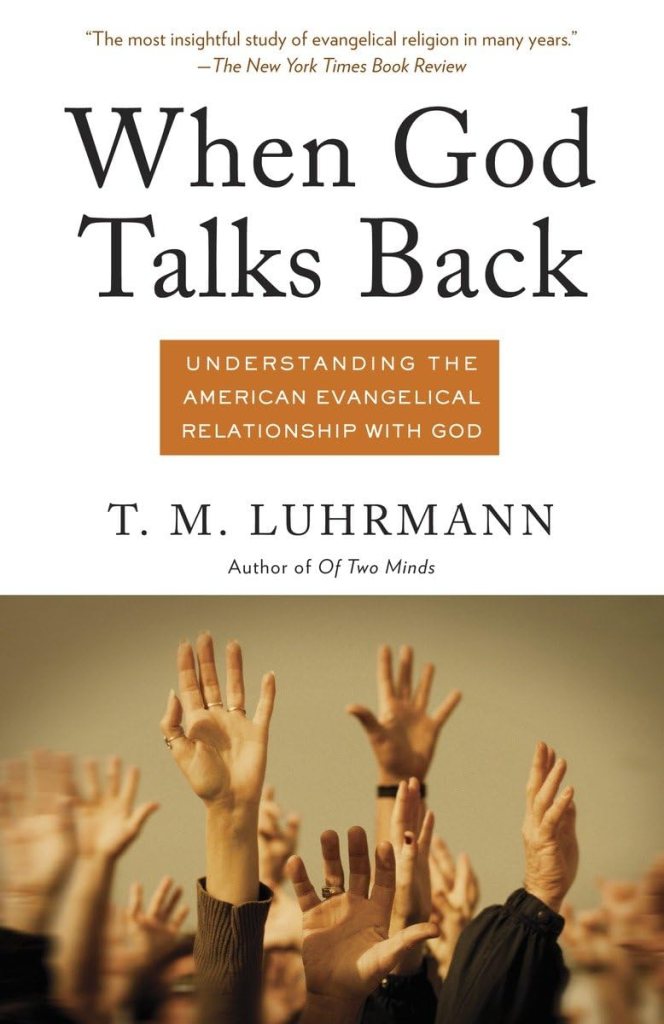
#6: When God Talks Back by Tanya Luhrmann
Version 1.0.0
When I switched my major from English to anthropology during my sophomore year of college, I was drawn to the discipline’s emphasis on empathy. Using field notes, interviews, culture theory, and participant observation, anthropologists attempt to immerse themselves as fully as possible in the lived experience of the “other,” seeking first and foremost to understand. Over time, I fell in love with this approach and came to see it as a tool for empowering marginalized communities. But I never had the anthropologist’s gaze trained on me – on my community. Until now. And wow, is it a surreal experience!
Tanya Luhrmann introduces her in-depth study of American evangelicalism with something she calls “the problem of presence”: How is it that religious believers come to experience a God who cannot be seen, heard, or felt as a real, living relationship? The rest of her book explores her answers to that question. Lurhmann’s writing is erudite yet approachable, and her dedication to understanding her subjects is remarkable. She argues that her findings are compatible with both Christian and skeptical worldviews (in other words, they don’t prove or disprove the existence of the supernatural), and she’s eager to help both audiences see each other accurately – for skeptics to grasp how Christians can believe the things they do, and for Christians to grasp why skeptics might find their beliefs so incomprehensible.
As someone who left religious faith very recently, I’m still wrestling with lots of difficult questions about my many years in the church: Was any of it real? How could I have believed so ardently in realities that I now think are nonexistent? What do I make of “miraculous” occurrences, or experiences where God’s presence and voice felt undeniable? Luhrmann’s outsider perspective enabled me to see the community that raised me with fresh eyes, to reexamine the foundations of my former faith. This book is essential reading for believers and skeptics alike. I can’t recommend it highly enough.
#5. Autumn by Karl Ove Knausgaard
This is my favorite kind of writing: patient, wide-eyed, and heartfelt, concerned with ultimate questions yet rooted in the everyday. Framed as a series of letters to an unborn daughter, Autumn is really an exercise in paying attention. In chapter one, Knausgaard writes: “These astounding things, which you will soon encounter and see for yourself, are so easy to lose sight of, and there are almost as many ways of doing that as there are people. That is why I am writing this book for you. I want to show you the world, as it is, all around us, all the time. Only by doing so will I myself be able to glimpse it.”
Nestled between monthly letters are reflections on a host of mundane topics: apples, teeth, plastic bags, chewing gum, frogs, churches, blood, jellyfish, eyes, toilets, lightning, thermos flasks, forgiveness, and much more. These meditations are more akin to prose poems than traditional chapters. Again and again, Knausgaard pulls profound insights from the seemingly ordinary, offering stunning passages like this one: “For darkness is the rule and light its exception, as death is the rule and life its exception. Light and life are anomalies, the dawn is their continual affirmation.”
#4: Star Child by Claire Nivola
“Over the years you will try to make sense of that happy, sad, full, empty, always-shifting life you are in. And when the time comes to return to your star, it may be hard to say goodbye to that strangely beautiful world. Think well, then, before you go.”
So say the elders to the Star Child, a “flame of vapor, invisible and timeless” who longs to experience life on planet Earth. And so begins one of the most achingly beautiful love letters to the world ever written, cleverly disguised as a children’s book (but really meant for adults). The story is a simple one, but watch out. If you’re anything like me, you may find yourself plunged into a state of existential reflection, tears streaming down your face by the time you reach those bittersweet final pages.
Like many people, I first encountered Star Child through the trailer of Mike Mills’ gorgeous 2021 film C’mon C’mon, where a weary Joaquin Phoenix cries while reading the book to his nephew at bedtime. Unfathomably (it should already be a classic by now), the book is nigh impossible to find, either cheaply for purchase on Amazon or at local libraries (those near me, anyway). However, you can watch it read aloud on YouTube. The book’s power is as much a product of its illustrations as its words – those whimsical watercolor paintings, effortlessly childlike and vibrant as life itself. Come to think of it, that last phrase sums the book up pretty darn well…
It’s $50 on Amazon, but if you bought it on a whim, that’d be money well spent.
#3: My Struggle: Book 1 by Karl Ove Knausgaard
Version 1.0.0
It was difficult to give this book a star rating, because it’s like nothing else I’ve ever read before. Many of my favorite stories are about finding beauty in the mundane: Marilynn Robinson’s Gilead, Herman Melville’s Moby Dick, Wendell Berry’s Jayber Crow, Amor Towles’ A Gentleman in Moscow, and Leif Enger’s Virgil Wander, to name a few. Yet, I’ve never read a book that so accurately captures the feeling of the mundane, with all its repetition and banality and transience, as the first volume of Karl Ove Knausgaard’s whopping 3,600-page memoir, My Struggle. Reading it, you get the sense that you’re not merely listening to a tale, but witnessing life as it’s lived.
It takes some getting used to. Listening to conversations between Knausgaard and his friends and family, you begin to realize just how curated most literary dialogue is. The story rambles forward without chapter breaks, skipping back and forth between past and present. Rather than forcing his narrative into a familiar structure, Knausgaard allows his mind to roam where it will, inviting readers into all his fragmentary impressions, nagging insecurities, and wistful meditations. In doing so, he challenges our notion of what counts as literature. My Struggle is a bold experiment: an attempt to craft a literary epic from the unremittingly ordinary.
Does it work? You’ll have to decide for yourself. This book isn’t for everybody, and I’d be lying if I said that much of Knausgaard’s tale didn’t leave me longing for something more – more drama, more order, more insight into the meaning of various experiences. Yet, doesn’t my own life do the same? Do I read books to escape my life, or to see it with new eyes? If my goal is the latter, then Knausgaard’s book is a worthy companion for the journey. His relentless attention to life’s ebb and flow might bore you to tears, but it also unveils moments of startling, transcendent beauty. The fact that I enjoyed the book from start to finish, coupled with the fact that I’m seriously considering reading the rest of this behemoth (!), means Knausgaard must have done something right.
Plus, I learned lots of interesting stuff about Norway! So that was cool.
#2: I Cheerfully Refuse by Leif Enger
Version 1.0.0
How on earth is this not my #1 book of the year?
When times get dark, we turn to those we trust for comfort. And if there’s any author I’d trust enough to follow anywhere, it’s Leif Enger.
I didn’t plan on reading I Cheerfully Refuse around election time, but I’m so grateful that the stars aligned just so. Again and again, Enger’s novels have met me when I needed them, reviving my flagging spirits. He’s my favorite author, and I’ve read each of his previous novels twice, so beginning this new tale felt like greeting an old friend long missed. So much was familiar: the Midwestern setting with its frigid winds and storm-tossed lakes; the cast of quirky and achingly human characters; the bemused, elfin humor; the breathless reverence for the mundane; and that miraculous prose, that relentless revelry in language that makes you want to laugh aloud from sheer joy (or am I the only one?). But for all its familiarity, this novel was strange and unsettling in ways I hadn’t anticipated.
While Enger has never shied away from grappling with the cost of redemption, “I Cheerfully Refuse” is darker and weightier than anything he’s written before. Not since Cormac McCarthy’s The Road have I read such a grim vision of apocalypse (“terrifyingly prophetic,” a critic announces from the book jacket, and that hits the nail on its head). And while the world McCarthy describes is far bleaker, Enger’s feels more visceral for its nearness. It’s not hard to imagine ourselves in this foundering and splintered version of America, if the sinister trends we see around us every day continue unabated.
Enger’s novels may shine with irrepressible affection for life, but the hope that their characters pursue has always been hard-won. Here, that hope is tested to its breaking point. Enger offers no easy outs, no quick fixes, no guarantee that Rainy’s battered ship will stay afloat. And that’s what I needed, at this time of all times – not optimism (I’m much too tired for that) but a companion brave enough to walk the tightrope over despair with me and see if, in spite of everything, it just might hold.
No spoiler alerts here; I don’t want to give you any sense of where this one ends up. The journey’s too wild and wondrous for that, and you’ll have to decide whether it’s a risk worth taking. Suffice it to say, it’s my favorite read of the year and a new masterpiece for our perilous moment in time, one that I’d like to put in the hands of everyone everywhere.
P.S. There’s also a heroic scene with grapefruit, and I think my life may now be complete.
And now, in a stunning and unprecedented turn of events… A TWO-WAY TIE FOR FIRST PLACE! (Wait a second… did he just sneak 11 titles into his top 10 list?)
First #1: Life of Pi by Yann Martel
In the spirit of Life of Pi, let me begin this review with a story.
It was June of 2017, and I was on a Qatar Airways flight bound for Southeast Asia. I was a senior in college and had accepted a six-month internship with a missionary organization there. Seated next to me was a Muslim woman from Kenya. During the flight, she pulled out her paperback copy of the Quran and began trying to convert me to Islam. The tactic was a familiar one: as an American Christian, I was well-versed in the delicate art of airplane evangelism. I listened attentively to her case, fumbling over the words of the shahadah (confession of faith) that she urged me to repeat: There is no God but Allah, and Muhammad is his prophet. “There,” she smiled. “Now you are a Muslim!”
Besides my unwitting conversion to Islam, this interaction was memorable for several reasons. I was going to live with Muslims for the next half-year, but I’d never met one before. Most of what I’d heard about Muslims from fellow evangelicals and American news media was negative, but this woman was funny and kind. I was also amazed by how many of the woman’s stories I knew: tales of Adam and Eve, Noah, Joseph, Moses, Joshua, and Jesus. When she’d finished talking, I made an effort to explain Christianity to her, but I couldn’t shake my surprise at how much we held in common.
The missionary organization that I worked with had a retreat center – a small building where team members rested once a week. We were living in a metropolitan slum, laboring alongside impoverished trash-pickers, and time away from these harsh realities was welcome. It was at this building one afternoon that I found a copy of Yann Martel’s Life of Pi. I remembered watching the movie in high school and being simultaneously awed and unsettled. Pi, the film’s shipwrecked protagonist, practiced a unique blend of Hinduism, Christianity, and Islam. I’d come to Indonesia to share Jesus with non-Christians, so I wasn’t keen to revisit Pi’s strange, salad-bowl spirituality. I did crack open the novel, though, and encountered one of the most beautiful descriptions of the suffering Christ I’d ever read. As far as I knew, Martel wasn’t a Christian, so how could he write about Christ this way?
Looking back on that time, I can see that I wasn’t ready for Life of Pi. I had come to Southeast Asia to help people, but I also hoped to change their minds; I wasn’t looking to have my own worldview changed. Over the next six months, as I shared the joys and hardships of slum life with my Muslim neighbors and listened to their stories, my faith was challenged and altered in unexpected ways. Again and again, like the enormous, ever-shifting ocean that sweeps Pi and his tiger companion along, life burst the boundaries I’d constructed for it. Many Christians, including myself, took issue with Life of Pi because they believed it encouraged religious syncretism: “All faiths are the same!” That isn’t the case. Pi’s bizarre form of faith isn’t prescriptive; it’s an expression of a personality marked by irrepressible curiosity, wonder, and lust for life – what G.K. Chesterton called “a sense of eccentric privilege.” Life of Pi is, first and foremost, an invitation to broaden our view of the world – to open ourselves up to mystery and to glimpse, as Pi does, life in all its vivid, savage, indescribable glory.
On its surface, this book shouldn’t work. A first-person account from an Indian boy that’s told by a white Canadian, a coming-of-age tale that’s also a seafaring survival epic, a story within a story that mingles theology with psychology and zoology? Come on. Like the writer whose interview notes are scattered throughout the book, you might be tempted to dismiss Pi’s story as an impossibility, until you hear it. Not since Moby Dick have I encountered a book that spans so many genres and topics successfully. Like Melville’s masterpiece, Life of Pi ponders the diverse creatures that share our watery planet, and it also explores the stories we tell (religious and otherwise) to make sense of life’s complexity and uncertainty. Finally, like Melville’s miraculous prose, Martel’s narration sparkles with a heaping dose of good-hearted humor.
One of the marks of Life of Pi’s greatness is the amount of discussion it has generated since its publication. What do we make of that mysterious island? How do we interpret that haunting, wondrous, befuddling ending? What can we believe, or should we believe, about Pi’s story? After digging into some analysis of the story’s themes, motifs, and allusions, I can tell you that this novel rewards contemplation (the names of characters, animals, places, and boats offer a particularly fascinating rabbit hole).
Near the beginning of the book, Martel’s stand-in writer hears that Pi’s story will make him believe in God. Life of Pi is at once a thoughtful interrogation of faith and a beautiful argument for it. I’ve abandoned the religion that I once carried to Southeast Asia. Pi’s shipwreck may have strengthened his belief in God, but my recent crisis of faith led me to atheism. I still mourn the loss of my religious heritage and convictions. Yet, as I navigate the aftermath of that storm, grasping for what flotsam I can, I find Martel’s eccentric, wide-eyed protagonist to be a kindred spirit. We might disagree on a host of topics, but I know that Pi would hear my story with a twinkle in his eye (at the very least, he’d be grateful that I don’t call myself an agnostic!), and I think he’d respond with something like this quote by Frederick Buechner: “Here is the world. Beautiful and terrible things will happen. Don’t be afraid.”
Now I need to revisit that movie adaptation again.
Second#1: This Life: Secular Faith and Spiritual Freedom by Martin Hägglund
Hands down the best book of philosophy I’ve ever read, and one of the most inspiring reading experiences I’ve ever had, too. There’s so much I could say about it… where to start?
The most remarkable thing about the book, I think, is its seamlessness. In a little less than 400 pages, Hägglund attempts to prove that human finitude is the source of all true meaning, purpose, morality, and freedom. Along the way, he weaves philosophical exploration with theological reflection, social and economic analysis, and literary critique. He engages with Augustine and Kierkegaard and C.S. Lewis, Marx and Hegel and MLK, Mill and Keynes and Hayek. Yet, incredibly, it all hangs together. Hägglund’s reflections on mortality and his critiques of religious faith flow beautifully into his devastating takedown of capitalism. The book is erudite yet readable, incisive yet heartfelt. I began reading quickly and eventually slowed down and doubled back to take notes, which I’m so glad I did. There’s just so much to take in, in the very best of ways, and I know I’ll be revisiting it often as the years pass.
Some may argue that Hägglund’s writing style is unnecessarily repetitive, which is a valid criticism. Yet I was grateful for the author’s restatement of key points, which helped me grasp his arguments much better. Hägglund is a college professor, and his teacher’s heart really comes through here. So many books written by brilliant people hold you at arm’s length, but this one invites you in, eager to unfold itself to you.
I was predisposed to enjoy This Life, since it explores questions I’ve been mulling over for years: How can we love the world we inhabit when it is so deeply riven by suffering? Can religious faith be reconciled with genuine care and concern for mortal life? Can our current economic systems ever deliver on promises of justice and equality? (I resonated deeply with Marx when I read him in college, but I still had lingering misconceptions about his teachings; after digesting Hägglund’s in-depth analysis of Marx’s work, I’m pretty sold on socialism). Hägglund contends that there are answers to these questions – serious, sobering, and ultimately liberating answers that point us toward the world we dream about but can scarcely bring ourselves to hope for. That world feels a long way off, but who knows? With books like these to guide us, we might just find our way there.
How does it feel To be on your own With no direction home Like a complete unknown Like a rolling stone?
More than any other Bob Dylan lyric, that legendary chorus may come closest to capturing the spirit of its author – a lonesome, mercurial, dissembling spirit that no musical biopic could ever hope to fully represent. Wisely, James Mangold’s new film doesn’t try to resolve Dylan’s enigma. The songwriter’s life was, from the very beginning, for good and for ill, a performance. Rather than analyzing that performance, A Complete Unknown invites us to simply look and listen – to witness the impact of Dylan’s music on the 1960s folk scene and on the people whose lives and longings swirled in its powerful orbit.
I’ve spent the past year listening through Dylan’s discography and studying his cultural impact. I’m also a huge fan of Timothée Chalamet’s acting. So I was stoked when this picture was announced. If anyone could capture Dylan’s elusive persona, I believed it was Chalamet, whose portrayals of creative, restless, introspective characters have wowed me time and time again (Have you seen his work in Call Me By Your Name? Beautiful Boy? Little Women?). I’m happy to say that he nails the part. While (thankfully) it’s not an impression, the accent and physicality are so good that you gradually forget you’re watching an actor. Add to that his live performances of Dylan’s songs, which feature guitars and harmonica and conjure Dylan’s nasal voice like a ghost, and you’ve got an award-worthy performance. The movie’s well worth watching for the concert scenes alone.
The bad: Mangold focuses so heavily on the “important” scenes of Dylan’s rise to fame, including trivia from his recording sessions, that he neglects the psychology of his supporting cast. While marveling at the fidelity of Elle Fanning’s, Monica Barbaro’s, and Edward Norton’s performances, I found myself wondering why they were drawn to Dylan and what specifically his music meant to them. Mangold gives us many scenes of characters staring at Dylan in awe (too many, by my lights), but he fails to probe beneath the surface of their attraction to Dylan. Thus, several of the story’s emotional beats fall flat.
Similarly, while the Greenwhich village folk scene is beautifully imagined, I wish Mangold had dedicated more time to exploring the social issues that inspired Dylan’s songs. Seismic events like Civil Rights marches, the Cuban missile crisis, and JFK’s assassination are all depicted, but each is too fleeting and peripheral to drive home the cultural force of Dylan’s lyrics.
The good: You could criticize this movie for making Dylan’s ascent to stardom seem too prosaic, too mundane. Where is the muse quickening his pen? Where are all the scenes of heroic vindication? What resolution or meaning to be found for the women whose hearts were broken along the way? Was all this, after all, really just about a hungry, insecure, self-absorbed dude and his songs?
Bravely, Mangold presents us with a portrait of America’s greatest troubadour that is at once reverent and brutally honest, daring to depict him as (dare we say it?) a human being like the rest of us, caught up in a myth of his own and others’ making. Idols, for all their shine, are human constructions. Dylan’s magic trick of concealment is also his greatest curse. Look closer, and all you’ll see is what he wanted you to see (and what, ultimately, he couldn’t help but become): a complete unknown.
In the spirit of Life of Pi, let me begin this review with a story.
It was June of 2017, and I was on a Qatar Airways flight bound for Southeast Asia. I was a senior in college and had accepted a six-month internship with a missionary organization there. Seated next to me was a Muslim woman from Kenya. During the flight, she pulled out her paperback copy of the Quran and began trying to convert me to Islam. The tactic was a familiar one; as an American Christian, I was well-versed in the delicate art of airplane evangelism. In the unlikely event that the plane crashed, each of us believed that the other’s soul was bound for perdition. Thus, the stakes were high. I listened attentively to her case, fumbling over the words of the shahadah (confession of faith) that she urged me to repeat: There is no God but Allah, and Muhammad is his prophet. “There,” she said with a smile. “Now you are a Muslim!”
Besides my unwitting conversion to Islam, this interaction was memorable for several reasons. I was going to live with Muslims for the next half-year, but I’d never met one before. Most of what I’d heard about Muslims from fellow evangelicals and American news media was negative, but this woman was funny and kind. I was also amazed by how many of the woman’s stories I knew: tales of Adam and Eve, Noah, Joseph, Moses, Joshua, and Jesus. When she’d finished talking, I made an effort to explain the Christian gospel to her, but I couldn’t shake my surprise at how much we held in common.
The missionary organization that I worked with had a retreat center – a small building where team members rested once a week. We were living in a metropolitan slum, laboring alongside impoverished trash-pickers, and time away from these harsh realities was welcome. It was at this building one afternoon that I found a small copy of Yann Martel’s Life of Pi. I recalled watching Ang Lee’s movie adaptation in high school and remembered feeling simultaneously awed and unsettled. Pi, the film’s shipwrecked protagonist, practiced an idiosyncratic blend of Hinduism, Christianity, and Islam. I’d come to Southeast Asia to share Jesus with non-Christians, so I wasn’t keen to revisit Pi’s strange, salad-bowl spirituality. I did crack open the novel, though, and encountered one of the most beautiful descriptions of the suffering Christ I’d ever read. As far as I knew, Martel wasn’t a Christian, so how could he write about Christ this way?
Looking back on that time, I can see that I wasn’t ready for Life of Pi. I had chosen to live in a slum because I wanted to help suffering people, but I also hoped to change their minds; I wasn’t looking to have my own worldview changed. Over the next six months, as I shared the joys and hardships of slum life with my Muslim neighbors, observed their religious rituals, and listened to their stories, my faith was challenged and altered in unexpected ways. Again and again, like the enormous, ever-shifting ocean that sweeps Pi and his tiger companion along, life burst the ideological boundaries I’d constructed for it.
Many Christians, including myself, took issue with Life of Pi because we believed it encouraged religious syncretism: “All faiths are the same!” That isn’t the case. Pi’s bizarre form of faith isn’t prescriptive; it’s an expression of a personality marked by irrepressible curiosity, wonder, and lust for life – what G.K. Chesterton called “a sense of eccentric privilege.” Life of Pi is, first and foremost, an invitation to broaden our view of the world – to open ourselves up to mystery and to glimpse, as Pi does, life in all its vivid, savage, indescribable glory.
On its surface, the book shouldn’t work. A first-person account from an Indian boy that’s told by a white Canadian, a coming-of-age tale that’s also a seafaring survival epic, a story within a story that mingles theology with psychological and zoological analysis? Come on. Like the writer whose interview notes are scattered throughout the novel, you might be tempted to dismiss Pi’s story as an impossibility, until you hear it. Not since Moby Dick have I encountered a novel that spans genres and topics so delightfully. Like Melville’s masterpiece, Life of Pi ponders the diverse life-forms that share our watery planet. It also explores the stories we tell (religious and otherwise) to make sense of life’s complexity and uncertainty. And like Melville’s prose, Martel’s narration sparkles with a heaping dose of open-hearted humor.
One of the marks of Life of Pi‘s greatness is the amount of discussion it has generated since its publication. What do we make of that mysterious island? How do we interpret that haunting, wondrous, befuddling ending? What can we believe, or should we believe, about Pi’s story? After digging into some analysis of the story’s themes, motifs, and allusions, I can tell you that this novel rewards contemplation (the names of characters, animals, places, and boats offer a particularly fascinating rabbit hole).
Near the beginning of the book, Martel’s stand-in writer hears that Pi’s story will make him believe in God. Life of Pi is a thoughtful interrogation of faith and a beautiful argument for it. I’ve abandoned the religion that I once carried to Southeast Asia. Pi’s shipwreck may have strengthened his belief in God, but my recent crisis of faith led me to atheism. I still mourn the loss of my religious heritage and convictions. Yet, as I navigate the aftermath of that storm, grasping for what flotsam I can, I find Martel’s eccentric, wide-eyed protagonist to be a kindred spirit. We might disagree on a host of topics, but I know that Pi would hear my story with a twinkle in his eye (at the very least, he’d be grateful that I don’t call myself an agnostic!), and I think he’d respond with something like this quote from Frederick Buechner: “Here is the world. Beautiful and terrible things will happen. Don’t be afraid.”
Now I need to revisit that movie adaptation again.
In February of 2024, Rolling Stone published their list of the 500 greatest songs of all time. Sitting atop that list were stone-cold classics such as Stevie Wonder’s “Superstition,” The Beach Boys’ “God Only Knows,” Queen’s “Bohemian Rhapsody,” Marvin Gaye’s “What’s Going On,” John Lennon’s “Imagine,” and Aretha Franklin’s “Respect.” Scrolling through that enormous list, you might find yourself wondering: Why were these songs selected over others? Were they chosen for their artfulness, their cultural impact, their ubiquity, their musical innovativeness, their political relevance, or a combination of all these factors? Once they were chosen, who assembled them into a ranking, and who made the final cuts? How did they compare songs that were written in vastly different styles and intended for vastly different purposes? When the project was finished, did its creators thump their chests and shout, Eureka! We’ve done it! Or did they close their laptops and heave wistful sighs, their minds bleary with sleep deprivation and lingering doubts about the futility of the whole art-list-making enterprise?
If you really want to know, I’m sure you could Google some behind-the-scenes story about the making of the Rolling Stone 500. Pondering the project myself, I emerge with two general conclusions about “best-of” music lists. First: They can never be definitive. Everyone brings their own unique background and perspective to the works of art which they enjoy, and aside from whether or not it was composed in Ireland, there’s no objective metric for what counts as a “great” tune (I’m only slightly kidding). Is a song great because it’s popular, because it’s memorable, because it’s unusual, or because it’s progressive? Does the melody matter more than the lyrics, or vice versa? Should music critics decide what counts as great, or should that be left up to ordinary folks tuning their car radios? Is complexity preferable to simplicity? Is there any conceivable world in which Rednex’s “Cotton Eye Joe” beats Leonard Cohen’s “Hallelujah” in a cage match? How much cowbell really is too much? Ultimately, we’ll never know.
Second: Like the mythical Sisyphus’ doomed efforts to roll his boulder uphill (Wait a sec… is that where “rock-n-roll” got started, and Rolling Stone for that matter?), best-of-lists remain a worthwhile enterprise, despite their apparent futility. I’ve discovered dozens of incredible songs through Rolling Stone‘s list, and I’m so grateful that people took the time to compile it. These lists aren’t a way of pinning music down, bug-on-a-card style, and deciding that we’ve figured it all out. They’re actually a way of opening music up. Undoubtedly, a best-of list can become an excuse for snobbery, in which the list-maker applauds their own aesthetic judgements. But it can also become an invitation to the celebration of beauty – a breathless, wonderstruck encouragement to explore works of creativity that have stirred the list-maker’s heart and mind.
This is the latter kind of list. Below, I’ve compiled my ten favorite songs of all time (along with one honorable mention that I just couldn’t help myself from including). If you’re a music nerd like me, that might sound like a fool’s errand, and I’d be lying if I said it was easy. There were so many wonderful songs to consider, and sacrifices had to be made (I may never forgive myself for leaving off Kermit the Frog’s “Rainbow Connection”). However, the challenge wasn’t as difficult as you might expect. I’ve lived long and journeyed far with the tracks listed below. I know them inside and out, like old friends. They’re the songs that I’ve found myself returning to, over and over again, throughout life’s changing seasons, the ballads that I catch myself whistling when the road gets dark and the shadows come out. Everyone’s got their own criteria for what makes a perfect song, and here are mine: 1) beautifully crafted lyrics, 2) a melody that brings those words to vivid life, 3) an experience that delves to the heart of what it means to be human. The songs on this list demanded their place by hitting those criteria out of the park.
I hope these songs make you glad to be alive, as they do for me, and I’d love to hear your own examples of perfect songs in the comments below. Happy listening!
Honorable Mention: “Shrike” – Hozier
For thousands of years, songwriters have expressed their love and heartbreak through metaphor, drawing inspiration from the natural world in their quest to convey inner truth (How many lovers have been compared to the moon, I wonder?). You might think that all the good metaphors would’ve been used up by now. However, I’m willing to bet that singer-songwriter Hozier is the first to use this one: a bird, native to his home country of Ireland, that impales its prey on thorn bushes. If your response to that is, “Ick!,” I’m right there with you. Yet, in the hands of this brooding wordsmith (who composed one of my favorite albums of all time, 2019’s Wasteland, Baby!), that grisly image turns profound. Facing his inevitable death, Hozier yearns to be reborn as a shrike and fly back to the “sharp and glorious thorn” of the woman who broke his heart – to endure the sting of loss all over again, if only to draw near to her one last time.
#10. “Moon River” – Henry Mancini & Johnny Mercer
My little sister introduced this song to me years ago, and it just stayed with me. The lyrics are deceptively simple, but the longing they capture is deep and wide as the river that summons the singer. There’ve been many great covers of this one by artists like Jacob Collier, Frank Ocean, and Josh Ritter, but Audrey Hepburn’s soulful rendition in Breakfast at Tiffany’s will always be my favorite.
#9. “On Raglan Road” – Luke Kelly
I’m a sucker for sad Irish folk ballads, and this, in my humble opinion, is the saddest and best of them. Luke Kelly of the Dubliners had a voice like no other, as mighty and vibrant as the Irish coast, and when he put Patrick Kavanagh’s poetry to music, he captured something ineffable. “Tis better to have loved and lost than never to have loved,” Tennyson wrote. Maybe so. But on this side of the grave, those lovely ghosts never really leave us, and neither does the ache.
#8. “For What It’s Worth” – J Lind
I’ll never forget hearing the title track of J Lind’s astonishing debut album for the first time. In just under five minutes, it explores the weight of human and animal suffering, the tension between religious faith and doubt, and the struggle of making peace with the world’s wounds, more honestly and articulately than many books I’ve read on those subjects. The whole of For What It’s Worth was inspired by Friedrich Nietzsche’s concept (borrowed from the ancient Greeks) of amor fati – “love of fate” – and it ponders the reality that hardship and beauty are inextricable. Lind’s music deserves wider recognition, but he seems content to write his masterful songs for anyone who will listen. Clearly, he’s doing something right.
#7. “Diamonds on the Soles of Her Shoes” – Paul Simon
Paul Simon’s collaboration with the South African band Ladysmith Black Mambazo opens with one of the greatest lyric intros of all time:
She’s a rich girl, she don’t try to hide it Diamonds on the soles of her shoes He’s a poor boy, empty as a pocket Empty as a pocket with nothing to lose
Once that jubilant rhythm section (helmed by lead guitarist Ray Phiri, bassist Baghiti Khumalo, and drummer Isaac Mtshali) kicks in, it’s hard to stop smiling… or dancing. I’m not religious anymore, but when I was, I used to imagine that this was the kind of music they’d make in heaven – diverse cultures, languages, and styles swirling together, as if they were always meant to, into something unforgettable.
#6. “The Words” – Anaïs Mitchell
Do you have a song that brings you to tears every time you hear it? This is that song for me. I won’t try to explain why it hits me so deeply; there’s too much complicated backstory there, at least for this kind of post. All I can say is that this track, penned by the acclaimed creator of Hadestown (one of my favorite musicals), was a balm for me during the most difficult season of my life, and it fills me with gratitude for the woman whose love carried me through that storm.
#5. “Round Here” – Counting Crows
In 1991, 28-year-old Adam Duritz sang this song by night in the bars and coffee shops of San Francisco, taking a break from his job as a dishwasher to lament his aimlessness, and Counting Crows was born. It was the very first song composed by one of my all-time favorite bands, and it remains their masterpiece. I don’t know any other song that evokes the restless, raw bewilderment of adolescence and young adulthood in modern America as honestly as this one does. The song’s characters are at once mysterious and heartbreakingly familiar. Duritz’s version remains iconic, but this cover by songwriter Noah Gundersen finds new resonance in the original, and I can tell that he feels the same way about the song that I do.
#4. “Thin Blue Flame” – Josh Ritter
Who’s the best American songwriter of all time? Is it Bob Dylan? Paul Simon? Bruce Springsteen? Joni Mitchell? Stevie Wonder? I’m a huge fan of all these artists, but my money is on Josh Ritter, the soft-spoken folk troubadour from Moscow, Idaho. If you need proof of his songwriting prowess, check out this ten-minute epic, which some have called the song of its decade. Packed with dozens of literary allusions, Ritter’s magnum opus is equal parts lament and love letter – a searing evocation of a world in ruins and a reverent meditation on this planet’s persistent, fragile glory.
#3. “Magic Kingdom” – Ben Shive
No one writes songs about the passing of time better than Ben Shive. A music producer by trade, Shive has only released two of his own studio albums (both remarkable works), the latter of which dropped in 2019. So, when he shared this track last year, I couldn’t have been more excited. I visited Disney World with my family a couple times as a kid, and I’ll never forget the feeling of hurtling through the night on the park’s monorail, palm fronds rustling below, as the day’s excitement gave way to sleep and dreams. After listening to this song, my older brother and I agreed that Shive captures that experience perfectly. However, if you think this song’s about Disney World, hold on for the ride. The “magic kingdom” that Shive describes here has nothing to do with Mickey Mouse, everything to do with life’s most precious gifts.
#2. “Thunder Road” – Bruce Springsteen
Gosh, it hurts my heart to put this at #2. On any other day, it could easily take the top spot. “Born to Run” might be Springsteen’s quintessential anthem (and deservedly so), but “Thunder Road”‘s yearning and vulnerability are unparalleled in the songwriter’s legendary corpus. If you’ve already heard this ballad about taking chances for love and striking out into the unknown, just wait until you discover that no two lines of the song are sung exactly alike, either rhythmically or melodically. As in the hero’s journey, discovery waits around every corner. Few artists have written love songs that people across the world know by heart, despite their differing languages, and Springsteen is one of them. There’s a reason they call him The Boss.
#1. “Magnificent (She Says)” – Elbow
Here it is, folks. The song that has moved and inspired me more than any other. The first verse introduces us to a little girl, her toes sunk in wet sand, reaching for a fragment of sea glass as her father looks on. Through this simple image and everything that follows it, the lead singer of British rock band Elbow, Guy Garvey, meditates on what it means to truly and lovingly attend to the world around us. The father who stands on the beach is older and wiser than his daughter. He has seen far more of the world than his child can imagine – its far-flung landscapes, its diverse peoples, its innumerable joys and sorrows. Yet might the child have something to teach the parent? Garvey seems to think so, and he imparts that lesson atop soaring, shimmering strings that sound like a bird unfurling its wings, a child opening its eyes, or a frozen heart thawing in the warmth of a forgotten flame.
In this era of iTunes and YouTube and Spotify, records have lost some of the prominence that they once enjoyed. Songs are usually appreciated in isolation, randomly shuffled, suggested by algorithms, or compiled into playlists with tunes by a variety of artists. These new listening styles have their perks. We’re busy people, busier than ever before, and sometimes a few upbeat background tracks are all we need. Additionally, there’s so much great music at our fingertips, just waiting to be explored. With all these options, all this potential for surprise and discovery, why limit ourselves to a single piece of work by a single artist?
It’s a valid question. Throughout high school and college, I curated all my music in playlists. This practice exposed me to many singers and songwriters whose music I still enjoy today. However, in recent years, I’ve found myself gravitating toward albums, either listening through entire projects online or picking out stacks of CDs from my local library (yes, I’m that guy). After working my way through hundreds and hundreds of albums, I’ve grown to love the album as an art form, to appreciate what a well-crafted record can be. Like a great novel or film, which draws power from its scenes or chapters but isn’t reducible to them, the whole of a masterful album is greater than the sum of its songs. There’s a unique beauty in cohesiveness – in the connections between disparate lyrics that unfold themselves over time, in the way one tune flows into the next, in the mood or overarching narrative that binds tracks together. Sure, it takes time and patience to explore a record front-to-back. Not all albums reward the effort (looking at you, Album #4). But over and over again, I’ve found the experience of thoughtfully attending to longer musical works to be an enlivening and enriching one.
So, without any further ado, here are my reviews of seven albums that I listened through for the first time this summer – some celebratory, some critical, and all fun to write about. It’s been quite a year for music, and there’s lots of interesting stuff to talk about. Let’s get to it!
1. Brat by Charlie XCX My score: 3 stars
Brat summer, anyone? I really enjoyed my first experience of listening through Charlie XCX’s sixth studio album, which is currently the highest-rated record of 2024. I’ve never been a huge fan of dance music (and not just because I can’t dance to save my life), but the unique blend of electropop that Charlie and her producers have served up is infectious, shot through with blistering beats and a dizzying array of sonic flourishes. Just when you think you’ve caught a song’s wave, it turns on a dime, heading in an entirely new direction.
Those things said, I’ve found that this one sags a bit on re-listen, particularly due to the weakness of Charlie’s lyrics. Dance tunes aren’t usually known for their profundity, but Charlie delves beneath the surface here, offering up vulnerable reflections on love, family, fame, and self-image. Unfortunately, lackluster writing can make it harder to empathize with those sentiments. For me, Brat didn’t live up to the hype (which, in fairness, has been massive). But the album’s still a banger from front to back, well worth a summertime spin.
Favorite Track: “Sympathy is a Knife,” because that bass and percussion slap so hard.
#2. Hit Me Hard and Soft by Billie Eilish My score: 3 and 1/2 stars
The opening track of Billie Eilish’s third album contains these stunning lines:
People say I look happy Just because I got skinny But the old me is still me and maybe the real me And I think she’s pretty
Right there, folks, are the sharp songwriting and soul-baring honesty that have made this young artist a global icon. I’m a big fan of Billie and her brother, Finneas, who has co-written and produced all his sister’s records. The duo has already scaled astounding heights: ten Grammys, two Academy Awards, and counting! Hit Me Hard and Soft isn’t their best work (that title goes to their dark and brooding debut masterpiece, When We All Fall Asleep, Where Do We Go?), but it’s still a groundbreaking album, one that adds new hues to their consistently colorful musical palette (an apt metaphor, as these siblings share the unique gift of synesthesia). Surprises lurk throughout. Mournful ballads and eerie confessions transfigure themselves without warning, morphing into orchestral detours, walls of synthesizer chords, and driving dance beats. What will these wunderkinds do next? Hard to say. If they keep innovating like they have been, the sky’s the limit.
Favorite Track: “Lunch,” because it’s a witty, delightfully irreverent love song, and I can’t get enough of that old-school lead guitar.
#3. Stick Season by Noah Kahan My score: 4 stars
I love so much about this album: its vivid sense of place, its unflinching self-examination, and its catchy folk-rock vibe, to name a few. Eager for inspiration, Kahan returned to his childhood home in New England, re-immersing himself in the joys and heartache that accompanied his journey to adulthood. It was clearly a painful process. Time may have passed, but not all of Kahan’s scars have healed. Yet, as bitter as the weather that menaces his hometown may be, he still approaches that fraught place with grace and love, seeking above all to remember and understand.
Kahan’s stories hum with authenticity. Like any skilled writer, he knows the value of “Show, don’t tell,” and he employs that technique admirably here. The melodies on Stick Season‘s songs might be fairly predictable, but let me assure you that they also lend themselves to passionate belting on long car rides. Looking up Kahan on Wikipedia after my first listen, I stared at his list of musical inspirations: Hozier, Counting Crows, Paul Simon, Mumford and Sons. No wonder he’s such an honest and gifted songwriter.
Favorite song: “Stick Season,” because Kahan’s lyricism is achingly precise.
#4. The Tortured Poets Department by Taylor Swift My score: 1 and 1/2 stars
Ah, yes. Album #4. Here we are. When I reflect on this gargantuan double album, which smashed a bunch of records and ignited a frenzy of internet debate, the word that keeps coming back to me is “juvenile.” Let me explain.
Last year, my wife and I listened through all of Taylor Swift’s albums. We also listened to commentary on each album, trying to dig deeper into Taylor’s stories and songs. The experiment deepened my appreciation for her songwriting chops and her cultural influence. I’m no Swiftie, but I can understand why Taylor’s music has resonated with so many people, and I’ve enjoyed several of her records (Red, 1989, and Lover, especially).
Which is why I found The Tortured Poets Department so disheartening. Taylor has a massive platform, and she’s admired by so many people (including many of my 4th, 5th, and 6th grade students). At this point in her career, as she approaches middle age, you would hope that her songwriting would have matured, too, delving into new lyrical territory, sharing hard-won lessons, and setting an example for youngsters to follow. Sadly, that simply isn’t the case. More than anything, the songs on Taylor’s eleventh album bear a striking (and unflattering) resemblance to teenage poetry. It isn’t just that the lyrics feel haphazard and underdeveloped (The title of a recent New York Times‘ review is telling: “On ‘The Tortured Poets Department,’ Taylor Swift Could Use an Editor”); they’re also incredibly petty. Rightly or wrongly, Taylor has long been criticized for elevating herself by dragging her exes and enemies through the mud. On The Tortured Poets Department, she leans into that tendency wholesale, alternately spilling tea, bragging about her power, wallowing in perceived injustices, and castigating those who’ve broken her heart. Is there a time and place for such songs? Absolutely. But Taylor has covered this ground before, over and over again, and it’s getting really old (at least for this writer). If you’re looking for thoughtful, mature introspection here, you aren’t going to find it.
Add to all that the lack of musical inspiration (the beats on these songs sound like they were lifted straight from the same retro synthesizer catalog) and Taylor’s unwillingness to share the Billboard charts with younger artists (see Anthony Fantano’s YouTube video “Taylor Swift is Petty” for more details), and there’s not a lot going for this record beyond its commercial success, in my humble opinion. Hopefully, Taylor can try something new with her next project, but it’ll be a hard sell for me moving forward.
Favorite Track: “I Can Do It With a Broken Heart,” because the chorus has a pretty cool beat, and… yeah, that’s about it.
#5. Cowboy Carter by Beyoncé My score: 3 and 1/2 stars
Is this album the landmark reinvention of American country music that many people think it is? I’m not convinced. Is it a super fun and musically inventive listen? You betcha. Beyoncé’s Southern homecoming straddles a wide variety of genres, incorporating folk, rap, hip-hop, flamenco, and even opera (check out her gorgeous rendition of “Caro Mio Ben” on the song “Daughter”). Her goal is a noble one – to spotlight the invaluable (and oft neglected) contributions of black musicians to country music – and she hits it out of the park. I came way late to the Queen B’s party, but I’m so glad I finally showed up. Cowboy Carter might not reach the sonic and lyrical heights of Beyoncé 2016 masterpiece, Lemonade, but it’s another stellar entry in a hugely influential catalog.
Favorite Track: “II Most Wanted,” because (to quote YouTuber HT Haze) someone oughta give Beyoncé and Miley the award for “Best Duet of 2024” right now.
#6. If This Is the End by Noah Gundersen My score: 4 and 1/2 stars
Have you ever encountered a song or album that felt like a message in a bottle handwritten for you? If This Is The End was that kind of album for me this summer. I discovered Gundersen through his 2009 song “Jesus, Jesus,” which is still the most poignant song about religious doubt that I’ve ever heard. I listened to Ledges and Carry the Ghost, enjoying the first and struggling with the second, but I wasn’t prepared for the transparency and artistry of Gundersen’s most recent project.
In song after song, Gundersen channels his longings and regrets with breathtaking immediacy. His phrasing is straightforward, complemented by tasteful instrumentation that beckons you into his stories. Yet the simple lyrics are freighted with meaning, layers and layers of it. They nail that elusive balance: general enough to resonate widely, specific enough to seem tactile and real. I can’t relate to Gundersen’s meditations on the perils of fame, but there are dozens of moments on this album that struck a chord with me. On If This Is the End, we witness a talented artist taking stock of his journey, making peace with his failures, and passing on wisdom to whoever cares to listen. Gundersen and Taylor Swift are the same age, and she could learn a few things from this under-appreciated indie songwriter.
Favorite Track: “Everything Is New,” because of Gundersen’s vocals, the wondrously evocative string arrangement, and the gentle reassurance I needed this year.
#7. Ghosteen by Nick Cave and the Bad Seeds My score: 5 stars
Where on earth to begin?
On July 14, 2015, singer-songwriter Nick Cave was notified that his 15-year-old son, Arthur, had taken LSD and fallen to his death from a cliff near the family’s home in Brighton, England. For decades, Cave had been renowned as a pioneer of aggressive post-punk and gothic rock. In the aftermath of his son’s death, Cave’s music underwent a dramatic transformation, one that reflected a seismic shift in his posture toward the world. His recent book, Faith, Hope, and Carnage, recounts that journey. And his 2019 album Ghosteen puts it to music.
I checked out Ghosteen after hearing that it was the best-reviewed album of the 2010s, tied with Kendrick Lamar’s To Pimp a Butterfly (one of my all-time favorite records). On a whim, I downloaded the album from Apple Music, put on my headphones, and went for a run. I had no idea what to expect, and I couldn’t have prepared myself for what I heard. Ghosteen is first and foremost an expression of profound, unimaginable grief. Cave has described the album as a kind of seance – an attempt to communicate with his son beyond the grave and to receive absolution for his own shortcomings as a father. The album’s cover reflects its lyrics, which are chock-full of mythic, fantastical imagery – kings and queens, fiery horses, flying ships, stairways to the sky, black trees, dragons in the sea. This fairytale tapestry becomes a language that Cave can use to make sense of his sorrow, broken occasionally by vivid images of mundane family life – Cave’s wife at the kitchen table right before the tragic news arrived, the hotel stay where Cave’s son was conceived, drives to the sea in the wake of Arthur’s death. As he expresses his loss and longing, inviting listeners along for the ride, Cave wrestles with God and finds solace in the unutterable mysteries of the human condition.
Despite its heavy subject matter, Ghosteen remains suffused with hope and light. Few works of art have filled me with so much wonder at my place in the cosmos, the fragile and fleeting glory of life on planet Earth. This, Cave suggests, is the antidote to our deepest sorrows – a turning outward, an opening up of the heart. His album eschews traditional melodies, rhythm, and song structures, opting instead for swelling, shimmering ambience that carries his words like ocean tides. On the song “Fireflies,” Cave sings, “We are photons released from a dying star / And I am here and you are where you are.” Listening to the music of Ghosteen, one can almost feel the breath of that interstellar transit, flickering like candlelight in the expanse.
Favorite Track: “Bright Horses,” because Cave grapples with nothing less than life’s biggest questions as he turns his sorrow into beauty.
As a literature teacher, I enjoy few things more than sharing great stories with people. Now, with autumn fast approaching (*pumps fist wildly*), here’s a list of books that I discovered for the first time this summer – some old, some new; some great, some not-so-great… Whether you agree with my reviews or think that I’m hopelessly wrong, I’d love to hear your thoughts in the comments. Here’s to a new season of moving and memorable literary voyages!
#1. My Struggle by Karl Ove Knausgaard My rating: 4 stars
It was difficult to give this book a star rating, because it’s like nothing else I’ve ever read before. Many of my favorite stories are about finding beauty in the mundane: Marilynne Robinson’s Gilead, Herman Melville’s Moby Dick, Wendell Berry’s Jayber Crow, Amor Towles’ A Gentleman in Moscow, and Leif Enger’s Virgil Wander, to name a few. Yet, I’ve never read a book that so accurately captures the feeling of the mundane, with all its repetition and banality and transience, as the first volume of Karl Ove Knausgaard’s whopping 3,600-page memoir, My Struggle. Reading it, you get the sense that you’re not merely listening to a tale, but witnessing life as it is lived.
It takes some getting used to. Listening to conversations between Knausgaard and his friends and family, you begin to realize just how curated most literary dialogue is. The story rambles forward without chapter breaks, skipping back and forth between past and present. Rather than forcing his narrative into a familiar structure, Knausgaard allows his mind to roam where it will, inviting readers into all his fragmentary impressions, nagging insecurities, and wistful meditations. In doing so, he challenges our notion of what counts as literature. My Struggle is a bold experiment: an attempt to craft a literary epic from the unremittingly ordinary.
Does it work? You’ll have to decide for yourself. This book isn’t for everybody, and I’d be lying if I said that much of Knausgaard’s tale didn’t leave me longing for something more – more drama, more order, more insight into the meaning of various experiences. Yet, doesn’t my own life do the same? Do I read books to escape my life, or to see it with new eyes? If my goal is the latter, then Knausgaard’s book is a worthy companion for the journey. His relentless attention to life’s ebb and flow might bore you to tears, but it also unveils moments of startling, transcendent beauty. The fact that I enjoyed the book from start to finish, coupled with the fact that I’m seriously considering reading the rest of this behemoth (!), means Knausgaard must have done something right.
Plus, I learned lots of interesting stuff about Norway! So that was cool.
#2. So Brave, Young, and Handsome by Leif Enger My rating: 4-and-1/2 stars
No one writes stories like Leif Enger.
Prior to re-reading this aloud with Kelly, I would have described it as my least favorite of Enger’s novels. That wasn’t a knock in any sense, because I still loved its story, which rambled along with Enger’s lyrical, wonderstruck prose (still my favorite writing in the world – how many authors do you know that make every sentence sing?). I’d burned through the book at high speed during college, so I didn’t remember many of the details. Returning to it was a joy, and taking it slowly helped me appreciate what a beautiful and marvelously quirky story it is.
Like me, Leif Enger was a midwesterner raised on westerns, and it’s delightful to see him leaning further into the western influences that shimmered like a distant sea at the edges of his unforgettable first novel, Peace Like a River. As westerns go, this book is a fascinating anomaly: an outlaw romp that simultaneously romanticizes, interrogates, pokes fun at, and subverts the tropes of American cowboy stories. Enger’s west is far more mundane than the mythic landscape of those earlier tales. His characters are alternately noble and silly, deeply human and all the better for it. And so this novel, which seems like a typical, cross-country cowboy yarn on its surface, ends up being about the stories we tell ourselves, the myths and legends we try to live up to, the cost of our dearly-held fantasies, and the grace we might find unexpectedly in the world before our eyes.
Plus it’s really, really funny (as all of Enger’s books are), best enjoyed aloud with an exaggerated cowboy accent. This man has written three of my favorite novels in the world, and I can’t wait to read his next one (which came out this year!).
#3. The Amber Spyglass by Phillip Pullman My rating: 2 stars
Man, I really, really wanted to like this book – the conclusion to Phillip Pullman’s His Dark Materials trilogy. I had begun to glimpse some big plot holes toward the end of The Subtle Knife, and I had a growing list of bothersome questions, but I was still riding high on the blast of whimsy and magic that was The Golden Compass, and I was holding out hope that the series finale might recapture that energy, getting the train back onto the tracks.
Unfortunately, the finale to the series is a long, slow train wreck, one that just keeps getting worse. It’s a beautifully imagined train, for sure, and Pullman describes it vividly. But nothing about it holds together. Huge questions are left completely unanswered, others answered through long speeches by characters that sound like nothing they would ever actually say. Characters don’t develop; they just change inexplicably, like powered-up Pokémon, sometimes into completely different people. Pullman’s over-reliance on surprises to keep things moving (“Suddenly…” “All of a sudden…” “Without warning…”) reaches an absurd level here, as if the story is playing on fast-forward. Pullman clearly loves the world that he’s created, which makes his lack of care for its mechanics all the more befuddling.
The feat that Pullman is trying to pull off – a subversive retelling of Milton’s Paradise Lost and the Biblical narrative of fall and redemption (Pullman has said he wanted to create an atheist alternative to The Chronicles of Narnia) – is fascinating, and I wish he’d stuck the landing. We need more fantasy that challenges religious dogma, teaching young people to think for themselves and reckoning with the twin evils of authoritarianism and indoctrination.
Yet, sadly, The Amber Spyglass didn’t remind me of Milton or the Bible or Narnia. More than anything, it reminded me of a movie – The Hobbit: The Battle of the Five Armies – a similarly epic, trilogy-ending catastrophe that I’ve tried very, very hard to forget.
#4. Turtles All the Way Down by John Green My rating: 3 stars
I’m frankly surprised that I enjoyed this book as much as I did. I’ve never read John Green’s previous works (The Fault in Our Stars, Paper Towns, The Anthropocene Reviewed), and I don’t typically go for young adult novels. Honestly, this one doesn’t have a whole lot going for it. It hits various YA rom com tropes hard: the mysterious and seemingly perfect boyfriend; the sidekick buddy who is saying witty, sarcastic things all.the.time; dramatic interior monologues spelling everything out for the audience; stretches of dialogue that sound like nothing any teenager would ever actually say, etc. The mystery arc, which excited me at the beginning, ultimately fades into the background and terminates in an abrupt, clumsily handled attempt at catharsis.
So, why the heck did I like this book? Maybe it was the author’s deep dives into the philosophy of self and consciousness, which frequently felt out of place but remained super interesting. Maybe it was the few plot points in the back half of the novel that took me by surprise, opening space for poignant moments of character development. But most of all, I think it was the author’s raw, unflinching portrayal of life with OCD that resonated with me. My obsessions and compulsions don’t look like Aza’s, but the voices in her head sounded all too familiar, and I was inspired by her struggle to overcome them. She may not have reached the closure that she hoped for, but she won me over in the end.
#5. Star Child by Claire Nivola My rating: 5 stars
“Over the years you will try to make sense of that happy, sad, full, empty, always-shifting life you are in. And when the time comes to return to your star, it may be hard to say goodbye to that strangely beautiful world. Think well, then, before you go.”
So say the elders to the Star Child, a “flame of vapor, invisible and timeless” who longs to experience life on planet Earth. And so begins one of the most achingly beautiful love letters to the world ever written, cleverly disguised as a children’s book (but really meant for adults). The story is a simple one, but watch out. If you’re anything like me, you may find yourself plunged into a state of existential reflection, tears streaming down your face by the time you reach those bittersweet final pages.
Like many people, I first encountered Star Child through Mike Mills’ gorgeous 2021 film C’mon C’mon, where a weary Joaquin Phoenix cries while reading the book to his nephew at bedtime. Unfathomably (it should already be a classic by now), the book is nigh impossible to find, either cheaply for purchase on Amazon or at local libraries (those near me, anyway). However, you can watch it read aloud on YouTube. The book’s power is as much a product of its illustrations as its words – those whimsical watercolor paintings, effortlessly childlike and vibrant as life itself. Come to think of it, that last phrase sums the book up pretty darn well…
It’s $50 on Amazon, but if you bought it on a whim, that’d be money well spent.
#6. Faith, Hope, and Carnage by Nick Cave and Seán O’Hagan My rating: 4 stars
As a certified music nerd, I’ve read, watched, and listened to numerous interviews with bands and songwriters over the years. Yet this strange and beautiful book, pieced together from more than 40 hours of conversation between Australian singer-songwriter Nick Cave and Irish journalist Seán O’Hagan, stands above them all.
I checked the book out after listening through Nick Cave’s album Ghosteen, eager for a glimpse into the making of that remarkable record (it’s my favorite musical find of 2024, and one of the most moving listening experiences I’ve ever had). Faith, Hope, and Carnage delivered that, but it also provided something better: a raw, profound, and wide-ranging conversation on life in all its complexity.
Cave’s vulnerability is astounding. As the book unfolds, he lays bare his creative process, his regrets and insecurities, his struggle to overcome heroin addiction, his marital hardships, his wrestling with God, and the grief he endured after the tragic death of his 15-year-old son. As the interviewer, O’Hagan strikes a graceful balance, alternately pulling back and probing deeper, honoring his friend’s wounds and challenging his perspectives. The depths that these men traverse testify to the strength of their bond – a trust forged from decades of shared joys and sorrows.
Does that all sound heavy? It is, and yet it isn’t. Over and over, Cave bears witness to the fragile beauty of the world, to the deep wonderment available on the far side of devastation. His story inspires me to live boldly, to love hard, to keep my eyes open. And it also makes me want to spin Ghosteen again.
#7. This Life: Secular Faith & Spiritual Freedom by Martin Hägglund My rating: 5 stars
Hands down the best book of philosophy I’ve ever read, and one of the most inspiring reading experiences I’ve ever had, too. There’s so much I could say about it… where to start?
The most remarkable thing about the book, I think, is its seamlessness. In a little less than 400 pages, Hägglund attempts to prove that human finitude is the source of all true meaning, purpose, morality, and freedom. Along the way, he weaves philosophical exploration with theological reflection, social and economic analysis, and literary critique. He engages with Augustine and Kierkegaard and C.S. Lewis, Marx and Hegel and MLK, Mill and Keynes and Hayek. Yet, incredibly, it all hangs together. Hägglund’s reflections on mortality and his critiques of religious faith flow beautifully into his devastating takedown of capitalism. The book is erudite yet readable, incisive yet heartfelt. I began reading quickly and eventually slowed down and doubled back to take notes, which I’m so glad I did. There’s just so much to take in, in the very best of ways, and I know I’ll be revisiting it often as the years pass.
Some may argue that Hägglund’s writing style is unnecessarily repetitive, which is a valid criticism. Yet I was grateful for the author’s restatement of key points, which helped me grasp his arguments much better. Hägglund is a college professor, and his teacher’s heart really comes through here. So many books written by brilliant people hold you at arm’s length, but this one invites you in, eager to unfold itself to you.
I was predisposed to enjoy This Life, since it explores questions I’ve been mulling over for years: How can we love the world we inhabit when it is so deeply riven by suffering? Can religious faith be reconciled with genuine care and concern for mortal life? Can our current economic systems ever deliver on promises of justice and equality? (I resonated deeply with Marx when I read him in college, but I still had lingering misconceptions about his teachings; after digesting Hägglund’s in-depth analysis of Marx’s work, I’m pretty sold on socialism). Hägglund contends that there are answers to these questions – serious, sobering, and ultimately liberating answers that point us toward the world we dream about but can scarcely bring ourselves to hope for. That world feels a long way off, but who knows? With books like these to guide us, we might just find our way there.