
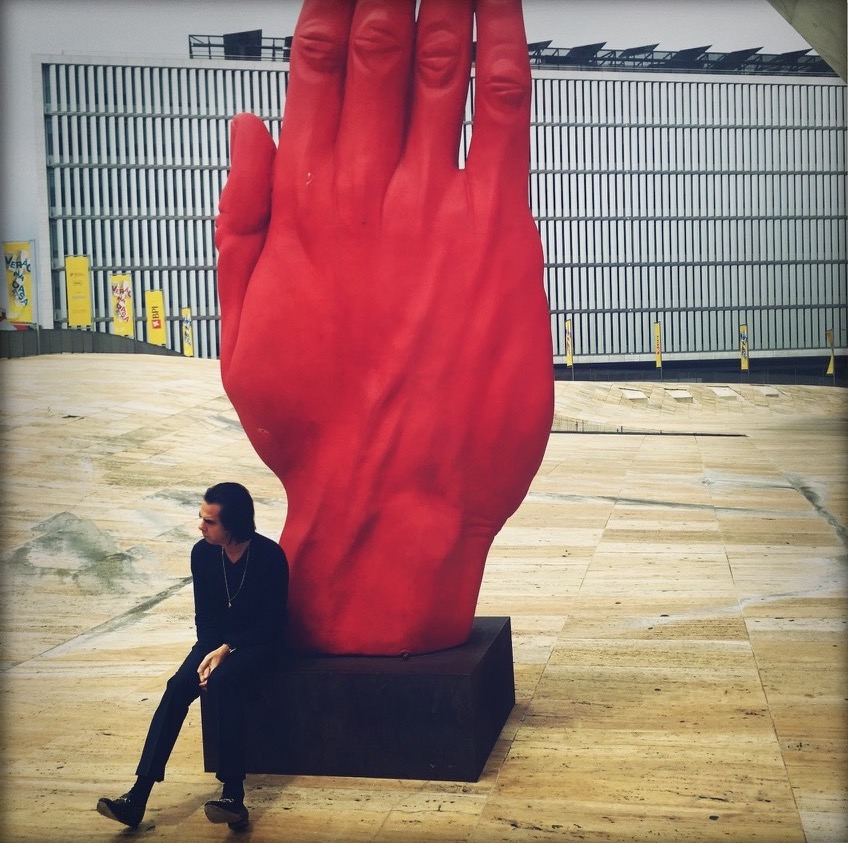
In September of 2018, singer-songwriter Nick Cave began a project called The Red Hand Files, in which he invited fans to write to him. “You can ask me anything,” Cave told them. “There will be no moderator.” A flood of letters ensued, and Cave has now published more than three hundred of them on his website. Many of these messages are deeply personal, confessing private fears, longings, frustrations, and sorrows. Their candor echoes the honesty of Cave’s music, which has long explored the trials and tribulations of the human condition, but it’s also traceable to another source. In July of 2015, after taking LSD, Cave’s fifteen-year-old son, Arthur, fell to his death from a cliff in Brighton, England. Cave’s subsequent journey through despair (an experience documented on his magnificent 2019 album, Ghosteen) inspired his desire for deeper transparency and fellowship with his audience. In this way, shared heartache generated community. Listeners felt safe to share their broken hearts with Cave because they knew that the songwriter’s heart was broken too.
Some of the letters that Cave received were focused on the state of the world. In April of 2022, a listener named Valerio wrote:
Following the last few years I’m feeling empty and more cynical than ever. I’m losing faith in other people, and I’m scared to pass these feelings to my little son. Do you still believe in Us (human beings)?
Cave’s response drew hard-earned wisdom from a deep well of loss:
Dear Valerio,
You are right to be worried about your growing feelings of cynicism and you need to take action to protect yourself and those around you, especially your child. Cynicism is not a neutral position — and although it asks almost nothing of us, it is highly infectious and unbelievably destructive. In my view, it is the most common and easy of evils.
I know this because much of my early life was spent holding the world and the people in it in contempt. It was a position both seductive and indulgent. The truth is, I was young and had no idea what was coming down the line. I lacked the knowledge, the foresight, the self-awareness. I just didn’t know. It took a devastation to teach me the preciousness of life and the essential goodness of people. It took a devastation to reveal the precariousness of the world, of its very soul, to understand that it was crying out for help. It took a devastation to understand the idea of mortal value, and it took a devastation to find hope.
Unlike cynicism, hopefulness is hard-earned, makes demands upon us, and can often feel like the most indefensible and lonely place on Earth. Hopefulness is not a neutral position either. It is adversarial. It is the warrior emotion that can lay waste to cynicism. Each redemptive or loving act, as small as you like, Valerio, such as reading to your little boy, or showing him a thing you love, or singing him a song, or putting on his shoes, keeps the devil down in the hole. It says the world and its inhabitants have value and are worth defending. It says the world is worth believing in. In time, we come to find that it is so.1
Usually, when I compile my annual favorites lists of books, movies, and music, I’m not thinking too much about the state of the world. These lists are an opportunity to revisit works of art that kindled my imagination, to ponder why those projects resonated with me, and to recommend beautiful creations to others. This time, however, is different. 2024 was a hard, hard year, for me personally and for the country I call home. In many ways, society feels more vulnerable than ever, and the same questions that haunted Valerio dog my own steps. When everything around us appears to be falling apart, where can we turn for hope? Should we even be looking for hope in the first place?
Cave’s answer to this question (contained in his response to Valerio) seems to be no, but not for the reasons we might expect. According to Cave, hope isn’t something we look for – a fragile, birdlike feeling that flits away from our grasp. It’s something we do – the action of a warrior bracing herself for battle. Like love and faith, hope is a choice. We tend to view hopefulness as a cheery state of mind, but hope is more like a soldier on the front lines, doggedly contending with forces of decay. It’s a response to desperation, not the absence of it, and thus it’s contingent on continuing hardship. As Reverend Ernst Toller says in the movie First Reformed: “Wisdom is holding two contradictory truths in our mind, simultaneously: hope and despair. A life without despair is a life without hope. Holding these two ideas in our head is life itself.” Hope, this relentless struggle in the cavernous jaws of the world, is most necessary when feelings of hope seem hardest to find.
Hope may be glimpsed in extraordinary feats of heroism, but according to Cage, it’s most often expressed in the mundane (“everyday deeds of ordinary folk that keep the darkness at bay,” as Gandalf the Grey once put it). Simple actions like the tying of a child’s shoes, the singing of a song, or the reading of a bedtime story become deeply significant when viewed as acts of resistance to a looming, ever-present darkness. Our lives, it seems, are only as humdrum as we allow them to be. Here be dragons, and the seemingly innocuous stories that we tell ourselves are brimming with great and perilous import. Author and philosopher G.K. Chesterton captured this idea well when he wrote: “Fairy tales do not tell children the dragons exist. Children already know that dragons exist. Fairy tales tell children the dragons can be killed.”
As I glance over my list of favorite books from 2024, I find that its titles are imbued with hopefulness – that unassuming struggle for goodness that Cave describes. One of them has the word “hope” in its title, and the rest express hope through their quests for truth, their celebrations of beauty, and their visions of human flourishing. Most of these books aren’t new (I’m always playing catch-up when it comes to great literature), but they shone like beacons in a dark and dreary year. I’ve warmed my hands and spirits beside their flames, and I hope that you can too. May you carry their light into the wilderness. May you choose hope.
Honorable Mentions:
– Aurora Leigh by Elizabeth Barrett Browning
– Beowulf by Seamus Heaney
– Night Comes: Death, Imagination, and the Last Things by Dale C. Allison, Jr.
– The Great Agnostic by Susan Jacoby
– Piranesi by Susanna Clarke
– When Stars Are Scattered by Omar Mahmood Mohamed & Victoria Jamieson
– Yes to Life in Spite of Everything by Victor Frankl
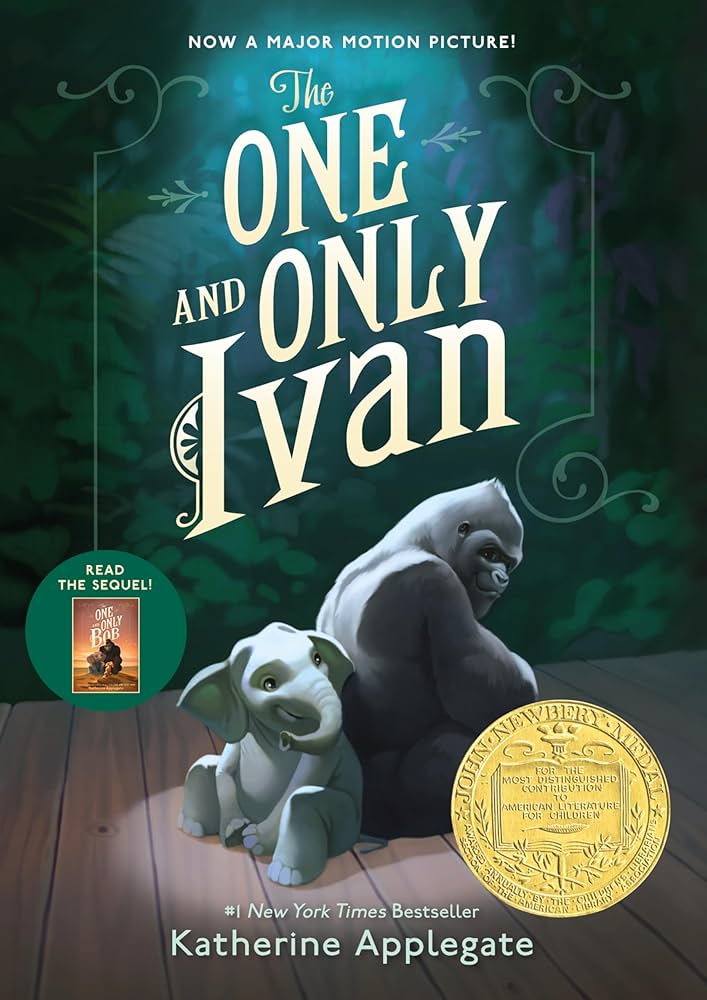
#10: The One and Only Ivan by Katherine Applegate
“It is never too late to be what you might have been.”
This George Eliot quote is the beating heart of The One and Only Ivan, Katherine Applegate’s Newberry Medal-winning tale of an aging silverback gorilla in captivity. Trafficked at a young age and raised by humans, Ivan has almost forgotten life outside the plexiglass boundaries of his domain. He spends his days observing shoppers at the Exit 8 Big Top Mall and Video Arcade, finger painting, and talking with his animal companions, Bob (a dog) and Stella (an elephant). But when a talkative kid elephant shows up at the mall, Ivan is forced to recall things he’d rather forget, to assume responsibilities he would’ve never imagined, and to confront the possibility of a future beyond his walls.
Children’s stories told by animals are a dime a dozen these days, but I’ve never read one that imagines its narrator’s voice so delightfully. Ivan’s sparse, straightforward diction is enchanting, and his offbeat perspective is unforgettable. Based on a real-life gorilla at Zoo Atlanta, Applegate’s story is an exercise in empathy – an invitation to view our world through the eyes of another creature. Animal rights issues and questions about humanity’s relationship to nature are handled in fascinating ways. Apes are my favorite animals, so I’m a little biased, but I found this story heartbreaking and heartwarming in equal measure, and it was the best story that I read aloud to my 5th and 6th grade students last year. No surprise: they loved it too.
#9. The Brothers Karamazov by Fyodor Dostoevsky
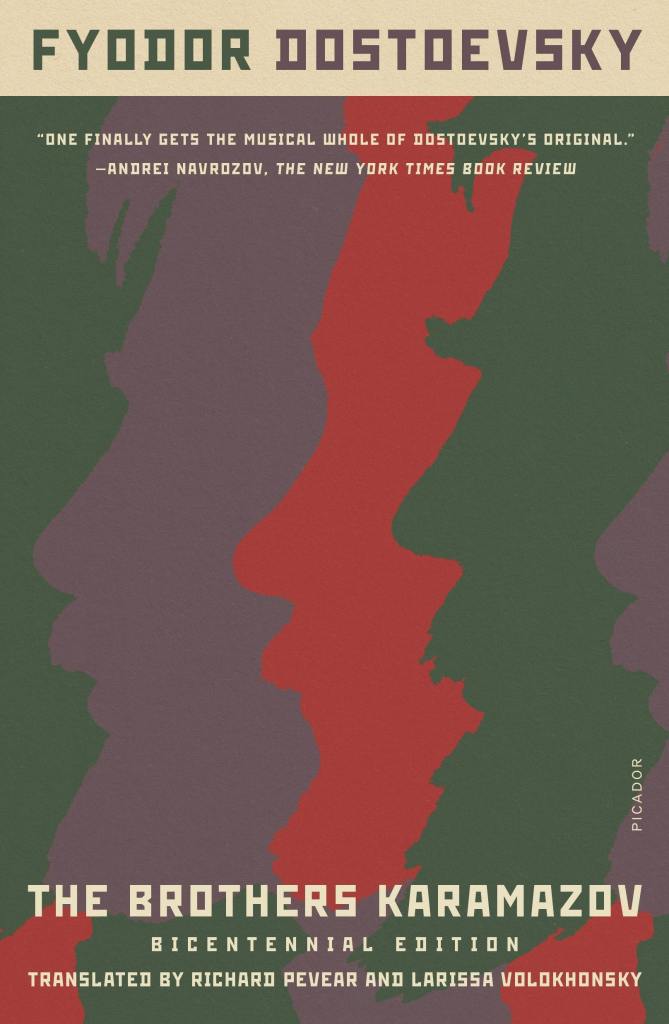
I knew I’d have to get around to this tome eventually, and I’m so glad I did. What can I say about it that hasn’t already been said? It’s a masterpiece. I’d read excerpts quoted in other books and expected philosophical profundity, but I wasn’t prepared for the murder mystery that unfolds throughout the second half of the novel. Here, every detail becomes significant, and Dostoevsky’s mastery of plot is on full display. Even though I knew what had happened to sleazy ol’ Fyodor Pavlovich Karamazov and what the outcome of the trial would be (Dostoevsky tells you beforehand!), I still found myself riveted by the climactic courtroom scene. The social and psychological analysis of Russian culture that the author weaves into the defense attorney’s closing speech was icing on the cake (or gilding on the gavel…?).
Those things said, I can’t help but take issue with Dostoevsky’s portrayal of atheism, which, while certainly compassionate (Ivan Karamazov’s depiction of child suffering is one of the most powerful critiques of God ever posed, and his existentialist monologue about “the sticky leaves that come out in spring” is my favorite passage of the book), also relies on some frustrating and harmful stereotypes that link religious skepticism with madness, lawlessness, and the occult. Alyosha Karamazov might be Dostoevsky’s hero, and I like his earthbound, open-hearted theology a whole lot; but in this brutal, beautiful, and bewildering world of ours, my sympathies lie with Ivan.
On an unrelated note, this book gave me a fascinating new lens with which to appreciate Christopher Nolan’s film The Dark Knight (thanks for the insight, Thug Notes!), and it also inspired my recent essay on Vampire Weekend’s glorious third album, Modern Vampires of the City.
#8: The House of Silk by Anthony Horowitz

ll right, here come the superlatives: Hands-down, this was the best mystery novel I’ve ever read and the best audiobook listening experience I’ve ever had. Whoever convinced Derek Jacobi (one of my favorite Shakespearean actors) to narrate this book deserves a raise. Jacobi’s rich, weathered voice brings out all the music in Anthony Horowitz’s prose, which in turn sounds like it was pulled straight from the foggy, lamplit streets of Victorian London.
Prior to reading The House of Silk, the only Horowitz books that I’d read were the Alex Rider spy novels that I burned through way back in elementary school. I knew he was a prolific murder mystery writer, and I assumed the sheer quantity of his output meant that his stories might be undercooked. Boy, was I wrong. On my wife’s recommendation, I picked up this Sherlock Holmes novel, which Horowitz wrote on special commission from the Sir Arthur Conan Doyle foundation (what a job to receive!). Horowitz pulls off a high-wire act here, simultaneously honoring his character’s legacy and subverting the tropes of Doyle’s stories in some surprising ways. By the book’s mind-bending denouement, when the pieces of the puzzle finally click into place, you know you’re in the hands of a master storyteller.
Hats off to my wife for her excellent taste in books. If you’re looking for a spooky, scintillating autumnal read, you can’t do better than this.
#7: Radical Hope: Ethics in the Face of Cultural Devastation by Jonathan Lear

What a fascinating read! This book is my favorite kind of case study: multidisciplinary, culturally informed, and vividly written. Combining historical and anthropological data with philosophical and psychological analysis, Lear’s examination of the Crow tribe ponders how a people group might recover and move forward from a cultural collapse. The solution that he explores – “radical hope” – is exemplified in the remarkable actions of the last Crow chief, Plenty Coups, as well as his followers.
I do wish that Lear’s analysis was more connected with modern events, and I kept wishing he would generalize more from his findings or recommend how modern people might embody radical hope. Some of his argumentation was also a bit tricky to follow for this amateur philosopher. Yet it’s a stirring account of optimism in grim circumstances, one that I’ll be thinking about for a long time. I wasn’t expecting Plenty Coup’s struggle to resonate so deeply with my experience of leaving religion – that bewildering and terrifying dissolution of categories for making sense of the world. If you’re looking for a thought-provoking, unconventional read, then I heartily recommend this book.
Shout-out to my friend Ethan for the great recommendation!
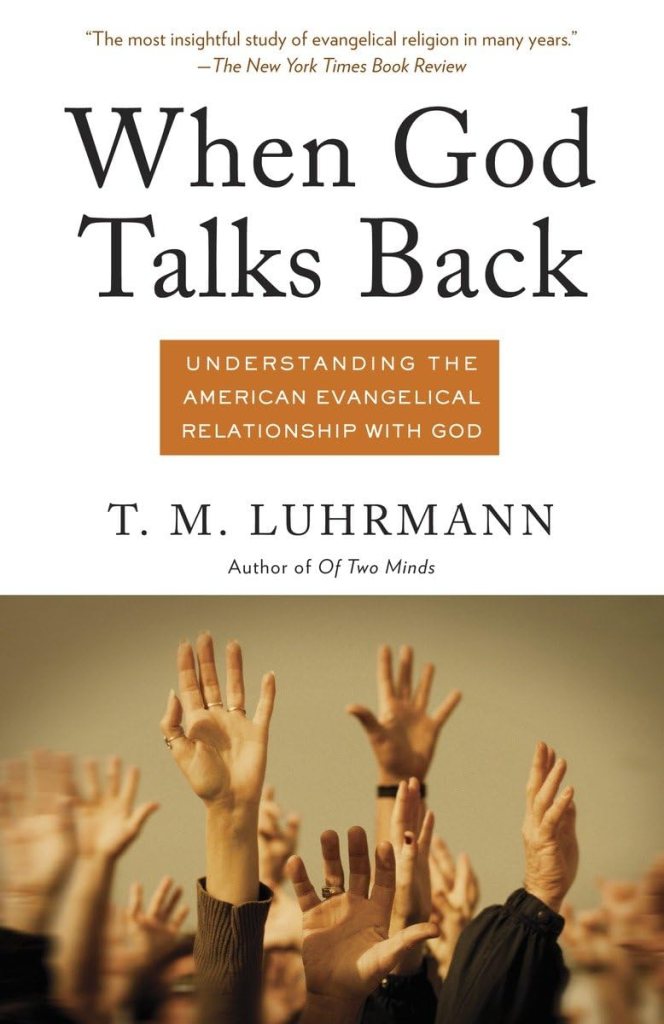
#6: When God Talks Back by Tanya Luhrmann
When I switched my major from English to anthropology during my sophomore year of college, I was drawn to the discipline’s emphasis on empathy. Using field notes, interviews, culture theory, and participant observation, anthropologists attempt to immerse themselves as fully as possible in the lived experience of the “other,” seeking first and foremost to understand. Over time, I fell in love with this approach and came to see it as a tool for empowering marginalized communities. But I never had the anthropologist’s gaze trained on me – on my community. Until now. And wow, is it a surreal experience!
Tanya Luhrmann introduces her in-depth study of American evangelicalism with something she calls “the problem of presence”: How is it that religious believers come to experience a God who cannot be seen, heard, or felt as a real, living relationship? The rest of her book explores her answers to that question. Lurhmann’s writing is erudite yet approachable, and her dedication to understanding her subjects is remarkable. She argues that her findings are compatible with both Christian and skeptical worldviews (in other words, they don’t prove or disprove the existence of the supernatural), and she’s eager to help both audiences see each other accurately – for skeptics to grasp how Christians can believe the things they do, and for Christians to grasp why skeptics might find their beliefs so incomprehensible.
As someone who left religious faith very recently, I’m still wrestling with lots of difficult questions about my many years in the church: Was any of it real? How could I have believed so ardently in realities that I now think are nonexistent? What do I make of “miraculous” occurrences, or experiences where God’s presence and voice felt undeniable? Luhrmann’s outsider perspective enabled me to see the community that raised me with fresh eyes, to reexamine the foundations of my former faith. This book is essential reading for believers and skeptics alike. I can’t recommend it highly enough.
#5. Autumn by Karl Ove Knausgaard
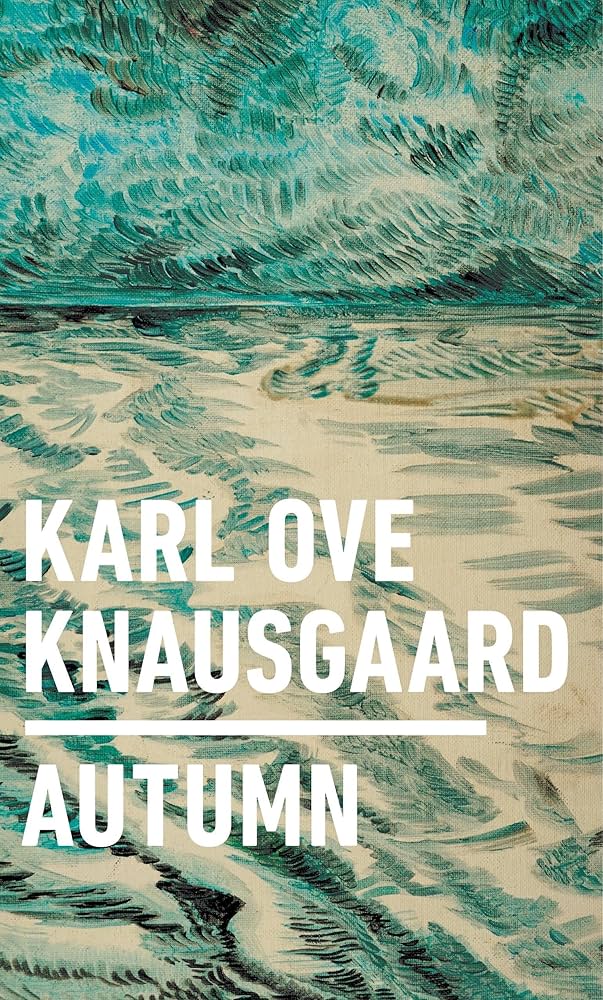
This is my favorite kind of writing: patient, wide-eyed, and heartfelt, concerned with ultimate questions yet rooted in the everyday. Framed as a series of letters to an unborn daughter, Autumn is really an exercise in paying attention. In chapter one, Knausgaard writes: “These astounding things, which you will soon encounter and see for yourself, are so easy to lose sight of, and there are almost as many ways of doing that as there are people. That is why I am writing this book for you. I want to show you the world, as it is, all around us, all the time. Only by doing so will I myself be able to glimpse it.”
Nestled between monthly letters are reflections on a host of mundane topics: apples, teeth, plastic bags, chewing gum, frogs, churches, blood, jellyfish, eyes, toilets, lightning, thermos flasks, forgiveness, and much more. These meditations are more akin to prose poems than traditional chapters. Again and again, Knausgaard pulls profound insights from the seemingly ordinary, offering stunning passages like this one: “For darkness is the rule and light its exception, as death is the rule and life its exception. Light and life are anomalies, the dawn is their continual affirmation.”
#4: Star Child by Claire Nivola

“Over the years you will try to make sense of that happy, sad, full, empty, always-shifting life you are in. And when the time comes to return to your star, it may be hard to say goodbye to that strangely beautiful world. Think well, then, before you go.”
So say the elders to the Star Child, a “flame of vapor, invisible and timeless” who longs to experience life on planet Earth. And so begins one of the most achingly beautiful love letters to the world ever written, cleverly disguised as a children’s book (but really meant for adults). The story is a simple one, but watch out. If you’re anything like me, you may find yourself plunged into a state of existential reflection, tears streaming down your face by the time you reach those bittersweet final pages.
Like many people, I first encountered Star Child through the trailer of Mike Mills’ gorgeous 2021 film C’mon C’mon, where a weary Joaquin Phoenix cries while reading the book to his nephew at bedtime. Unfathomably (it should already be a classic by now), the book is nigh impossible to find, either cheaply for purchase on Amazon or at local libraries (those near me, anyway). However, you can watch it read aloud on YouTube. The book’s power is as much a product of its illustrations as its words – those whimsical watercolor paintings, effortlessly childlike and vibrant as life itself. Come to think of it, that last phrase sums the book up pretty darn well…
It’s $50 on Amazon, but if you bought it on a whim, that’d be money well spent.
#3: My Struggle: Book 1 by Karl Ove Knausgaard
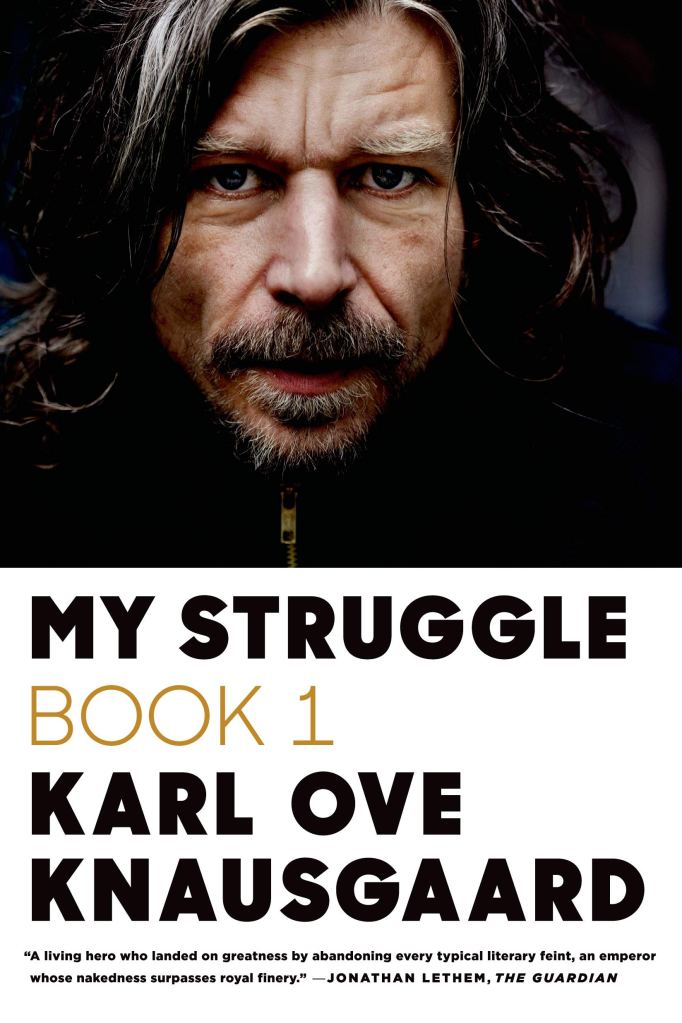
It was difficult to give this book a star rating, because it’s like nothing else I’ve ever read before. Many of my favorite stories are about finding beauty in the mundane: Marilynn Robinson’s Gilead, Herman Melville’s Moby Dick, Wendell Berry’s Jayber Crow, Amor Towles’ A Gentleman in Moscow, and Leif Enger’s Virgil Wander, to name a few. Yet, I’ve never read a book that so accurately captures the feeling of the mundane, with all its repetition and banality and transience, as the first volume of Karl Ove Knausgaard’s whopping 3,600-page memoir, My Struggle. Reading it, you get the sense that you’re not merely listening to a tale, but witnessing life as it’s lived.
It takes some getting used to. Listening to conversations between Knausgaard and his friends and family, you begin to realize just how curated most literary dialogue is. The story rambles forward without chapter breaks, skipping back and forth between past and present. Rather than forcing his narrative into a familiar structure, Knausgaard allows his mind to roam where it will, inviting readers into all his fragmentary impressions, nagging insecurities, and wistful meditations. In doing so, he challenges our notion of what counts as literature. My Struggle is a bold experiment: an attempt to craft a literary epic from the unremittingly ordinary.
Does it work? You’ll have to decide for yourself. This book isn’t for everybody, and I’d be lying if I said that much of Knausgaard’s tale didn’t leave me longing for something more – more drama, more order, more insight into the meaning of various experiences. Yet, doesn’t my own life do the same? Do I read books to escape my life, or to see it with new eyes? If my goal is the latter, then Knausgaard’s book is a worthy companion for the journey. His relentless attention to life’s ebb and flow might bore you to tears, but it also unveils moments of startling, transcendent beauty. The fact that I enjoyed the book from start to finish, coupled with the fact that I’m seriously considering reading the rest of this behemoth (!), means Knausgaard must have done something right.
Plus, I learned lots of interesting stuff about Norway! So that was cool.
#2: I Cheerfully Refuse by Leif Enger
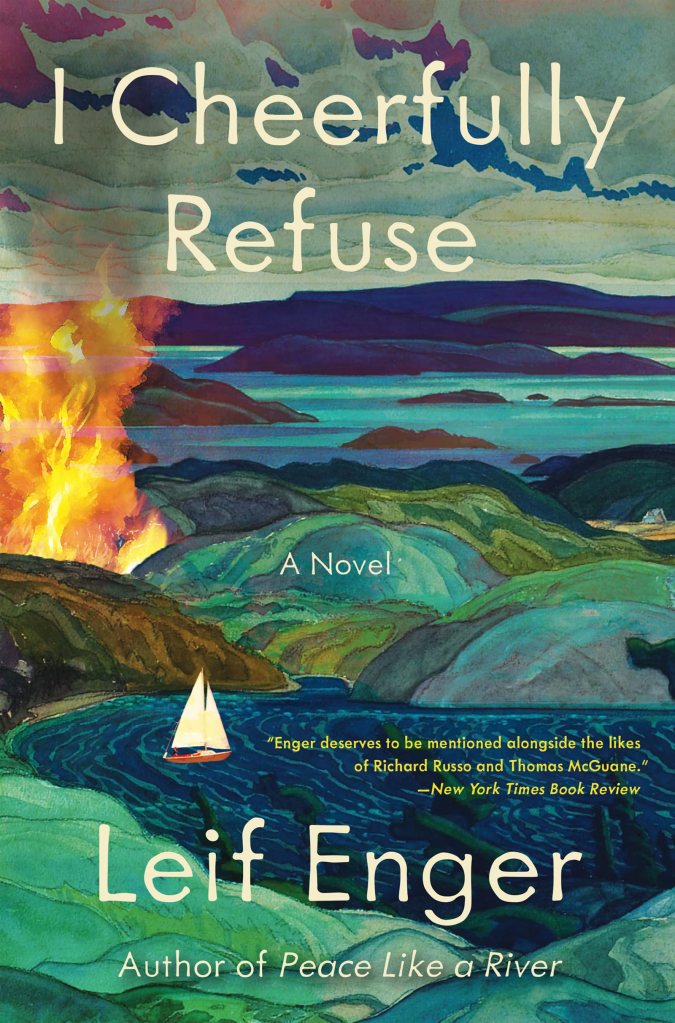
How on earth is this not my #1 book of the year?
When times get dark, we turn to those we trust for comfort. And if there’s any author I’d trust enough to follow anywhere, it’s Leif Enger.
I didn’t plan on reading I Cheerfully Refuse around election time, but I’m so grateful that the stars aligned just so. Again and again, Enger’s novels have met me when I needed them, reviving my flagging spirits. He’s my favorite author, and I’ve read each of his previous novels twice, so beginning this new tale felt like greeting an old friend long missed. So much was familiar: the Midwestern setting with its frigid winds and storm-tossed lakes; the cast of quirky and achingly human characters; the bemused, elfin humor; the breathless reverence for the mundane; and that miraculous prose, that relentless revelry in language that makes you want to laugh aloud from sheer joy (or am I the only one?). But for all its familiarity, this novel was strange and unsettling in ways I hadn’t anticipated.
While Enger has never shied away from grappling with the cost of redemption, “I Cheerfully Refuse” is darker and weightier than anything he’s written before. Not since Cormac McCarthy’s The Road have I read such a grim vision of apocalypse (“terrifyingly prophetic,” a critic announces from the book jacket, and that hits the nail on its head). And while the world McCarthy describes is far bleaker, Enger’s feels more visceral for its nearness. It’s not hard to imagine ourselves in this foundering and splintered version of America, if the sinister trends we see around us every day continue unabated.
Enger’s novels may shine with irrepressible affection for life, but the hope that their characters pursue has always been hard-won. Here, that hope is tested to its breaking point. Enger offers no easy outs, no quick fixes, no guarantee that Rainy’s battered ship will stay afloat. And that’s what I needed, at this time of all times – not optimism (I’m much too tired for that) but a companion brave enough to walk the tightrope over despair with me and see if, in spite of everything, it just might hold.
No spoiler alerts here; I don’t want to give you any sense of where this one ends up. The journey’s too wild and wondrous for that, and you’ll have to decide whether it’s a risk worth taking. Suffice it to say, it’s my favorite read of the year and a new masterpiece for our perilous moment in time, one that I’d like to put in the hands of everyone everywhere.
P.S. There’s also a heroic scene with grapefruit, and I think my life may now be complete.
And now, in a stunning and unprecedented turn of events… A TWO-WAY TIE FOR FIRST PLACE! (Wait a second… did he just sneak 11 titles into his top 10 list?)
First #1: Life of Pi by Yann Martel

In the spirit of Life of Pi, let me begin this review with a story.
It was June of 2017, and I was on a Qatar Airways flight bound for Southeast Asia. I was a senior in college and had accepted a six-month internship with a missionary organization there. Seated next to me was a Muslim woman from Kenya. During the flight, she pulled out her paperback copy of the Quran and began trying to convert me to Islam. The tactic was a familiar one: as an American Christian, I was well-versed in the delicate art of airplane evangelism. I listened attentively to her case, fumbling over the words of the shahadah (confession of faith) that she urged me to repeat: There is no God but Allah, and Muhammad is his prophet. “There,” she smiled. “Now you are a Muslim!”
Besides my unwitting conversion to Islam, this interaction was memorable for several reasons. I was going to live with Muslims for the next half-year, but I’d never met one before. Most of what I’d heard about Muslims from fellow evangelicals and American news media was negative, but this woman was funny and kind. I was also amazed by how many of the woman’s stories I knew: tales of Adam and Eve, Noah, Joseph, Moses, Joshua, and Jesus. When she’d finished talking, I made an effort to explain Christianity to her, but I couldn’t shake my surprise at how much we held in common.
The missionary organization that I worked with had a retreat center – a small building where team members rested once a week. We were living in a metropolitan slum, laboring alongside impoverished trash-pickers, and time away from these harsh realities was welcome. It was at this building one afternoon that I found a copy of Yann Martel’s Life of Pi. I remembered watching the movie in high school and being simultaneously awed and unsettled. Pi, the film’s shipwrecked protagonist, practiced a unique blend of Hinduism, Christianity, and Islam. I’d come to Indonesia to share Jesus with non-Christians, so I wasn’t keen to revisit Pi’s strange, salad-bowl spirituality. I did crack open the novel, though, and encountered one of the most beautiful descriptions of the suffering Christ I’d ever read. As far as I knew, Martel wasn’t a Christian, so how could he write about Christ this way?
Looking back on that time, I can see that I wasn’t ready for Life of Pi. I had come to Southeast Asia to help people, but I also hoped to change their minds; I wasn’t looking to have my own worldview changed. Over the next six months, as I shared the joys and hardships of slum life with my Muslim neighbors and listened to their stories, my faith was challenged and altered in unexpected ways. Again and again, like the enormous, ever-shifting ocean that sweeps Pi and his tiger companion along, life burst the boundaries I’d constructed for it. Many Christians, including myself, took issue with Life of Pi because they believed it encouraged religious syncretism: “All faiths are the same!” That isn’t the case. Pi’s bizarre form of faith isn’t prescriptive; it’s an expression of a personality marked by irrepressible curiosity, wonder, and lust for life – what G.K. Chesterton called “a sense of eccentric privilege.” Life of Pi is, first and foremost, an invitation to broaden our view of the world – to open ourselves up to mystery and to glimpse, as Pi does, life in all its vivid, savage, indescribable glory.
On its surface, this book shouldn’t work. A first-person account from an Indian boy that’s told by a white Canadian, a coming-of-age tale that’s also a seafaring survival epic, a story within a story that mingles theology with psychology and zoology? Come on. Like the writer whose interview notes are scattered throughout the book, you might be tempted to dismiss Pi’s story as an impossibility, until you hear it. Not since Moby Dick have I encountered a book that spans so many genres and topics successfully. Like Melville’s masterpiece, Life of Pi ponders the diverse creatures that share our watery planet, and it also explores the stories we tell (religious and otherwise) to make sense of life’s complexity and uncertainty. Finally, like Melville’s miraculous prose, Martel’s narration sparkles with a heaping dose of good-hearted humor.
One of the marks of Life of Pi’s greatness is the amount of discussion it has generated since its publication. What do we make of that mysterious island? How do we interpret that haunting, wondrous, befuddling ending? What can we believe, or should we believe, about Pi’s story? After digging into some analysis of the story’s themes, motifs, and allusions, I can tell you that this novel rewards contemplation (the names of characters, animals, places, and boats offer a particularly fascinating rabbit hole).
Near the beginning of the book, Martel’s stand-in writer hears that Pi’s story will make him believe in God. Life of Pi is at once a thoughtful interrogation of faith and a beautiful argument for it. I’ve abandoned the religion that I once carried to Southeast Asia. Pi’s shipwreck may have strengthened his belief in God, but my recent crisis of faith led me to atheism. I still mourn the loss of my religious heritage and convictions. Yet, as I navigate the aftermath of that storm, grasping for what flotsam I can, I find Martel’s eccentric, wide-eyed protagonist to be a kindred spirit. We might disagree on a host of topics, but I know that Pi would hear my story with a twinkle in his eye (at the very least, he’d be grateful that I don’t call myself an agnostic!), and I think he’d respond with something like this quote by Frederick Buechner: “Here is the world. Beautiful and terrible things will happen. Don’t be afraid.”
Now I need to revisit that movie adaptation again.
Second #1: This Life: Secular Faith and Spiritual Freedom by Martin Hägglund
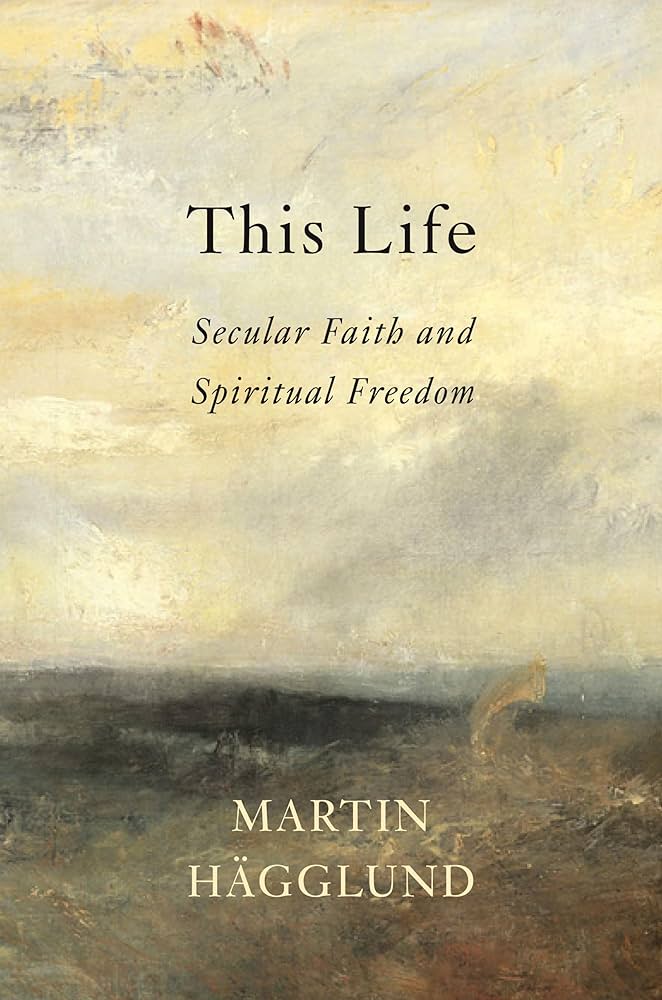
Hands down the best book of philosophy I’ve ever read, and one of the most inspiring reading experiences I’ve ever had, too. There’s so much I could say about it… where to start?
The most remarkable thing about the book, I think, is its seamlessness. In a little less than 400 pages, Hägglund attempts to prove that human finitude is the source of all true meaning, purpose, morality, and freedom. Along the way, he weaves philosophical exploration with theological reflection, social and economic analysis, and literary critique. He engages with Augustine and Kierkegaard and C.S. Lewis, Marx and Hegel and MLK, Mill and Keynes and Hayek. Yet, incredibly, it all hangs together. Hägglund’s reflections on mortality and his critiques of religious faith flow beautifully into his devastating takedown of capitalism. The book is erudite yet readable, incisive yet heartfelt. I began reading quickly and eventually slowed down and doubled back to take notes, which I’m so glad I did. There’s just so much to take in, in the very best of ways, and I know I’ll be revisiting it often as the years pass.
Some may argue that Hägglund’s writing style is unnecessarily repetitive, which is a valid criticism. Yet I was grateful for the author’s restatement of key points, which helped me grasp his arguments much better. Hägglund is a college professor, and his teacher’s heart really comes through here. So many books written by brilliant people hold you at arm’s length, but this one invites you in, eager to unfold itself to you.
I was predisposed to enjoy This Life, since it explores questions I’ve been mulling over for years: How can we love the world we inhabit when it is so deeply riven by suffering? Can religious faith be reconciled with genuine care and concern for mortal life? Can our current economic systems ever deliver on promises of justice and equality? (I resonated deeply with Marx when I read him in college, but I still had lingering misconceptions about his teachings; after digesting Hägglund’s in-depth analysis of Marx’s work, I’m pretty sold on socialism). Hägglund contends that there are answers to these questions – serious, sobering, and ultimately liberating answers that point us toward the world we dream about but can scarcely bring ourselves to hope for. That world feels a long way off, but who knows? With books like these to guide us, we might just find our way there.
Coming Soon: My top 10 favorite movies of 2024!
References:
1. “Issue #190.” The Red Hand Files, April 2022. https://www.theredhandfiles.com/do-you-still-believe-in-us/

