You Don’t Want to Live Forever. Here’s Why.

It might be the greatest pickup line of all time. 

For twenty minutes, two young adults have been talking on a train. She’s French and he’s American. They met by happenstance, after the German couple in front of them began loudly bickering and a move to a quieter car became necessary. But now they’ve covered travel, literature, family, childhood, death, loneliness, and belonging, and the conversation shows no signs of slowing down. Which is a problem, because the train itself has come to a screeching halt in Vienna, where he’s supposed to catch a flight while she continues on to Paris. The young man knows that he’s got to act fast, so he invites her to get off the train with him, suggesting that they spend a day exploring Vienna together. After awkwardly reassuring her that he isn’t a “psycho,” he unfurls an elevator pitch for the ages:

Alright, alright. Think of it like this. Jump ahead, ten, twenty years, okay, and you’re married. Only your marriage doesn’t have that same energy that it used to have, you know? You start to blame your husband. You start to think about all those guys you’ve met in your life and what might have happened if you’d picked up with one of them, right? Well, I’m one of those guys! That’s me, you know. So think of this as time travel, from then to now, to find out what you’re missing out on. See, what this really could be is a gigantic favor to both you and your future husband to find out that you’re not missing out on anything. I’m just as big a loser as he is, totally unmotivated, totally boring, and, uh, you made the right choice, and you’re really happy.

A bold move if ever there was one. He waits, wide-eyed, for a reply. Did he blow it? She smiles bashfully, considers, then says, “Let me get my bag.” And so begins one of the greatest romances in cinematic history. 

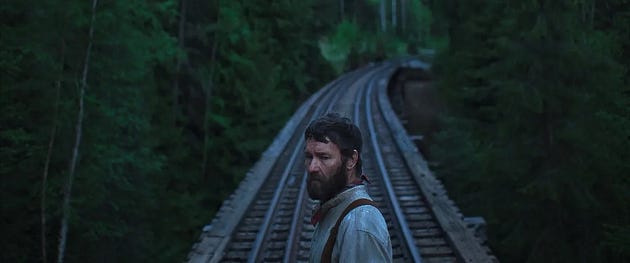
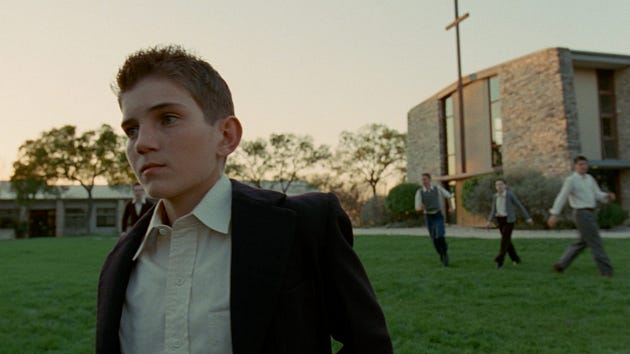
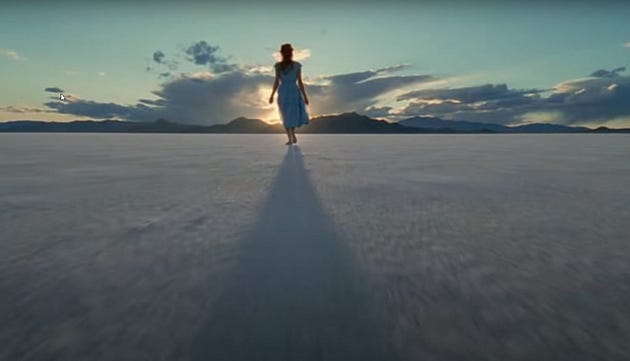
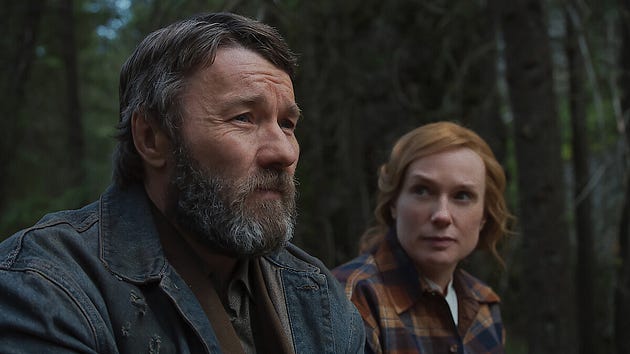
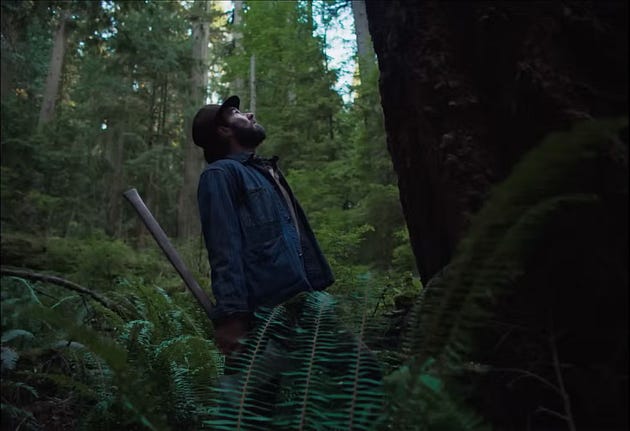
As many of you know, I’m referring to Jesse (played by Ethan Hawke) and Celine (played by Julie Delpy) in Richard Linklater’s 1995 film Before Sunrise. If you haven’t seen the film, then you might imagine that Jesse’s time-travel speech is a one-off… and a pretty weird one, at that. However, Linklater’s story is steeped in references to the passing of time. There’s the opening shot of train tracks receding into the distance; Jesse and Celine’s rambling discussions of youth and memory and growing old; the Friedhof der Namenlosen (“Cemetery of the Nameless”) where the two lovers pause to examine a child’s grave; a wrinkled fortune-teller who calls them both “stardust”; an exhibit by the painter Georges Seurat, in which mournful figures seem to dissipate into the background like ghosts; and Dylan Thomas’ poem “As I Walked Out One Evening,” which Jesse quotes late in the film and which contains the ominous refrain: “O let not Time deceive you, / You cannot conquer Time.” We know that Jesse has to catch a flight home the following morning. So, from the start of his impromptu adventure with Celine, we’re conscious of the fact that the clock is ticking. 

Image from “Before Sunrise” by Richard Linklater.

Back in March, my wife and I traveled to Chicago’s Music Box Theatre (by train, of course) to see Before Sunrise on the final day of Filmspotting Fest. It was a very special experience for us. Like the movie, I was turning thirty —  pondering my own circuitous journey through spacetime — and we’d both grown up in Europe, visiting cities like Budapest and Vienna on weekends. Since I can’t help but over-analyze great art, the film also got me thinking about the concept of eternal life — that holy grail of religions across the globe — and why, after seeking it for most of my life, I no longer want it. 

I never fretted about death prior to my twenty-seventh birthday, when I abandoned the Christian faith of my upbringing. The Baptist churches that raised me had done their job far too well for that. After listening to dozens of sermons on Paul’s mockery of mortality in 1 Corinthians 15:55— “Where, O death, is your victory? Where, O death, is your sting?” — and singing countless hymns about heavenly glories to come, I was fully convinced that I’d survive my final breath. Jesus’ crucifixion, and the atonement for sins that accompanied it, had rendered my own demise irrelevant. No, what worried me was boredom and missed opportunity. I knew the idea of praising God endlessly was supposed to thrill me, but it didn’t (Believe it or not, those verses in Revelation about the “four living creatures,” with their six wings and eyes all over their bodies, who chant “Holy, holy, holy” day and night, night and day, without ever taking bathroom breaks… didn’t do it for me, either). Earthly life itself was more inviting. At church, where we studied the apocalyptic trials that would soon befall humanity, I dreamed of playing soccer and writing novels and traveling to China. I found myself resonating with the second verse of Noah Gundersen’s song “Jesus, Jesus”: 

Jesus, Jesus, it’s such a pretty place we live in
And I know we fucked it up, but please be kind
Don’t let us go out like the dinosaurs
Or blown to bits in a third World War
There are a hundred different things I’d still like to do
I’d like to climb to the top of the Eiffel Tower
Look up from the ground at a meteor shower
And maybe even raise a family

According to Jesus, there wouldn’t be any marriage in heaven (Matthew 22:30), and gosh-darn it, I really, really wanted to get married. Thus, I joined the ranks of believers who pray “Even so, come, Lord Jesus” while secretly hoping the end isn’t as nigh as their pastors claim. 

Then, in college, I discovered N.T. Wright.

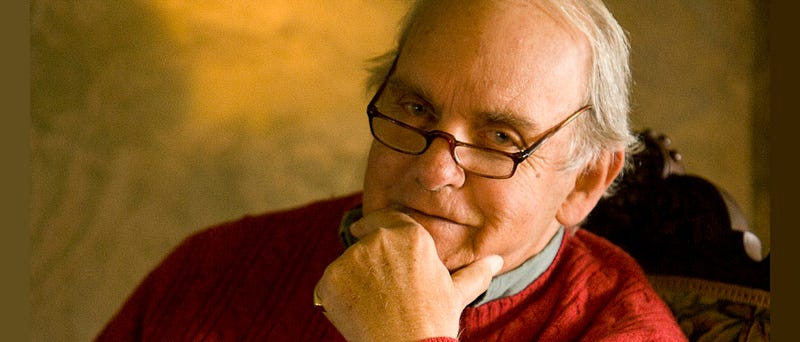
N.T. Wright. Image from BreakPoint.

Looking back, I can see that some of Wright’s appeal for me was rooted in his mellifluous British accent, but that was just icing on the cake. He’s an English theologian, New Testament scholar, and former bishop who has challenged many traditional Christian assumptions about the world to come. According to him, God’s future paradise won’t be the disembodied and cloud-filled “heaven” where many believers expect their souls to end up; rather, it’ll be a “new heaven and new earth” — a continuation and enhancement of our current physical life, purged of all sin and sorrow and death (Revelation 21:1- 4). Our life on Earth matters, Wright says, because everything that we do for Christ will, in some mysterious way, find its way into God’s New Jerusalem. He expounds this idea in Surprised by Hope: 

The point of the resurrection… is that the present bodily life is not valueless just because it will die… What you do in the present — by painting, preaching, singing, sewing, praying, teaching, building hospitals, digging wells, campaigning for justice, writing poems, caring for the needy, loving your neighbor as yourself — will last into God’s future. These activities are not simply ways of making the present life a little less beastly, a little more bearable, until the day when we leave it behind altogether… They are part of what we may call building for God’s kingdom.

Wright’s writings (sorry, no pun intended) made Christianity’s vision of the afterlife attractive again. This world, only better? I could get behind that. It certainly sounds wonderful — an eternal adventure in a utopian cityscape. We might imagine Jesse and Celine in Before Sunrise, chatting excitedly and roving through the lamplit streets of Vienna on an evening that never ends. Yet I must admit that the more I consider this possibility, the less it appeals to me. In fact, I now believe that the Bible’s ideal of redeemed creation would rob life of everything that makes it worth living. And I got this idea from a Swedish philosopher whose accent is almost as cool as Wright’s. 

Martin Hägglund. Image from The Politic.

Throughout his provocatively titled book This Life: Secular Faith and Spiritual Freedom, Martin Hägglund builds a case that the religious notion of eternal life is inherently undesirable. He begins by critiquing the idea that our mortality is a problem to be fixed. “To be religious,” he writes, “is to regard our finitude as a lack, an illusion, or a fallen state of being.” Hägglund understands the appeal of this view: “The thought of my own death, and the death of everything I love, is utterly painful. I do not want to die, since I want to sustain my life and the life of what I love.Nevertheless, he claims that an endless existence would eliminate our impetus to care for the people, places, and projects around us, since our drive to sustain these things in the here and now depends upon a recognition of their finitude:

An eternal life is not only unattainable but also undesirable, since it would eliminate the care and passion that animate my life. This problem can be traced even within religious traditions that espouse faith in eternal life. An article in U.S. Catholic asks: “Heaven: Will it be Boring?” The article answers no, for in heaven souls are called “not to eternal rest but to eternal activity — eternal social concern.” Yet this answer only underlines the problem, since there is nothing to be concerned about in heaven. Concern presupposes that something can go wrong or can be lost; otherwise we would not care… The problem is not that an eternal activity would be “boring” but that it would be unintelligible as my activity. 

The Catholic article cited by Hägglund echoes my own childhood fears that heaven would rob life of its momentum and variety. Yet you might find yourself asking: “Hold on… Why would eternal activity done for the good of redeemed humanity be nonsensical? Why assume that my care for family and friends depends on their vulnerability to death?” Hägglund elaborates:

Far from making my life meaningful, eternity would make it meaningless, since my actions would have no purpose. What I do and what I love can matter to me only because I understand myself as mortal… The question of what I ought to do with my life — a question that is at issue in everything I do — presupposes that I understand my time to be finite… If I believed that my life would last forever, I could never take my life to be at stake and I would never be seized by the need to do anything with my time. I would not even be able to understand what it means to do something sooner rather than later in my life, since I would have no sense of a finite lifetime that gives urgency to any project or activity. 

The sense of my own irreplaceable life, then, is inseparable from my sense that it will end. When I return to the same landscape every summer, part of what makes it so poignant is that I may never see it again. Moreover, I care for the preservation of the landscape because I am aware that even the duration of the natural environment is not guaranteed. Likewise, my devotion to the ones I love is inseparable from the sense that they cannot be taken for granted. My time with family and friends is precious because we have to make the most of it. Our time together is illuminated by the sense that it will not last forever and we need to take care of one another because our lives are fragile. 

Hägglund’s argument draws its power from experience. Why do you till your garden, undertake projects at work, play with your kids, repair your house, or deliver casserole to an ailing neighbor? It’s because you realize, consciously or unconsciously, that these things will collapse or become unwell without your intervention. If you neglect these tasks, then the plants in your garden will wither, your job will be lost, your kids will feel resentful, your house will fall apart, and your ailing neighbor will suffer alone… with no casserole. The fragility of these things — their susceptibility to decay — is what motivates you to nurture them in the first place, just as your knowledge that spring flowers and autumn leaves won’t last inspires you to turn off your TV, get off your couch, and savor each passing season. 

Image by Matt from Unsplash.

Likewise, our decision to embark on romantic relationships is animated by the risks that accompany them — the breathless uncertainty as to whether our affections will be reciprocated. Anyone who has ever psyched themself up to ask out their crush knows that the world-expanding thrill of a “Yes” depends upon the world-crumbling prospect of a “No”:

The risk of being shattered is not a weakness to be overcome but remains in the fulfillment of love itself. The possibility of being touched is inseparable from the peril of being wounded and the exposure to loss is part of the experience of rapture.

These considerations stem from the nature of life itself. Hägglund reminds us that all living organisms are “characterized by self-maintenance. A living being cannot simply exist but must sustain and reproduce itself through its own activity.” The ever-present possibility of breakdown and death is what keeps our hearts and our brains, our nervous and digestive systems, pumping along in the first place. If the looming specter of our mortality was removed, then these organs would serve no purpose (Except, perhaps, for our spleens… Do any of us really know what those things do?). Building on these points, Hägglund states his thesis in the strongest possible terms:

A religious redemption from loss… is not a solution to any of our problems. Rather than making our dreams come true, it would obliterate who we are. To be invulnerable to grief is not to be consummated; it is to be deprived of the capacity to care. And to rest in peace is not to be fulfilled; it is to be dead.

With these considerations in mind, let’s revisit N.T. Wright’s words from Surprised by Hope, quoted above. Wright suggests that our present life would be “valueless” if it ended at the grave, since it only matters “because God has a great future in store for it.” This perspective is profoundly utilitarian. It treats all our earthly joys, strivings, and heartbreaks as means to an end — as setup for an infinite party that will, ultimately, eclipse them like sparks thrown out by the sun — rather than as realities meaningful in and of themselves. In sharp contrast, Hägglund maintains that the grave itself is what imbues our present with significance. Against the backdrop of the void, each moment of wonder that we experience is incalculably precious — a miracle, to borrow religious language, that’s worth cherishing for its own sake. I think Hägglund would agree with the Sorcerer Supreme (played by Tilda Swinton) in Marvel’s Doctor Strange, when she gazes at falling snow through a hospital window and intones that “Death is what gives life meaning. To know your days are numbered, your time is short.”

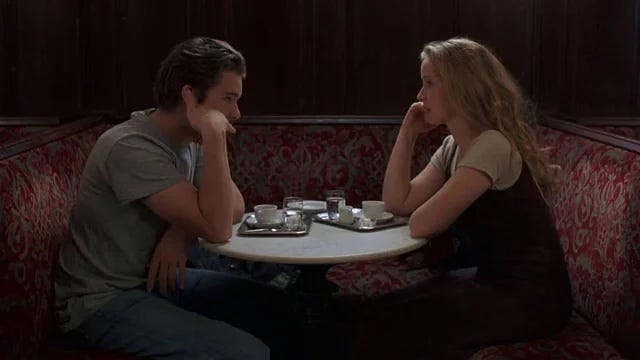
Hägglund’s philosophy illuminates a big part of what makes Before Sunrise resonate with audiences, even after thirty years. Midway through the film, Jesse says to Celine: “I feel like this is some dream world we’re in, you know?” She replies: “Yeah, it’s so weird. It’s like our time together is just ours. It’s our own creation.” Instead of sucking the joy out of their Vienna experience, the time constraint imposed upon the couple’s adventure has transfigured it, lending it a vivid, almost mystical shine. The time they spend together isn’t valuable because it foreshadows some grand finale, some distant hereafter. It’s valuable because it’s their time — here and now. 

Image from “Before Sunrise” by Richard Linklater.

Later, at a dinner table, Jesse describes a friend of his who, on witnessing the birth of his first child, couldn’t stop thinking that this newborn would die someday. “Everything is so finite,” he concludes. “But don’t you think that’s what makes our time and specific moments so important?” In response, Celine says softly: “Yeah, I know. It’s the same for us tonight, though. After tomorrow morning, we’re probably never going to see each other again, right?” With those words, the conversation shifts. We watch as both characters reckon with the scarcity of their remaining hours, as they ponder the possibility of exchanging phone numbers or traveling to see each other overseas. Celine’s question isn’t just about their time in Vienna; it’s just as applicable to our brief existence on planet Earth. Why throw our whole selves — our beating hearts and fragile bodies — into something that won’t last? If one night isn’t enough, then what about one life? 

After a long pause, Jesse looks up. Candlelight and shadow bleed together and flicker across his face. “Well, all right,” he says. “Let’s do it. No delusions, no projections. We’ll just make tonight great.” A band begins playing music as he reaches for Celine’s hand. She hesitates: “It’s just — it’s depressing, no? Now that the only thing we’re going to think of is that we have to say goodbye tomorrow.” Jesse thinks for a moment, then suggests that they both say goodbye now. “That way,” he explains, “we won’t have to worry about it in the morning.” So they do.

“Goodbye.”

“Goodbye.”

Au revoir.

“Later.”

Watching Jesse and Celine as they clasp hands and gaze silently into each other’s eyes, I consider the wonders that I’ve said farewell to over the years — the people, landscapes, memories, and past versions of myself. Time takes a heavy toll. Yet the ticking clock that made Jesse invite Celine into Vienna (How could he have done so if their train never stopped moving?), and that made them savor each step of their pilgrimage, is the same clock that compelled me to step onto a train to Chicago, to experience a film festival and a film anniversary that would only happen once, and — four years earlier, almost to the day — to ask out the woman who accompanied me on that train. Staring at the clock on my apartment wall now, I recall the closing stanzas of Ben Shive’s song “Wear Your Wedding Dress,” which sensitized my soul to the aching, transient beauty of a single day, back when I was still a Christian and believed my days would never end.

Time is short
And we both know it is
Today may be my only chance
To thank you for your love

So grieve for me, my darling, grieve for me
Think of me in death and close your eyes
Then weep for me, my darling, weep for me
Every day is the day to say goodbye

I could tell you how Before Sunrise ends — assure you that everything will be well for Jesse and Celine and all lovers who bare their souls in the fierce onslaught of time. But, dear reader, don’t you want to find out for yourself? 

Image from “Before Sunrise” by Richard Linklater.

God, the Sea, and Me: How I Found Peace in the Chaos of Unbelief

I still love the sea, despite the fact that it almost ruined my life.

On a windy day in the fall of 2017, while bodysurfing in the Indian Ocean, I was caught off guard by a huge wave that slammed my head against the seabed and swept the rest of my body over it. The experience remains vivid years later — I can still taste the saltwater that flooded my mouth, hear the sickening crunch in my neck, and feel my hands clawing at the sandy bottom of the inlet in a vain attempt to slow myself down. Seconds later, when the wave subsided, I lurched to my feet and stumbled toward shore. For two days, I couldn’t open my mouth without deep pain and pressure in the hinges of my jaw, which was even more worrying than it might sound. I’d been diagnosed with craniocervical instability — a rare disorder that afflicts the upper spine and base of the skull and had left more than one member of my family bedridden — just before my trip to Southeast Asia. The neurosurgeon who’d read my MRI results joked that I should be fine to travel, so long as I refrained from boxing. I don’t doubt that the watery one-two punch of breaker and undertow could’ve snapped my neck, and I’m grateful that didn’t happen. Yet, surprisingly, what has stayed with me over the years isn’t the anxiety caused by this injury; rather, it’s the memory of being caught in the clutches of the sea — that terrifying loss of control at the mercy of forces which didn’t know or care that I existed. 

In retrospect, that big wave now seems like a microcosm of the wild half-year that surrounded it. I’d traveled to Southeast Asia as a senior in college, eager to participate in a six-month internship with an undercover missionary organization (Yep, it’s a long story). I’d never spent extended time away from my cultural and religious communities before, and instead of dipping my toes into this notoriously disorienting experience, I’d chucked off my snorkel and flippers and belly-flopped into the deep end. 

My teammates overseas believed that God had called them to share Jesus’ love with the poorest of Asia’s poor. To accomplish this task, they’d moved their families into a slum, where they lived and labored with undocumented migrants who scavenged recyclable materials from city dumps and waste bins. You might not believe this, but the fact that the plywood shack where I slept was infested with large flying cockroaches wasn’t the toughest part of the trip. I was an outsider in a community where none of my neighbors spoke English, where everyone practiced Islam, and where my pale skin signaled levels of socioeconomic privilege that my neighbors couldn’t fathom. The experience of diving into their world was overwhelming, and it threw my young faith for a loop. My journals from those six months are filled with difficult questions: How do the evangelical teachings that I’ve inherited apply to people living in abject poverty? Are all of my neighbors destined for hellfire simply because they haven’t accepted Christ? Where is God in the midst of their suffering, and why do I have a return ticket home from circumstances which they may never escape? My bodysurfing injury, sustained during a weekend retreat from the daily grind of slum life, tossed another loaded query into the mix: Why would God intensify my suffering precisely when I’m trying my hardest to do his will? 

These theological waters might’ve been deep, but they weren’t uncharted. Christianity had given me a framework for navigating upheaval and uncertainty — the intrinsic chaos of existence that, throughout the pages of the Bible, is represented using imagery of the sea. In Genesis 1, God creates the world by driving back a “formless and void” primordial ocean. In Exodus 14, he leads his chosen people to freedom by parting the Red Sea. This deliverance à la H2O becomes a motif; Biblical psalmists and prophets routinely extol Yahweh as one who restrains the sea and subdues its monsters — most notably Leviathan, a fire-breathing dragon that embodies all the power and unpredictability of the deep. Later, in the New Testament, Jesus displays his divinity by walking on water and calming a storm on the Sea of Galilee. And in the closing chapters of the Bible, God establishes his New Jerusalem after vanquishing the ocean itself: “Then I saw a new heaven and a new earth, for the first heaven and the first earth had passed away, and the sea was no more” (Revelation 21:1). 

The take-aways from these passages seemed clear: Life’s chaos was a temporary condition, nothing happened outside of God’s control, and Christians should respond to the unknown by taking refuge in the known — in the scriptures, the gathering of the saints, and communion with Christ. If I held fast to these truths, I was often told, then God would keep my faith afloat. Sure, the questions raised by my time overseas were troubling, but as I readjusted to familiar rhythms of life in the U.S., I became adept at absorbing their impact and riding them out. What I couldn’t see, waist-deep in my attempts to carry on as before, was that another wave of doubt was coming — one that would flip my entire world on its head. 

Four years after my college graduation, I became petrified that I might lose my faith. Questions that I’d encountered in Southeast Asia had resurfaced, and my OCD brain had — for lack of a better word — gone apeshit, prompting a year-long quest to quell lingering doubts with obsessive research. Spoiler alert… it didn’t work. No matter how fiercely I bailed water with Christian apologetic arguments, facts about failed prophecy, the dubious historicity of the New Testament, and the problematic moral character of Yahweh kept washing over the sides of my boat. I couldn’t shake the feeling that I hadn’t been told the whole story — that the world was far bigger than my scriptures let on — and this wasn’t a welcome realization. Since childhood, I’d been taught that life outside the church was defined by chaos. Without God’s divine law to restrain my sin nature, how would I avoid sinking into moral depravity? How could I make decisions without the Holy Spirit’s guidance? If life ended at death, didn’t that obliterate any meaning that I might make during my lifetime? In other words, if I abandoned ship now, wasn’t I at the mercy of Leviathan?

Frederick Buechner. Image taken from The Gospel Coalition.

Faced with a world that refuses to fit neatly within religious boundaries, religious people have three options: They can retreat from the world in a doomed attempt to shore up those boundaries, give up belief entirely, or attempt to make peace with realities that confound their paradigms. For a while, I took the third option, drawing comfort from the works of authors like Frederick Buechner. In his book Telling the Truth: The Gospel as Tragedy, Comedy, and Fairy Tale, Buechner explores the variegated tumult of life that churns beneath all our language and dogma. He begins with a New Testament passage in which a soon-to-be-crucified Christ responds to the Roman governor’s interrogations — “What is truth?” — with silence (Mark 15:1–5, John 18:38). From this cryptic passage, Buechner concludes that the Gospel — the “good news” of Christianity — is silence before it is spoken, since reality itself can’t be contained in words and is rather more akin to “the evening news, the television news, but with the sound turned off”:

Picture that then, the video without the audio, the news with, for the moment, no words to explain it or explain it away, no words to cushion or sharpen the shock of it, no definition given to dispose of it with such as a fire, a battle, a strike, a treaty, a beauty, an accident. Just the thing itself, life itself, or as much of it as the screen can hold, flickering away in the dark of the room. A man is making a speech outside on a flight of stone steps with one fist going up and down, his lips moving, a single wisp of hair lifted up by the breeze like a feather… A beautiful young woman in a long dress sits down as a piano, and a pair of blacks carrying a body on a stretcher between them hotfoot it down a city street in a running crouch while from high windows snipers’ bullets fly out silent as a dream. A great ship cuts through the water…

Buechner’s silent TV analogy perfectly evokes the mysterious quality of existence without explanation — the tidal wave of sights and sounds that crashes over each of us upon our gasping entry into the world. Words accumulate as we grow, enabling us to chart a course through life’s chaos, but that primordial splash of mystery never fully goes away. We may feel it when a symphony’s crescendo leaves us tongue-tied, when the mountains that we’ve read about in dozens of paperback novels stretch higher than we could have imagined, or when the words in our blog post about the shortfalls of language never seem quite right (I’m speaking generally, of course). Buechner drives the point home with a tongue-in-cheek story about (fittingly, in the context of this essay) head trauma:

The crazy Zen monk holds a stick in his hand and says, ‘What have I got in my hand?’ and the eager searcher after truth but only after a particular truth says, ‘It is a stick.’ Then the monk hits the man over the head with the stick as he richly deserves and says, ‘No, that’s what it is,’ or doesn’t even bother to say it.

Buechner goes on to distinguish between the “particular truth” expressed in words and “the truth” itself — life without human interpretation. Biblical prophets, he says, wrote many particular truths about their time and place. Rarely, however, did these authors touch the bedrock of truth itself. When they did, it was only through the elusive, elliptical cadences of poetry. The upshot of Buechner’s argument seems to be that, beyond their surface references to concrete historical events, the stories of the Bible are primarily valuable as myth and metaphor — as imperfect, sometimes accurate, and occasionally profound maps of ever-shifting seas. Yet Buechner maintains that the Biblical narrative adds up to — and ultimately contains — the essence of reality. After laying out scriptural tenets of humanity’s sinfulness, its need for redemption, and its dependence on Jesus’ atonement, he says of these claims: “All together they are the truth.”

Buechner’s writing is undeniably beautiful. Unlike many religious people, he leaves great space within his worldview for complexity, incongruity, and reformulation. But there’s a problem here, and it’s pretty glaring. You can’t say that reality — Truth with a capital T — exists beyond the bounds of language while also contending that your religion’s holy book encapsulates reality. That’s like saying that the rough-edged pieces of your Christmas jigsaw puzzle are equivalent to real kittens in stockings once they’re fully assembled. Buechner’s distinction between “the truth” and “particular truths” also gets fuzzy when applied to Christian scripture; we might well ask why core Biblical doctrines — humanity’s fall into original sin, redemption through belief in Jesus’ blood sacrifice, imminent apocalyptic judgement, the rewards of heaven and the punishments of hell — aren’t just as particular, just as time-bound, and just as prone to error as their ancient authors’ ethical codes and accounts of historical events. If the Bible, with its narrow scope and numerous flaws, can encompass life’s universal ocean, then why can’t Muslim, Hindu, or Buddhist texts — or, for that matter, Tolstoy’s novels and Shakespeare’s plays?

Ultimately, Buechner’s acknowledgement of language’s limits rang truer than his attempts to brace traditional Christianity for life’s chaotic seas. In the fall of 2022, I finally surrendered to my doubts and came out to family and friends as a nonbeliever. Words can’t express how terrifying this transition was. Trying to describe it a therapist over Zoom, I imagined myself treading water in a fathomless sea. My legs needed to start kicking, but with no divine lights on the horizon, how could I be sure that I’d choose the right direction — or that I’d survive the journey at all? My categories for making sense of the world were gone, nothing around me looked familiar anymore, and it was hard to escape the conclusion that this trials would define the rest of my life, until it finally dragged me under. 

Oddly enough, what brought comfort in this profoundly disorienting time was a documentary about fish guts. 

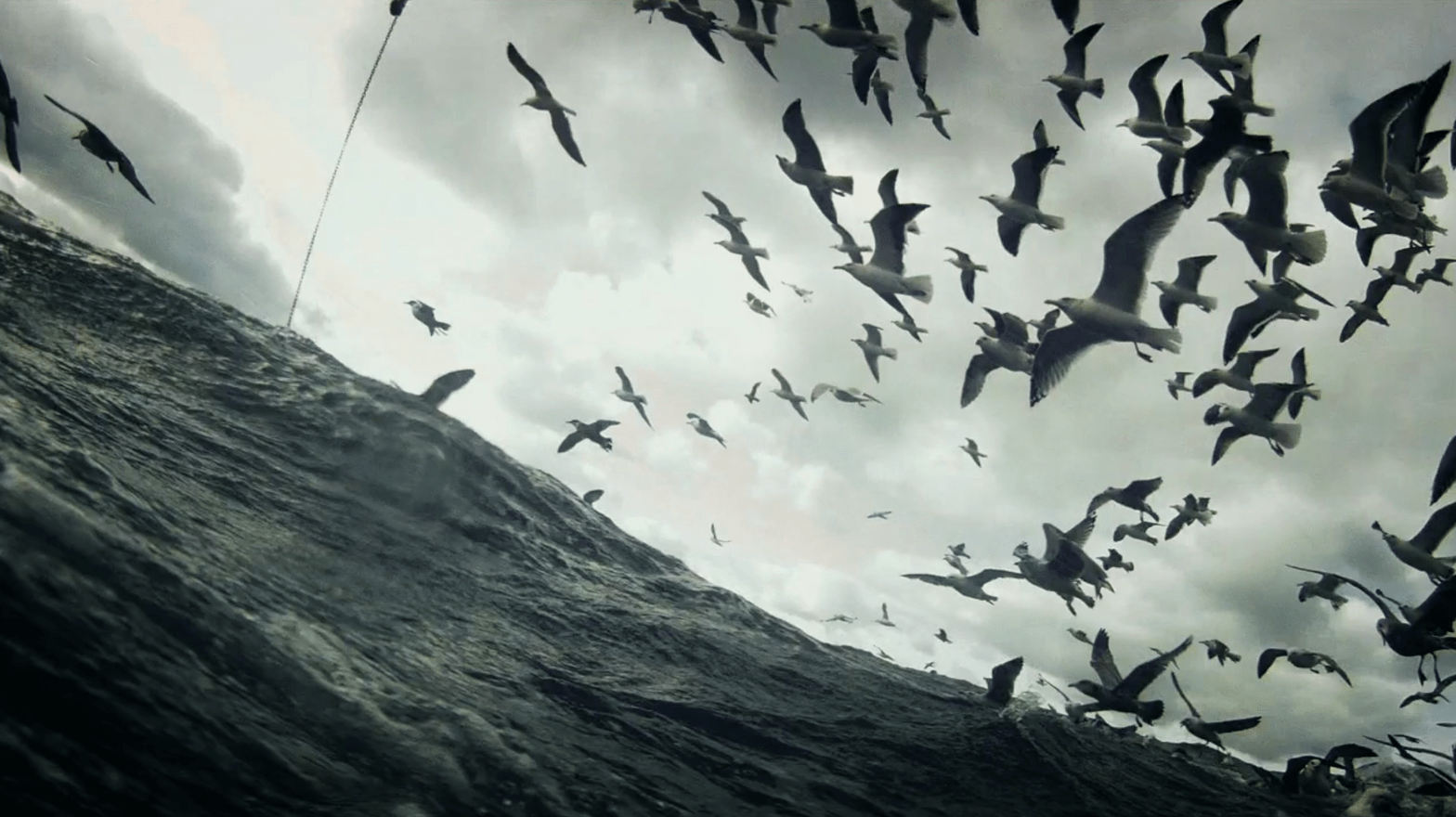
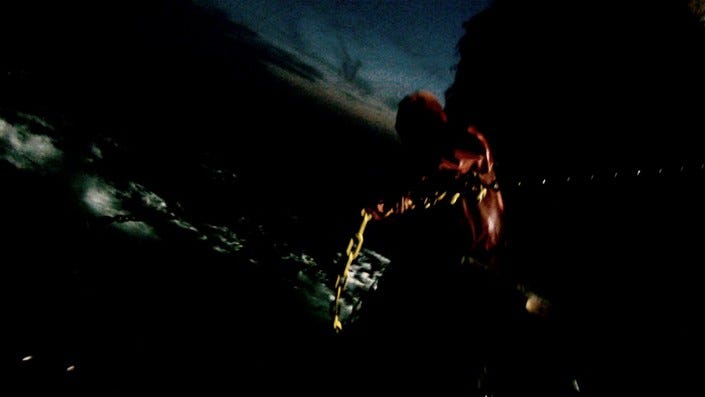
Image taken from “Leviathan” (2012), directed by Lucien Castaing-Taylor and Véréna Paravel

The 2012 film Leviathan, directed by Lucien Castaing-Taylor and Véréna Paravel, opens with a quote from the book of Job that describes — you guessed it — the Bible’s legendary sea monster: “He maketh the deep boil like a pot… Upon earth there is not his like, who is made without fear.” It’s a fitting start. Not only is the documentary set in the same North Atlantic waters that inspired Herman Melville’s Moby Dick, but it’s also a depiction of chaos unlike any film in recent memory. The movie’s directors hail from the Sensory Ethnography Lab at Harvard University, and they use GoPro cameras to immerse viewers in the sensory experience of life aboard a commercial fishing boat… with zero narration, story structure, or dialogue to make sense of that experience. 

Fishermen pulling chains in the pre-dawn darkness. Severed heads of cod sloshing across the surface of the deck. A maelstrom of innumerable starfish. As each wordless sequence gives way to the next, you might find yourself recalling Buechner’s vision of life “with the sound turned off.” Except the sound isn’t turned off here; rather, it’s turned up to eleven, with the mechanical din of the ship’s passage adding percussion to the susurrous melodies of spray and tide. In what is perhaps their boldest artistic move, the filmmakers lash their cameras to poles which are alternately plunged underwater or thrust into the sky, forcing us to witness the ship from the perspective of the fish caught in its nets and the birds hovering above its wake. Now, if you’ve never wanted to know what it feels like to be chased, captured, and disemboweled by fishermen, this film might not be your cup of tea. However, if you allow yourself to sync up with Leviathan’s ebb and flow, two mysterious things begin to happen.

First, the beauty and brutality of life at sea become visceral realities instead of abstract concepts. It’s one thing to read statistics about the environmental toll of the fishing industry, another to see vast quantities of fish spilling through machinery like grain in a combine. Likewise, while the testimony of a fisherman might alert us to the human costs of capitalism, we learn something else entirely by spending extended time with sailors drenched by waves, ankle-deep in clam shells, and exhausted from repetitive movements. Rarely has Tennyson’s “nature red in tooth and claw” — the apparent absurdity and indifference of the cosmos — been more starkly displayed. Yet these grim details also throw the film’s moments of transcendence into sharper relief. Night bleeds into the flush of sunrise. Flecks of water catch sunlight and sparkle like diamonds. And, in one of the most awe-inspiring scenes ever put to film, a lofty camera flips upside-down in a flock of hundreds of seagulls, winging their way above the tempest like Biblical spirits at the dawn of creation (Genesis 1:2).

Leviathan reminds me that uncertainty is a double-edged sword — frightening and liberating in equal measure. The decision to sit with our questions and to resist dogmatic solutions to them can be very uncomfortable, but it also opens us up to new discoveries, sensitizing us to the miracle and mystery of existence in ways that can transform us.

Before traveling to Southeast Asia, I’d studied poverty in depth. Yet the experience of digging through trash bags and shouldering sacks of recyclable materials with slum-dwellers enabled me to understand it in ways that words couldn’t — in my skin and joints and muscles. Similarly, I’d heard countless sermons on the eternal fate of unbelievers, and I’d listened as Christian apologists trumpeted the superiority of the gospel over Muslim doctrine. Yet the experience of getting to know actual Muslims — through conversations over coffee, meals shared in plywood shacks, visits to mosques, and theological discussions (You better believe I tried and failed to expound the Trinity to my neighbors) — made Jesus’ fiery pronouncements of doom and damnation feel incredibly prosaic. When I stopped picturing my neighbors as souls to be saved, their physical suffering weighed heavier on my conscience; I yearned to play some small role in fixing the systems that held them down. Conversely, their joy, resilience, hospitality, and creativity soared higher in my estimation, like the handcrafted kites their children flew above the trash heaps. 

I’ll never forget standing by the polluted stream that bisected the slum, listening to the adhan (call to prayer) as night fell, and realizing — perhaps for the first time — how little I really knew, how small I was in the grand scheme of things, and how grateful I felt to be a part of it all. Years later, when I finally set the Bible aside, questions about the origin of the universe, the enigma of consciousness, the scope of Darwinian evolution, and the brute fact of existence kindled awe that the words “And God said” couldn’t replicate. The conviction that life on Earth was a prelude to a glorious future gave way to a desire to savor life’s fleeting wonders. 

Image taken from “Leviathan” (2012), directed by Lucien Castaing-Taylor and Véréna Paravel

The film Leviathan also highlights the empathy that emerges from mutual disorientation. As I watch it, I find myself asking: Who am I supposed to root for here? The fish plucked from the sea? The birds hurrying to keep up with the ship? The crew members fighting to provide for themselves and their families? With no narrator to direct our sympathies, and with camera shots that mimic the eyes of fish and fishermen alike (Trust me, there are lots of fish eyes in this movie…), our labels and categories become irrelevant. Instead of searching for “good guys” and “bad guys,” we begin to see cod, seagulls, sailors, and ship as a single organism, bound together by their shared struggle to navigate the depths.

When I renounced faith in Jesus Christ, part of me expected to drown in the chaos of life without God. I’d be lying if I said that fear has ever fully dissipated. At times, I yearn for the stability that church and scripture provided with an ache that can’t be articulated in words. Nevertheless, I feel a newfound kinship with the planet, with my cousins and distant relatives in the animal kingdom, and with the diverse humans I meet each day. When I’m tempted to lament my mortality or to wallow in my confusion, I take heart from the millions of atheists, agnostics, and freethinkers who turn bewilderment into curiosity each day; who grow compassion for the “other” from seeds of personal hardship; and who — with the gift of a Nietzschean rose — thank the abyss for awakening them to life’s wordless glory. Suffering, as the playwright Thornton Wilder once wrote, becomes the key to empathy:

Without your wounds where would your power be? It is your melancholy that makes your low voice tremble into the hearts of men and women. The very angels themselves cannot persuade the wretched and blundering children on earth as can one human being broken on the wheels of living. In Love’s service, only wounded soldiers can serve. Physician, draw back.

Not for nothing is Leviathan feared. For all its grandeur, the sea is a harsh and lonesome place. Yet, after three years of treading its waters, I can honestly say that I wouldn’t trade the wonders my eyes have seen or the relationships I’ve gained for the comforts of life on deck. As scary as that big wave in Southeast Asia was, there was something thrilling about taking its full force and living to tell the tale. No written words will ever capture it. 

“Sell your cleverness,” advises the Sufi poet Rumi, “and buy bewilderment. Cleverness is mere opinion, bewilderment is intuition.” While I’ve left religion behind, I still admire the monks and mystics who, like Frederick Buechner, suggest that God is found in silence. Why settle for cheap explanations when we can feel — in our bones as well as our souls — the tactile intimacy and limitless expanse of the cosmos we call home?

In the year before I became an atheist, the pastor at my evangelical church preached a sermon on Revelation 21. “As difficult as this might be to imagine,” he said, “there will be no ocean in heaven.” Though I agreed with his exegesis, I found myself bristling at the notion that God might one day obliterate the sea forever. Even then, I sensed a truth that would take years to unpack — the reality that chaos is our ancestral homeland, as the book of Genesis inadvertently suggests, not a foe to be conquered. Yes, it almost ruined my life, but I love it anyway. Herman Melville, that salty old mariner who knew all too well the crush and grace of the sea, expressed my feelings perfectly when he penned the following words in Moby Dick:

All deep, earnest thinking is but the intrepid effort of the soul to keep the open independence of her sea… As in landlessness alone resides the highest truth, shoreless, indefinite as God — so better is it to perish in that howling infinite, than be ingloriously dashed upon the lee.

Or, as Ella Mine puts it in the opening of song of her album Dream War

Though there are shadows dancing
Just beneath the waves
I wanna jump in anyway

Image by Keaten Chancellor, taken from Unsplash.

5 Things “Severance” Gets Exactly Right About Religious Deconstruction

This post contains spoilers from episodes 1–5 of Severance: Season 1. No spoilers from episodes 6–9 or from Season 2 are discussed.

A powerful organization with deep historical roots, founded by a charismatic leader, that demands unquestioning obedience from its members, restricts access to information, stokes fears of the world outside its walls, and inspires loyalty through sacred scripture, art, and music.

A church? A cult? A secret society, perhaps? It’s actually a description of Lumon, the corporation at the center of Apple TV’s Emmy award-winning series Severance. In the show’s first episode, we’re introduced to Mark, Helly, Irving, and Dylan — four employees who compose Lumon’s “Macrodata Refinement” (MDR) team. Each of them has voluntarily undergone the procedure known as “severance,” a surgical memory-split that prevents them from recalling their workdays once they exit Lumon’s doors, effectively creating two separate selves — an “innie” (work self) and an “outie” (home self). Why is this procedure necessary? What’s really happening at Lumon? No one seems to know. The work is “mysterious and important,” as MDR’s supervisors are fond of saying. And that explanation contents Severance’s protagonists… until the sudden disappearance of a coworker throws the entirety of their carefully curated world into question.

My wife and I recently finished season 2 of Severance, and we’re currently re-watching season 1 with friends. The show hooked us from the get-go with its complex characters, brilliant staging, haunting soundtrack, and mind-bending plot twists. Yet the show resonated with me for more than just aesthetic reasons. Something about its storyline felt eerily familiar, and it wasn’t long before I traced this uncanny vibe to its source: the collapse of my Christian faith. Not only is the show chock-full of religious symbolism, but it also helped me process my departure from the evangelical church in unexpected ways. So, without further ado, here are five things that Severance gets right about religious deconstruction.

#1. The Ones Who Disappear

Peter “Petey” Kilmer reappears outside Lumon. Image taken from Awards Daily.

Most stories begin with an inciting incident, and Severance is no exception. The series’ first episode revolves around the departure of Petey, the wisecracking former leader of MDR. Mark, Helly, Irving, and Dylan aren’t privy to the reasons behind Petey’s disappearance, and neither is the audience. Naturally, speculations abound. Was it misbehavior, illness, retirement, or something more sinister? Lumon’s higher-ups suggest that Petey was unfit for his job. However, this terse excuse is tough for MDR’s members to swallow — particularly Mark, who was close with Petey. Matters get worse when Petey reappears outside Lumon and visits outie Mark in secret (Mark doesn’t recognize him, of course). “Nothing down there is what they say,” Petey tells his former coworker across a diner table. “If something happens to me, the things I know need to stay known. I’d prefer it be by a friend.” Before he left Lumon, Petey sketched a map of Lumon’s lower floors, and innie Mark eventually finds this drawing inside the framed team photo on his desk. He hides it quickly. But he can’t stop thinking about it… or glancing at it when no one else is around.

Churches spend lots of time discussing those who leave the fold. For the sincere religious adherent, few things are more terrifying than apostasy — the choice to deny the faith of one’s upbringing. Within evangelical Christianity, for instance, the rejection of Jesus Christ is often labeled the “unpardonable sin” and a surefire ticket (no pun intended) to hell. Congregants regularly speak of ex-Christian friends and family members in hushed, bewildered, and sorrowful tones: What could have possessed them to leave? Don’t they know what they’re risking? Will they ever come back? A beloved brother’s or sister’s disavowal of religion sends shockwaves through the ranks of the faithful, and it leaves behind a massive crater that cries out for explanations — answers that pastors and parishioners are eager to provide: Maybe they never believed, or maybe dark powers manipulated them, or maybe the pleasures of secular life were simply too enticing…

Most churchgoers draw solace from these pre-packaged conclusions, but others find them far too neat and tidy. Many people begin deconstructing their beliefs because they know and love someone who walked away; because their church’s fearful, critical, or downright hostile response to this apostasy unsettled them; or because the cognitive dissonance caused by the departure — the struggle to grasp that someone whose faith seemed so alive and loving and genuine could leave it all behind — can’t be suppressed. Like Petey’s map, tucked behind the photograph on Mark’s desk, something whispers that the story isn’t as simple as it appears.

#2. Reading Up

Dylan, Mark, and Irving discover a mysterious book. Image taken from Polygon.

The seeds of Mark’s doubts about Lumon are sowed by Petey, but they’re watered and fertilized by the arrival of a strange, sickeningly-colored self-help book in MDR’s office. The audience knows that this text was penned by Mark’s hippie brother-in-law, Ricken, stolen from outie Mark’s house by a Lumon employee, and accidentally left near MDR. Its contents are poorly written — comically so, in fact — and thoroughly harmless. But for innie Mark, they might as well be missile launch codes from enemy territory. Information from the outside world is forbidden on Lumon’s lower levels. Prior to Petey’s removal, Mark might’ve handed Ricken’s book over to his supervisors. Yet now he finds himself unable to resist its pages. He stows it in his desk drawer, sneaks it to the restroom when nobody’s looking, and — with bated breath and pounding heart — begins to read.

Religious orders like to portray themselves as well-informed, and many progressive churches fit the bill. Yet, for many congregants, access to outsider perspectives on their religion is often hindered. Sometimes, this looks like overt censorship, as with groups that compile lists of banned books (Roman Catholics, pre-1966), discourage their members from using the internet (Jehovah’s Witnesses), or protest the teaching of evolution in public schools (fundamentalist Christians). Other times, it’s more subtle.

Growing up in the evangelical church, I was taught that atheist authors were motivated by sinful pride, that professors at secular schools would try to squash my faith, that the entertainment industry was captive to a toxic LGBTQ+ agenda, and that the act of consuming certain forms of media would corrupt my mind and heart (looking at you, Harry Potter). I wasn’t forbidden from listening to such voices once I’d reached maturity, but I was certainly scared of doing so — scared enough that, when my doubts about the truth of my religion became unbearable, I spent a year studying nothing but Christian apologetics content before allowing myself to crack open texts by non-Christian writers. Once I started flipping pages in those secular books, I couldn’t stop. The realization that another world lay out there — a sea of diverse thought and belief that I’d been both wittingly and unwittingly blind to — was Severance levels of disorienting.

To outsiders, my reluctance to hear out those who disagreed with me might seem as silly as innie Mark’s fear of Ricken’s book. However, those raised in conservative religious households know what’s at stake in such choices. In a hostile world, where devils lurk around corners and souls are subjected to ceaseless assault, the simple act of reading can require immense courage — the courage to admit that, despite everything you’ve ever been told, you might be wrong about everything.

#3. Already in Hell

Helly tries to escape from MDR. Image taken from IGN.

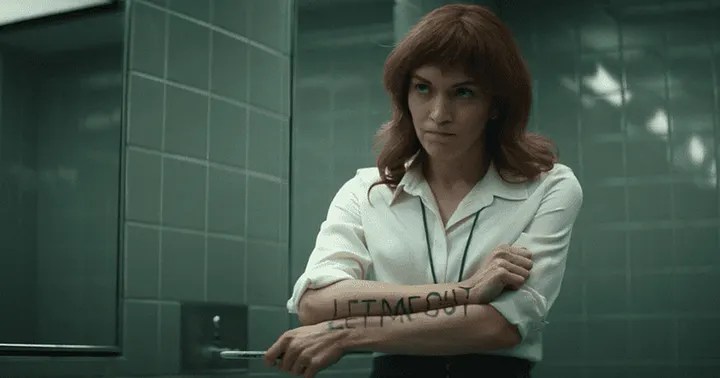
In the first few episodes of Severance, newcomer Helly is the sole critic of MDR’s setup. Rules and routines that her coworkers find completely normal — the prohibition of messages to upper floors, the perpetually cheerful aesthetic, and the dreaded “Break Room” where employees are sent after minor infractions — disturb her deeply. Nothing that Mark, Irving, or Dylan say can keep her from scurrying for nearby exits. When her demands to leave are finally (or seemingly?) granted in episode 4, she graces Mark with a rare but weary smile. “Well, boss. I guess this is the part where I should tell you to go to hell. Except you’re already here.”

Mark can’t help but take Helly’s jabs at Lumon personally, just as many religious folks do with the questions and critiques of would-be apostates. Isn’t such restlessness evidence of an inexplicable, irredeemable animosity toward one’s community? A bitter desire to “sever” ties and to strike out on one’s own, unencumbered by old relationships?

Perhaps this is true for some ex-religious people, but not for most. Those who have deconstructed know how excruciatingly painful, lonely, and unwelcome the process is. Sure, being mistreated or deceived by religious institutions can generate anger. Yet, as therapists regularly remind us, anger is a secondary emotion, not a root cause. Fear and sadness are the predominant emotions of those leaving behind the only worldview they’ve ever known. I often tell people that the prospect of abandoning my faith was my worst nightmare. Like Helly, I had no clue what life outside my church’s walls would mean, only a host of questions: What’s real? Who can I trust? Who am I without all this? Will I be punished for my decision to leave? Will I ever be whole again? The assumption that religious deconstruction is an act of rebellion — something akin to a child’s tantrum — is deeply misguided. Those who have experienced it know that it hurts like hell.

#4. “I’m Afraid You Don’t Mean It”

Helly visits the Break Room. Image taken from Assemble

For most of us, the “break room” is a place we look forward to visiting — a sanctuary from the bustle and stress of our workdays, complete with drab wallpaper, days-old donuts, and a prehistoric coffee maker. For Lumon employees, its mere mention evokes visceral fear. In episode 3 of Severance, we learn what takes place there: Rule-breakers are forced to read a statement of guilt and apology over and over and over again. After each reading, a supervisor replies: “I’m afraid you don’t mean it. Again.” In a dark room, half-blinded by the luminous board on which their punishment is etched, the members of MDR learn — slowly and agonizingly — that any difficulties they face in adhering to Lumon’s code are their own fault.

I’ll never forget the final meeting that I had with the pastor of the last church I attended. After a long, anxiety-inducing effort to manage my rapidly ballooning doubts, I had decided to stop identifying myself as a Christian, and I had shared this hard news with my pastor. In a gentle voice, he informed me that God had revealed the root cause of my deconstruction to him: selfish pride. I had worshipped the false idol of worldly knowledge and had neglected my relationship with Jesus. These words hit me with the force of a sledgehammer. When I tried to reply, my throat closed, my hands shook, and tears sprang to my eyes. I wanted to plead my case, but somehow I knew that it wouldn’t help. No matter how fiercely I reiterated my love for Christ and the church, the countless ways that I’d tried to solicit God’s help, or my longing to do literally anything but leave, his judgement would stand. God had told him so.

For all their claims of open-mindedness, conservative religious groups cannot entertain the notion that a sincere spiritual seeker — one whose deepest desire is for truth, goodness, and communion with the divine — might find their quest leading them away from the church. Apostasy is always a moral failure, never the result of honest inquiry. This knee-jerk response might rub you the wrong way, but it makes a lot of sense. If a devout believer can fall away despite every effort to hold on, might not the same thing happen to anyone? And what would that imply about the religious authorities who condemn backsliders behind office doors?

#5. “Your Tribe is Bigger Than You Think”

The members of MDR. Image taken from The Los Angeles Times

Severance’s plot kicks into high gear once Mark, Helly, Irving, and Dylan each realize that they aren’t alone in their questions: Are there other departments than MDR? If so, how many? Who are those odd people in the hallways? And why aren’t we allowed to talk with them? The choice to divulge their doubts to one another doesn’t just offer comfort; it also sparks a plan of resistance that might finally provide answers… or spell disaster on an unimaginable scale. Nevertheless, one thing’s for sure: MDR’s members will face these challenges together.

For those navigating the wilderness of religious deconstruction, few things are as vital as finding community. This often involves signing up for therapy, but it also entails building relationships with folks who’ve traveled a similar road — a challenging but increasingly attainable goal. According to 2024 data by the Pew Research Center, 28% of U.S. adults now identify as atheists, agnostics, or religiously unaffiliated “nones.” This percentage has risen significantly in recent decades. As more and more of us make the difficult decision to “come out” as skeptics and nonbelievers, our ability to organize and to resist oppressive actions by religious groups grows. Community empowers hurting people to empower other hurting people.

When I left the Christian faith in 2022, I didn’t know a single person who had done likewise. The year leading up to this step was a profoundly lonely one. At times, I thought that the loneliness might never dissipate. But it did. Gradually, I discovered that the internet was brimming over with the testimonies of countless ordinary apostates like me. When I eventually worked up the courage to share my deconstruction story in a blog post, I was contacted by a bunch of friends whose stories mirrored mine — formerly devout Christians who I would never have expected to renounce their commitment to Christ. And just last month, I attended a retreat for ex-religious people near Charlottesville, Virginia, where I spent a weekend swapping stories, sharing meals, listening to lectures, and singing late-night karaoke with dozens of folks who had grasped my story of wrestling with religion immediately, because it was their story.

Like Mark, Helly, Irving, and Dylan, my fumbling attempts at honesty and vulnerability have forged new friendships with like-minded, open-hearted skeptics, and I wouldn’t trade that for the world. Are you deconstructing your faith? You may feel alone, but you’re not. As author Leif Enger writes in his novel Virgil Wander, “Your tribe is always bigger than you think.”

Now, if you’ll excuse me, I’m going to watch some more Severance.

Thanks for taking the time to read my writing! I really appreciate it. Liking and sharing this post helps my work reach a wider audience. If you’d like to read more essays on life after religion, please consider subscribing to receive e-mail updates of new content!

Close Your Bible, Save a Tree: Why Christianity is bad for the environment

What if it’s true? That would be amazing!

I’m standing in front of the chimpanzee enclosure at my local zoo when this thought flits through my mind. For the past five minutes, I’ve been gazing at the young ape just beyond the fence — at the lines on his palms, the shape of his nose and mouth, the eyes that watch me like I’m the curious creature on display. My zookeeper brother has warned me that chimps enjoy flinging their poo at visitors, so I should probably be wary of airborne excrement. Yet I’m too struck by our physical similarities to recall the fence between us. It’s summer break, I’ve just finished my junior year at college, and fragments of lectures from my recent biology class (which I may or may not have fully processed, given that my crush was sitting nearby) are swirling in my brain. According to my professor, the primate returning my stare is family — a close cousin on an evolutionary tree whose branches stretch back billions of years and connect all living things. As I scrutinize his features and compare them to my own, I feel a deep sense of awe, and I realize suddenly that I want my professor’s words to be true.

This is a problem. I was raised on science books published by Answers in Genesis, trained to defend the tenets of Young Earth creationism, and taught that Richard Dawkins spent time with the devil on weekends. I guzzled Nathan Frankowski’s propaganda film Expelled: No Intelligence Allowed — in which Darwinism is linked to atheism, communism, fascism, eugenics, and the Holocaust — like it was a 7-Eleven Slurpee, and I used its arguments to challenge my high school biology teacher. My youth group also watched the highly publicized debate between Ken Ham and Bill Nye, and while I had to admit that Nye mopped the floor with his stuffy Australian foe, I knew that he couldn’t be right. Those who accepted the theory of evolution were dangerously deluded. Their secular science wasn’t just an affront to the Creator of all things; it was a fast-track to social ruin.

My creationist upbringing was powerful enough that I remained agnostic about evolution until I left Christianity at twenty-seven years old. By that time, I’d befriended many Christians who accepted Darwin’s ideas, so skeptical attacks on literalist interpretations of Genesis didn’t faze me. I knew that the Bible wasn’t a science textbook and that it could be interpreted in a variety of ways. My former biology professor, John H. Walton, had penned a landmark defense of theistic evolution rooted in scriptural analysis: The Lost World of Genesis One: Ancient Cosmology and the Origins Debate. I sympathized with his attempt to square Darwinism with religious belief, and I applauded his acceptance of scientific data that I now found undeniable. Yet my departure from the church changed my perspective on the culture wars that inspired Walton’s book. I’m now convinced that debates between theistic evolutionists and Young Earth creationists have obscured deeper problems within traditional Christianity — problems that raze to the bone of the religion and that have also had devastating consequences on the natural world we inhabit.

What do I mean by this? For starters, I’m not saying that Christians don’t care about the environment. I know many churchgoers who work tirelessly for ecological causes. Likewise, I’m not claiming that the Bible can’t bolster such work. Christian environmentalists often ground their advocacy in scriptural passages that affirm the beauty and goodness of creation (Genesis 1, Psalm 19), God’s provision for wildlife (Psalm 104), and responsible farming practices (Leviticus 25). One of my favorite Christian authors, Wendell Berry, has been doing so for decades.

My claim is that certain key passages of Genesis — scriptural texts that have, for most Christians throughout history, been viewed as theological bedrock — have hastened rather than hindered the destruction of our planet. I’m well aware that progressive Christians who deny the inerrancy of the Bible may agree that these texts are problematic and that their messages should be rejected. Great! On the flip side, conservative Christians may contend that my interpretations of these passages are simply mistaken. That’s okay! My position is a controversial one. If you think I’m wrong, I’d love to hear your critiques in the comments below. Hopefully, in our dialogue, we can rise above our primate instincts and avoid any metaphorical shit-tossing.

The impact of religious worldviews on global ecology has never been more relevant. Eighty percent of white evangelical Christians voted for Donald Trump in November of 2024, supporting a Republican regime that has, in the span of a few months, rolled back numerous environmental protections including U.S. participation in the Paris Agreement, limits on domestic oil and gas production, incentives for electric vehicle ownership, and laws preventing power plant pollution. In this essay, I will argue that the Bible’s opening chapters espouse two ideas which are highly problematic from an ecological standpoint — influential doctrines that have been widely accepted both throughout history and across denominational lines. If we want to save our planet, then we must interrogate these beliefs, as difficult as that process may be. So, without further ado, let’s take our cue from dear old Darwin and put them under the microscope!

Problematic Doctrine #1: Humanity was created in God’s image.

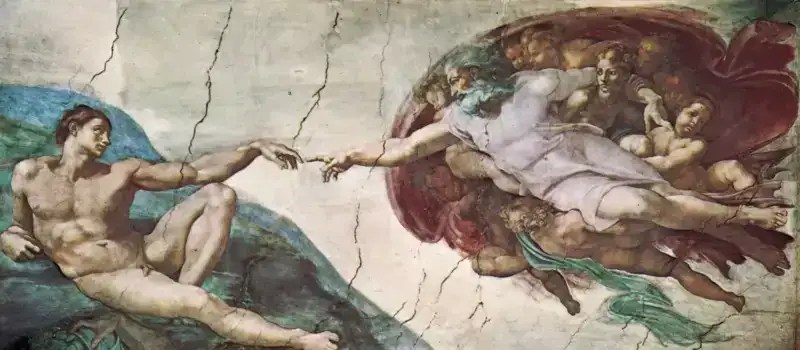
“The Creation of Adam” by Michelangelo

In the first chapter of the book of Genesis, we learn that human beings are — despite surface similarities with their fellow creatures — profoundly distinct from the rest of the natural world. As the final living beings to be formed, they are the pinnacle of Adonai’s creation, made “in the image of God” (Genesis 1:26). At a base level, this means that each human possesses an immortal soul which is capable of relating to God and receiving the gift of salvation. Many Christians also believe that it entails uniquely human capacities for reason, free will, creativity, and moral behavior. Answers in Genesis summarizes this view: “For animals, their ‘spirit’ seems to be merely an animating force… For mankind, the soul is the animating factor, plus the seat of logic and reason, emotion and conscience, and all the rest of the essence of a person — and it is eternal.”

When I was growing up, my fellow Baptists and I bristled at the notion that humans could be classified as “animals,” and we used the term “animalistic” to describe behaviors that seemed savage, primitive, or degrading. Theistic evolutionists like Francis Collins, Tim Keller, and Pope Francis might demur, citing abundant evidence for common ancestry. Yet they held the similar conviction that, at some point in our evolutionary past, God conferred the imago dei on hominids, transforming them into something qualitatively different from the rest of the animal kingdom.

Why is the doctrine God’s image problematic? For starters, it’s a deeply anthropocentric idea. Creationists believe that Tennyson’s “Nature, red in tooth and claw” was an inevitable consequence of Adam and Eve’s sin, while theistic evolutionists argue that it’s part and parcel of God’s creative process. Yet members of both camps agree that God’s allowance of animal agony — either tens of thousands or billions of years of it, depending on your interpretation of Genesis — is a necessary step in the human drama of redemption. Animals don’t have immortal souls, and they can’t accept Jesus (If they could, then missionary work at local zoos would become imperative), so their suffering can’t be compensated after their death. Conclusion: Bambi’s bloody demise is, in some sense, required for your trip to paradise. This troubling idea has led some Christian apologists, such as William Lane Craig, to address the problem of animal suffering by asserting that animals can’t experience pain (not a good look there, Bill). However, as biologists continue to unveil new evidence of reason, emotion, empathy, and creativity in the animal kingdom, challenging simplistic views of non-human consciousness, the boundary between homo sapiens and other species — a gulf which supposedly renders the former fit for eternal bliss and necessitates the predation and/or extinction of the latter — becomes increasingly murky.

Traditional definitions of the imago dei raise a host of troubling questions. Christians often claim that human life is meaningless in the absence of an eternal hereafter. One irony of this claim is that dogs and deer and dolphins and desert tortoises do not, on a Christian worldview, have hope for eternal life. Are their brief lives consequently meaningless? Furthermore, if humans alone possess immortal souls, how does one escape the conclusion that non-human nature is, by definition, soulless? Are animals merely instinct machines? If not — if they are capable of more free thought and conscious action and self-giving love than we previously imagined — then why are they denied the possibility of redemption? Finally, if God conferred his image on select hominids during humanity’s evolution, how did he choose which ones got to live forever while their forebears perished, and how was this choice anything but arbitrary?

The notion of God’s image may dignify humanity, but it only does so by demoting the rest of the animal kingdom to secondary, subservient status. Genesis 1:26, which sets human beings apart from non-human animals on a fundamental level, clashes with our growing awareness that we are members of a vast, evolving, and interdependent community of species — that, to quote Bill Nye, “What happens to other species also happens to us.” Growing up, I never thought twice about killing animals, eating their meat, or using products made from their bodies. Didn’t they lack the soul that imbued human suffering with significance? Hadn’t God given “all living creatures” to his image-bearers for food (Genesis 9:3)? Didn’t he institute a system of sacrifice in which countless livestock were butchered to atone for human sin? Nowadays, convicted of my anthropocentrism, I approach the subject of animal suffering with greater reverence (an attitude that can, in my opinion, be shared by vegans and meat-eaters alike). I also find myself agreeing with Mohammad Saud, the bird-saving hero of Shaunak Sen’s 2022 documentary All That Breathes: “Life itself is kinship… One shouldn’t differentiate between all that breathes.”

Problematic Doctrine #2: Humanity has been given dominion over nature.

“Wanderer Above the Sea of Fog” by Caspar David Friedrich

The doctrine of God’s image goes hand in hand with the Bible’s claim that humanity was given “dominion” over the natural world (Genesis 1:26). Many Christians see this authority as a kind of nurturing stewardship — a mandate to enhance the well-being of the planet that God has entrusted them with by carefully conserving its resources. During my years at Christian college, this was how I envisioned humanity’s role in the natural world. However, I no longer believe that it reflects the message of Genesis’ earliest chapters.

The Hebrew word râdâh, translated as “dominion,” has connotations which are far more adversarial than many Christians think; throughout the Bible, the word is translated as “reign,” “rule over,” “prevail against,” “subjugate,” “trample,” “tread down,” and “chastise.” Contrary to widespread assumptions, humanity’s task in Genesis 1 isn’t to nurture creation but rather to conquer it — to “subdue” their environment (Genesis 1:28) and to take tribute from it, just as a king would. This verse doesn’t require that humanity’s relationship to nature be solely exploitative; monarchs can, after all, choose kindness when it suits them. Nevertheless, Genesis 1 conveys humanity’s God-given right to dominate nature and to use its resources as they see fit. Early Christians couldn’t have imagined the impact that this assumption of authority would have over millennia, yet they took it for granted: Earth is, first and foremost, a habitat for humanity.

The idea of humanity’s dominion over nature has had far-reaching ecological consequences. In a 1967 essay titled “The Historical Roots of Our Ecological Crisis,” medieval historian Lynn White Jr. contrasts the Judeo-Christian creation story, in which Adonai designs the world “explicitly for man’s benefit and rule,” with other ancient myths that envisioned humanity as both indistinguishable from their environment and duty-bound to respect its spirits: “Christianity, in absolute contrast to ancient paganism and Asia’s religions… not only established a dualism of man and nature but also insisted that it is God’s will that man exploit nature for his proper ends.” The aftershock of this ideological shift continues to reverberate:

I personally doubt that disastrous ecologic backlash can be avoided simply by applying to our problems more science and more technology. Our science and technology have grown out of Christian attitudes towards man’s relation to nature which are almost universally held not only by Christians and neo-Christians but also by those who fondly regard themselves as post-Christians. Despite Copernicus, all the cosmos rotates around our little globe. Despite Darwin, we are not, in our hearts, part of the natural process. We are superior to nature, contemptuous of it, willing to use it for our slightest whim. The newly elected Governor of California, like myself a churchman but less troubled than I, spoke for the Christian tradition when he said (as is alleged), ‘When you’ve seen one redwood tree, you’ve seen them all.’ To a Christian a tree can be no more than a physical fact. The whole concept of the sacred grove is alien to Christianity and to the ethos of the West. For nearly 2 millennia Christian missionaries have been chopping down sacred groves, which are idolatrous because they assume spirit in nature.

If, as White Jr. argues, humanity’s exploitation of nature has been legitimized by the Judeo-Christian doctrine of dominion, then efforts to combat such exploitation must also challenge this doctrine. The historian writes: “No new set of basic values has been accepted in our society to displace those of Christianity. Hence we shall continue to have a worsening ecologic crisis until we reject the Christian axiom that nature has no reason for existence save to serve men.”

As stated above, many Christians interpret “dominion” as stewardship, not conquest. Yet an uncomfortable fact remains: If Genesis 1 has been used to justify public gardens, ocean cleanup, veterinary clinics, and wildlife sanctuaries, it has also — indeed, far more often — been used to justify the felling of forests, the damming of rivers, the construction of factories, and the slaughter of animals for the advancement of human society.

Would our behavior toward our environment change if we told a different story about ourselves — one in which we weren’t rulers exalted over nature but simply members of it? Daniel Quinn thinks so. In his award-winning novel Ishmael, the author puts these words in the mouth of a telepathic gorilla (You’ve got to read the book, I promise that it makes sense):

There’s nothing fundamentally wrong with people. Given a story to enact that puts them in accord with the world, they will live in accord with the world. But given a story to enact that puts them at odds with the world, as yours does, they will live at odds with the world. Given a story to enact in which they are the lords of the world, they will act like the lords of the world. And, given a story in which the world is a foe to be conquered, they will conquer it like a foe, and one day, inevitably, their foe will lie bleeding to death at their feet, as the world is now.

The Family Across the Fence

Image by Kelly Sikkema, taken from Unsplash

In 2019, I wrote a nature-themed blog post that contained the following claim: “Each beautiful part of nature that we experience is, at bottom, a love letter from God to us.” Six years later, I couldn’t disagree with myself more. When I stare at chimpanzees over the fence of a zoo enclosure, I no longer see them as beings created for my benefit or as object lessons in God’s attributes. I see them as fellow travelers on the journey of life, as family members whose destinies are interwoven with mine in ways I’ll never fully grasp. In their eyes, I witness the same spark that lights the gaze of my loved ones and that once lit the stars. “There is,” as Darwin wrote at the finale of his book On the Origin of Species, “grandeur in this view of life” — in the notion that billions of years of history have brought us to this moment and made our shared life on this wild, whirling, and wounded planet possible. It’s all we’ve ever had and all we’ll ever have. Let’s set scripture aside for the moment and get busy saving it.


Thanks so much for reading! I really appreciate it. If you’d like to read more of my reflections on life after religion, you can subscribe to this blog to receive email updates on my latest content.

Fire, Foes, & Failed Prophecy: Why Jesus was wrong about the end of the world


We were bound for the Badlands, and I couldn’t have been more excited.

When I was a kid, many of my heroes were pulled straight from TV Westerns. There was Davy Crockett from Disney’s King of the Wild Frontier, grinning a grizzly bear into submission. There was True Grit’s Rooster Cogburn, riding into battle with six-shooters drawn and the reins clenched between his teeth. And, of course, there was Chuck Norris’ Walker, Texas Ranger, roundhouse-kicking every unsavory character west of the Mississippi (I spent hours practicing this deadly move on furniture and replicating it with my action figures). These tales presented me with two groups of people — “good guys” and “bad guys” — that were both easily recognizable. The bad guys slunk around in caves, wore stylish black outfits, greased their mustaches, and kicked stray dogs for no discernible reason. The good guys walked tall, spoke with short but authoritative sentences, made women swoon just by glancing in their direction, and never shot first but always shot straightest. Justice, when it inevitably arrived with guns blazing, left the desert sand soaked in blood. And I couldn’t get enough of it.

So, when my wife and I embarked on a two-week trip to Yellowstone, Zion, and Grand Canyon National Parks at the end of June, I was thrilled. We filled a bingo sheet with things we hoped to see (bison, tumbleweeds, desperados, etc.) and spent much of the trip speaking to each other in exaggerated cowboy drawls. The wide-open spaces of the American West had achieved mythic status in my imagination, and I was eager to see whether they’d live up to the hype. As we drove through South Dakota and the high buttes, plateaus, and spires of the Badlands came into view, I realized that my dreams weren’t wide enough.

In retrospect, my childhood thirst for Westerns makes a lot of sense. I was reading other books then — stories that, while set in far different times and places, bore a striking resemblance to these sun-scorched tales of rebellion and reckoning. As a middle-schooler, I binge-read the Left Behind: The Kids series by Jerry B. Jenkins and Tim LaHaye (all forty volumes), in which Christians are hunted, imprisoned, and killed by non-Christians during Earth’s last days. In the final volume, after descending to the desert soil of Israel and flambéing unrepentant humans with holy fire, Jesus throws these humans into Hell, where they are sentenced to burn forever with the devil and his angels. I read with the blood pulsing in my ears, riveted, because this novel confirmed a tale that my Baptist church claimed was anything but fictional. The world’s chaos would deepen as God abandoned unbelievers to the twisted desires of their hearts, persecution of Christians would become state policy, and a time was coming — indeed, was almost here — when Christ would return to destroy and eternally punish all who had rejected his message of salvation. Justice — of the bloody, guns-blazing variety — would be served in a parched, lawless, and unforgiving land.

For many Christians, this story is a call to sincere faith, righteous action, and missionary outreach. Sure, it’s a bit of a downer, but isn’t there tremendous comfort in the idea that all wrongs will someday be made right? That evildoers — the Hitlers and Stalins and Mussolinis of the world — will finally receive their comeuppance? This was certainly true for me. Add to these things the threat of damnation for rejecting the gospel, and you’ve got a powerful impetus for belief. The Bible’s account of apocalypse strengthened my young faith. It also killed my adult faith stone-cold. 

In January of 2022, I began seriously considering the possibility that Jesus’ doomsday prophecies might’ve been mistaken. I’d weathered seasons of doubt before and would likely have withstood this one, if not for the fact that it was exacerbated by my mental health struggles. I have OCD, and during that fateful January, it was as if my disorder strode into town, caught wind of my new doubts, and decided to launch an all-out manhunt, complete with shotguns and slobbering hounds and an army of sinister thugs from who-knows-where. Petrified that my skepticism might derail my commitment to Christ, I did what many Christians do when faced with doubt and plunged headfirst into the sea of apologetics media created to defend the truth of Christianity. I spent a year studying Jesus’ prophecies in obsessive detail, consuming every book and article and lecture on the subject that I could find. These resources put some of my doubts to rest, but the respite never lasted. In fact, the opposite happened: The more I examined Christian answers to the charge that Jesus messed up, the more holes I began to see in those answers. My faith was on the run, staggering and riddled with bullet wounds, and my reason was in hot pursuit.

Ultimately, my search for answers led me to three conclusions that prompted my departure from the Christian church. To explain how I reached those conclusions, I’ll need to delve into something that Christians call “eschatology” — a fascinating branch of theology focused on “last things” like death, final judgement, and the afterlife. It’s difficult terrain, and I can only provide a bird’s-eye view of it. Yet Jesus’ teachings on these topics have shaped our modern world in profound and problematic ways, and I’m convinced that we ignore them to our peril. So, without further ado, let’s saddle up!

Conclusion #1: Jesus was an apocalyptic prophet who expected God’s final judgement of humanity to occur during his own generation.

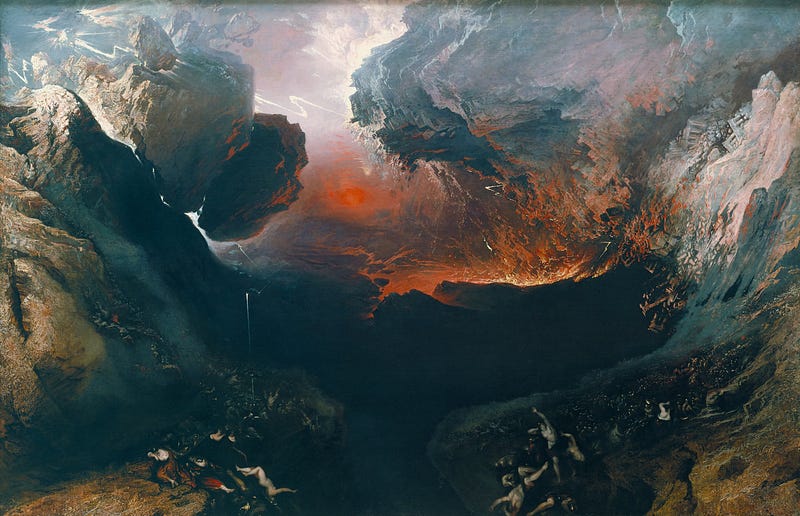
“The Great Day of His Wrath” by John Martin, 1851–1853. 

If, like me, you were raised in the Christian church, you may be surprised to learn that the consensus view among New Testament scholars — a consensus that has held for more than a century — is that Jesus was an apocalyptic prophet who expected God’s final judgement to arrive within the lifetimes of his earliest followers. Jesus lived during a time of intense eschatological fervor. Many of his fellow Jews believed that God was about to establish his glorious kingdom by overthrowing the oppressive Roman Empire, and this belief spawned numerous messianic movements that were designed to make that kingdom a reality. 

Jesus shared this apocalyptic worldview, and he also saw himself as the divinely appointed “Son of Man” who would fulfill it. His first public proclamation, recorded in the Gospel of Mark, makes this clear: “The time is fulfilled, and the kingdom of God has come near; repent, and believe in the good news” (Mark 1:15). Jesus elaborates this statement in his famous Olivet Discourse — a lengthy speech that took place on the Mount of Olives near Jerusalem and is recorded in Mark 13, Matthew 24, and Luke 21. When Jesus predicts that the Jewish temple will be destroyed, his disciples ask: “Tell us, when will these things happen? And what will be the sign that they are all about to be fulfilled?” (Mark 13:4). In response, Jesus foretells a series of highly unfortunate events — wars, earthquakes, famines, plagues, persecutions, and betrayals — that will culminate in cosmic signs — the sun and moon going dark, stars falling from the sky, and other “heavenly bodies” being shaken. When this escalating chaos has reached fever pitch, God’s righteous judgement will sweep across the earth:

Then the sign of the Son of Man will appear in heaven, and then all the tribes of the earth will mourn, and they will see the Son of Man coming on the clouds of heaven with power and great glory. And he will send out his angels with a loud trumpet call, and they will gather his elect from the four winds, from one end of heaven to the other (Matthew 24:30–31). 

These verses didn’t faze me; I’d read them dozens of times, and I often prayed that they would speedily come to pass. My dizzying ride on the tilt-a-whirl of doubt was launched by the next part of Jesus’ monologue, which sets the timeline for these predictions: “Truly I tell you, this generation will not pass away until all these things have taken place” (Matthew 24:34, emphasis mine). Here, “all these things” includes the final judgment of humanity — the climactic, cloud-parting descent of the Son of Man, which causes “all the tribes of the earth” to mourn. It also includes the establishment of God’s glorious kingdom, signified by the regathering of Israel’s scattered tribes. With this prophecy, Jesus laid his cards on the table. The deliverance that his people had spent centuries yearning and praying for was no longer far off, and it wasn’t a fool’s hope. Some of his disciples would live to see it happen. 

Jesus restates and clarifies this imminent expectation elsewhere. In Matthew 10:23, he prepares his disciples for mistreatment by saying: “When they persecute you in one town, flee to the next, for truly I tell you, you will not have finished going through all the towns of Israel before the Son of Man comes.” His words in Mark 8:38–9:1 echo the Olivet Discourse in similar fashion (Ancient copies of Mark’s Gospel didn’t have chapter breaks, as modern Bibles do, so these verses flowed together): 

Those who are ashamed of me and my words in this adulterous and sinful generation, of them the Son of Man will be ashamed when he comes in the glory of his Father with the holy angels. Truly I tell you, there are some standing here who will not taste death before they see that the kingdom of God has come with power (Mark 8:38–9:1). 

After Jesus’ death, his followers carried his apocalyptic hopes forward. Their steadfast conviction that they were living through the last days saturates the pages of New Testament books like Romans, 1 Corinthians, Philippians, 1 & 2 Thessalonians, James, 1 Peter, 1 John, and Revelation — in other words, the whole kit and caboodle. And here’s the rub: None of these people lived to see the apocalypse that Jesus described. 

Christian apologists are familiar with the charge that Jesus misfired by a couple thousand years, and I gobbled their responses like hotcakes throughout 2022, desperate for any reassurance I could find. However, each one failed to satisfy, raising more questions than it answered. Jesus was clearly talking to his contemporaries — to “this generation” — and his timeline didn’t jive with my church’s belief that these prophecies were yet to be fulfilled. The notion that God the Father, speaking through his Son, Jesus Christ, would instruct the first disciples to “be on guard,” “be alert,” and “keep watch” (Mark 13:33, 35) for events that he knew would take place thousands of years after their deaths also seemed absurd, like telling your four-year-old to watch out for tax day. Furthermore, Jesus’ predictions of heavenly signs and the Son of Man “coming on the clouds” weren’t mere metaphors. His fellow Jews often used such language to foretell global, cataclysmic, end-of-history judgment that would descend from Heaven to Earth. Each theological defense that I came across was full of holes, and the skeptical posse in my brain always seemed to be closing in, no matter how hard I tried to escape it. Soon enough, it had me cornered. 

In November of 2022, after a year of frantic study, I made the painful decision to leave the Christian church. I could no longer deny that Jesus’ apocalyptic predictions were off-base, and while I knew that some Christian scholars — C.S. Lewis and Dale C. Allison Jr. among them — acknowledged this inconvenient fact while maintaining their faith, I couldn’t follow suit. In the Old Testament, Moses tells the Israelites that any self-proclaimed prophet whose predictions don’t come to pass isn’t from God and shouldn’t be listened to (Deuteronomy 18:20–22). Was Jesus an exception? Wasn’t he God in human flesh and thus incapable of screwing up? And if he was wrong about something as huge as the climax of history, what else might he be wrong about? I’m glad you asked…

Conclusion #2: Jesus’ apocalyptic worldview was founded on simplistic and harmful “us vs. them” binaries.

Image by Jess Lindner, taken from Unsplash.

Like many apocalyptic prophets before and after him, Jesus divided the world’s population into two groups: those who accepted his lordship and were thus destined for eternal life, and those who rejected his message and were thus bound for perdition. He spoke often of the hellfire awaiting nonbelievers (see Mark 9:43–48, Matthew 25:31–46, Luke 16:9–31), and while Christians debate whether this inferno is literal or eternal, there’s no doubt that it refers to severe punishment and complete destruction. Jesus’ views on the afterlife are neatly summarized in Matthew 12:30: “Whoever is not with me is against me, and whoever does not gather with me scatters.” 

In the wake of my deconversion, I’ve come to see Jesus’ binary view of humanity as both naive and toxic. At its core, it’s a form of out-group bias — that universal human tendency to view those who aren’t like us with suspicion and hostility. Such an attitude is very understandable in contexts of conflict, like the state-sponsored persecution faced by Jews in 1st-century Palestine. Nevertheless, if left unchecked, “us vs. them” thinking can spread and mutate like a disease, wreaking havoc that its originators may never have imagined. Out west, White colonialists trumpeted Jesus’ words about righteous sheep and wicked goats (Matthew 25:31–46) as they slaughtered Native Americans, who were viewed as irredeemable children of Satan. In our own day, Christian nationalists are following in these settlers’ footsteps, framing the mass deportation of refugees, migrants, and other citizens of color as a war against evil. The cowboy logic behind such actions is easy to spot. When you assume that “good guys” or “bad guys” are easily identifiable — that, for instance, all non-Christians are enemies of God (Romans 5:10) who deserve what’s coming to them — and reduce peoples’ humanity to things like the content of their religious beliefs, you pave the way for demonization of the “other.” Justice, in the last analysis, is merely a matter of finding and boiling the bad eggs. 

During my recent western vacation, I read Tommy Orange’s masterful debut novel There There, which was a finalist for the Pulitzer Prize in 2019. The story follows twelve Native Americans as they travel to a powwow in Oakland, California. Along the way, Orange slowly reveals the many connections between his characters’ divergent stories. He also examines the impact of America’s racist, genocidal, and oft-neglected history on modern Native American experiences. As I flipped pages, I pictured the men that I’d spent my childhood idolizing — those pale-skinned roughriders who walked tall and shot straight and were always on the right side of history, even when Native Americans were involved (looking at you, Dances With Wolves). Reality told a different story: It was this very belief in the righteousness of their cause — in their God-given “manifest destiny,” and, by extension, in the depravity of their indigenous foes — that enabled the White conquest of the American West. If “us vs. them” rhetoric caused such damage when wielded by my cultural forebears, why had I ever assumed that it was safe in the hands of my religious heroes? 

There There doesn’t simply expose the skeletons in White America’s closet. It also explores the complex effects of poverty, discrimination, and generational trauma on crimes committed by modern Native Americans. Orange’s novel reminds me that justice isn’t something reserved for those pesky folks across the street. It’s something that emerges from the stuff of our shared life — the oppressive social systems that we participate in and suffer under and benefit from and can also take part in dismantling, the dehumanizing conditions that drive marginalized people to acts of desperation, and the tenuous line between mercy and malice that, as Russian author Aleksandr Solzhenitsyn suggests, runs “right through every human heart — and through all human hearts.” Jesus’ apocalyptic categories are much too simple. No one is inherently wicked, just as no one deserves hellfire. We’re all products of the world we choose to build together.

Conclusion #3: Jesus’ apocalyptic teachings encouraged detachment from earthly concerns.

Image by Daria Trofimova, taken from Unsplash.

It’s well-known that Jesus practiced asceticism — the renunciation of material concerns for spiritual ends. He told his followers to sell their possessions (Luke 12:33), encouraged them to abandon their homes and families (Luke 14:26–27; Matthew 19:29) and promoted celibacy as a religious ideal (Matthew 19:11–12). His ethical instruction mirrors that of the apostle Paul, who taught that Christians’ efforts to get married and achieve freedom from slavery were futile in light of the kingdom’s imminent arrival (1 Corinthians 7:17–31). In his book Jesus of Nazareth: Millenarian Prophet, New Testament scholar Dale C. Allison Jr. writes that these strict teachings flowed directly from Jesus’ apocalyptic beliefs:

We have no difficulty understanding why Jesus and his followers… let go of their possessions, their businesses, their families. They did not need this world when they were soon to enter another, and they certainly didn’t have to worry about extending their community into the future through raising children. Their eschatological dualism — the present order will soon be eclipsed by another — encouraged detachment from this world.

Some modern Christians downplay Jesus’ “us vs. them” rhetoric, while others amplify it. Likewise, while many Christians care deeply about social justice and environmentalism, others cite Jesus’ teachings as support for their resistance to such causes. If our world is bound for fiery destruction, as scriptures like 2 Peter 3:5–13 suggest, then the incentive to make it a better place seems to be removed. Since souls are eternal and trees aren’t, shouldn’t we throw ourselves into saving souls and let the trees burn? Megachurch pastor Mark Driscoll expressed this view with characteristic machismo: “I know who made the environment. He’s coming back and he’s going to burn it all up. So yes, I drive an SUV.” This outlook sheds light on the 80 percent of White evangelicals who voted for Donald Trump last November, despite his campaign promises to roll back numerous hard-won environmental protections. 

As we traveled west, my wife and I saw many signs warning tourists of extreme heat levels. Forest fires are on the rise in America, stoked by the relentless winds of climate change. We also learned about plant and animal species extinguished or endangered by corporate greed. “The greatest threat to our planet,” writes arctic explorer and renewable energy champion Robert Swan, “is the belief that someone else will save it.” Swan’s “someone else” might suggest politicians, ecologists, or your tree-hugging neighbor who makes their own granola, but it could just as easily refer to the man upstairs. There’s a literal world of difference between the apocalyptic finale of the Biblical narrative — in which God intervenes to reboot the system and thus overrides our feeble attempts to patch it up — and the realization that no one is coming to save us, that we alone can reverse humanity’s reckless plundering of the environment, and that our children and grandchildren will inherit whatever rubble we fail to repair.

“There’s no hell but the hell we make”

The Dragon Bravo Fire. Image taken from AZ Central.

On July 12, the last day of our trip, my wife and I joined hundreds of people in a mass evacuation from the North Rim of the Grand Canyon. The Dragon Bravo Fire, which began a week prior, had jumped its containment lines and was headed our way. As of today, the blaze has consumed 100 buildings and spread to more than 71,000 acres. It’s still burning.

As we drove north, I was struck by how apocalyptic our situation seemed. Black smoke billowing on the horizon. A full moon stained blood-red by the haze. Dozens of cars fleeing disaster, their tail lights visible in the gathering dark. Even the name of the fire sounded Biblical, conjuring up the “enormous red dragon” of Revelation 12. Back when I was a Christian, I might have whispered prayers and interpreted these events as a preview of calamity to come. Yet now, miles away from my former faith, I glimpsed them in a different light. I noticed the herds of deer leaving the forest and pondered humanity’s relationship to the environment. I watched the Navajo reservation flash by the windows and thought about the characters of There There, about guns and broken promises and the countless bones scattered throughout America’s soil. And I thought about Jesus — his certainty of impending judgement and the two thousand years that have rolled by since he consigned his religious opponents to hell. 

Christianity’s founding prophet was wrong. Fire isn’t an instrument of divine judgement. It’s a growing threat that we’re all complicit in and responsible for. Our foes aren’t the people who disagree with us. They’re the avarice, apathy, and animosity that are woven into the fabric of the institutions we make and that make us. Doomsday prophecy has always been snake oil. Our world was never destined for destruction. As singer-songwriter Derek Webb suggests in his song “I’m Still Here,” its future is as bright as we allow it to be:

There’s this thought I just can’t shake
That there’s no hell but the hell we make
So this could be heaven


Derek Webb’s “Survival Songs” is a Pride-Themed Masterpiece for Our Time

When I was in college, my favorite singer-songwriter was a guy named Rich Mullins. If you aren’t a member of Gen X or a millennial, or if you didn’t grow up in the evangelical church, that name probably won’t ring any bells. A gifted multi-instrumentalist, Mullins composed staples of contemporary worship music like “Awesome God,” “Sometimes by Step,” “Creed,” “Hold Me Jesus” and “Sing Your Praise to the Lord.” Many Christian artists trace their careers back to his influence. Mullins could have achieved fame with his songs alone, but many also remember him as an unwashed, cigarette-smoking firebrand who lived on a Navajo reservation and consistently challenged his era’s religious status quo. During a concert that took place shortly before his untimely death in 1997, Mullins said the following:

Jesus said, ‘Whatever you do to the least of these my brothers, you’ve done it to me.’ And this is what I’ve come to think: that if I want to identify fully with Jesus Christ, who I claim to be my savior and Lord, the best way that I can do that is to identify with the poor. This, I know, will go against the teachings of all the popular evangelical preachers. But they’re just wrong. They’re not bad. They’re just wrong. Christianity is not about building an absolutely secure little niche in the world where you can live with your perfect little wife and your perfect little children in a beautiful little house where you have no gays or minority groups anywhere near you. Christianity is about learning to love like Jesus loved, and Jesus loved the poor and Jesus loved the broken-hearted.

This concern for marginalized people is, more than anything, what drew me to Mullins. In his songs and stories, I heard the beating heart of Christ – Jesus’ command to “love your enemies and pray for those who persecute you” (Matthew 5:44), which he exemplified by pardoning his killers on the cross (Luke 23:34); his requirement that his disciples sell their possessions and give the proceeds to the poor (Luke 12:33); his friendship with “tax collectors and sinners” (Matthew 11:19), which scandalized Israel’s complacent majority; and his table-flipping protest against economic injustice at the Jerusalem temple (Mark 11:15-18). This same heartbeat is loud (and proud) in the music of Derek Webb – a singer-songwriter who once drew inspiration from Mullins and Christ and who now writes songs about LGBTQ+ experiences outside the walls of the Christian church.

Formerly a member of the award-winning band Caedmon’s Call, Webb was known for pushing the envelope of Christian music well before his deconversion. He embarked on a solo career in the early 2000s, releasing a string of critically acclaimed albums – She Must and Shall Go Free (2003), Stockholm Syndrome (2009), and I Was Wrong, I’m Sorry, and I Love You (2013) among them – that championed social justice causes and challenged mainstream evangelical attitudes toward religious and cultural outsiders. In 2017, Webb released Fingers Crossed, an album that explored his personal experience of spiritual deconstruction. Six years later, he followed that up with The Jesus Hypothesis, in which he reflected on the legacy of his former faith. Now, Webb has just released his thirteenth solo album, which he describes as “nine songs of empowering, encouraging soundtrack for my loved ones and my friends in the queer community.” Self-produced and written within the span of one month, Survival Songs isn’t just Webb’s best work to date; it’s a bold call for empathy in a chaotic, frightening, and deeply polarized time.

Image Credit: The Christian Century.

The album’s first track, “Queer Kid,” opens with a stanza that immediately sets the stakes for all that is to come:

Growing up, she heard about the end times
But they never felt so close
If showing love could make you a criminal
And wearing your own clothes

These lines reference the flurry of anti-LGBTQ+ executive orders that followed Donald Trump’s inauguration in January of 2025, which rolled back (“like a tape stuck in reverse,” as Webb sings) decades of legislation designed to protect queer people from discrimination (even though Trump himself once supported such legislation) and also sought to erase trans people as a cultural category. Buoyed by rhythmic guitar strums and syncopated piano chords, Webb takes aim at the evangelical church’s justification of hateful rhetoric in the bridge of the song:

Why don’t they call it what it is?
Wholesale gendercide aimed right at the kids
While their own holy book says ‘Love your enemies’
And ‘All the little children, let them come unto me

Meanwhile, they’re so busy changing all the rules
Building up the kingdom using all the devil’s tools
They forgot the way history’ll show just what they did
By then there’ll be green grass growing on the grave
Of that queer kid

In “Nail Polish,” Webb describes his custom of wearing nail polish in public. Such an act might seem innocuous, but it draws lots of questions, and it’s also not primarily for Webb’s enjoyment. The singer explains in a video posted on his YouTube channel:

While it is a fun and easy way to challenge gender binaries, it turns out painted nails are a fantastic early warning system when I’m out in public with my queer family and friends. Potentially unsafe, homophobic and transphobic people cannot help but stare and out themselves. So when me and my painted nails walk into a room, I get a quick sense of who I need to watch out for to help keep my people safe.

Webb’s strategy might seem like overkill if you aren’t unacquainted with statistics on violence toward LGBTQ+ people in the United States. According to the Human Rights Campaign, “More than 1 in 5 of any type of hate crime is now motivated by anti-LGBTQ+ bias” (emphasis mine). FBI data shows that attacks based on gender and sexual orientation are rising quickly, to the extent that LGBTQ+ people are now five times as likely to be the victims of violent crime as their straight and cisgender counterparts. When Webb sings that “you gotta plan ahead and be brave / and pick a shade,” he’s dead serious. His queer loved ones are at risk in ways he’ll never be.

Webb makes this distinction clear in “Stay Safe,” which begins with a haunting choral intro: “It does not require bravery to face the world as I am… But I see you weighing life and death / every day in your skin.” I’ll never forget listening to my first trans friend describe their terror after hearing of a gender-based murder near their hometown. Such realities temper and complicate Webb’s desire for his queer loved ones to engage acts of public protest: “You gotta stay safe out in the open / I want you free, but I need you alive.”

The fourth track on Survival Songs is sonically warm and upbeat, but it tells a painful story of self-harm that is familiar to many in the LGBTQ+ community. The Trevor Project’s 2023 U.S. National Survey on the Mental Health of Young People found that 54% of queer youth reported self-injuring that year; of those youth, 59% also considered suicide and 27% attempted it. Reasons for self-harm are often complex, involving factors such as shame, trauma, loneliness, confusion, and social rejection. However, the journey of healing and self-acceptance may be catalyzed by simple acts of love, like the handwritten note that a barista tucked into the coffee cup of Webb’s wounded friend: “I was there too. It won’t be this way forever.”

Track five, “Muscle Memory,” is a love song that depicts the difficulty of lowering our inner defenses and building trust with someone different than us. Webb’s wife, Abbie Parker (formerly of the Christian band I Am They) contributes to the duet. On “Sola Translove (Words of Meditation),” above a shimmering bed of plucked strings and gentle piano notes, Webb repurposes a benediction that is used in many churches, evoking both the transcendence of love across boundaries and the queer “cloud of witnesses” that surrounds those he loves:

Above you, below you
Before you, behind you
With you and for you
Sola translove

“In your place” is the standout song on an album of great songs. Over hauntingly beautiful fingerstyle guitar riffs, Webb plays with different meanings of the phrase “in your place,” pondering the temptation to conform to societal expectations in the midst of an unsafe world, the challenge of viewing life through another’s eyes, and the encouragement of those who have faced similar injustices. The song’s final stanza references the “chosen family” that queer people must regularly seek out, as their biological families (and church families) often refuse to accept them as they are and, in many cases, ostracize them. Community with like-minded others, whether in the present or throughout history, offers potentially life-saving courage: “You could be like them / ’cause they’ve all been / in your place.”

Survival Songs climaxes with the hymnic track “This May Be the Time to Close Your Eyes” – a track that contains some of Webb’s most stunning lyricism to date. The song opens simply and builds to a thunderous crescendo as, in a style reminiscent of the folk troubadours of the civil rights era, Webb surveys the landscape of American society – its fake news and censorship, its authoritarian government and denial of basic human rights, its collusion of church and state and oppression of vulnerable populations. What begins as a call to brace for the worst eventually transforms itself, as soft and luminous as the dawn, into a vision of what the world could someday be:

But listen softly for the sound, the burning fuse
Igniting painters, activists, prophets bringing news
Of families, stories, hearts and minds opening wide
The hopes of all the painted bruises realized

Of all god’s children’s thriving lives, may this be the day
Of husbands and husbands, wives and wives, may this be the day
When beauty’s beauty and love is love, may this be the day
Thank god you’re safe and you’re enough, may this be the day

When all the faceless hear their names, let this be the night
When all the shapeless rest in frames, let this be the night
When all the tears are wiped away, let this be the night
When all true justice falls like rain, let this be the night

Child, this may be the time
Open up your eyes

In the album’s closing track, “Sola Translove (Words of Affirmation),” Webb wisely steps back, allowing his queer friends to share their perspectives. Words of encouragement swirl into a simple refrain that is repeated over and over: “You are loved. You are loved. You are loved.”

I spent decades of my life memorizing scripture, and I can assure you that these final songs sound much closer to the Bible’s vision of justice (and much closer to Jesus’ own words about marginalized groups) than Donald Trump’s pseudo-religious fearmongering ever has. This should come as no surprise. Derek Webb actually believed in the Christ that Trump pretends to worship. Additionally, unlike Trump, he’s still committed to advancing Christ’s vision of unconditional, self-giving love across ideological borders. Webb may not agree with all the beliefs that his former hero, Rich Mullins, espoused, or with everything that Jesus said and did. But I have a feeling that both men would be proud of him. I certainly am. By standing in solidarity with his queer brothers and sisters, he’s showing us – just as the Biblical prophets once did – the world we dream about, which has never been out of reach.

May this be the day, indeed.

C.S. Lewis’ Greatest Mistake

Many people, on encountering scenes of beauty, whip out their phones and begin snapping photos. I take mental pictures. Whether I’m gazing up at the watercolor wash of a sunset, watching rainwater pool beside streets and sidewalks, or stopping to appreciate the blossoms on a magnolia tree, I spend lots of time looking at things that catch my eye. You’ve probably run into me at zoos or museums; I’m that guy who stands in front of Rembrandt paintings and chimpanzee enclosures (and in front of you) for a few minutes too long.

These pauses aren’t just about aesthetics. I’m chasing a feeling — one that you’ve probably experienced yourself. See if this sounds familiar: You’re staring at an everyday vista — beautiful but not particularly unique — and suddenly it’s like an invisible curtain is drawn back. Your surroundings shine with a vibrancy that takes your breath away, the moment feels afire with meaning, and then the vision vanishes as quickly as it appeared. The return to normalcy leaves you blinking and bewildered. What power transfigured this seemingly ordinary view? Where did all that wonder come from, where did it go, and can it be recaptured? As you turn away from the sight, longing for what was lost fills your chest cavity with a palpable ache.

The Christian author and literary critic Clive Staples (C.S.) Lewis had a word for this feeling: sehnsucht. In his autobiography Surprised by Joy, Lewis defines this German term as “a single, unendurable sense of desire and loss.” He shares a childhood experience of sehnsucht prompted by the sight of a flowering currant bush near his home in Belfast, Ireland:

It is difficult to find words strong enough for the sensation which came over me; Milton’s ‘enormous bliss’ of Eden (giving the full, ancient meaning to enormous) comes somewhere near to it. It was a sensation, of course, of desire; but desire for what?… Before I knew what I desired, the desire itself was gone, the whole glimpse… withdrawn, the world turned commonplace again, or only stirred by a longing for the longing that had just ceased.

According to Lewis, sehnsucht is fleeting yet accompanied by a sense of “incalculable importance.” It’s also pleasurable and painful in equal measure; later in his autobiography, Lewis refers to it as “the stab of joy” that is “almost like heartbreak.” These strange contradictions, he argues, reveal the emotion’s divine origin. Sehnsucht is a preview of the paradise that awaits followers of Jesus Christ. In his book Mere Christianity, the author distills this thought into a syllogism: “If I find in myself desires which nothing in this world can satisfy, the only logical explanation is that I was made for another world.”

If, like me, you were raised in American evangelicalism, you’ve likely heard this quote. The Baptist churches that I attended gave Catholic veneration of saints a side-eye, but our reverence for C.S. Lewis wasn’t too different. The Cambridge don loomed large in my young imagination, so much so that I attended Wheaton College in Illinois because they owned his desk (I’m only slightly exaggerating). His writings on sehnsucht have inspired countless sermons, stories, and songs, and they’re a popular apologetic for Christian faith. If the beauty of this world doesn’t quench our spiritual thirst, believers contend, then this proves that we’re meant for more — a relationship with the creator of beauty that lasts beyond the grave.

My acceptance of this argument shaped my faith in profound ways, and it also complicated my decision to leave the Christian church in November of 2022. When people ask about my experience of deconversion, I tell them that it felt like someone had taken a giant vacuum cleaner and sucked all the magic out of the world. Events that once inspired worship now raised painful questions: Was the awe that accompanied these “religious experiences” a sign of transcendence, or was it an accident of brain chemistry? Could any meaning be found in wonders that had emerged through a slow, mechanistic process of evolution? And if the beauty that stirred my longings wasn’t a love letter penned by a divine hand, how could I escape the conclusion that it was lifeless and arbitrary?

In his book A Secular Age, philosopher Charles Taylor makes a claim that echoes Lewis’ notion of sehnsucht: “All joy strives for eternity, because it loses some of its sense if it doesn’t last.” Senseless is exactly how post-Christian life seemed. For decades, I had awaited a cosmic redemption — “a new heaven and a new earth” (Revelation 21:1) that would answer my deepest desires. Now, staring down the barrel of my mortality, I realized that my yearning would never be fulfilled. As singer-songwriter Ben Shive wrote, there was “nothing for the ache.”

But was Lewis correct? Is eternity the “only logical explanation” for our feelings of wonderment? Are those who abandon religion doomed to wander through a disenchanted world? These questions nagged at me, and then (as often happens) I found solace in literature — specifically, a six-volume, 3,600-page autobiographical novel series by Norwegian author Karl Ove Knausgaard.

Karl Ove Knausgaard, author of My Struggle

These books, collectively titled My Struggle, describe the author’s daily life in exhaustive detail; visits to the grocery store, conversations with children, funeral arrangements, house parties with friends, and trips to nearby cities can stretch for twenty pages or more. “Why would you do that to yourself?” you may be asking, and it’s a fair question. I can only say that Knausgaard’s prose makes each moment shine, no matter how mundane it may seem. Furthermore, as I’ve pondered My Struggle, I’ve realized that the book answers the challenge posed by Surprised by Joy and Mere Christianity, exposing the fatal flaw in C.S. Lewis’ most famous idea.

In the first volume of My Struggle, Knausgaard describes “those sudden states of clearsightedness that everyone must know, where for a few seconds you catch sight of another world from the one you were in a moment earlier, where the world seems to step forward and show itself for a brief glimpse before reverting and leaving everything as before.” He then relates one of these experiences, in which he is ambushed by feelings of awe while gazing at a sunset through the window of a commuter train:

I wasn’t thinking about anything in particular, just staring at the burning red ball in the sky and the pleasure that suffused me was so sharp and came with such intensity that it was indistinguishable from pain. What I experienced seemed to me to be of enormous significance. Enormous significance. When the moment had passed the feeling of significance did not diminish, but all of a sudden it became hard to place: exactly what was significant? And why? A train, an industrial area, sun, mist?

The parallels here to Lewis’ childhood epiphany are striking. In each experience, the setting is thoroughly mundane, yet it kindles astonishment in the observer; feelings of joy and heartache swirl together; the moment feels incredibly important (Knausgaard even uses the same word as Lewis — “enormous” — to describe it); and the end of the experience generates questions. If Knausgaard was a religious person, he might follow Lewis and frame this scene as a glimpse of divinity (Lewis’ run-in with a currant bush recalls the burning bush seen by Moses in Exodus 3; apparently, God likes using greenery for conference calls). However, the Norwegian interprets his own epiphany in profoundly different terms.

According to Lewis, experiences of sehnsucht are so remarkable that they make the rest of the world seem “commonplace” and “insignificant by comparison.” This contrast leads him to infer that something is fundamentally wrong with the world. Beauty fades, time passes too quickly, and life doesn’t satisfy as it should. Shouldn’t the situation be otherwise? Don’t these unpleasant facts prove that our current material world isn’t enough — that we were designed for elsewhere?

This argument fits snugly within a religious worldview. Over and over again, the Bible depicts our planet as foreign and inhospitable territory; Christians are “sojourners and exiles” (1 Peter 2:11) who are “not of the world” (John 15:19) and are “looking for the city that is to come” (Hebrews 13:14). The founders of the Christian church urged their followers to detach themselves from earthly concerns. “Set your minds on things that are above,” the apostle Paul wrote, “not on things that are on earth” (Colossians 3:2). The author of 1 John put it more bluntly — “Do not love the world of the things in the world. If anyone loves the world, the love of the Father is not in him” (1 John 2:15) — as did the author of James: “You adulterous people! Do you not know that friendship with the world is enmity with God?” (James 4:4). Christians may involve themselves in worldly careers and activities, but their real concern is the world to come, not this broken planet that is ultimately doomed to pass away (Revelation 21:5).

Growing up in the evangelical church, I often heard my life described in terms that rendered it insubstantial — it was a mist, a vapor, an echo, a shadow, a prelude, a foretaste of thrills to come. “Enjoy it,” people told me, “but don’t get attached. Your real home is right around the corner, and it’ll blow this puny cosmos out of the water.” Thus, while Lewis’ notion of sehnsucht might seem original, it merely recycles this age-old doctrine of the world’s inadequacy. The inevitable consequence of this doctrine is detachment — believers are admonished to focus their time and attention on what is eternal and to avoid caring too deeply for things that pass away.

Knausgaard understands this impulse. In book six of My Struggle, he writes:

I know what it means to see something without attaching yourself to it. Everything is there, houses, trees, cars, people, sky, earth, but something is missing nonetheless. You have not attached yourself to what you see, you do not belong to the world and can, if push comes to shove, just as well leave it.

However, attachment is the very thing Knausgaard is after. In his book This Life: Secular Faith and Spiritual Freedom, Swedish philosopher Martin Hägglund highlights a phrase that recurs throughout the pages of My Struggle — Det gjelder å feste blikket — which he translates as follows: “Focus your gaze by attaching yourself to what you see.” This is what Knausgaard is doing by writing 3,600 pages on his everyday life. He isn’t a narcissist (or, as those who hate writing may imagine, a masochist). He’s paying attention to his surroundings, reflecting on his place within them, and savoring their beauty for its own sake. Moments of sehnsucht aren’t drawing him out of his world; they’re pushing him deeper into it.

This movement is also evident in his experience on the train. Knausgaard may sound like Lewis when he refers to “another world,” but his meaning becomes clear in the following sentence, where he says that “the world seems to step forward and show itself for a brief glimpse.” The wondrous place that Lewis sees when he encounters beauty isn’t, as he imagines, a distant or heavenly hereafter. It’s the world right in front of his nose, momentarily revealing itself — to eyes that have forgotten how to see — as the miracle it already is. Together, Knausgaard’s attempt to “focus the gaze” and his description of the world showing itself recall the finale of Thornton Wilder’s play Our Town, in which a ghost revisits a scene from her childhood and breaks down in tears, saying: “I can’t look at everything hard enough… Oh, earth, you’re too wonderful for anybody to realize you!”

If life’s majesty falls short of Lewis’ ideals, it’s only because he has grown accustomed to it. Gazing back from the vantage point of middle age, he views his childhood awe as evidence that the world’s beauty doesn’t satisfy. But I’d be willing to bet that his younger self didn’t feel that way (let me know if I’m wrong, Clive). Children aren’t obsessed with eternal fulfillment or discouraged by the dissipation of their excitement. Each transient discovery, whether it’s the sight of a first snowfall or the revelation that farts are inherently funny, propels them onward to the next — “further up and further in,” as Lewis himself writes in The Chronicles of Narnia. Lewis uses this phrase to describe a Christian’s ascent into the glories of paradise (“Aslan’s country”), but it’s just as applicable to a planet whose manifold wonders — autumn leaves, soccer games, blue whales, rock songs, bedtime stories, first kisses, star-filled skies, belly laughs, mountain ranges, and late-night conversations — have always been more than enough.

Like Knausgaard, we may want to savor life’s temporary pleasures. Yet is Charles Taylor right when he says that joy “loses some of its sense if it doesn’t last”? If nothing satisfies us fully, and if our desires end at death, doesn’t that make our pursuit of beauty meaningless? Depends how you look at it. In the second volume of My Struggle, Knausgaard writes that “meaning is not something we are given, but which we give. Death makes life meaningless because everything we have ever striven for ceases when life does, and it makes life meaningful, too, because its presence makes the little we have of it indispensable, every moment precious.” In other words, the value of our surroundings isn’t dependent on their endless existence or bestowed by God’s decree. It emerges from our decision to notice and appreciate the beauty they hold — a choice that remains open to us for as long as we live. Indeed, as Knausgaard suggests, the finitude of that beauty is integral to our perception of its meaningfulness. This explains the ache that accompanies our experiences of sehnsucht. Hägglund elaborates in his analysis of Knausgaard’s work:

The experience of beauty is…a stab in the heart, and [Knausgaard] is seized by the desire to hold on to everything that will not last… When he is seized by the colors of the world, the sense that they will fade is part of what makes them absorbing, part of what compels him to pay attention to their qualities and linger over their beauty… Only someone who is torn open by time can be moved and affected. Only someone who is finite can sense the miracle of being alive.

I still spend long periods of time staring at flowers and rainfall and sunsets. During some of these pauses — infrequently but often enough to keep me coming back — that old familiar ache fills my chest. This sehnsucht-longing used to bring C.S. Lewis to mind, but now it makes me think of Karl Ove Knausgaard. The Norwegian author is right: True joy isn’t a destination that we reach, and it doesn’t lie beyond the grave. Rather, it’s what we choose to make of this brief yet beautiful journey that we find ourselves on. Considered in this light, Lewis’ decision to pine for another world becomes a grave error. Philosopher Albert Camus says it best: “If there is a sin against this life, it consists, perhaps, not so much in despairing of life as in hoping for another life and eluding the quiet grandeur of this one.”

Photo by Jason Mavrommatis on Unsplash

Spinning at the Crossroads: My Life With Religious OCD

A perilous beautiful move, choosing to throw yourself at the future, even if it means one day coming down in the sea.
Leif Enger, Virgil Wander

I.

I’m standing in the middle of a country intersection, drenched in rain, and the fields around me are singing. I can hear their music in the sound of droplets hitting soil, in the tidal hiss of corn stalks swept by wind, in the watery echoes from the culvert by the roadside. I close my eyes. Tune my ears for harmony.

Is this, I wonder, what the prophet Isaiah meant when he described the trees of the field clapping their hands, the mountains and hills bursting into song? Not just a promise of redemption, but an ever-present hymn of praise?

Ahead of me, a stop sign titles at a dangerous angle. Fifty yards beyond it, where the fields are broken by a stretch of pines, the pale walls of a farmhouse rise ghostlike from the mud. The house’s yard and driveway are empty. I’m still not used to the stillness of rural Michigan – the absence of bustle and buildings – but I’m glad that I’ve walked to this spot. It’s where I perform the ritual.

Very slowly, I make a series of ninety degree turns, gazing down each dirt road to the place where it touches skyline. I pause for twenty seconds after each turn. Rainwater blurs my glasses, and I wipe the lenses clean with the sleeve of my jacket. Eventually, my rotation leaves me staring down the road I’ve come from. I shut my eyes again and murmur a quick prayer. Listen for the voice that rumbles, faint but steadying like a bass groove, beneath the others. Then I head for home.

In the years that follow, I’ll return to this intersection again and again, repeating the same exact sequence of turns – always counterclockwise, often on rainy days. Unlike most of the rites that I’ve performed throughout my life, this is one I get to choose, and it’s a lifeline. I need to be here, spinning at the crossroads, straining to hear voices in the wind and rain. I need to feel the roads unfurling themselves beneath me, and I need to remember what they mean.

II.

The rituals begin early, although I won’t recognize them as such for many years. “I’m sorry” comes first. Once, when I’m six years old, I sit beneath the maple in my grandparents’ front lawn with my head bowed and a handwritten apology note in my lap. I’m worried that I’ve offended one of my grandmother’s friends – a kindly, soft-spoken woman who is visiting our family cookout – and I’m awaiting her departure to deliver my message. The offense? Not greeting her warmly enough. The lady didn’t seem offended by this, but the mere possibility that I might’ve hurt her feelings is eating me up inside. The only way to still this anxiety is to make a formal apology. My mother spies me through the lace curtains of my grandparents’ windows. As I grow, she’ll recall this story many times. Her eyes will shine whenever she tells it. “You had such a strong conscience, even then,” she’ll say, tousling my hair. “You always needed to make things right.”

As you might’ve guessed, I’m not a strong-willed child. Energetic? You betcha – a whirlwind of pounding feet and ceaseless chatter, always running headlong and leaping over furniture when I’m not dashing off stories with Crayola washable markers. However, I treat my parents’ rules as gospel, and I’m quick to confess mistakes. Sometimes, my urge to right wrongs makes sense, as when I’ve stolen chocolate and then lied about stealing chocolate. Other times, it could be overkill, as when I stumble through a dark house in the middle of the night to ensure that the boogers I’ve picked wind up in the trash. I feel at peace while doing what’s expected of me. Conversely, if I’ve transgressed a boundary – any boundary at all – then I feel scared, restless, and unmoored.

This conscientious streak serves me well. I’m raised in a devoutly religious family as the son of Baptist missionaries. When I’m four years old, my parents stow our family’s belongings in cardboard boxes and move us to the village of Vel’ký Biel, Slovakia. I’m too young to grasp the details of their ministry, which involves assisting local evangelical churches. My time in Eastern Europe is a blur of backyard play with my two brothers and two sisters, Sonlight curriculum homeschool assignments, and weekend trips to Bratislava and Budapest. Yet religion pulses like lifeblood through our days, and I grow to love its rhythms. The Sunday gatherings at the local pentecostal church, where elderly congregants speak in tongues. The hushed prayers before meals and bedtime. The family devotionals on Easter and Christmas Eve. The Awana clubs with their sticker charts and flannel graphs and Bible memorization games. As good Baptists, we avoid the term “liturgy” (much too Catholic), but that’s what this sacred procession is – from the Greek leitourgia, “the work of the people.” My people.

I grow up surrounded by stories. Father Abraham, frail with exhaustion and old age, trading blows with Yahweh under the moon. Moses smashing tablets on the dusty slopes of Sinai. Storm-tossed Jonah facing down the abyss of a whale’s maw. The Narnia books and VeggieTales VHS tapes and Adventures in Odyssey cassettes (if you know, you know). These tales kindle my young imagination, but the stories that my family tells are even better. My paternal grandparents are both Christian authors, and my dad inherited their narrative gift. I listen, shaking with laughter, as Dad and Grandpa describe pranks at Bible school, and I hold my breath as they recount proof of God’s faithfulness. Grandpa evangelizing a homeless prizefighter at knifepoint on Skid Row. Dad, stranded as Sabbath evening fell in Jerusalem, praying for taxi fare and watching the wind carry a twenty-shekel note to his feet. The bus he missed when my older brother was sick, which was pulverized by a suicide bomber. This heritage of faith is the tapestry into which my youthful dreams will be woven, the drama in which my story will play a small but meaningful part. God’s existence is always a given, and I yearn to make him and my family proud.

I’m five years old when I say the Sinner’s Prayer for the first time. I sit cross-legged on my bunk, listening as Dad describes Jesus’ sacrificial death on the cross. This story makes intuitive sense to me, and it also confirms my deepest fears. I’ve offended someone with my misbehavior – the ruler of the universe, in fact – so much so that I deserve separation from the source of all goodness. Unlike many Baptist parents, my dad doesn’t mention hellfire or brimstone. Instead, he describes God’s radical love for humanity in general and me in particular. Yet I sense that the stakes are high. My fibs and pride and petty crimes (that darn chocolate) have already caused the death of God’s beloved son. Left unchecked, they’ll ruin me. I welcome Jesus into my heart with eyes screwed shut, willing myself to mean every word. Later, when I press the landline receiver against my ear and tell my grandparents that I’ve been born again, elation surges through me like an electric current. My mistakes might fill me with shame, but they can’t come between me and God anymore. I’m safe.

III.

When I’m eight years old, my family returns to the United States and settles in a suburb of Grand Rapids. The move is abrupt. We miss our friends, and American culture takes some getting used to. Yet life rolls on as before. My energy levels continue unabated; as a fourth grader, I organize a puppet show troupe, invent a knockoff D&D game for my classmates to play at recess, and fill Mead notebooks with secret agent novels. My teacher watches my pencil as it whirs across sheets of lined paper. “Is it connected to your brain?” she asks. The rhythms of my family’s religious life continue, too. Sundays bring sermons at the local Baptist church, Wednesdays bring youth group Bible studies with canned sodas and bags of Doritos, and summers bring church camp with its endless outdoor games and sing-alongs (“It’s a big, big house…”).

These activities fill me with excitement, but they also spawn new fears. I’m in elementary school when I begin repeating the Sinner’s Prayer. Pastors assure my friends and me that once is enough; God sees our sincerity and cherishes our fumbling attempts at faith. But that’s the problem: How can I be sure that I’m sincere? No bright lights or audible voices have ever confirmed my rebirth. Jesus taught that genuine faith is expressed through obedience: “Not everyone who says to me, ‘Lord, Lord,’ will enter the kingdom of heaven, but only the one who does the will of my Father who is in heaven” (Matthew 7:21). His subsequent response to supposed believers – “I never knew you” (7:23) – haunts me, as do sermons on the rapture. One night, I have a dream in which my friends vanish, one by one, as I pray to be taken with them. Lying awake afterwards, I scan my memories for instances of righteous action, and then I question whether those acts were motivated by genuine love or by prideful self-interest. And I say the words one more time – “Lord God, I come to you a sinner…” The assurance that follows this prayer will last until the following night.

These worries can’t dampen my religious enthusiasm. I love the sacred world that I inhabit. When pastors wax poetic on the glory of the gospel, I yearn to treasure scripture as they do, and I redouble my efforts to conquer Leviticus and read through the Bible in a year. When congregants rise to thunder hymns (accompanied by guitar and drums, not the holy pipe organ), I imagine the Holy Spirit sweeping through the sanctuary on invisible wings. When I read of my namesake, Hudson Taylor, sailing for China with empty pockets, I dream up missionary trials for myself on far-flung shores. I’m baptized by my father in the sixth grade (fully immersed, of course). As I stammer my testimony into the microphone on the edge of the baptismal font, with my relatives seated below, a wave of pride washes over me. Here – surrounded by family and friends and the arms of the Almighty – is where I belong. Life feels too good to be true. Doesn’t it always, just before the earthquake hits?

IV.

Eighth grade is the year the world splits open. Years later, I’ll remember it as a gulf – a cliff-edged chasm between the child I was and the teenager and adult I would become. I’ll also picture it when reading Bible verses about hell.

In the last weeks of summer break, I discover that I can’t fall asleep. Nights without slumber – an hour or two, if I’m lucky – crawl forward into weeks. I greet each morning with my fists pressed into my eyes, sobbing silently as dawn breaks and the shadows in my room dissolve. My concerned parents try everything – prayer, soft music, hot milk, warm baths, rotating fans, melatonin capsules – and eventually this cocktail puts me under. But the sirens in my brain have already begun screaming, and they won’t stop for seven months.

I enter fall semester with dark half-moons under my eyes. At once, I’m aware that something in my mind has shifted. Guilt and fear are old neighbors, and I’ve grown accustomed to their awkward visits. But these new thoughts that crowd my skull – harsh, frantic, and accusatory – are impossible to ignore. They’re vandals smearing paint, burglars knifing furniture, invaders smashing windows. I hear them when my geometry teacher scrawls formulas across her whiteboard: You can’t understand any of this. You’re going to flunk. I hear them while sitting with classmates in the cafeteria: They can’t stand you. They nod and smile when you speak out of sheer politeness. I hear them during wrestling practice, as I dig my heels into the ground and arch my back to avoid getting pinned: You’re lazy, selfish, disgusting. You quit when the going gets tough. Once, when my arms give out and my shoulders slam into the mat, I hear my wrestling coach say, “That’s the Jesse I know, right there,” and some wall or defense deep inside of me crumbles into dust.

These new thoughts are accompanied by new behaviors – strange rituals that I don’t understand and can’t stop performing. Alone in the school bathroom, I scrub my hands in icy water until the skin cracks and bleeds. I erase whole pages of homework because my handwriting is never quite right, and then I write them again, erase them again, rewrite, erase, rewrite, erase, until none of the pencils in our house have erasers anymore. I spend hours smoothing bedsheets until every wrinkle is gone, and then I unfurl the sheets and start over again. If I don’t follow these rules – if I use warm water or write sloppy letters or leave blankets unkempt – then everything my mind says is true, and nothing is right anymore, and nothing in the world will ever be right again until I prove that I’m not lazy, selfish, and disgusting.

My wrestling coach wants me to cut weight – ninety pounds down to eighty-five – so I can compete in the lowest weight class. Every weekday, I toss untouched meals into the cafeteria waste bin. My eating disorder has nothing to do with my physical appearance and everything to do with punishing myself. On the weekends, when I’m not practicing or attending wrestling meets, I run sprints in the snow until I collapse from exhaustion.

Gradually, my religious practice is sucked into this widening gyre. I’ve never once felt attracted to other boys, but now I’m petrified that I might be gay, which is bad because I’ve heard how the adults at church talk about homosexuality – “shameful,” “wicked,” “depraved,” and “unnatural,” quoting the apostle Paul’s letter to the Romans. Hurrying between classes with my arms full of textbooks, I analyze each glance that grazes my male classmates: How can I be sure that I haven’t lusted after them?

Likewise, I’ve never struggled with doubt, but now I’m convinced that my faith is weak and might collapse at any moment. I scour Biblical commentaries for answers to tough questions, scribble detailed notes during morning devotionals, and watch dozens of YouTube lectures by Christian apologists like Os Guinness and Ravi Zacharias and William Lane Craig. Then I wonder whether I’ve committed the unpardonable sin that Jesus describes in Matthew 12:31-32. Some scholars argue that it’s a lifelong rejection of Christ’s message, but the text is vague; no one really knows what “blasphemy against the Holy Spirit” means. Christians also debate the book of Hebrews’ declaration that it’s “impossible for those for those who have once been enlightened, who have tasted the heavenly gift, who have shared in the Holy Spirit… and who have fallen away, to be brought back to repentance” (Hebrews 6:4-6). How can I be sure that these passages don’t describe me? Better confess something, anything, just in case. Then repeat the confession a few times to make sure it’s sincere.

One wintry night, I kneel at the edge of my family’s driveway with my dad’s coat slung over my shoulders, gazing up at a pitch-black sky. Inside the house, my parents and siblings are washing dishes and winding down before bed. I plead with God to show me a sign, to prove that he hasn’t abandoned me. I shut my eyes and wait. No sign comes. The sky remains starless. I head inside when the cold bleeds through the knees of my jeans.

After a couple months, my parents discover that I’m dodging meals, and they’re horrified. I’ve always been scrawny, but now my ribs bulge through skin. Mom cradles me at night while I weep. Dad takes time off work and drives to school every day at lunchtime. He watches me cry as I force mandarin slices between my lips and my brain roars in protest, and his brow is creased with sorrow. When I resist the protein shakes that he hands me before wrestling practice, he threatens to pull me from the team. I drink them, hate them, love him. My parents take me to appointments with psychologists and psychiatrists, where I answer survey questions with number two pencils. Finally, I’m prescribed a medication for anxiety that alleviates my symptoms in a matter of weeks. The change feels like clambering out of a deep well and seeing colors you forgot existed. I begin writing stories again – the fourth installment of my secret agent saga. And one day in the spring, my youngest sister tells my parents that “Jesse’s got his funny back.”

My family isn’t sure what to make of my seven-month spiral. We call it a “hormonal imbalance” and trace it back to my childhood hypoglycemia. No diagnosis is made. My mom recalls a time when she raged at God, exhausted by the demands of motherhood. “I can’t measure up to your expectations,” she told him. His answer arrived like an echo: “You never could. That’s why I died for you.” In the decade following eighth grade, I’ll interpret my suffering through the lens of this story. “I thought I understood the gospel,” I’ll tell folks at church, “but I didn’t. I was arrogant and self-reliant. I thought that I could earn God’s approval. Jesus wanted a relationship with me, so he stripped everything else away until I could embrace him.” My faith has survived the crucible. In the final week of spring semester, I perform Kutless’ song “What Faith Can Do” as a solo for my junior high choir, and my music teacher wipes tears from his eyes as he listens:

I’ve seen dreams that move the mountains
Hope that doesn’t ever end, even when the sky is falling
I’ve seen miracles just happen
Silent prayers get answered, broken hearts become brand new
That’s what faith can do

V.

I’m wrapping up my eighth grade year when I discover Robert Zemeckis’ film Cast Away, curled up on a basement couch with my dad and my older brother. The movie tells the story of Chuck Noland (played by Tom Hanks), an ambitious FedEx executive who makes no apologies for his workaholism. He berates employees for their slowness, checks his pager during Christmas dinner, and struggles to find time for his girlfriend, Kelly. When Chuck looks toward the horizon, he sees a checklist – an endless sequence of predictable tasks and measurable results, stretching as far as his eyes can see. Boarding a plane to resolve a work problem in Malaysia, he knows exactly what he’ll do upon his return: pop the question to Kelly and continue business as usual.

Neither of these things happen. As his flight nears its destination, it’s buffeted by a violent storm and crash-lands in the Pacific. The next day, Chuck washes ashore on an uninhabited island, the sole survivor of the wreck. He’ll remain there for four years.

As the story unfolds, Chuck struggles to adapt to isolation. He treks across the island, exploring its haunts and hideaways. He learns how to crack coconuts, how to spear fish from the tide pools, and how to coax a fire into life. He salvages packages from the sunken plane, repurposing everything from ice skates to fishnet stockings. One of these packages divulges an unexpected companion – a volleyball (named “Wilson” after its logo) that becomes his deadpan conversation partner throughout the film. Eventually, Chuck escapes the island on a makeshift raft. Half dead and adrift, he is once again plucked from the sea, this time by an ocean liner.

I expect the story to end there, but it doesn’t. Chuck has spent four years yearning for the familiar routines of society. Now, he discovers that his old life is anything but familiar. As he attempts to reintegrate into a world that believed him dead and gone, he faces challenges more difficult than any encountered on the island – most notably, the remarriage of the woman whose memory kept him alive.

I’m riveted. I can’t look away. One scene in particular reduces me to tears. At long last, Chuck has broken through the waves that surround the island, using a wall from a portable toilet as a sail. He whoops with joy. Then he looks back at the island. His smile vanishes, and his eyes fill with tears. For the first time in the film, Alan Silvestri’s soundtrack becomes audible – a tide of woodwinds and strings that elicits an almost physical ache. Minutes later, Wilson the volleyball tumbles overboard and is lost to the sea. Chuck weeps unconsolably. “I’m sorry, I’m sorry, I’m sorry,” he says.

Why does this scene move me so deeply? Maybe it’s Hanks’ emotional performance. Maybe it’s the fact that I, too, know what it feels like to suffer alone. To flounder, totally helpless, in foreign seas. To say a thousand apologies that never bring relief. Or maybe it’s the recognition – subtle and unconscious – that Chuck has grown to love his island prison, that he needs Wilson’s voice to be real, that he can’t bear to let these things go. What will he become without them?

VI.

I’m a junior in high school when I watch porn for the first time. 2:00 a.m., hunched over a desktop computer, my family’s asleep. I’ve never masturbated before. Don’t even know how. When my body responds to the images on-screen, the rush of pleasure morphs into bewilderment, and then it becomes shame that settles in my stomach like nausea. The next day, I come clean to my parents and God. Dad installs Covenant Eyes software on the computer, and he encourages me to avoid staying up too late. “Lead me not into temptation,” I whisper on my mattress. “Deliver me from evil.” But the floodgates are open now. A pattern solidifies: I’ll stay strong for a week, two weeks, a month, and then I’ll sneak out of my bedroom in the dark and yield again, grieve Jesus’ heart again, berate myself again (How could you be so stupid?), and pray for deliverance again. This cycle will continue for the next decade.

Porn offers a distraction from a lonely and difficult routine. My social life never recovered after eighth grade. Friendships that were strained by my prolonged isolation have blinked down to coals and vanished like smoke. Once, I drew classmates like a magnet – doodled and joked and told goofy stories whenever I could. Now I struggle to initiate conversations because I’m terrified of saying the wrong thing and looking foolish. Academics are safer. I don’t erase homework assignments anymore, but I still fuss over them late into the night. As a senior, I take five AP classes, graduate fourth in my class, win my school’s writing contest, and earn a National Merit scholarship. And I’m miserable. I’ve never heard of burnout, but whatever flame I had is long gone.

I still experience intrusive thoughts. Once, they were just voices, but now there are pictures, too – gruesome images that I can’t bear to verbalize, waking nightmares in which I do terrible things to people I love. I shake my head repetitively to ward off these dark scenes. Start handling knives with extra caution and become skittish around children. Would I ever act on these thoughts? Not in a million years. Everything about them repulses me. Yet doubt creeps in, nonetheless: What if I did? How can I be sure that I won’t? Can I really trust myself not to?

My porn habit isn’t the only thing complicating my sexuality. When I was in middle school, my friends and I sat through Christian sex ed classes taught by snowy-haired elders at our church. These men leaned over a wobbling lectern and warned us that pornography corrupted the soul, that it drove wedges between us and God, that it wrecked marriages and devastated families. They taught us to “bounce our eyes” when looking at attractive girls, to fix our gaze on faces and eyes and nothing else. We fidgeted in our seats and exchanged nervous glances. “Jesus,” the men said, “taught that whoever lusts after a woman has already committed adultery with her in his heart. He’d be better off plucking out his eye or severing his hand than allowing that sin to consume his life” (Matthew 5:27-30). Now, years later, I’ve developed a habit of averting my eyes whenever I notice a female classmate’s body. I know that it’s not immoral to appreciate a woman’s appearance. Jesus himself invented beauty, after all. But how do I know when my appreciation of beauty becomes lustful and turns deadly? How long can my thoughts linger before I’ve sinned? Scripture doesn’t say. Consequently, my confessions of lust become preemptive; when it’s possible that I might think someone’s attractive, I ask God for forgiveness.

During high school, I begin talking long walks in the rain. This strange practice acquires deep spiritual significance. Since no one else is outdoors, I can talk to Jesus at a regular volume without looking like a crazy person. I tell him about my loneliness and fatigue, my shame and fear of hurting others. When I feel like weeping, I try to imagine that he’s weeping with me. Sending down sympathy through grey skies and dreary weather. I’ve always struggled to discern God’s voice – always wished that it was louder or clearer. Now, I find that I can almost hear it – a low murmur, soft and steady, like the drumbeat of distant thunder. Years later, I’ll learn the word “sacrament,” and that’s what these sodden strolls are. A “means of grace.” Somehow, amidst the sights and sounds and smells of rainfall, the Psalmist’s notion that God is “near to the brokenhearted” is a little bit easier to believe.

In the fall of my senior year, my dad and I drive south to Illinois and visit Wheaton College, the school that my paternal grandparents attended. I sit through chapel and an English literature class, and then we visit a small building on the edge of campus that collects memorabilia from Christian authors – C.S. Lewis, J.R.R. Tolkien, G.K. Chesterton, Dorothy Sayers, and George MacDonald. My eyes widen as we survey the relics. Tolkien’s desk and pen and pipe. Lewis’ tea mug and childhood wardrobe. Childhood illustrations materialize – Aslan shaking his mane with a roar to end all winter, enormous eagles plucking Frodo and Sam from the blistered crags of Mordor. Dad read The Chronicles of Narnia and The Lord of the Rings aloud when my family lived in Slovakia, and these stories are deep in my bones, nearly as sacred as Scripture. If Wheaton College loves them as much as I do, then this is where I want to study writing. I submit my application a couple months later, and classes start the following August.

College is exhilarating. I love the impromptu frisbee games, the late-night burrito runs, the Men’s Glee Club, the school-sponsored communion services with grape juice and sourdough bread, and the dorm-room theology debates over endless “isms” (Arminianism or Calvinism? Creationism or Darwinism? Pentecostalism or Cessationism? Egalitarianism or Complementarianism?) At Wheaton, I’m surrounded by kindred spirits – young people who yearn to make a difference “for Christ and his Kingdom ” by fulfilling the Great Commission in Matthew 28:16-20: “Therefore go and make disciples of all nations…” My classes – even the boring ones – feel like preparation for this great adventure. Campus is studded with memorials to famous evangelists like Billy Graham and Jim Elliot, and my heart quickens when I pass them on my walks between classes. Could that be me someday?

College is also exhausting. Rituals that I’d hoped to leave in Michigan have stalked me to Illinois. My classmates often procrastinate, but I can’t seem to complete homework assignments at anything less than a hundred and fifty percent, even if doing so means pulling all-nighters with 16-oz Americanos. My battle with porn drags on, too. Early in the autumn, I join a “Lust Free Living” small group, where dudes on my floor confess to (horror of horrors) having sexual thoughts each week. These meetings reassure me that I’m not alone in my temptations, but they don’t reduce my shame or halt my repetitive prayers for forgiveness. I still don’t know how to interact with girls – still find it hard to look at many of them, much less talk to them. And I continue upbraiding myself for my anxiety, my social awkwardness, my self-perceived selfishness, and my inability to feel like the “new creation” in Christ that 2 Corinthians 5:17 proclaims I am.

What makes my self-criticism so frustrating is that I know I shouldn’t be feeling it. The religion that I practice is suffused with grace, and the Source of that grace – Jesus Christ – dwells inside me by the power of the Holy Spirit. Why, then, do I beat myself myself up every day? The word “ragamuffin” enters my lexicon – a descriptor of the holy mess that I imagine myself to be. The Ragamuffin Gospel, written by an alcoholic priest named Brennan Manning, astonishes me with its depiction of a heavenly Father who runs, reckless with pent-up affection, to kiss and embrace his prodigal children. Alone in my dorm room, I spin Rich Mullins’ album A Liturgy, a Legacy, & a Ragamuffin Band on repeat, aching for the assurance of redemption that the songwriter’s lyrics celebrate:

The Salvation Army Band is playing this hymn
And Your grace rings out so deep
It makes my resistance seem so thin

God’s grace may feel elusive, but the kindness of my friends is undeniable. I room with the same three guys throughout college. When we aren’t studying (or when we should be), we binge-watch anime, discuss Lord of the Rings trivia, and debate the merits of the Star Wars sequel trilogy. Gradually, anxieties that I’ve tried to hide assert themselves, and I’m surprised to find that they don’t sink my relationships. If anything, bonds of trust deepen. When I fret about speaking too much, request pardon for things said weeks before, or apologize after every disagreement, my roommates encourage me to rest easy. They’re quick to forgive and eager to understand. After a while, I become convinced that I need to tell them my worst mistakes; if I don’t, my brain argues, then I’m being two-faced. I lay on my bunk, elbows splayed across my pillow, and stammer out my darkest memories. My heart thuds against my ribcage. When my roommates say that their opinions of me haven’t changed, I heave a sigh of relief.

Midway through sophomore year, I ditch my English major for anthropology. I’m taking a class called “Third World Issues,” where a bald professor lectures on the historical fallout of White colonialism, the roots of systemic racism, and the impact of poverty on global migration. I’ve never heard of these things. The Baptist church that raised me never mentioned them. In class, we watch videos of doctors treating Malaria and UNHCR workers handing bundled provisions to refugees. By contrast, the Shakespearean plays that I’m analyzing and the poems that I’m editing start to seem ridiculous, like limericks in a house that’s on fire. Does the world really need more storytellers? Millions of people are suffering and dying without the hope of eternal life that Jesus offers. I want to help them, but I also want to know that I’m doing God’s will, and literature has become a selfish pursuit.

For the first time in my life, I stop writing stories. Maybe God wants me to be a writer. But how can I be certain? If there’s a more responsible road, I’ll choose it every time.

VII.

In the summer before my senior year, I accept a six-month internship with a missionary organization in a Southeast Asian slum. I’ve been warned that it’ll involve difficult work, but I’m a budding anthropologist who’s eager to see poverty up close. I want to put names and faces to it, as liberation theologian Gustavo Gutierrez recommends, and to encounter Christ in what Mother Teresa dubbed “the distressing disguise of the poor.” The fact that Christian proselytizing is illegal in this Muslim-majority country only adds to its allure. As my flight touches down on foreign soil, missionary dreams from childhood resurface, hovering like mist over the palm fronds outside the windows.

My supervisor and teammates – a crew of locals, Kiwis, and Americans – engage in something which they call “incarnational ministry,” living with the poor in imitation of Christ who “became flesh and blood and moved into the neighborhood” (as their beloved Message translation of the John 1:14 puts it). The slum is nestled between a busy toll road, high-rise hotels, and two enormous trash dumps, and the shacks that fill this undeveloped land appear to have sprouted from the rubbish – jumbled collages of plywood and asbestos and corrugated iron. Each morning, when the rooster outside my shack sounds his infernal alarm, my neighbors rise to collect the city’s waste, lugging it home in rice sacks slung over their shoulders. They spend the rest of the day sorting recyclable materials to sell to local factories. I crouch beside them on moldy rugs, swatting away flies, and watch as they slice plastic labels from water bottles with utility knives, bundle strips of cardboard with twine, crack metal with pliers and sledgehammers. Their speed and stamina are remarkable.

At first, my host family won’t let me to help with their work. “Too smelly,” the tattooed patriarch says, waving a hand in front of his nose. But I keep asking, and one day he hands me a bag of trash. This is new territory for a germaphobe. I stifle nausea as my fingers grasp used tissues and diapers, banana peels and lumps of ambiguous sludge. Yet I grow to love these sorting sessions under sweltering midday sun, the visits to the trash field to discard unusable scraps at dusk. Once, back at Wheaton, I saw a painting in which Jesus breaks bread with a group of Mexican farmworkers. I was raised on White Jesus – his trim beard and hippie mane and Neutrogena skin – but the Christ of this painting arrested me because he looked like his migrant companions. You couldn’t tell which figure was him. Now, while digging through bags of trash, I envision Jesus as a scavenger – see him stretching sore legs, puffing on cigarettes, and sharing instant coffee with the old man who visits every evening and mumbles for an hour without stopping. These are his people – “the least of these” described in Matthew 25:31-46. I feel honored to walk among them.

My neighbors are bemused by my presence. They ask many questions: “Where are you going?” “Are you a Christian?” “Have you met Barack Obama?” “Are you from Texas or California or New York?” “How much did your plane ticket cost?” The most common query concerns my marital status. I tell people that I have a girlfriend, and they nod their heads in approval. She and I met in Wheaton and began dating a month before my trip overseas. Already I love her deeply, but I can’t tell her that. The voices in my head won’t let me. When we chat over Facebook Messenger, I strain to hear her over the din of my doubts: How can I be sure that God wants me to date her? Are our theological views compatible? What if she’s not the one, and I let things get too far, and we both get hurt? I start dreading our conversations. Ask to reduce their frequency because I want to be present where I’m at, which is true but also a lie.

When I took this internship, I thought I knew what undercover missionary work entailed. I didn’t. My teammates do nothing but good. They teach literacy and sewing classes, care for pregnant women, and accompany widows with tuberculosis to nearby hospitals. Yet missionary outreach – even in the form of humanitarian work – is forbidden by the government. By moving into the slum, I’ve become a squatter on public land. Once a month, I ride a minibus downtown and sit in an immigration office with a folder of forged paperwork, my right foot twitching on the tile floor. Forgive me, Father, if this is wrong. Back in the slum, I type anxious emails to my professors at Wheaton: Didn’t the apostle Paul tell us to “be subject to the governing authorities” in Romans 13:1? How much law-breaking is permissible for the sake of the gospel? Couldn’t my teammates assist slum-dwellers from legal addresses? Electricity in the slum is stolen from city power lines, and I ease my troubled conscience by refusing to use it. Months of restless, sweat-soaked sleep follow. An unused pedestal fan gathers dust beside my mosquito net.

At the end of June, my host family drives east to their village to celebrate Eid al-Fitr – the end of Ramadan. I travel with them, greet their relatives, eat more cookies than I can ever remember eating. One afternoon, everyone gathers at the local cemetery. Men from the village chant Arabic verses over the graves, and I stand with their wives and watch. Afterwards, parents toss coins for their children to gather between the headstones. My supervisor later tells me that my friends were pleading with Allah to pardon their ancestors. That night, I lie awake in my shack, watching cockroaches scuttle across the bamboo rafters overhead, and I think about all the generations that have lived and died here without hearing about Jesus Christ. The old men bowed under sacks of trash. The mothers frying sweet-and-spicy tofu. The children flying kites. These tired, resilient, ordinary strangers whom I’ve grown to love. Are they bound for eternal torment? I’ve never doubted the doctrine of hell before. It’s there – bleak and recognizable as a graveyard – in the New Testament. Mark 9 and Matthew 25 and 2 Thessalonians 1 and Revelation 20. The fate that I deserved. The reason Jesus had to die. Why does it still keep me awake?

I leave the country as the wet season begins. The rain here isn’t something you walk around in. It pounds like angry fists on rooftops, swamps houses and highways, turns garbage heaps into murky brown oceans of filth. God’s voice, sent from the heavens, putting slum-dwellers out of work. As I head to the airport, I watch it trickle down the windows of my Uber – my return ticket to a world of comforts that my trash-picking friends will never see – and a verse from the book of Isaiah springs to mind: “I form light and create darkness, I bring prosperity and create disaster; I am the Lord, who does all these things” (Isaiah 45:7). Does Yahweh identify with these people in their suffering, as my teammates believed? Or is he responsible for it?

My girlfriend and I break up when we return to school in January. She says that I haven’t been emotionally available. She’s right. I’ve hurt her deeply. We stare at each other across a cafeteria table, and familiar words reverberate in my head: Lazy. Selfish. Disgusting. I head back to my apartment. Google porn on my laptop. Say another round of prayers in the dark.

VIII.

After graduation, I return to Michigan to live with my parents, who’ve recently left the suburbs of Grand Rapids for farm country. I’m not sure what to do with my anthropology major, so I accept a social work job at a residential home for undocumented refugee minors. The young men who I work with have all experienced horrors – war, famine, torture, imprisonment, gang violence, sexual abuse. Some days, we drink chai and play soccer and I listen to their stories. Wish to God that I knew how to help them. Other days, someone’s buried trauma claws its way to the surface, conflicts erupt, and then my coworkers and I hold on for dear life.

I want to leave the job, not only because it’s exhausting. I’ve started reading fantasy novels again. I burn through Andrew Peterson’s Wingfeather Saga, delighting in its zany illustrations, and I carry Harry Potter and the Sorcerer’s Stone home from the library like it contains actual sorcery (J.K. Rowling’s books were taboo in my evangelical youth). Little by little, memories of my fourth-grade stories flicker, catch flame. Those tales delivered joy, shaped my hopes and values, and connected me to others. How could I have ever believed that writing was superfluous? Now I’m dreaming about becoming an English professor and starting a blog that explores Christian elements in popular movies and music. Yet I can’t shake the fear that my literary ambitions are arrogant. What if I’m seeking my own pleasure and comfort, and God has a rougher road in store for me? I ask God to help me choose between writing and overseas missionary work. Sometimes I sense that he wants me to be an author, other times the alternative. Four years pass, and I’m still mired in social work, slogging toward a fresh round of burnout. God hasn’t shown me the way yet, but I believe that he will. He has to.

Dark thoughts persist, and I still repent after each one. Two, three, four times in a row, depending on the circumstances. When these visions become unbearable, I promise God that I’ll never commit the acts they contain. I make a similar vow intended to drive away lust, telling God that I won’t date anyone for six months if I view pornography again. This decision to raise stakes is my lightweight alternative to Biblical eye-plucking and hand-severing. Surprisingly, it doesn’t work. I request a meeting with my pastor, who says that my oath is binding and encourages me to accept its consequences. My perennial battle with porn was already a deep wound; this well-intentioned battle strategy has added a generous helping of lemon juice.

Religious rituals spring up like weeds. Riding shotgun in my grandpa’s Toyota pickup, I listen as he explains his refusal to defy the speed limit. “God commands us to obey the government,” he says, “and the government sets speed limits. Unless there’s an emergency, breaking the law means disobeying God.” This argument makes sense to me, so I ask for God’s forgiveness every time my speedometer nudges past the posted limit. When I pass stationary cars on the roadside, I say a short prayer, asking God to provide for their drivers’ needs. These rituals might seem benign – compassionate, even. However, they’re not optional. If I don’t apologize for speeding or don’t pray for an unfortunate traveler, my mind will gnaw and scrape like a caged beast until I do. Worse still, I close my eyes during these prayers to ensure their sincerity. When I do so, for a few brief seconds, my car hurtles down highways under the command of a blind pilot.

I revisit the movie Cast Away around this time. Strangely, I’d forgotten the final scene. Chuck Noland, that plucky FedEx fellow, has grieved the loss of his girlfriend and attempted to reorient himself to civilization. He’s standing next to a dusty crossroads in rural Texas, peering at a map and trying to get his bearings. A pickup truck pulls over next to him, and an auburn-haired woman leans out of the window.

“Where are you headed?” she asks.

Chuck looks up. “Well, I was just about to figure that out.”

The woman climbs out of her truck and looks around. “Well, that’s 83 South. And this road here will hook you up with I-40 East. If you turn right, that’ll take you to Amarillo, Flagstaff, California.” She smiles and gestures toward her farm. “And if you head back that direction, you’ll find a whole lot of nothing all the way to Canada.”

Chuck thanks the woman, who wishes him well: “Good luck, Cowboy.” She returns to her truck and drives off. Alone again, Chuck walks into the middle of the crossroads. Slowly, he turns to face each direction. The camera turns with him, showing each highway laid out towards the horizon. Finally, he turns toward the camera, staring down the road taken by the auburn-haired stranger (and at us). The hint of a smile appears on his lips. And then the credits roll.

It’s a simple, quiet scene, but it moves me more deeply than any movie moment I can remember. After this viewing, I start taking rainy-day walks to an intersection near my family’s home. On the way, I ask forgiveness for my selfishness, my lust, and my inability to trust that God will provide. Jesus’ gentle responses are audible in the rain – fainter than they were in high school, perhaps, but still there. When I reach the crossroads, I mimic Chuck Noland’s slow revolution. Something about this place fills me with hope. Those miles of pavement stretching out to who knows where. They feel like a fresh start – like an unwritten future where grace might still, despite plane crashes and pornography and paralyzing doubts, have the final say. This good news – this “gospel” – has been preached to me all my life. Standing there in the rain, I can almost believe it’s true.

IX.

The first thing I notice is her eyes. Not just because they’re blue like seawater on a clear day, but also because she’s wearing a surgical mask. The year is 2020. The young adult ministry at my church is hosting an outdoor social, the COVID-19 pandemic is in full swing, and my friends are introducing me to a blonde graduate of Wheaton College. Our first interaction lasts for a minute or two. A week later, I dust off the old Church Kid’s Courtship Playbook and volunteer to stack chairs on the church patio. Move toward her and strike up a conversation like I wasn’t already planning to. She’s interested in psychology and refugee outreach, the writings of George MacDonald and Charlotte Brontë. Like me, she grew up as a missionary kid in Eastern Europe. And I’m hooked.

In February of 2021, we meet in the empty church café. I tell her that I’d like to date her… in a few months. My six-month abstinence from dating, which has already been extended a couple times, will end in June. We’ve started having long conversations after Tuesday worship services, and I don’t want her to think that I’m not interested. She’s surprised by this information, but she appreciates my honesty. I’m sheepish and relieved, and summertime can’t come soon enough.

I’d forgotten how awesome dating is. My girlfriend and I visit escape rooms because she loves murder mysteries, swap book recommendations over coffee, talk by Lake Michigan as sunset spreads its watercolor hues over the sand dunes. Friends and family say that we’re perfect for each other, but I’m anxious again. If I have a negative thought about her, then I’ve got to ask for her forgiveness, no matter how fleeting or insubstantial the thought is. When we kiss, I fret about lust. Worst of all, she’s an egalitarian who rejects the Baptist dogma of male headship and female submission in marriage. I spend hours researching Bible chapters like Ephesians 5 and 1 Peter 3, because I still don’t know what to think, and fears about theological compatibility torpedoed my last relationship, and how can we tie the knot if we don’t agree on this? I share these reservations with her, and she listens. As autumn sweeps through Michigan, setting treetops ablaze, I realize that my quirks haven’t scared her off. She’s still here. Patiently loving me like Jesus does. Once again, the future is an empty road under open sky, because God is paving the way for us. And, once again, the ground beneath me is about to give way.

It begins the morning after I buy the engagement ring. Rubbing sleep from my eyes, I realize with a start that my faith could collapse. Nothing in my life suggests that this will happen; I haven’t been struggling with spiritual doubt. But how can I be certain that it won’t? This insecurity embeds itself in my brain, sends down roots, twines serpentine branches around every thought I have. More questions follow. What if I abandon Christianity after getting married? How might this loss of faith impact my wife? Can I, in good conscience, commit my life to someone despite this risk? It’s as if my brain is hunting for uncertainty, rummaging through cabinets for every theological quandary that’s ever stumped me. Hellfire. Darwinian evolution. The problem of evil. If these issues aren’t resolved quickly, then my faith will rupture, and I’ll never be able to marry the woman I love, and my worst nightmare will come true. Apostasy. The denial of Christ’s salvation. A fate worse than death. “But whoever disowns me before others, I will disown before my Father in heaven” (Matthew 10:33).

Suddenly, I’m right back in eighth grade, consuming all the Christian apologetics content that I can find. Books arrive in the mail – used volumes on intelligent design, end-times prophecy, the origin of the universe, moral arguments for God’s existence, and the historicity of Jesus’ resurrection. Whenever I’ve got spare time, both at home and at work, I’m reading articles on answered prayer and archaeology and annihilationism, watching hundreds of hours of YouTube lectures. I know this search is obsessive, but – surprise? – I can’t stop myself. When I resolve to table my search, the voices in my head reach fever pitch. There’s no time! Don’t you realize what’s at stake? I know, I know. I’m back at it.

I want certainty – crave it like dopamine – but my search raises questions I never thought to ask. Why are the New Testament accounts of Jesus’ birth and resurrection littered with contradictions? Does the arc of humanity’s redemption justify millions of years of animal suffering? Can Israel’s treatment of the Canaanites be classified as anything other than genocide? How can I ignore those ghastly depictions of eternal punishment? Driving home from my family’s place one night, I think about the fact that a trillion years of torment are just the beginning of an unbeliever’s sentence in Hell, and I shake my head over and over while tears run down my face, because this is wrong, this can never be explained, this is what happens to my friends in the slums of Southeast Asia, and the Savior and Lover of my soul has declared it so.

The thorniest question that I encounter concerns the delay of the parousia – Jesus’ glorious return with the holy angels to “reward each person according to what he has done.” Again and again – in Mark 9 and 13; Matthew 10, 16, and 24; Luke 9 and 21 – Jesus says that this final judgement will occur within the lifetimes of his disciples. His apocalyptic fervor is carried forward. It’s there in the epistles of James and Jude, in Paul’s letters to the Romans and Corinthians and Philippians and Thessalonians. Later texts, like 2 Peter and the gospel of John, reinterpret Jesus’ prophecies as history drags on and the promised restoration of Israel fails to arrive. I know these passages by heart, but I’ve never reckoned with them. For several months, I take refuge with scholars like R.C. Sproul and N.T. Wright who advocate “partial preterism” – the idea that Jesus’ doomsday predictions were fulfilled by the destruction of the Jewish temple in A.D. 70. But I can’t fit Scripture into this mold, no matter how hard I shove. Some pesky verses always spill out over the edges.

Debates about Biblical prophecy are notoriously murky, and I’ve heard how folks at church respond to questions like mine: “No one really knows what this stuff means. Why not focus on Jesus instead of worrying about such controversial topics?” But I am focusing on Jesus. If Christ was mistaken about something as fundamental as the end of history, then how can I worship him as God incarnate? I’ve awaited the renewal of creation since I was small. Prayed for it, sung about it, and imagined it during periods of heartache. Aslan’s “further up and further in.” Gandalf’s “far green country.” Sam Gamgee’s tears of joy as everything sad comes untrue. Two thousand years have passed since Jesus kindled this dream. Was it always a fool’s hope?

I share my doubts with pastors. Attend weekly therapy sessions with a Christian counselor. Meet with the elders of my church, who lay hands on my head and shoulders and pray for deliverance. I fast from meals, listen to sermons on faith and doubt, confess every sin that I can think of. I’ve hardly cried in the decade since eighth grade, but I’m crying all the time now. My girlfriend strokes my head as I weep in the driver’s seat of my Honda Accord. She doesn’t think that God will allow my faith to crumble. Says she’ll stick around even if he does.

A month later, surrounded by January snowflakes, I kneel down on the patio outside my church – the place where my girlfriend and I first met – and I ask her to marry me. She cries happy tears and says yes. I cried, too, in my apartment the day before. Begged God for mercy with my face pressed into the carpet.

When fear becomes unbearable, I plead for miracles. This might be arrogance; Scripture warns against putting Yahweh to the test. But he guided the Israelites with pillars of cloud and fire, with manna from heaven and mountaintop thunder, and I’m as desperate as they were. Strange coincidences follow – synchronicities that I interpret as signs of God’s presence. A sermon on hell the morning after my anguished drive. A song about marriage on the radio as I travel to a meeting with my pastor. The epilogue of an apologetics book urging me to leap into the unknown. One night, as I approach my girlfriend’s house, the dying lamp above her family’s garage emits triple-bursts of light – one-two-three, one-two-three – and I recall her habit of squeezing my hand three times to say “I love you.” Might Jesus be saying the same? Tapping morse code through this broken light fixture for a sailor adrift? A few days later, while praying on a park bench, I lean sideways and imagine resting my head on Jesus’ shoulder. The next morning, my church’s worship team introduces a song called “Leaning.” What further proof could I need? Why can’t I trust God like everyone around me does? But it’s not enough. Doubts return like clockwork. Fears that I’m conjuring the very signs and wonders I need to see. So I ask for more.

In September of 2022, I stand under an electric blue sky and watch as my father-in-law escorts my bride down the aisle. She’s beautiful, and my brain is on fire. This is a step of obedience, I prayed before the wedding ceremony. I’ve followed where I think you’ve led, and now you’ve got to help me, Jesus, because I can’t do this anymore. We say our vows, dance an Irish reel with our bridal party, and I put my spiritual search on hold as we fly off to Dublin and Edinburgh. The time away is wonderful, and I breathe it as deeply as I can. But my anxiety is waiting, dead-eyed on the tarmac, when our return flight lands in Grand Rapids.

In the weeks after our honeymoon, a painful fact asserts itself, becomes impossible to ignore. I want to know whether Christianity is true, and I’ve spent a year studying every apologetic argument I can find, but I haven’t exposed myself to contrary opinions. Back in junior high school, I read Lee Strobel’s The Case for Christ and admired the author’s willingness to confront his own biases – to follow the evidence wherever it led. Now, I realize that I’m reluctant to do the same. My research hasn’t killed my doubt – has worsened it tenfold, in fact – and I’m terrified of what might happen if I confront skeptical views on their own terms. Yet I know that I’ll never be at peace until I do.

I take the plunge – read books on eschatology and the reliability of the gospels by non-Christian scholars – and hope dies in a matter of weeks. The damage was already done. I’ve studied long enough to recognize arrows to my faith’s weakest spots, answers that satisfy like religious explanations never could. Late one evening, while scrubbing dishes, I realize that I don’t believe Jesus is God. The revelation is quiet and unobtrusive – a candle guttering out on the windowsill. I try to tell my wife. Stammer for fifteen minutes because my throat has closed and the words won’t come. In the end, I scribble the words on a notecard: I don’t think I can be a Christian anymore. Shudder with silent sobs while she holds me.

The next few months are a blur. I’m petrified of announcing my apostasy to family and friends, but I have to, because I won’t rest until I’ve divulged everything; hasn’t it always been that way? My community is shocked by the news. The crease in my father’s brow as I deliver the dread message, the tears on my mother’s and sister’s faces, the blank expressions of my friends – these sights land like hammer blows. All I’ve ever wanted is to make these people proud. To avoid hurting them. They assure me that they still love me, that nothing has changed, but I know that I’ve let them all down. I start a new project in the wake of these conversations – a summary of all the evidence that destroyed my faith in Christ. After a couple weeks, it balloons to a hundred and fifty pages. My wife urges me to rest, says that this frenzied attempt to justify my deconversion is devouring the rest of my life, and I know that I’m failing her, too. We attend Sunday services together until March, and then I stop going. The songs and sermons are too painful.

Intrusive thoughts worsen after my departure from church – old familiar ghosts acquiring flesh and blood. I sit across a café table from one of my former pastors, and he says he’d probably commit suicide if the gospel wasn’t true, because what point would there be to anything? Someone else asks what’ll keep me from going crazy, abandoning my morals, and injuring those around me. I’ve pictured myself doing such things for years. The Holy Spirit was always there to restrain, but what’s to stop me from enacting these nightmares now? Promises that I can’t trust myself to keep? Kelly and I meet with a second pastor who leans back in his chair and explains that God has revealed the source of my struggles to him: “Satan’s attacking you. You’ve made an idol out of knowledge and neglected your relationship with Jesus. What you really need is intimacy with Christ, not answers to your questions.” My hands shake in my lap. How can I convince him that I’ve done everything I can? That I don’t know how it’s possible to love Jesus more than I already do?

Like Chuck Noland in Cast Away, I’ve woken from storm-tossed sleep to find that the world has rearranged itself. Nothing looks familiar. I stare at my surroundings – trees, cars, dogs, sidewalks, clouds, strangers in restaurants – and I wonder: What holds these things together if not Christ’s sustaining hand? What do they exist for if not his glory? What do I exist for? Lying awake beside my wife, I realize with a start that the bedroom is silent, and no one is listening to my thoughts. My interior world has never been my sole province. I think about Wilson the volleyball, growing smaller and smaller and then vanishing over a watery horizon while its maker weeps. Did I make it all up? His voice, his love, our countless conversations? The magic that infused those sacred stories and swirled just beyond the veil?

Grief breaks like waves. I’ve never experienced it before and don’t know what to do with it. One spring morning, I drive to a cemetery and sit among the headstones. I play some bagpipe music on my iPhone, write a farewell letter to Jesus, and try to imagine him lying cold under dirt. Say goodbye for good. Months later, when the fury at this God who has died and who has also abandoned me won’t stay put, I drive to the empty parking lot of the local Presbyterian church and scream inside my car and punch the seat cushions with my fists. Both of these makeshift therapies, I imagine, would look pretty funny from a distance. Neither brings closure.

In July of 2023, my wife and I move back to Illinois. She has been accepted into graduate school. I’ve been hired to teach math to ninth graders (a job which, for a former English major, is almost sufficient proof of Hell). Each day, I leave our apartment at 5:30am and return at 6:00pm. Months wheel by, and our evenings together feel depressingly short.

On train rides to and from work, I find myself thinking about our marriage. Two facts have snapped into focus: First, my old framework for marital life, which was rooted in scriptures like Genesis 1:20-25, Matthew 19:1-11, and Ephesians 5:21-33, has evaporated. Second, I no longer believe that alternatives to traditional Christian marriage – temporary, non-monogamous, or homosexual unions – are sinful. These facts prompt further questions: Was I ready to get married? Did I choose a lifelong partnership because that’s what I really wanted, or because that was the only option available – what the Christian church indoctrinated me to want? I ponder a line from Kierkegaard – “Anxiety is the dizziness of freedom” – and imagine myself at the junction of innumerable paths. Choosing a direction means saying no to all the others, and how can I be sure that I’ve chosen the right one when the heavens are silent? That there’s even a right one to choose? I’ve done the right thing, the selfless thing, the Christlike thing, since I can remember. Stacked dreams and desires on God’s altar like Abraham on Mount Moriah. And where has it left me?

A third fact emerges: If I leave my marriage someday, then each day spent with my wife will make our divorce more painful, especially once children have entered the equation. Once again, the clock’s ticking.

It takes months for me to admit these doubts to my wife. When I finally tell her that I don’t think I want to stay married forever, and she weeps silently on our bed, saying that she thought I loved her, then I realize what that old cliché means – rip your heart out – because that’s what this feels like. Ribs snapping, tissue coming apart. The voices in my head have never been louder, and now I know that they were right. I was always destined to fuck everything up and wound irreparably the people I love most, and no apology could ever make this right.

We decide to spend some time apart. My wife moves in with some friends while I stay at our apartment. I begin to notice pale blotches spreading themselves across my hair and the skin of my face. Staring at my reflection in the mirror, I think about the mark that Yahweh gave to Adam’s firstborn son, Cain, after he’d murdered his brother and been exiled from his homeland. “My punishment is more than I can bear,” Cain told God. “Today you are driving me from the land, and I will be hidden from your presence; I will be a restless wanderer on the earth” (Genesis 4:13-14) I google skin conditions on my laptop. Discover that mine is called vitiligo, is activated by severe stress, and is irreversible. Try to fall asleep in a bed that feels too large.

I watch pornography after work. Binge movies about people trying to find themselves – Into the Wild, Lost in Translation, The Worst Person in the World. One night, I watch Michel Gondry’s film Eternal Sunshine of the Spotless Mind, in which a grieving man volunteers to have memories of his estranged girlfriend erased, then spends the rest of the movie trying to undo the procedure. When the movie finishes, I stare at the bookshelf above my desk, and I try to imagine what it would mean to toss my wife’s letters into the trash, to remove her watercolor paintings from the walls, to clean out every trace of the life we’ve lived together.

A month after our separation, my wife and I meet up at a park in the center of town. We sit on the edges of a bench like strangers. The wind is tugging at her hair, and her seawater eyes are steady. We’ve both had lots of time to think. I draw a deep breath and tell her that I’ve chosen to stay – chosen her – because she saw me at my worst and could have run a hundred times and didn’t. My head screams as I say these words. I haven’t stilled my doubts about our marriage, and I don’t know that I ever will. Yet, in my ocean of unknowns, I know this woman loves me for the mess that I am. And if the grace of God – the unconditional welcome that I’ve yearned for my whole life – is a lie, her grace isn’t. I’ve seen it up close. It’s what sailed me home.

X.

One evening, while watching a comedy special on YouTube, I see an advertisement for people struggling with obsessive-compulsive disorder. I’ve always thought OCD was about neatness and organization – maladies which, outside of my eighth grade year, I’ve rarely been afflicted with (just ask my elementary teacher, who nicknamed me “Pigpen” after seeing the inside of my desk). But the actors in the video are asking questions: What if I act on a scary thought? What if I’m immoral? What if I’m a fake? What if I’ve committed a sin? What if I accidentally ruined my life? I stare at the screen of my laptop, wide-eyed, because I’ve never once heard my intrusive thoughts articulated before. I’m twenty-nine years old.

My wife and I are meeting with a marriage counselor. Efforts to rebuild trust are slow and painful, but we aren’t giving up. I mention the ad to our therapist during one of our sessions, and it turns out she’s an OCD specialist. She sends me a survey that lists symptoms of the disorder and instructs me to fill it out. Scanning the list, I realize that it’s all there. The apologies, the self-criticism, the fear of harming others, the preoccupation with rules. I learn about scrupulosity, a form of OCD that involves excessive worry about moral and religious matters. A diagnosis follows. My therapist tells me that OCD is “the doubter’s disease,” and that’s no shocker. Doubt has been my constant companion since I was a child. The knowledge that this isn’t my fault – that my brain is behind the sinister thoughts and indecisiveness that I’ve battled for decades – is like an embrace after years of solitude. Like oxygen after drowning.

Slowly, I start to untangle the complex relationship between OCD and my religious upbringing. On the one hand, Christianity gave me tools to manage uncertainty. Prayers of confession reassured me that I was forgiven despite my faults and failures. Sermons proclaimed that God was guiding my steps, no matter how foggy the way ahead might seem. Scripture, for all its mystery, offered clear answers to life’s biggest questions – who I was, why I was created, how I was meant to live, and what my final destiny would be.

On the other hand, my religion exacerbated the very doubts that it enabled me to cope with. It emphasized that something was deeply, fundamentally wrong with me; that this brokenness – this inherited “sin nature” – was my fault; and that I deserved horrific punishment. The Bible taught me that my heart was “desperately wicked” (Jeremiah 17:9), that my reason couldn’t be trusted (Proverbs 3:5, 28:26; 1 Corinthians 19-21), that my thoughts must be “taken captive” (2 Corinthians 10:5) and confessed, and that God’s grace was the only thing restraining me from moral chaos. As an OCD sufferer, I might have believed these lies even if I was raised outside the church. But Christianity presented them as divinely inspired doctrines that I couldn’t challenge. Deepened my sickness while selling me the cure, and, in so doing, created a cycle of dependency that was excruciatingly painful to halt.

My departure from church is similarly double-edged. Community is difficult to find outside its walls. Once a month, I drive to a nearby city and attend a support group for people who have renounced religion. We swap stories around a library table, and, for two hours, the ruins of my old life are washed by sunlight. I miss so many aspects of that life. Ancient songs and stories. Prayers offered up for the sick and the sorrowful. The quiet grandeur of the Eucharist: Body of Christ, broken for you. Blood of Christ, shed for you. I miss the way I once saw the world – the conviction that each spark of goodness was a love letter penned by a divine hand, a gift from the giver of all good things (James 1:17). Can this sense of enchantment be recovered? Most days, I doubt it. And yet, on my better days, I hope.

Despite these losses, I’m grateful that I left the church. My obsessions and compulsions are much less pronounced than they were when I was a Christian. That doesn’t mean they’ve vanished; OCD is a shape-shifter that evolves as you do, latching onto the things you love most. However, I’m learning to make peace with my thoughts, to love the self that I’ve stifled for so many years, and to celebrate the unredeemed and unrepentant beauty that has always existed outside the Christian fold. I wouldn’t have left my religion without my OCD – would have abandoned my quest for truth well before walls began collapsing. If I’m honest, I still feel lost and discouraged sixty to eighty percent of the time. Yet there’s comfort in knowing that I’ve confronted my own biases, that I’ve listened to opposing viewpoints, and that I’ve chased after the truth to the best of my ability. For that reason, as crazy as it may sound, I’m grateful for my OCD, too.

Two years after my deconversion, I decide to write my story down in the hope that it might encourage others who have struggled with scrupulosity. The writing process is agony. I haven’t written a story in a decade, and sometimes I’ve doubted that I ever would again. I cry multiple times while drafting the piece, not because it’s sad, but because the words are never right. Scrap my first draft, write a second, a third, a fourth. My wife puts her hands on my shoulders as I type. Presses her cheek against mine. “It will come,” she says. “Keep going.” I don’t think I believe her, but then I imagine a boy sitting under his grandparents’ maple tree – head bowed, apology note clutched in his hands, so fixated on mistakes he never made that he can’t see the grass under his shoes, the leaves over his head, the birds on the branches, the enormous blank page of the world laying itself before him and daring him to dream and do and get everything wrong and try again. And I keep writing.

One autumn night, I take a stroll through my neighborhood. Rain is falling – a soft, slow rain that drips from eaves and trickles down gutters and waxes the asphalt to a shine. I head straight for a quarter mile before turning around. On the way back, after glancing around for oncoming cars, I walk to the middle of an intersection and stand there with my hands in my pockets, listening. The streets are quiet. Aside from the rainfall and the hum of distant traffic, everything is still.

Closing my eyes, I think about the finale of Cast Away – that scene where Chuck Noland spins in an intersection and then smiles into the camera. I’ve always assumed that this smile expresses some newfound inner peace. Chuck’s old life as a FedEx executive, with its ceaseless deadlines and soul-squelching pressure, is over. He can go wherever he wants to go, do whatever he wants to do, without any burdens of responsibility. His future is wide open. Yet now I wonder whether I’ve misinterpreted the scene. I try to imagine what that would feel like – standing at the center of that crossroads, alone in a world that’s no longer recognizable, with the person you once were dead and buried, the things you devoted your life to undone, and the person you loved most – your very reason for breathing – gone forever. Maybe Chuck’s smile doesn’t reveal the absence of fear, but a resolution reached in spite of it. Maybe the freedom to chart a new course isn’t just a luxury. Sometimes, choosing a direction might be the bravest and most terrifying thing we’ll ever do.

I breathe deeply and open my eyes. Spin around as the rain falls. Turn towards home.
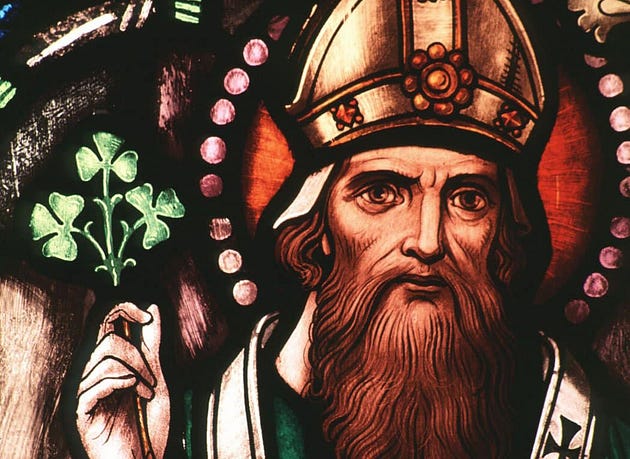
Maybe There Are Banshees: Friendship, Fault Lines, & the Fractured Conscience of American Christianity

In the opening shots of Martin McDonagh’s film The Banshees of Inisherin, we’re introduced to a fictional Irish town that, at first glance, seems totally idyllic. We descend from the sky, taking in the emerald sweep of pastureland. As the camera drifts along the seaside, we hear strains of an ethereal chorus sung in Gaelic. Next, we glimpse a lone figure striding through the town’s harbor. Gulls wheel in the air above Pádraic Súilleabháin, and a rainbow is visible behind him. He smiles and waves at passerby with easy familiarity. Reaching a fork in the road, the farmer turns toward the home of his friend, Colm Doherty, eager to invite Colm to the local pub for a pint or two. For one brief minute, the world seems at rights. Nothing in these images augurs the chaos that is about to break loose on the isle of Inisherin.

Much to Pádraic’s surprise, Colm doesn’t want to share a pint. In fact, he doesn’t want to continue his friendship with Pádraic at all. When the farmer finally corners his evasive drinking buddy at the pub, Colm heaves a sigh and confesses: “I just don’t like you no more.” The blunt declaration bewilders Pádraic, who can only blink and stammer in reply: “But you liked me yesterday.” The rationale for Colm’s change of heart soon becomes clear: he’s waist-deep in an existential crisis. Cognizant of his dwindling lifespan, he yearns to compose music that will outlast him. He can’t spare any more time for Pádraic’s dull chatter, which regularly centers on topics like the ingredients of “pony shite.”

Padráic (Colin Farrell) confronts Colm (Brendan Gleeson) outside the pub. Image credit: Vanity Fair

To Pádraic, Colm’s decision to cut ties is incomprehensible. Unwilling to let the matter go, Pádraic hounds and harangues his fiddle-playing friend until the latter issues a grisly ultimatum: every time that Pádraic talks to him, Colm will chop off one of his own fingers. Pádraic is horrified, and you might expect the dispute to end there. But this is an Irish film, and a Martin McDonagh picture to boot – equal parts black comedy and Shakespearean tragedy. By the time the credits roll, fingers will be severed, deaths will be suffered, and Inisherin’s tranquility will be shattered. Explaining his new tune – “The Banshees of Inisherin” – at the midpoint of the film, Colm conjectures that the island’s fragile peace may never have existed at all. “Maybe there are banshees [on Inisherin]… I just don’t think that they scream to portend death anymore. I think they just sit back, amused, and observe.”

If you haven’t seen The Banshees of Inisherin yet (and if you can stomach a few dismemberments), consider this your recommendation. It’s a cinematic masterclass that was nominated for nine Oscars, and it features career-best performances from acting legends Colin Farrell and Brendan Gleeson. It’s also laugh-out-loud funny. Like all great stories, the film holds layers of meaning that require time and patience to unravel. Banshees blew me away when I saw it in theaters in 2022, and I was eager to see what I might glean from a second viewing. Braced for a fresh round of Irish spirits (both alcoholic and mystical), I discovered that Martin McDonagh’s tale of fractured friendship had instead conjured up ghosts from my own past – specifically, my long history as a member of the American evangelical church.

In retrospect, this shouldn’t have been surprising. I rewatched Banshees in early November, as the tidal wave of anxiety and animosity surrounding the U.S. presidential election reached its crest. Eight years ago, eighty percent of White evangelical Christians voted for Donald Trump, igniting fierce debates about the church’s influence on American politics. This year, the same percentage cast their vote for the controversial candidate. For many Americans, Trump’s ascendancy is a divinely orchestrated triumph (“Jesus is our Savior, and Trump is our president,” proclaims a new deluge of Republican merchandise). For others, Trump’s win is deeply distressing – a harbinger of doom akin to Martin McDonagh’s banshees. The run-up to November 5 unfurled a litany of distressing headlines: widespread fear, assassination attempts, incendiary rhetoric, misinformation campaigns, promises of retribution, natural disasters, bomb threats at polling stations, and much more. Debates about public policy rage not only in government offices but also in homes and schools and churches across the country. Many of us, if we’re honest, feel more vulnerable than ever. No matter where you stand in America’s political landscape, the widening fault lines are impossible to miss.

In the wake of current events, it’s no wonder that Banshees‘ tale of simmering grievances brought religion and politics to mind. The story asks questions that are at once timely and timeless: Where do conflict and bigotry originate? What prevents us from truly seeing and understanding each other? Can worldview differences be overcome, and if so, how? McDonagh’s film may be set in 1920s Ireland, and it may focus on the intimate details of a particular friendship. Yet, for those with eyes to see and ears to hear, it also has profound things to say about our modern culture wars – specifically, about the perception, the peril, and the power of human vulnerability.

The following essay combines cinematic analysis with thoughts on White evangelicalism and its political legacy in the United States. A few disclaimers are in order before we begin. This is the first overtly political piece I’ve ever written for my blog. My content explores intersections between contemporary art, culture, and spirituality, and my ultimate goal is the celebration of beauty, not social critique. Consequently, I’ve wondered whether to publish this post at all. I worry that it might sound patronizing, that it’ll almost certainly be misunderstood by some, and that it may ignite outrage. Yet I’ve decided to publish anyway, compelled to do so by my conscience. To quote Albus Dumbledore in Harry Potter and The Goblet of Fire: “Dark times lie ahead of us, and there will be a time when we must choose between what is easy and what is right.” Silence on political matters will no longer do, and I find that the risk of controversy is, after all, one that I must take. I hope this essay will provoke thought, encourage discussion, and bridge deepening social divides. In pursuit of those aims, I’ve taken care to write as clearly and compassionately as I can, aware that I’ll inevitably fall short of my aspirations. If the views that I express here run counter to yours, I hope you’ll grant me the charity of a fair hearing (at the very least, please don’t threaten to chop off any of your fingers).

The following reflections arise from a place of love. I was once an earnest follower of Jesus Christ, committed wholeheartedly to the work of evangelism and discipleship. Two years ago, after a prolonged and painful crisis of faith, I made the difficult decision to leave the Christian church, unable to believe its core tenets anymore. I now stand outside that church’s walls, but I’m not distant from it. For twenty-seven years, it was my entire world. Most of my friends and family members still call it home. I hold deep respect for evangelicals, many of whom lead lives of generous, self-sacrificial love. Evangelicalism is no monolith, and many of its adherents would agree with the concerns and critiques that I’ll share below. This essay muses on troubling trends in the White evangelical church as a whole – actions and attitudes in which I myself have been complicit – and makes no claims about the moral status of particular evangelicals. I’ve discarded many of my former convictions, but I think Jesus was right when he taught that truth sets us free (John 8:32). Honest self-examination is often uncomfortable, but it’s the only way to expose our blind spots and broken places – to prevent destructive patterns from becoming malignant. I’m as susceptible to these patterns as anyone, and the mirror that I hold up to Jesus’ American followers is, in the end, one that I must also hold up to myself.

One final note: This essay contains spoilers. Without any further ado, what might a film about two squabbling Irishmen teach us about the fraught world we inhabit?

I. “What’s the matter with everybody?”: The perception of vulnerability

Pádraic spies on Colm. Image Credit: The National Catholic Reporter

If there’s anything the characters of Banshees have in common, it’s their struggle to understand the sufferings of others. McDonagh’s film suggests emotional distance through physical blocking: characters duck behind walls to escape awkward conversations, stare at neighbors through windowpanes and spyglasses, and frequently fail to meet each other’s gaze. Misunderstandings abound on Inisherin. Early in the film, Pádraic’s sister Siobhán (played by Kerry Condon) suggests that Colm’s behavior may be a symptom of depression. Pádraic is quick to agree: “That’s what I was thinking, that he’s depressed!” However, the farmer repeatedly fails to grasp how his impulsive pleas and outbursts may be affecting Colm, even after the musician’s digits begin to disappear. Colm, for his part, seems blind to the emotional toll his absence has inflicted on Pádraic. During a tense run-in at the pub, Colm laments that he and Pádraic “were doing so well” with their pact of silence, to which an inebriated Pádraic retorts: “I wasn’t doing so well!”

Again and again, the sorrows voiced by Inisherin’s townsfolk fall on deaf ears. “Do you never got lonely, Pádraic?” Siobhán asks early in the movie, exposing her inner world in a rare moment of candor. Pádraic responds to her with the same dismissiveness that he shows Colm: “What’s the matter with everybody? Jesus!” Later in the film, Pádraic asks the same question – “What’s the matter?” – when he hears Siobhán weeping in her bed. This time, his tone is filled with concern, but his sister can only whisper in reply: “Nothing.” Siobhán feels starved for companionship. However, she fails to spot this same hunger in the town fool, Dominic (played by Barry Keoghan), whose desperate need for kindness she continually rebuffs. When Dominic confesses his love for her, Siobhán turns him down gently. Yet her melancholy prevents her from extending comfort to the ragged victim of domestic abuse, who stares into the distance and murmurs: “Well, there goes that dream.”

Dominic (Barry Keoghan) professes his love for Siobhán (Kerry Condon). Image Credit: Decider

The Banshees of Inisherin reminds me that it’s often difficult to accurately perceive vulnerabilities, whether those vulnerabilities belong to us or to others. We’ve all experienced situations where we felt more endangered than we actually were, fears that people judged or disliked us more than they actually did, and the sinking feeling that everyone around us had it all together. Likewise, we’ve all made assumptions about the struggles faced by others, and we’ve all become fixated on our own problems to the neglect of other people’s. I know how tempting it can be, when I’m fearful or frustrated, to withdraw into my proverbial shell, lick my wounds, and ignore the burdens my wife is carrying (just ask her, she’ll verify). This tendency to exaggerate our own hardships while disregarding those faced by others is deeply human. It also serves a practical purpose: self-preservation. Like the moat or rampart surrounding a castle, our self-focus guards our sensitive spots from scrutiny and attack. However, it also distances us from others, making it harder to glimpse the suffering that our neighbors might be experiencing.

Our myopia isn’t just fortified by internal barriers; it’s also the product of external divides. Encounters with marginalized people groups, whether they take place on a short-term missions trip, at a homeless shelter, or through the screen of a cinema, have a way of placing our struggles into perspective. Conversely, separation from racial, cultural, or religious outsiders makes it much easier to underestimate their vulnerabilities and, in doing so, to overestimate the threat they pose to our welfare.

Growing up in American evangelical churches, I was told many things about the secular world, and few of them were rosy. My fellow congregants and I believed that God loved everyone, no matter where they came from or how many poor choices they’d made. At our best, we sought to embody God’s unconditional welcome through acts of charity and hospitality. Yet we also believed that we were profoundly vulnerable. Persecution was inevitable for those who followed Christ – hadn’t Jesus himself taught this to his disciples (Mark 10:29-30, Matthew 5:10-12, Luke 21:10-19, John 15:19-20)? Our lives might appear stable, but this was an illusion; clearly, we were living in the last days, and society was a runaway train bound for ruin. Immorality was rampant, Jesus’ return was imminent, and the holy horrors depicted in the Book of Revelation might break loose at any time (I remember binge-reading the Left Behind: The Kids series in middle school – all forty volumes! – and gulping as Jerry B. Jenkins and Tim LaHaye described the pursuit, imprisonment, and execution of American believers by non-Christians). Missionary tales of overseas persecution amplified our fears, reminding us that the people whom we were called to love might turn on us at any time, just as they had once turned on Christ. When we exited our churches on Sunday mornings, we were soldiers plunging into a spiritual battleground.

Persecution was discussed not only as a future prospect but also as a present reality. Again and again, I heard White evangelicals speak of a secular “agenda” to undermine religious values and bar American Christians from the public sphere. This plot, I learned, was spearheaded by liberals, Democrats, atheists, socialists, and members of the LGBTQIA+ community. Besides government halls and the entertainment industry, their main target was classrooms. Purported evidence of educational discrimination was sketchy, most of it concerning the teaching of evolution, the ban on corporate prayer, and the affirmation of queer relationships in public schools. These things might seem harmless, but they were just the tip of the secular iceberg. Propaganda films like God’s Not Dead and Expelled: No Intelligence Allowed portrayed universities as hotbeds of censorship, and the latter linked the teaching of Darwinism to such far-flung woes as apostasy, nihilism, fascism, eugenics, warfare, and (you guessed it) the Holocaust. Pastors trained students in apologetics – the reasoned defense of Christian doctrine – to brace them for colleges that would inevitably seek to squelch their faith. If atheist professors didn’t curb-stomp students’ morals, then binge-drinking and casual sex probably would. American colleges weren’t irredeemably evil, but they weren’t safe either. Here, as elsewhere, God’s truth and God’s people were under fire.

Looking back, I’m struck by how readily I swallowed these claims. In my twenty-seven years as an evangelical, I never once experienced persecution from nonbelievers, nor did I witness a single instance of a fellow Christian being mistreated because of their faith. Alleged examples of persecution usually concerned the right of non-Christians to practice morality outside the bounds of traditional religion, like the legalization of same-sex marriage in 2015. Inconvenient facts whizzed overhead: the fact that most Americans, including almost all congresspeople, identified as Christians; the fact that Jesus and the Bible were regularly invoked in political discourse; the fact that Christians were the only religious group campaigning for prayer in public schools (can you imagine how people would react if Muslims made the same appeal?); the fact that Christian churches, and many Christian schools, enjoyed tax-exempt status. The historical record is clear: Christians in America have always held the reins of social and political power. If Donald Trump’s landslide victory in 2024 reveals anything, it’s that White evangelical fears of a covert liberal takeover (including claims that Democrats rigged the 2020 election) have always been bogus, as flimsy and unfounded as Flat Earth science. Given these realities, how could I have ever thought that Christians in America were a persecuted minority?

Sadly, the answer is simple: I hadn’t spent time listening to non-Christians and other cultural outsiders. During and after college, when I finally befriended Muslims and atheists and members of the queer community, I realized just how little I understood about what legitimate persecution entailed. Consider these stunning statistics about the discrimination faced by America’s LGBTQIA+ population, compiled by the National Sexual Violence Research Center:

  • Queer people are 4x as likely to experience violence as straight people.
  • 50% of trans people have been sexually assaulted.
  • In 2020, murders of trans people were at an all-time high, and most victims were women of color.
  • Trans people are 7x as likely to experience police brutality as straight people.
  • 53% of trans people have been publicly harassed, 90% at their workplace.
  • More than 50% of queer workers reported concealing their romantic relationships to prevent workplace hostility.
  • 46% of homeless LGBTQIA+ youth were disowned by their families due to their sexual orientation or gender identity, 43% were expelled from their houses by parents, and 32% were physically, sexually, or emotionally abused.
  • Queer youth are 5x as likely to die by suicide as straight youth.
  • Queer people are more likely than straight people to experience unemployment, housing discrimination, poverty, and denial of health services due to their sexual orientation or gender identity.

These aren’t just statistics. They’re stories painfully familiar to my queer friends. Suffering isn’t a contest (not one that I want to partake in, anyway), but the discrimination faced by members of the LGBTQIA+ community far exceeds any persecution faced by White evangelicals in America. I don’t list these facts to minimize real hardships that particular evangelicals might experience. Rather, I share them to highlight the widening chasm between evangelical perceptions of discrimination (what is pejoratively referred to as “the Christian persecution complex”) and the harsh realities faced by genuinely oppressed people groups. Daniel Cox, director of the Survey Center on American Life, describes this worrying trend in his article “Why Most Evangelicals Say They Face ‘A Lot’ of Discrimination.” According to Cox, the past fourteen years have evinced “a profound reversal in who white evangelicals believe faces discrimination in American society.” While most White evangelicals rejected the idea that they were discriminated against in 2009, sixty percent now report that they face “a lot of discrimination.” During the same period, the percentage of White evangelicals who perceived gay and lesbian people as targets of discrimination fell from sixty percent to thirty-nine percent. The question facing us in today’s America isn’t whether queer people are vulnerable. They are, and they always have been. The question is whether we’re still able to see those vulnerabilities for what they are.

Have you ever visited a foreign country? If you have, then you know that international travel isn’t easy (unless, of course, you’re a dashing secret agent with the last name Bond). Passports and visas are required for entry, along with immunizations and round-trip flight tickets. Hotel reservations must be secured, a new system of public transportation navigated, fragments of an unfamiliar language rehearsed. Once these barriers are crossed, others remain. Even if you move to the country, apply for citizenship, and dedicate your life to the task of cultural immersion, you’ll never experience the place in the same way that native inhabitants do. Some elements of its life, its language, and its landscape will always remain a mystery.

Whether we realize it or not, every person we’ll ever meet is a foreign country. Your interior world – the product of your unique parentage, biology, upbringing, and experience – is literally one-of-a-kind, unparalleled in the history of the universe. Consequently, your hardships and heartbreaks are unique, too. The author of the Book of Proverbs put it succinctly: “Each heart knows its own bitterness, and no one else can share its joy” (14:10). Like a trip to a foreign country, the quest to understand another person – to really see them as they are, with all their vulnerabilities – can’t be taken lightly. It requires time, patience, and steadfast resolve. We can choose to overlook the vulnerabilities of others, but like an ill-equipped stowaway to a foreign nation, or like Pádraic, Colm, and Siobhán, we do so at great peril. If banshees wail in mourning, it is for sorrows yet to come.

II. “To our graves we’re taking this”: The peril of vulnerability

Mrs. McCormick (Sheila Flitton) is Inisherin’s neighborhood banshee. Image Credit: Looper

When we first meet Colm and Padráic, their feud seems extraordinarily petty, and we can’t help but laugh as Inisherin’s townsfolk struggle to make sense of it. As the story progresses, however, humor gives way to horror. Colm’s withdrawal from community deepens his loneliness, and it also leads to self-harm. Rather than quelling Padráic’s anger, Colm’s disappearance inflames it, prompting the farmer to commit uncharacteristic acts of cruelty. Dominic marvels at the change in his friend’s behavior: “I used to think you were the nicest of them.” Padráic’s protest – “I am the nicest of them!” – rings hollow. His scrawny companion knows malice when he sees it. Farrell and Gleeson deliver masterful performances here, charting their characters’ emotional spirals with subtle shifts of posture, voice, and expression.

The longer this battle of wills continues, the harder it is to stop. Pádraic ignores the warnings of Mrs. McCormick (played by Sheila Flitton), the wizened soothsayer who haunts his steps like a shadow: “A death shall come to Inisherin afore the month is out. Maybe even two deaths.” He also ignores his sister, Siobhán, who urges him to bury his resentment and accompany her to the mainland. Siobhán’s letter to Pádraic references the Irish Civil War of 1922-1923, a bloodbath that rumbles like thunder in the background of Banshees. McDonagh never shows us war footage (a brilliant directorial choice), but he evokes it with subtle touches – the drumbeat of distant cannon fire, rumors of public executions, a whispered prayer for endangered soldiers – that invite us to draw connections between Inisherin’s localized tensions and broader historical trends. Whether they occur between neighbors or nations, all wars start small. The conflicts that ravage Ireland might once have seemed as trivial as the chip on Pádraic’s shoulder. Yet resolving them now seems like a herculean task. Just before the film’s climax, Pádraic confronts Colm at the pub, and his words leave no room for reconciliation: “To our graves we’re taking this. To one of our graves, anyways.”

Reverend Dr. Martin Luther King Jr. once framed hatred as an outcome of social distance: “I am convinced that men hate each other because they fear each other. They fear each other because they don’t know each other, and they don’t know each other because they don’t communicate with each other, and they don’t communicate with each other because they are separated from each other.”3 Martin McDonagh would seem to agree. The Banshees of Inisherin traces an arc that recurs with sickening reliability throughout human history: isolation spawns suspicion of ethnic, religious, or cultural “others,” which in turn stokes hostility that eventually erupts into violence. This is the peril of vulnerability. We might see nothing wrong with burying our heads, ostrich-like, in the sand. What harm could possibly come from minding our own business, sticking to our own kind, and ignoring those pesky neighbors? A lot of harm, it turns out. Oppression thrives on distance, and it dehumanizes targets and instigators alike. Likewise, indifference to the vulnerabilities of others renders everyone, including ourselves, more vulnerable.

In his book Radical Hope: Ethics in the Face of Cultural Devastation, philosopher Jonathan Lear explores the social and psychological upheaval faced by members of the Crow nation whose tribal lands were stolen by the U.S. government. Before they were forced onto reservations in Montana, the Crow people lived alongside White settlers, trading goods and forging alliances with those they struggled to understand. Eventually, White greed and distrust of indigenous folk short-circuited this cultural exchange. Lear describes this situation as the “closing of a middle ground” that had once given rise to unique cultural forms:

The middle ground is the place in-between – in-between cultures, peoples, and in-between empires and the non-state world of villages. On the middle ground, diverse peoples adjust their differences through what amounts to a process of creative – and often expedient – misunderstandings. They often misrepresent and distort both the values and the practices of those they deal with. But from these misunderstandings arise new meanings and, through them, new practices – the shared meanings and practices of the middle ground.

According to Lear, the middle ground is both uncomfortable and generative. Dialogue with those who differ from us isn’t easy. It compels us to examine our biases, to expose our convictions to critique, and to reevaluate our understandings of ourselves. Yet it also opens up new ways of being in the world that we may never have considered otherwise. Like a vaccine that appears to threaten our immune system while producing vital antibodies (yep, I’m going there), tough conversations strengthen our resistance to forces that might threaten to tear us apart. The closing of a middle ground might seem like the safer route. Why risk misunderstandings if you don’t have to? But the dismissal of dialogue breeds fear and enmity just as certainly as the rejection of medical treatment breeds vulnerability to infection. Once their lines of communication with White settlers were closed, the Crow people were decimated, and the possibility of ongoing, egalitarian cultural exchange was lost.

In the lead-up to the 2024 election, my heart broke as I witnessed a Republican campaign that was far more hateful than any in recent memory. Attacks on immigrants, racial and ethnic slurs, sexist tirades, and homophobic remarks weren’t slips of the tongue that necessitated hasty apologies; they were the movement’s stock-in-trade. I don’t want or need to cite the evidence here. It’s available in dozens of public rallies, debates, and interviews, as flagrant as a MAGA banner. To quote the apostle Paul’s speech to King Agrippa in Acts 26:26, these things were “not done in a corner.” Donald Trump’s admiration for dictators living and dead is similarly undisguised, and (need I say it?) that shouldn’t surprise us at this point. The demonization of minorities has been a central feature in totalitarian playbooks for thousands of years. It also preys on fears kindled by religious fundamentalism. Daniel Cox writes:

Stoking the specter of persecution can pay large dividends. It keeps people tuned in and paying attention, providing a strong incentive to donate, vote, and volunteer. If an elected official can convince you that they are the only thing standing between you and oblivion, they do not have to do anything else to win your vote. Character flaws, sexual misbehavior, or financial misdeeds are easily overlooked. Trump doesn’t have to be a good guy, so long as he’s “our” guy.

This concession of moral ground for political clout comes at a high price. Cox’s article goes on to describe the well-attested link between fundamentalist beliefs and acceptance of misinformation. According to Cox,

adopting a worldview in which powerful and nefarious forces are arrayed against you, your children, and your way of life makes all types of conspiracies seem more plausible. And here again, we see white evangelical Christians are far more prone to believe in political conspiracies than others.

During my years as an evangelical, I regularly heard the following passage preached as a warning of impending persecution:

But mark this: There will be terrible times in the last days. People will be lovers of themselves, lovers of money, boastful, proud, abusive, disobedient to their parents, ungrateful, unholy, without love, unforgiving, slanderous, without self-control, brutal, not lovers of the good, treacherous, rash, conceited, lovers of pleasure rather than lovers of god – having a form of godliness but denying its power. Have nothing to do with such people... They are men of depraved minds, who, as far as the faith is concerned, are rejected. But they will not get very far because, as in the case of those men, their folly will be clear to everyone (2 Timothy 3:1-9).

Sadly, the author of 2 Timothy was mistaken. It seems that the folly he described isn’t clear to everyone; some of these men get very far, indeed. The recent marriage of American evangelicalism with Republican politics has spawned a sinister irony. In their quest to escape persecution by imagined “antichrists,” White evangelicals have elected one themselves, aligning their ranks with a leader who unashamedly embodies the very “last day” qualities their scriptures warned them against. Here, we glimpse the peril of vulnerability on full display. Left unchallenged, our misplaced fears sometimes create the very chaos we dread. Insecurity gives way to hostility, long-held values are compromised, and minor feuds swell into major conflicts. Pretty soon, like Pádraic in a late scene from The Banshees of Inisherin, we find ourselves scowling into the mirror, unable to recognize the people we’ve become.

Near the end of his article, Daniel Cox shares this quote by an influential evangelical pastor named Robert Jeffress: “I don’t want some meek and mild leader or somebody who’s going to turn the other cheek. I’ve said I want the meanest, toughest SOB I can find to protect this nation.” While they might not agree with Jeffress’ sentiment, millions of American evangelicals have now endorsed it (twice) with their ballots, and the irony deepens. If a “meek and mild” president is no longer a viable option, what, I wonder, would modern evangelicals make of “gentle and lowly” Jesus Christ – the leader who once commanded them to “turn the other cheek” (Matthew 5:39, 11:29)? Might the humble carpenter from Nazareth have something to teach us about the power of vulnerability? It’s to that question that we now turn.

III. “Does God give a damn about miniature donkeys?”: The power of vulnerability

Colm confesses his despair to the local priest. Image Credit: The Banshees of Inisherin.

If you haven’t picked up on this already, let me tell you that The Banshees of Inisherin isn’t a cheery movie. Comic relief aside, the events depicted are about as uplifting as a rainy-day funeral procession, and the film’s conclusion offers little in the way of redemption. That said, hope still flickers on the shores of Inisherin, particularly in a brief scene that I’d forgotten about after my first viewing. Pondering that scene now, I find it offers a way forward – an answer to the problem and peril of human vulnerability that also bears deep resonances with the Christian story.

Near the end of Banshees, Colm sits in a confessional booth, talking with Inisherin’s priest about his despair. During the conversation, the musician admits that he feels guilty for inadvertently causing the death of Padráic’s beloved donkey, Jenny (the poor beast choked to death on one of his mangled fingers). Bemused, the priest asks: “Do you think God gives a damn about miniature donkeys, Colm?” Colm thinks for a moment, and then he replies: “I fear he doesn’t. And I fear that’s where it’s all gone wrong.”

Sounds hopeful, right? Stay with me. Following this cryptic exchange, Padráic meets Colm at the pub, delivering an ultimatum that recalls Colm’s earlier speech in the same location: “So tomorrow, Sunday, God’s day, around two o’clock, I’m going to call up to your house and I’m gonna set fire to it, and hopefully you’ll still be inside it. But I won’t be checking either way. Just be sure and leave your dog outside.” The next day, Padráic executes his plan with cold efficiency. He stacks firewood around the edge of Colm’s house. He finds Colm’s dog and hefts it into his wagon. Finally, he smashes a lantern against the wood, igniting a blaze that reduces the house to rubble. Colm sits inside, as motionless as a statue, and it seems that his fate is sealed.

But the story doesn’t end there. In the closing scene of Banshees, Padráic returns to the beach beside Colm’s ruined home and finds his old friend standing on the shore. Colm’s dog races to its master, who is overjoyed to see it. Padráic’s greeting is far chillier. When Colm muses that their feud may have run its course, the farmer retorts: “Some things there’s no moving on from. And I think that’s a good thing.” Yet Colm’s expression of gratitude – “Thanks for looking after me dog for me” – receives a different reply: “Anytime.”

The Banshees of Inisherin spends most of its two-hour runtime depicting the tendency for vulnerabilities – both actual and misperceived – to divide people. Yet it also highlights the potential for those same vulnerabilities to bridge divides. Colm’s confession to the priest reveals his dawning awareness that Padráic’s grief may not be so different from his own despair, after all. Likewise, Padráic’s refusal to hurt Colm’s dog evinces a surprising spark of empathy, especially when you consider the suffering endured by his own donkey. Padráic knows what it’s like to lose a pet amidst terrible loneliness, and that sorrow motivates mercy – a twisted sort of mercy, to be sure, but mercy nonetheless.

Christmastide feels different in the wake of my departure from Christianity. Songs and rituals that once filled my heart with joy now make me wistful. For those who grieve departed friends and family, and for those who mourn the collapse of a religious worldview and community, the holidays can be a very painful time. However, I still find myself drawn to the nativity. The opening chapters of the New Testament contain one of the greatest plot twists in world literature. Desiring to draw near to human beings, Yahweh, the creator and sustainer of the universe, chooses to be born as a helpless infant. Jesus’ birth takes place at a time of great turmoil. His people are oppressed, his society is riven by political squabbles, and his land is ruled by a murderous tyrant. Understandably, many Jews long for a military Messiah who can rescue them from Roman occupation. Yet the promised Savior arrives on the outskirts of town, unnoticed by royalty and peasants alike, kicking and wailing and soiling himself in a manger. It’s a risky move on God’s part. What could be more vulnerable than a baby?

As his story unfolds, Jesus continues to choose the way of vulnerability. He roves Judea as a homeless, itinerant preacher, mentoring a crew of foolish and fractious disciples. He shuns the political spotlight and rebuffs offers of kingship, spending most of his time with those on society’s margins. Eventually, when he’s arrested and framed by Jerusalem’s authorities, he refuses to defend himself, extending grace to the very people who crucify him. By almost any measure, Jesus’ ministry seems foolhardy. Why would the Lord of the cosmos adopt such a wimpy game plan? The answer, scripture tells us, is a longing for relationship: “For God so loved the world that he gave his one and only Son, that whoever believes in him shall not perish but have eternal life” (John 3:16).

This, at last, is the power of vulnerability. Societal fault lines don’t emerge from a vacuum; they mirror the fractures that run through each of our hearts. Yet those very wounds – our crippling insecurities, our suffocating fears, the bruised and busted-up parts of ourselves that we try desperately to hide – are the key to meaningful connection with others. The playwright and novelist Thornton Wilder captured this idea perfectly when he wrote: “The very angels themselves cannot persuade the wretched and blundering children on earth as can one human being broken on the wheels of living. In Love’s service, only wounded soldiers can serve.” We can always decide to suppress our vulnerabilities – to swap the discomfort of honest dialogue for the security of political power and, by doing so, to insulate ourselves against the possibility of suffering. However, this Faustian bargain takes its toll. Philosopher Martin Hägglund elaborates this point in his magnificent book This Life: Secular Faith and Spiritual Freedom:

Your love may lead to anger when there is harm, grief when there is death, despair when hope is crushed. But the same vulnerability is also what makes you receptive to the world, to yourself, and to others. You cannot shut down your sense of uncertainty and risk without also shutting down your capacity to feel joy, connection, and love. Only by acknowledging the importance of something beyond your control – that is: only through vulnerability – can you be moved by what happens. The precious quality of joy is inseparable from a sense of its precariousness, and the value of connecting to another person would not be felt without the risk of disconnection.

In a similarly insightful passage from Radical Hope, Jonathan Lear suggests that modern political rifts may be symptomatic of a refusal to seriously reckon with our shared vulnerabilities:

We live at a time of a heightened sense that civilizations are themselves vulnerable. Events around the world – terrorist attacks, violent social upheavals, and even natural catastrophes – have left us with an uncanny sense of menace. We seem to be aware of a shared vulnerability that we cannot quite name. I suspect that this feeling has provoked the widespread intolerance that we see around us today, from all points on the political spectrum. It is as though, without our insistence that our outlook is correct, the outlook itself might collapse. Perhaps, if we could give a name to our shared sense of vulnerability, we could find better ways to live with it.

Like Lear, I’m well aware that bigotry isn’t the exclusive property of Republicans. Those on the left are equally susceptible to the vices that accompany power. Yet I speak here to conservatives, especially evangelical Christians, because their dominance in American politics is no longer refutable. There’s no question that Trump’s regime will hurt people; the president’s own promises of retribution, censorship, and deportation have made this fact abundantly clear. I may disagree with your decision to vote for him (I could write a whole essay about the moral bankruptcy of the “lesser of two evils” argument), but if your views on issues like abortion compelled you to do so regretfully, then I can’t presume to judge you. There was a time when my own religious beliefs made voting for Democrats inconceivable. What I can do is ask you, with all the sincerity that I can muster: What will you do for those whose lives will be upended by the men you put in power? How will you speak up for the vulnerable – the really, truly, desperately vulnerable? Will you remember your Savior’s teachings about defending those on the margins of society (Matthew 5:43-48, 25:31-46; Luke 10:25-37)? Or will you be judged as one who neglected them when it mattered most?

Faced with the priest’s query to Colm – “Do you think God gives a damn about miniature donkeys?” – evangelicals should respond with a resounding “Yes.” After all, if you accept the veracity of the nativity stories, these shy animals were likely among the first witnesses to Jesus’ birth. The rabbi also rode a donkey into Jerusalem, asserting his claim to Israel’s throne with an act of humility rather than fanfare. Colm’s response to the priest is freighted with sorrow: “I fear he doesn’t. And I fear that’s where it’s all gone wrong.” Surveying the ruptured landscape of Inisherin, the fingerless fiddle-player sees little evidence of God’s heart for the vulnerable. How could he possibly believe in a divine love – a love which stretches from the loftiest height to the smallest, most insignificant creature – when the very people who claim to love him disregard his pain? If (God forbid) nothing changes, and if evangelicals across this nation continue to excuse cruel, greedy, racist, deceptive, misogynistic, and sexually abusive behavior for the sake of their political ends, then I fear that future generations, upon hearing the word “Christian,” won’t picture Jesus Christ. I fear they will picture Donald Trump.

Today – January 20, 2025 – is inauguration day. Many are celebrating the political gains of the Republican party. Many others are lamenting what feels like a giant step back. I wish I could say that I feel hopeful about America’s future. Honestly, I don’t. I feel sad, angry, and frightened. I grieve Trump’s return to the presidency, but more than that, I grieve the Trumpism that is spreading in the church I once called home. I no longer believe in the evangelical God. If I did, I think I’d wonder whether that God really cared for miniature donkeys, for immigrants, for queer people, or for nonbelievers like me. I might draw comfort from the words of Reverend Dr. Martin Luther King, Jr., whose legacy of compassion will endure far beyond the rubble of Trump’s administration: “We must build dikes of courage to hold back the flood of fear. We must accept finite disappointment, but never lose infinite hope.”
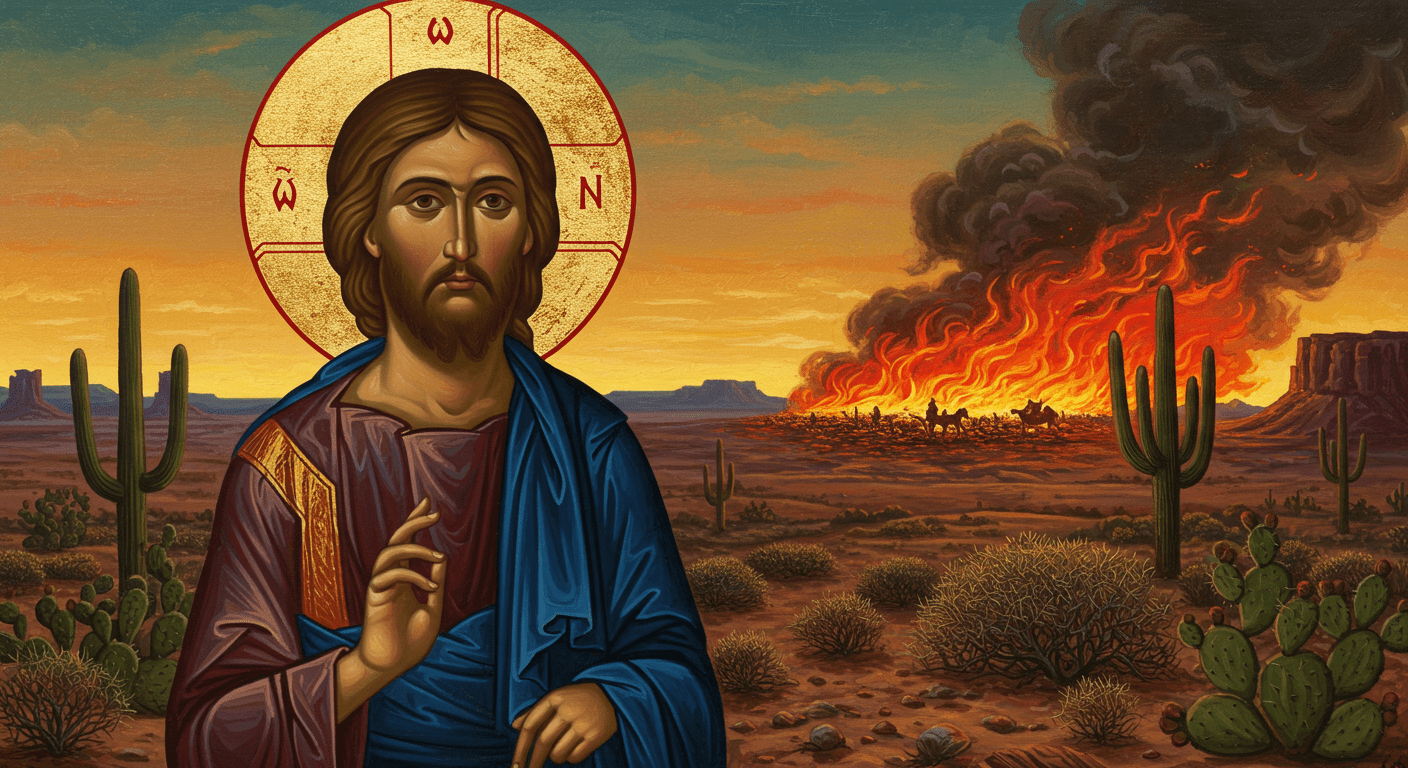

American evangelicals now face a difficult choice. Like Padráic in the final frame of Banshees, they can reach out across the gulf, just as Jesus once did; or they can turn and walk away, leaving vulnerable people alone with their wounds. We’ve already been warned. A banshee sits on the nearby cliff, silently watchful. How will our story end?


Mrs. McCormick watches from the cliff. Image Credit: The Banshees of Inisherin.

Sources Referenced:
1. “Fact Sheet on Injustice in the LGBTQ community” by the National Sexual Violence Resource Center: https://www.nsvrc.org/blogs/fact-sheet-injustice-lgbtq-community
2. “Why Most Evangelicals Say They Face ‘A Lot’ of Discrimination” by Daniel A. Cox: https://www.americansurveycenter.org/newsletter/why-most-evangelicals-say-they-face-a-lot-of-discrimination/#:~:text=There’s%20another%20reason%20white%20evangelicals,being%20fanned%20by%20political%20elites.
3. “Dr. Martin Luther King’s visit to Cornell College”: https://news.cornellcollege.edu/dr-martin-luther-kings-visit-to-cornell-college/
4. “The Mastery of Fear or Antidotes for Fear” by Martin Luther King, Jr: https://kinginstitute.stanford.edu/king-papers/documents/mastery-fear
5. Radical Hope: Ethics in the Face of Cultural Devastation by Jonathan Lear.
6. The Collected Short Plays of Thornton Wilder by Thornton Wilder.
7. This Life: Secular Faith and Spiritual Freedom by Martin Hägglund.

Rethinking the Rainbow: What I Learned About Queer Pride by Leaving Christianity

“Wow, that sounds a lot like coming out!”

Recently, while sharing the story of my deconversion from Christianity, I received this same response from two friends – one straight, the other queer. Both of them recognized similarities between the struggles I faced as an apostate and the hardships encountered by queer people embracing their sexuality. As I’ve pondered my friends’ remarks, I’ve realized that the parallels run far deeper than I could have imagined. Additionally, I’ve been challenged to reexamine the LGBT rights movement with fresh eyes, to repent of my own complicity in systems of inequality, and to advocate for constructive dialogue between affirming and non-affirming communities. This post is an account of that journey.

Before I launch into this post, a few disclaimers and clarifications are in order. I’m no expert in gender studies or contemporary literature on sexual orientation. On the contrary, I’ve only just begun to realize how much I still have to learn from my queer neighbors. Additionally, as a straight, cisgender man, I make no attempt to speak for members of the LGBT community, who must tell their own stories. My experience of spiritual deconstruction may resonate with their coming-out experiences to an extent, but it’s also of a fundamentally different type, and so there will be many aspects of their experiences which I simply can’t understand. Finally, I don’t expect this post to change many people’s opinions on gender and sexuality issues in the United States. Others are better-equipped to accomplish that task. What follows is merely a snapshot of my own thinking, learning, and becoming. However, I do hope that my story can make a positive difference, even if that difference is a small one.

If you’re non-affirming, I hope this post inspires you to reexamine your beliefs about your LGBT neighbors, to listen attentively to their stories, and to approach uncomfortable conversations with greater sensitivity and respect. As someone who only very recently left the conservative fold, I have zero right to judge those who remain within it. Yet, as someone who believes that disregard for queer narratives within religious communities is harmful, I feel compelled to speak out.

If you’re a member or ally of the LGBT community, I hope this post encourages you to be patient with your non-affirming neighbors, many of whom are grappling with difficult questions of religious faith and practice. I know from personal experience that interrogating deeply-held religious convictions can be an incredibly unsettling experience. In this bizarre and befuddling world that we inhabit, perhaps we all could use a little grace.

All right. Now that we’ve got those things out of the way, let’s dive in!


More to the Story

Over the past eight months, I’ve discussed my deconversion from Christianity with many people, most of whom identify as Christians. By and large, these conversations have been very warm, respectful, and supportive. I was fortunate to be raised within Christian communities that emphasized self-giving love and Christlike compassion over ideological division. Nevertheless, as I’ve shared my story with members of the evangelical church (by which I mean the evangelical community at large, not one particular institution), I’ve been confronted with many assumptions about my departure from that church.

People sometimes assume that I left Christianity because of hypocrisy in Christian communities, cultural pressures, mental health struggles, or an experience of God’s silence amidst suffering. These assumptions are relatively easy to correct. Although similar concerns have led many young people to abandon organized religion, my own deconversion wasn’t motivated by these things. First and foremost, my departure from the church was prompted by concerns about the reliability of the Bible. If I hadn’t lost my faith in the historical accuracy of the Old and New Testaments, then I wouldn’t have renounced my commitment to Jesus.

Other assumptions are much more painful and tricky to untangle. I’ve been told multiple times that my deconstruction was my own fault, caused by inadequate love for Jesus, an arrogant thirst for godlike knowledge, an insufficient grasp of scripture, rebellion against God’s will, satanic or demonic influence, or all of the above. Often, those who make such claims have made little effort to understand what my deconversion process actually entailed. They rarely seem open to reconsidering their diagnoses of my situation. Consequently, while I could present a host of evidence that undermines each of these assumptions, I sometimes feel like I’m fighting a losing battle, and I clam up. There are few things more disheartening than realizing that people have already made up their minds about you, regardless of what you might say in your defense.

As I’ve grappled with biased assessments of my deconversion, I’ve been convicted about my own former biases. Growing up within an evangelical culture, I inherited a number of flawed assumptions about the LGBT community which have collapsed through subsequent study and conversations with queer friends. I regularly heard (and believed some of) the following claims:

  • “No one is born gay.” (In fact, there is no scientific consensus on what causes homosexual attraction. Most scholars believe it results from a complex interplay of nature and nurture, genetic predisposition and environmental factors.)
  • “Homosexuality is a choice, not an identity.” (In fact, most queer people report little to no sense of choice or control over their sexual orientations.)
  • “Same-sex partnerships are mostly a modern, western phenomenon.” (In fact, romantic same-sex partnerships are well-documented throughout history and around the globe, including in every major sector of the animal kingdom.)
  • “Homosexual behavior may be exacerbated by family dysfunction or psychological struggles.” (In fact, there’s no link between homosexuality and psychopathology. It’s a normative, widespread disposition that has no detrimental mental health consequences. Additionally, many queer people come from stable, healthy families.)
  • “Gay and lesbian people can change their attractions and enjoy fulfilling, heterosexual marriages.” (In fact, while this may be true in rare cases, suppression of one’s sexual orientation can be deeply damaging. Conversely, acceptance and integration of one’s orientation increases health and well-being.)
  • “Queer people are only coming out because they want cultural sway and social acceptance.” (In fact, fear of rejection or reprisal prevents many people from coming out for long periods of time, especially those raised in conservative communities. Verbal harassment and abuse are nearly universal experiences for queer people, who still face significant social, employment, and housing discrimination in the United States.)
  • “Same-sex marriages are inherently unhappy and unstable.” (In fact, gay couples report equivalent levels of marriage satisfaction as straight couples. Many of them also form durable, lasting attachments.)
  • “Children raised in households with gay or lesbian parents will experience developmental struggles.” (In fact, children raised in gay households are no more likely than other children to experience developmental difficulties. They are just as happy and healthy as other children.)

Why do we make so many unfounded assumptions about people who are different from us? These beliefs don’t emerge from a vacuum. They’re the product of universal tendencies. We all tend to adopt the worldviews of the communities that raised us, to trust those who look and think like us, and to filter unfamiliar data through familiar categories. These tendencies make us shortsighted, but they also enabled our ancestors to recognize threats and to maintain social cohesion in dangerous environments. Faced with evidence that doesn’t fit our paradigms, we’re much more likely to force a fit than to allow that evidence to reshape those paradigms. This kind of behavior isn’t evil or dishonest. It’s a deeply human response, generated and reinforced by an unpredictable world.

Reflecting on the assumptions made about my deconversion and the hurt that some of those assumptions have caused, I’m saddened and humbled by my own mistaken assumptions about the LGBT community. Sure, I didn’t actively seek these opinions out. But I didn’t actively question them, either. My deconversion experience has taught me that there’s always more to the story than what fits neatly within our boxes. Life is incredibly complex, and our perspectives on it are far more limited than we usually like to admit. Each and every human being is a unique expression of that life – a walking mystery. Whatever beliefs we hold about queer partnerships, whether for or against, we would do well to set our preconceptions aside when engaging with the “other,” to strive to see and understand them as they are, to be “quick to listen, slow to speak” (James 1:19). We would do well to ask ourselves: Do I really know what makes this person tick? Am I open to the possibility that I could be wrong about them? Have I considered that they might have something valuable to teach me? The words of theologian and author Frederick Buechner are applicable here:

If we are to love our neighbors, before doing anything else we must see our neighbors. With our imagination as well as our eyes, that is to say like artists, we must see not just their faces but the life behind and within their faces. Here it is love that is the frame we see them in.


Crossing the Gap

One of the most difficult things about leaving organized religion was the profound sense of isolation. Immediately, I started seeking commiseration. I didn’t want sympathy – people feeling sorry for me and my situation. I wanted empathy – the assurance that I wasn’t alone in my struggle. The problem was, I didn’t know anyone who had left the faith or who was even seriously considering leaving the faith. My community was made up almost entirely of born-again, evangelical Christians. That isn’t to say that no one around me struggled with doubts. I knew I wasn’t the first person in history to grapple with skepticism or the only person at my church wrestling with hard passages of scripture. Yet, no one around me seemed as bothered or burdened by these issues as I was.

In those early months, the deepest comfort that I found came from online testimonies of deconstruction. The people sharing these testimonies were total strangers, but they also showed me that I wasn’t alone – that others had walked the same road for very similar reasons. Eventually, after publicizing my own deconversion story on this blog, I discovered that a number of friends in other parts of the country were navigating similar situations. Several of them reached out to me, thanking me for sharing my story and explaining that they, too, felt isolated in their struggles with doubt.

Why is it so difficult for those deconstructing religious faith to find community? While I can’t speak for others, I know that I played a role in my own isolation. Growing up within evangelical churches, I was taught that God loved nonbelievers. As a result, I needed to love nonbelievers, too. I believed that God wanted me to evangelize – to share the good news of Christ with neighbors through word and deed. Yet, from childhood through adolescence into adulthood, I had exactly one non-Christian friend who I actively did life with (looking at you, Aaron!). I interacted with non-Christians at work, at school, and across the street, but rarely did my relationships with them amount to more than casual acquaintance. Ninety-nine percent of my closest friends and companions were believers. I sincerely wanted to broaden my social circle, to break out of the “Christian bubble.” So, why didn’t I? Because life was easier with those in the bubble. We had more in common. We spoke the same language. There was less chance of awkwardness or discomfort.

My attitudes toward queer people were influenced by a similar lack of contact. Prior to entering college, I had no queer friends. Even after graduation, after many of my assumptions about the LGBT community had been challenged and replaced with more nuanced views, my contact with queer people was extremely limited. My Christian community had taught me what to think about members of the LGBT community. But I didn’t know anyone in that community, not really. That being the case, how could I be sure that my assessment of them was correct?

In his famous chapel address at Cornell College on October 15, 1962, the Reverend Dr. Martin Luther King, Jr. traced the roots of racial injustice to a surprising source. The catalyst of violence and oppression, he argued, wasn’t innate bigotry, mere simple-mindedness, or irredeemable evil. It was distance. King wrote:

I am convinced that men hate each other because they fear each other. They fear each other because they don’t know each other, and they don’t know each other because they don’t communicate with each other, and they don’t communicate with each other because they are separated from each other.

Why was it so hard to find non-Christian community after leaving the faith? Why did I harbor so many false assumptions about queer individuals? The answer to these questions is simple: I was afraid. I feared meaningful engagement – up-close-and-personal contact – with those beyond the walls of the church. Why did I fear interacting with people who believed and behaved differently than me? Because I didn’t know them. My knowledge of non-Christians and queer people was largely secondhand, founded on the opinions of others. I’d been taught to see those outside the faith as targets for evangelism, as lost souls in need of salvation, not as conversation partners to dialogue with, companions to journey alongside of, or friends to be shaped by. They were living on the other side of the tracks, and I’d been exhorted to mind the gap, not to cross it. When I finally did cross over, seriously engaging with non-Christian scholarship on the Bible and building relationships with members of the LGBT community, my assumptions about why people leave the church and who queer people are were exposed as shallow, simplistic prejudices.

A word to Christian readers: You may believe that Jesus loves gay people, bisexual people, and transgender people. You may believe that you love them yourself. You may even know some members of the LGBT community. But I invite you to ask yourself: How many queer people do you maintain close, committed, mutually enriching friendships with? How much time do you dedicate to hearing queer stories, to reading books by queer authors, or to reaching out to queer neighbors? Please don’t hear judgement in those questions. I speak as one who has failed miserably at practicing what he now preaches. Yet, I’m convinced that the barriers erected between conservative Christians and queer people – the barriers that have spawned misunderstanding, hatred, and discrimination for generations – will remain firmly in place, and will grow thicker with time, until we actually do the hard work of tunneling through them and getting to know those we disagree with.


No More Fear

Two weeks ago, I headed to downtown Grand Rapids to participate in the city’s annual Pride Festival. Several streets had been blocked off for the event, and the sidewalks were lined with tents, booths, and food trucks. Rap music thumped from speakers adjacent to a stage. As I slipped into the crowds milling about on the roads, I didn’t know what to expect. I had never attended an LGBT-themed event before. This was foreign territory. Yet, after twenty-seven years of making assumptions and watching from a safe distance, I had decided that it was high time to cross the gap. I felt compelled to acknowledge and repent of my former prejudices toward queer people, and I wanted to add my voice to the masses calling for equality.

Prior to leaving the Christian faith, I would’ve made certain assumptions about Pride gatherings: lots of young people, mostly LGBT, waving signs and placards in angry protest of heteronormative culture. Yet, what I saw that day challenged my paradigms, just as Biblical evidence had challenged my religious convictions. I saw thousands of people in brightly colored clothing – people of all different ages, races, sexual orientations, and religious backgrounds, walking and talking and laughing and singing together. I saw churches offering welcome, support, and resources to queer people in need. I saw people hugging, holding hands, and throwing their arms around each other’s shoulders, celebrating the gift of affection without any fear of judgement. As I watched the festivities, I was reminded that this world is full of stories – uniquely beautiful and three-dimensional stories – which can’t be reduced to labels or stuffed into boxes. I was reminded that the joys and heartaches which connect us are far stronger than the lines we draw in the sand. No longer separated from my queer neighbors, I realized that MLK was right after all. The fear was gone.

To my lesbian, gay, bisexual, and transgender friends and neighbors: I’m sorry. I’m sorry for making so many assumptions about who you were, for refusing to question the dogmas inherited from my faith community, and for never making the effort to cross the street and hear your stories. I know that I have a lot to learn. But I’m finally listening. Your road is an incredibly difficult one, and I never would’ve expected to walk a similar path. Yet, despite all the pain involved, I’m glad that I did. It’s so nice to have company, and the scenery is just more colorful here.