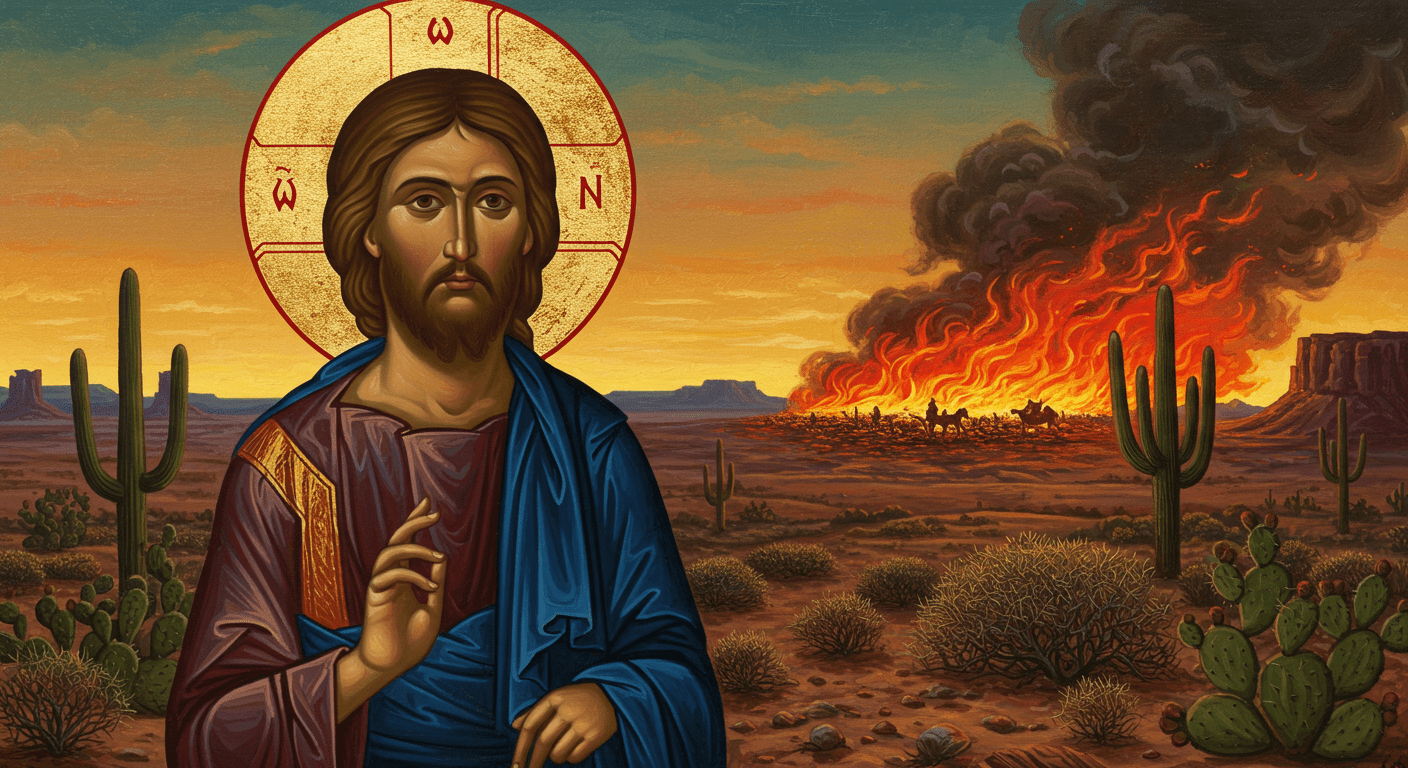
We were bound for the Badlands, and I couldn’t have been more excited.
When I was a kid, many of my heroes were pulled straight from TV Westerns. There was Davy Crockett from Disney’s King of the Wild Frontier, grinning a grizzly bear into submission. There was True Grit’s Rooster Cogburn, riding into battle with six-shooters drawn and the reins clenched between his teeth. And, of course, there was Chuck Norris’ Walker, Texas Ranger, roundhouse-kicking every unsavory character west of the Mississippi (I spent hours practicing this deadly move on furniture and replicating it with my action figures). These tales presented me with two groups of people — “good guys” and “bad guys” — that were both easily recognizable. The bad guys slunk around in caves, wore stylish black outfits, greased their mustaches, and kicked stray dogs for no discernible reason. The good guys walked tall, spoke with short but authoritative sentences, made women swoon just by glancing in their direction, and never shot first but always shot straightest. Justice, when it inevitably arrived with guns blazing, left the desert sand soaked in blood. And I couldn’t get enough of it.
So, when my wife and I embarked on a two-week trip to Yellowstone, Zion, and Grand Canyon National Parks at the end of June, I was thrilled. We filled a bingo sheet with things we hoped to see (bison, tumbleweeds, desperados, etc.) and spent much of the trip speaking to each other in exaggerated cowboy drawls. The wide-open spaces of the American West had achieved mythic status in my imagination, and I was eager to see whether they’d live up to the hype. As we drove through South Dakota and the high buttes, plateaus, and spires of the Badlands came into view, I realized that my dreams weren’t wide enough.
In retrospect, my childhood thirst for Westerns makes a lot of sense. I was reading other books then — stories that, while set in far different times and places, bore a striking resemblance to these sun-scorched tales of rebellion and reckoning. As a middle-schooler, I binge-read the Left Behind: The Kids series by Jerry B. Jenkins and Tim LaHaye (all forty volumes), in which Christians are hunted, imprisoned, and killed by non-Christians during Earth’s last days. In the final volume, after descending to the desert soil of Israel and flambéing unrepentant humans with holy fire, Jesus throws these humans into Hell, where they are sentenced to burn forever with the devil and his angels. I read with the blood pulsing in my ears, riveted, because this novel confirmed a tale that my Baptist church claimed was anything but fictional. The world’s chaos would deepen as God abandoned unbelievers to the twisted desires of their hearts, persecution of Christians would become state policy, and a time was coming — indeed, was almost here — when Christ would return to destroy and eternally punish all who had rejected his message of salvation. Justice — of the bloody, guns-blazing variety — would be served in a parched, lawless, and unforgiving land.
For many Christians, this story is a call to sincere faith, righteous action, and missionary outreach. Sure, it’s a bit of a downer, but isn’t there tremendous comfort in the idea that all wrongs will someday be made right? That evildoers — the Hitlers and Stalins and Mussolinis of the world — will finally receive their comeuppance? This was certainly true for me. Add to these things the threat of damnation for rejecting the gospel, and you’ve got a powerful impetus for belief. The Bible’s account of apocalypse strengthened my young faith. It also killed my adult faith stone-cold.
In January of 2022, I began seriously considering the possibility that Jesus’ doomsday prophecies might’ve been mistaken. I’d weathered seasons of doubt before and would likely have withstood this one, if not for the fact that it was exacerbated by my mental health struggles. I have OCD, and during that fateful January, it was as if my disorder strode into town, caught wind of my new doubts, and decided to launch an all-out manhunt, complete with shotguns and slobbering hounds and an army of sinister thugs from who-knows-where. Petrified that my skepticism might derail my commitment to Christ, I did what many Christians do when faced with doubt and plunged headfirst into the sea of apologetics media created to defend the truth of Christianity. I spent a year studying Jesus’ prophecies in obsessive detail, consuming every book and article and lecture on the subject that I could find. These resources put some of my doubts to rest, but the respite never lasted. In fact, the opposite happened: The more I examined Christian answers to the charge that Jesus messed up, the more holes I began to see in those answers. My faith was on the run, staggering and riddled with bullet wounds, and my reason was in hot pursuit.
Ultimately, my search for answers led me to three conclusions that prompted my departure from the Christian church. To explain how I reached those conclusions, I’ll need to delve into something that Christians call “eschatology” — a fascinating branch of theology focused on “last things” like death, final judgement, and the afterlife. It’s difficult terrain, and I can only provide a bird’s-eye view of it. Yet Jesus’ teachings on these topics have shaped our modern world in profound and problematic ways, and I’m convinced that we ignore them to our peril. So, without further ado, let’s saddle up!
Conclusion #1: Jesus was an apocalyptic prophet who expected God’s final judgement of humanity to occur during his own generation.
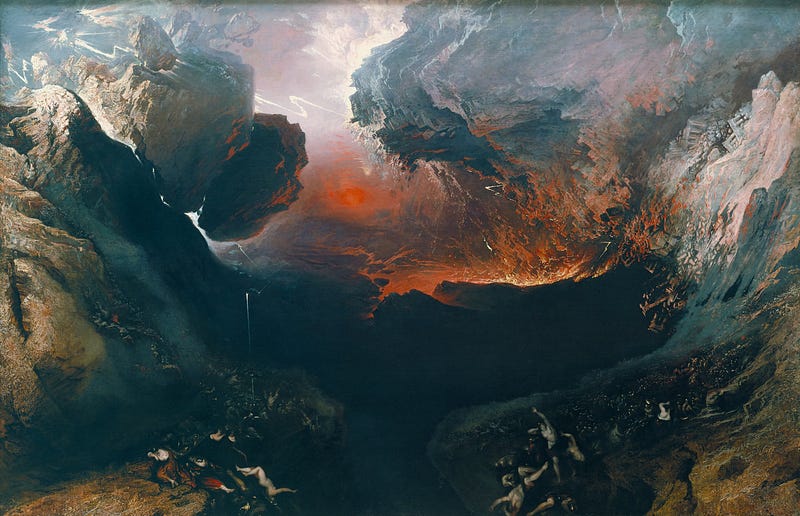
If, like me, you were raised in the Christian church, you may be surprised to learn that the consensus view among New Testament scholars — a consensus that has held for more than a century — is that Jesus was an apocalyptic prophet who expected God’s final judgement to arrive within the lifetimes of his earliest followers. Jesus lived during a time of intense eschatological fervor. Many of his fellow Jews believed that God was about to establish his glorious kingdom by overthrowing the oppressive Roman Empire, and this belief spawned numerous messianic movements that were designed to make that kingdom a reality.
Jesus shared this apocalyptic worldview, and he also saw himself as the divinely appointed “Son of Man” who would fulfill it. His first public proclamation, recorded in the Gospel of Mark, makes this clear: “The time is fulfilled, and the kingdom of God has come near; repent, and believe in the good news” (Mark 1:15). Jesus elaborates this statement in his famous Olivet Discourse — a lengthy speech that took place on the Mount of Olives near Jerusalem and is recorded in Mark 13, Matthew 24, and Luke 21. When Jesus predicts that the Jewish temple will be destroyed, his disciples ask: “Tell us, when will these things happen? And what will be the sign that they are all about to be fulfilled?” (Mark 13:4). In response, Jesus foretells a series of highly unfortunate events — wars, earthquakes, famines, plagues, persecutions, and betrayals — that will culminate in cosmic signs — the sun and moon going dark, stars falling from the sky, and other “heavenly bodies” being shaken. When this escalating chaos has reached fever pitch, God’s righteous judgement will sweep across the earth:
Then the sign of the Son of Man will appear in heaven, and then all the tribes of the earth will mourn, and they will see the Son of Man coming on the clouds of heaven with power and great glory. And he will send out his angels with a loud trumpet call, and they will gather his elect from the four winds, from one end of heaven to the other (Matthew 24:30–31).
These verses didn’t faze me; I’d read them dozens of times, and I often prayed that they would speedily come to pass. My dizzying ride on the tilt-a-whirl of doubt was launched by the next part of Jesus’ monologue, which sets the timeline for these predictions: “Truly I tell you, this generation will not pass away until all these things have taken place” (Matthew 24:34, emphasis mine). Here, “all these things” includes the final judgment of humanity — the climactic, cloud-parting descent of the Son of Man, which causes “all the tribes of the earth” to mourn. It also includes the establishment of God’s glorious kingdom, signified by the regathering of Israel’s scattered tribes. With this prophecy, Jesus laid his cards on the table. The deliverance that his people had spent centuries yearning and praying for was no longer far off, and it wasn’t a fool’s hope. Some of his disciples would live to see it happen.
Jesus restates and clarifies this imminent expectation elsewhere. In Matthew 10:23, he prepares his disciples for mistreatment by saying: “When they persecute you in one town, flee to the next, for truly I tell you, you will not have finished going through all the towns of Israel before the Son of Man comes.” His words in Mark 8:38–9:1 echo the Olivet Discourse in similar fashion (Ancient copies of Mark’s Gospel didn’t have chapter breaks, as modern Bibles do, so these verses flowed together):
Those who are ashamed of me and my words in this adulterous and sinful generation, of them the Son of Man will be ashamed when he comes in the glory of his Father with the holy angels. Truly I tell you, there are some standing here who will not taste death before they see that the kingdom of God has come with power (Mark 8:38–9:1).
After Jesus’ death, his followers carried his apocalyptic hopes forward. Their steadfast conviction that they were living through the last days saturates the pages of New Testament books like Romans, 1 Corinthians, Philippians, 1 & 2 Thessalonians, James, 1 Peter, 1 John, and Revelation — in other words, the whole kit and caboodle. And here’s the rub: None of these people lived to see the apocalypse that Jesus described.
Christian apologists are familiar with the charge that Jesus misfired by a couple thousand years, and I gobbled their responses like hotcakes throughout 2022, desperate for any reassurance I could find. However, each one failed to satisfy, raising more questions than it answered. Jesus was clearly talking to his contemporaries — to “this generation” — and his timeline didn’t jive with my church’s belief that these prophecies were yet to be fulfilled. The notion that God the Father, speaking through his Son, Jesus Christ, would instruct the first disciples to “be on guard,” “be alert,” and “keep watch” (Mark 13:33, 35) for events that he knew would take place thousands of years after their deaths also seemed absurd, like telling your four-year-old to watch out for tax day. Furthermore, Jesus’ predictions of heavenly signs and the Son of Man “coming on the clouds” weren’t mere metaphors. His fellow Jews often used such language to foretell global, cataclysmic, end-of-history judgment that would descend from Heaven to Earth. Each theological defense that I came across was full of holes, and the skeptical posse in my brain always seemed to be closing in, no matter how hard I tried to escape it. Soon enough, it had me cornered.
In November of 2022, after a year of frantic study, I made the painful decision to leave the Christian church. I could no longer deny that Jesus’ apocalyptic predictions were off-base, and while I knew that some Christian scholars — C.S. Lewis and Dale C. Allison Jr. among them — acknowledged this inconvenient fact while maintaining their faith, I couldn’t follow suit. In the Old Testament, Moses tells the Israelites that any self-proclaimed prophet whose predictions don’t come to pass isn’t from God and shouldn’t be listened to (Deuteronomy 18:20–22). Was Jesus an exception? Wasn’t he God in human flesh and thus incapable of screwing up? And if he was wrong about something as huge as the climax of history, what else might he be wrong about? I’m glad you asked…
Conclusion #2: Jesus’ apocalyptic worldview was founded on simplistic and harmful “us vs. them” binaries.

Like many apocalyptic prophets before and after him, Jesus divided the world’s population into two groups: those who accepted his lordship and were thus destined for eternal life, and those who rejected his message and were thus bound for perdition. He spoke often of the hellfire awaiting nonbelievers (see Mark 9:43–48, Matthew 25:31–46, Luke 16:9–31), and while Christians debate whether this inferno is literal or eternal, there’s no doubt that it refers to severe punishment and complete destruction. Jesus’ views on the afterlife are neatly summarized in Matthew 12:30: “Whoever is not with me is against me, and whoever does not gather with me scatters.”
In the wake of my deconversion, I’ve come to see Jesus’ binary view of humanity as both naive and toxic. At its core, it’s a form of out-group bias — that universal human tendency to view those who aren’t like us with suspicion and hostility. Such an attitude is very understandable in contexts of conflict, like the state-sponsored persecution faced by Jews in 1st-century Palestine. Nevertheless, if left unchecked, “us vs. them” thinking can spread and mutate like a disease, wreaking havoc that its originators may never have imagined. Out west, White colonialists trumpeted Jesus’ words about righteous sheep and wicked goats (Matthew 25:31–46) as they slaughtered Native Americans, who were viewed as irredeemable children of Satan. In our own day, Christian nationalists are following in these settlers’ footsteps, framing the mass deportation of refugees, migrants, and other citizens of color as a war against evil. The cowboy logic behind such actions is easy to spot. When you assume that “good guys” or “bad guys” are easily identifiable — that, for instance, all non-Christians are enemies of God (Romans 5:10) who deserve what’s coming to them — and reduce peoples’ humanity to things like the content of their religious beliefs, you pave the way for demonization of the “other.” Justice, in the last analysis, is merely a matter of finding and boiling the bad eggs.
During my recent western vacation, I read Tommy Orange’s masterful debut novel There There, which was a finalist for the Pulitzer Prize in 2019. The story follows twelve Native Americans as they travel to a powwow in Oakland, California. Along the way, Orange slowly reveals the many connections between his characters’ divergent stories. He also examines the impact of America’s racist, genocidal, and oft-neglected history on modern Native American experiences. As I flipped pages, I pictured the men that I’d spent my childhood idolizing — those pale-skinned roughriders who walked tall and shot straight and were always on the right side of history, even when Native Americans were involved (looking at you, Dances With Wolves). Reality told a different story: It was this very belief in the righteousness of their cause — in their God-given “manifest destiny,” and, by extension, in the depravity of their indigenous foes — that enabled the White conquest of the American West. If “us vs. them” rhetoric caused such damage when wielded by my cultural forebears, why had I ever assumed that it was safe in the hands of my religious heroes?
There There doesn’t simply expose the skeletons in White America’s closet. It also explores the complex effects of poverty, discrimination, and generational trauma on crimes committed by modern Native Americans. Orange’s novel reminds me that justice isn’t something reserved for those pesky folks across the street. It’s something that emerges from the stuff of our shared life — the oppressive social systems that we participate in and suffer under and benefit from and can also take part in dismantling, the dehumanizing conditions that drive marginalized people to acts of desperation, and the tenuous line between mercy and malice that, as Russian author Aleksandr Solzhenitsyn suggests, runs “right through every human heart — and through all human hearts.” Jesus’ apocalyptic categories are much too simple. No one is inherently wicked, just as no one deserves hellfire. We’re all products of the world we choose to build together.
Conclusion #3: Jesus’ apocalyptic teachings encouraged detachment from earthly concerns.

It’s well-known that Jesus practiced asceticism — the renunciation of material concerns for spiritual ends. He told his followers to sell their possessions (Luke 12:33), encouraged them to abandon their homes and families (Luke 14:26–27; Matthew 19:29) and promoted celibacy as a religious ideal (Matthew 19:11–12). His ethical instruction mirrors that of the apostle Paul, who taught that Christians’ efforts to get married and achieve freedom from slavery were futile in light of the kingdom’s imminent arrival (1 Corinthians 7:17–31). In his book Jesus of Nazareth: Millenarian Prophet, New Testament scholar Dale C. Allison Jr. writes that these strict teachings flowed directly from Jesus’ apocalyptic beliefs:
We have no difficulty understanding why Jesus and his followers… let go of their possessions, their businesses, their families. They did not need this world when they were soon to enter another, and they certainly didn’t have to worry about extending their community into the future through raising children. Their eschatological dualism — the present order will soon be eclipsed by another — encouraged detachment from this world.
Some modern Christians downplay Jesus’ “us vs. them” rhetoric, while others amplify it. Likewise, while many Christians care deeply about social justice and environmentalism, others cite Jesus’ teachings as support for their resistance to such causes. If our world is bound for fiery destruction, as scriptures like 2 Peter 3:5–13 suggest, then the incentive to make it a better place seems to be removed. Since souls are eternal and trees aren’t, shouldn’t we throw ourselves into saving souls and let the trees burn? Megachurch pastor Mark Driscoll expressed this view with characteristic machismo: “I know who made the environment. He’s coming back and he’s going to burn it all up. So yes, I drive an SUV.” This outlook sheds light on the 80 percent of White evangelicals who voted for Donald Trump last November, despite his campaign promises to roll back numerous hard-won environmental protections.
As we traveled west, my wife and I saw many signs warning tourists of extreme heat levels. Forest fires are on the rise in America, stoked by the relentless winds of climate change. We also learned about plant and animal species extinguished or endangered by corporate greed. “The greatest threat to our planet,” writes arctic explorer and renewable energy champion Robert Swan, “is the belief that someone else will save it.” Swan’s “someone else” might suggest politicians, ecologists, or your tree-hugging neighbor who makes their own granola, but it could just as easily refer to the man upstairs. There’s a literal world of difference between the apocalyptic finale of the Biblical narrative — in which God intervenes to reboot the system and thus overrides our feeble attempts to patch it up — and the realization that no one is coming to save us, that we alone can reverse humanity’s reckless plundering of the environment, and that our children and grandchildren will inherit whatever rubble we fail to repair.
“There’s no hell but the hell we make”
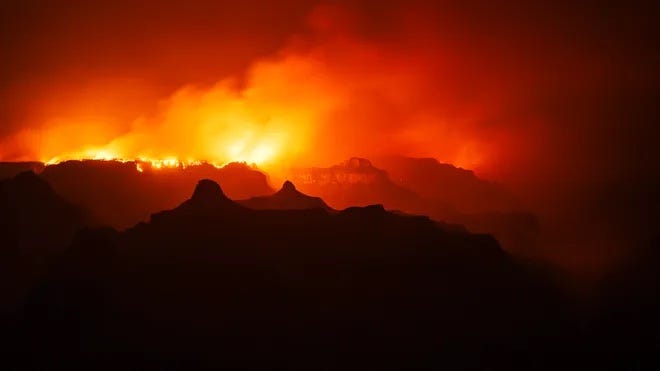
On July 12, the last day of our trip, my wife and I joined hundreds of people in a mass evacuation from the North Rim of the Grand Canyon. The Dragon Bravo Fire, which began a week prior, had jumped its containment lines and was headed our way. As of today, the blaze has consumed 100 buildings and spread to more than 71,000 acres. It’s still burning.
As we drove north, I was struck by how apocalyptic our situation seemed. Black smoke billowing on the horizon. A full moon stained blood-red by the haze. Dozens of cars fleeing disaster, their tail lights visible in the gathering dark. Even the name of the fire sounded Biblical, conjuring up the “enormous red dragon” of Revelation 12. Back when I was a Christian, I might have whispered prayers and interpreted these events as a preview of calamity to come. Yet now, miles away from my former faith, I glimpsed them in a different light. I noticed the herds of deer leaving the forest and pondered humanity’s relationship to the environment. I watched the Navajo reservation flash by the windows and thought about the characters of There There, about guns and broken promises and the countless bones scattered throughout America’s soil. And I thought about Jesus — his certainty of impending judgement and the two thousand years that have rolled by since he consigned his religious opponents to hell.
Christianity’s founding prophet was wrong. Fire isn’t an instrument of divine judgement. It’s a growing threat that we’re all complicit in and responsible for. Our foes aren’t the people who disagree with us. They’re the avarice, apathy, and animosity that are woven into the fabric of the institutions we make and that make us. Doomsday prophecy has always been snake oil. Our world was never destined for destruction. As singer-songwriter Derek Webb suggests in his song “I’m Still Here,” its future is as bright as we allow it to be:
There’s this thought I just can’t shake
That there’s no hell but the hell we make
So this could be heaven


I have wondered the same thing, but in my research on the Olivet Discourse it seems to me Jesus is not only speaking about the current temple that was destroyed by the Romans in AD 70, but also using apocolyptic language used often throughout the Old Testament. (Isaiah 13:9-11, Isaiah 34:1-8, Ezekiel 30:18; 32:7-8…) To the Jews, the temple was the center of their universe, their world, so it would seem cataclismic to them to see it destroyed.
LikeLike
Thanks for reading! I held that view myself for a while, but I eventually concluded that these passages describe more than just the temple’s destruction. Specifically, they depict the Son of Man coming on the clouds in power and glory, with his angelic host, to gather his people from across the earth (see Mark 13:26-27, Matthew 24:30-31, Luke 21:27). Furthermore, eschatological texts of Jesus’ day, such as 1 Enoch and The Testament of Moses, often used this kind of apocalyptic imagery (stars falling, sun and moon darkening, heavenly bodies shaking) to predict global, end-of-history judgement, not just localized catastrophes. If you’re interested in reading more on these topics, I’d recommend the opening chapter of Christopher Hays’ book When the Son of Man Didn’t Come, which summarizes them well.
LikeLike