
What if it’s true? That would be amazing!
I’m standing in front of the chimpanzee enclosure at my local zoo when this thought flits through my mind. For the past five minutes, I’ve been gazing at the young ape just beyond the fence — at the lines on his palms, the shape of his nose and mouth, the eyes that watch me like I’m the curious creature on display. My zookeeper brother has warned me that chimps enjoy flinging their poo at visitors, so I should probably be wary of airborne excrement. Yet I’m too struck by our physical similarities to recall the fence between us. It’s summer break, I’ve just finished my junior year at college, and fragments of lectures from my recent biology class (which I may or may not have fully processed, given that my crush was sitting nearby) are swirling in my brain. According to my professor, the primate returning my stare is family — a close cousin on an evolutionary tree whose branches stretch back billions of years and connect all living things. As I scrutinize his features and compare them to my own, I feel a deep sense of awe, and I realize suddenly that I want my professor’s words to be true.
This is a problem. I was raised on science books published by Answers in Genesis, trained to defend the tenets of Young Earth creationism, and taught that Richard Dawkins spent time with the devil on weekends. I guzzled Nathan Frankowski’s propaganda film Expelled: No Intelligence Allowed — in which Darwinism is linked to atheism, communism, fascism, eugenics, and the Holocaust — like it was a 7-Eleven Slurpee, and I used its arguments to challenge my high school biology teacher. My youth group also watched the highly publicized debate between Ken Ham and Bill Nye, and while I had to admit that Nye mopped the floor with his stuffy Australian foe, I knew that he couldn’t be right. Those who accepted the theory of evolution were dangerously deluded. Their secular science wasn’t just an affront to the Creator of all things; it was a fast-track to social ruin.
My creationist upbringing was powerful enough that I remained agnostic about evolution until I left Christianity at twenty-seven years old. By that time, I’d befriended many Christians who accepted Darwin’s ideas, so skeptical attacks on literalist interpretations of Genesis didn’t faze me. I knew that the Bible wasn’t a science textbook and that it could be interpreted in a variety of ways. My former biology professor, John H. Walton, had penned a landmark defense of theistic evolution rooted in scriptural analysis: The Lost World of Genesis One: Ancient Cosmology and the Origins Debate. I sympathized with his attempt to square Darwinism with religious belief, and I applauded his acceptance of scientific data that I now found undeniable. Yet my departure from the church changed my perspective on the culture wars that inspired Walton’s book. I’m now convinced that debates between theistic evolutionists and Young Earth creationists have obscured deeper problems within traditional Christianity — problems that raze to the bone of the religion and that have also had devastating consequences on the natural world we inhabit.
What do I mean by this? For starters, I’m not saying that Christians don’t care about the environment. I know many churchgoers who work tirelessly for ecological causes. Likewise, I’m not claiming that the Bible can’t bolster such work. Christian environmentalists often ground their advocacy in scriptural passages that affirm the beauty and goodness of creation (Genesis 1, Psalm 19), God’s provision for wildlife (Psalm 104), and responsible farming practices (Leviticus 25). One of my favorite Christian authors, Wendell Berry, has been doing so for decades.
My claim is that certain key passages of Genesis — scriptural texts that have, for most Christians throughout history, been viewed as theological bedrock — have hastened rather than hindered the destruction of our planet. I’m well aware that progressive Christians who deny the inerrancy of the Bible may agree that these texts are problematic and that their messages should be rejected. Great! On the flip side, conservative Christians may contend that my interpretations of these passages are simply mistaken. That’s okay! My position is a controversial one. If you think I’m wrong, I’d love to hear your critiques in the comments below. Hopefully, in our dialogue, we can rise above our primate instincts and avoid any metaphorical shit-tossing.
The impact of religious worldviews on global ecology has never been more relevant. Eighty percent of white evangelical Christians voted for Donald Trump in November of 2024, supporting a Republican regime that has, in the span of a few months, rolled back numerous environmental protections including U.S. participation in the Paris Agreement, limits on domestic oil and gas production, incentives for electric vehicle ownership, and laws preventing power plant pollution. In this essay, I will argue that the Bible’s opening chapters espouse two ideas which are highly problematic from an ecological standpoint — influential doctrines that have been widely accepted both throughout history and across denominational lines. If we want to save our planet, then we must interrogate these beliefs, as difficult as that process may be. So, without further ado, let’s take our cue from dear old Darwin and put them under the microscope!
Problematic Doctrine #1: Humanity was created in God’s image.
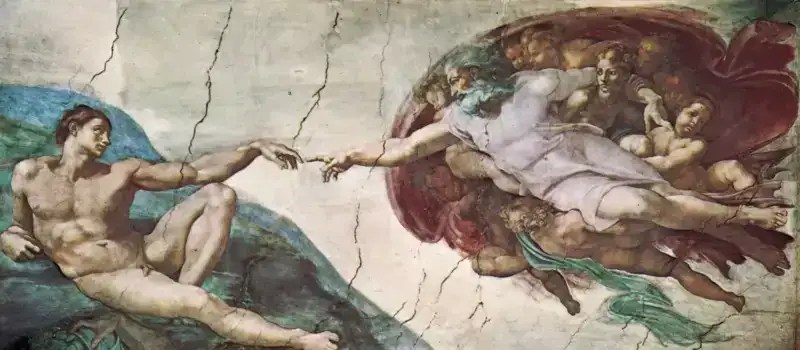
In the first chapter of the book of Genesis, we learn that human beings are — despite surface similarities with their fellow creatures — profoundly distinct from the rest of the natural world. As the final living beings to be formed, they are the pinnacle of Adonai’s creation, made “in the image of God” (Genesis 1:26). At a base level, this means that each human possesses an immortal soul which is capable of relating to God and receiving the gift of salvation. Many Christians also believe that it entails uniquely human capacities for reason, free will, creativity, and moral behavior. Answers in Genesis summarizes this view: “For animals, their ‘spirit’ seems to be merely an animating force… For mankind, the soul is the animating factor, plus the seat of logic and reason, emotion and conscience, and all the rest of the essence of a person — and it is eternal.”
When I was growing up, my fellow Baptists and I bristled at the notion that humans could be classified as “animals,” and we used the term “animalistic” to describe behaviors that seemed savage, primitive, or degrading. Theistic evolutionists like Francis Collins, Tim Keller, and Pope Francis might demur, citing abundant evidence for common ancestry. Yet they held the similar conviction that, at some point in our evolutionary past, God conferred the imago dei on hominids, transforming them into something qualitatively different from the rest of the animal kingdom.
Why is the doctrine God’s image problematic? For starters, it’s a deeply anthropocentric idea. Creationists believe that Tennyson’s “Nature, red in tooth and claw” was an inevitable consequence of Adam and Eve’s sin, while theistic evolutionists argue that it’s part and parcel of God’s creative process. Yet members of both camps agree that God’s allowance of animal agony — either tens of thousands or billions of years of it, depending on your interpretation of Genesis — is a necessary step in the human drama of redemption. Animals don’t have immortal souls, and they can’t accept Jesus (If they could, then missionary work at local zoos would become imperative), so their suffering can’t be compensated after their death. Conclusion: Bambi’s bloody demise is, in some sense, required for your trip to paradise. This troubling idea has led some Christian apologists, such as William Lane Craig, to address the problem of animal suffering by asserting that animals can’t experience pain (not a good look there, Bill). However, as biologists continue to unveil new evidence of reason, emotion, empathy, and creativity in the animal kingdom, challenging simplistic views of non-human consciousness, the boundary between homo sapiens and other species — a gulf which supposedly renders the former fit for eternal bliss and necessitates the predation and/or extinction of the latter — becomes increasingly murky.
Traditional definitions of the imago dei raise a host of troubling questions. Christians often claim that human life is meaningless in the absence of an eternal hereafter. One irony of this claim is that dogs and deer and dolphins and desert tortoises do not, on a Christian worldview, have hope for eternal life. Are their brief lives consequently meaningless? Furthermore, if humans alone possess immortal souls, how does one escape the conclusion that non-human nature is, by definition, soulless? Are animals merely instinct machines? If not — if they are capable of more free thought and conscious action and self-giving love than we previously imagined — then why are they denied the possibility of redemption? Finally, if God conferred his image on select hominids during humanity’s evolution, how did he choose which ones got to live forever while their forebears perished, and how was this choice anything but arbitrary?
The notion of God’s image may dignify humanity, but it only does so by demoting the rest of the animal kingdom to secondary, subservient status. Genesis 1:26, which sets human beings apart from non-human animals on a fundamental level, clashes with our growing awareness that we are members of a vast, evolving, and interdependent community of species — that, to quote Bill Nye, “What happens to other species also happens to us.” Growing up, I never thought twice about killing animals, eating their meat, or using products made from their bodies. Didn’t they lack the soul that imbued human suffering with significance? Hadn’t God given “all living creatures” to his image-bearers for food (Genesis 9:3)? Didn’t he institute a system of sacrifice in which countless livestock were butchered to atone for human sin? Nowadays, convicted of my anthropocentrism, I approach the subject of animal suffering with greater reverence (an attitude that can, in my opinion, be shared by vegans and meat-eaters alike). I also find myself agreeing with Mohammad Saud, the bird-saving hero of Shaunak Sen’s 2022 documentary All That Breathes: “Life itself is kinship… One shouldn’t differentiate between all that breathes.”
Problematic Doctrine #2: Humanity has been given dominion over nature.

The doctrine of God’s image goes hand in hand with the Bible’s claim that humanity was given “dominion” over the natural world (Genesis 1:26). Many Christians see this authority as a kind of nurturing stewardship — a mandate to enhance the well-being of the planet that God has entrusted them with by carefully conserving its resources. During my years at Christian college, this was how I envisioned humanity’s role in the natural world. However, I no longer believe that it reflects the message of Genesis’ earliest chapters.
The Hebrew word râdâh, translated as “dominion,” has connotations which are far more adversarial than many Christians think; throughout the Bible, the word is translated as “reign,” “rule over,” “prevail against,” “subjugate,” “trample,” “tread down,” and “chastise.” Contrary to widespread assumptions, humanity’s task in Genesis 1 isn’t to nurture creation but rather to conquer it — to “subdue” their environment (Genesis 1:28) and to take tribute from it, just as a king would. This verse doesn’t require that humanity’s relationship to nature be solely exploitative; monarchs can, after all, choose kindness when it suits them. Nevertheless, Genesis 1 conveys humanity’s God-given right to dominate nature and to use its resources as they see fit. Early Christians couldn’t have imagined the impact that this assumption of authority would have over millennia, yet they took it for granted: Earth is, first and foremost, a habitat for humanity.
The idea of humanity’s dominion over nature has had far-reaching ecological consequences. In a 1967 essay titled “The Historical Roots of Our Ecological Crisis,” medieval historian Lynn White Jr. contrasts the Judeo-Christian creation story, in which Adonai designs the world “explicitly for man’s benefit and rule,” with other ancient myths that envisioned humanity as both indistinguishable from their environment and duty-bound to respect its spirits: “Christianity, in absolute contrast to ancient paganism and Asia’s religions… not only established a dualism of man and nature but also insisted that it is God’s will that man exploit nature for his proper ends.” The aftershock of this ideological shift continues to reverberate:
I personally doubt that disastrous ecologic backlash can be avoided simply by applying to our problems more science and more technology. Our science and technology have grown out of Christian attitudes towards man’s relation to nature which are almost universally held not only by Christians and neo-Christians but also by those who fondly regard themselves as post-Christians. Despite Copernicus, all the cosmos rotates around our little globe. Despite Darwin, we are not, in our hearts, part of the natural process. We are superior to nature, contemptuous of it, willing to use it for our slightest whim. The newly elected Governor of California, like myself a churchman but less troubled than I, spoke for the Christian tradition when he said (as is alleged), ‘When you’ve seen one redwood tree, you’ve seen them all.’ To a Christian a tree can be no more than a physical fact. The whole concept of the sacred grove is alien to Christianity and to the ethos of the West. For nearly 2 millennia Christian missionaries have been chopping down sacred groves, which are idolatrous because they assume spirit in nature.
If, as White Jr. argues, humanity’s exploitation of nature has been legitimized by the Judeo-Christian doctrine of dominion, then efforts to combat such exploitation must also challenge this doctrine. The historian writes: “No new set of basic values has been accepted in our society to displace those of Christianity. Hence we shall continue to have a worsening ecologic crisis until we reject the Christian axiom that nature has no reason for existence save to serve men.”
As stated above, many Christians interpret “dominion” as stewardship, not conquest. Yet an uncomfortable fact remains: If Genesis 1 has been used to justify public gardens, ocean cleanup, veterinary clinics, and wildlife sanctuaries, it has also — indeed, far more often — been used to justify the felling of forests, the damming of rivers, the construction of factories, and the slaughter of animals for the advancement of human society.
Would our behavior toward our environment change if we told a different story about ourselves — one in which we weren’t rulers exalted over nature but simply members of it? Daniel Quinn thinks so. In his award-winning novel Ishmael, the author puts these words in the mouth of a telepathic gorilla (You’ve got to read the book, I promise that it makes sense):
There’s nothing fundamentally wrong with people. Given a story to enact that puts them in accord with the world, they will live in accord with the world. But given a story to enact that puts them at odds with the world, as yours does, they will live at odds with the world. Given a story to enact in which they are the lords of the world, they will act like the lords of the world. And, given a story in which the world is a foe to be conquered, they will conquer it like a foe, and one day, inevitably, their foe will lie bleeding to death at their feet, as the world is now.
The Family Across the Fence

In 2019, I wrote a nature-themed blog post that contained the following claim: “Each beautiful part of nature that we experience is, at bottom, a love letter from God to us.” Six years later, I couldn’t disagree with myself more. When I stare at chimpanzees over the fence of a zoo enclosure, I no longer see them as beings created for my benefit or as object lessons in God’s attributes. I see them as fellow travelers on the journey of life, as family members whose destinies are interwoven with mine in ways I’ll never fully grasp. In their eyes, I witness the same spark that lights the gaze of my loved ones and that once lit the stars. “There is,” as Darwin wrote at the finale of his book On the Origin of Species, “grandeur in this view of life” — in the notion that billions of years of history have brought us to this moment and made our shared life on this wild, whirling, and wounded planet possible. It’s all we’ve ever had and all we’ll ever have. Let’s set scripture aside for the moment and get busy saving it.
Thanks so much for reading! I really appreciate it. If you’d like to read more of my reflections on life after religion, you can subscribe to this blog to receive email updates on my latest content.
 Words for Wayfarers