How does it feel
To be on your own
With no direction home
Like a complete unknown
Like a rolling stone?
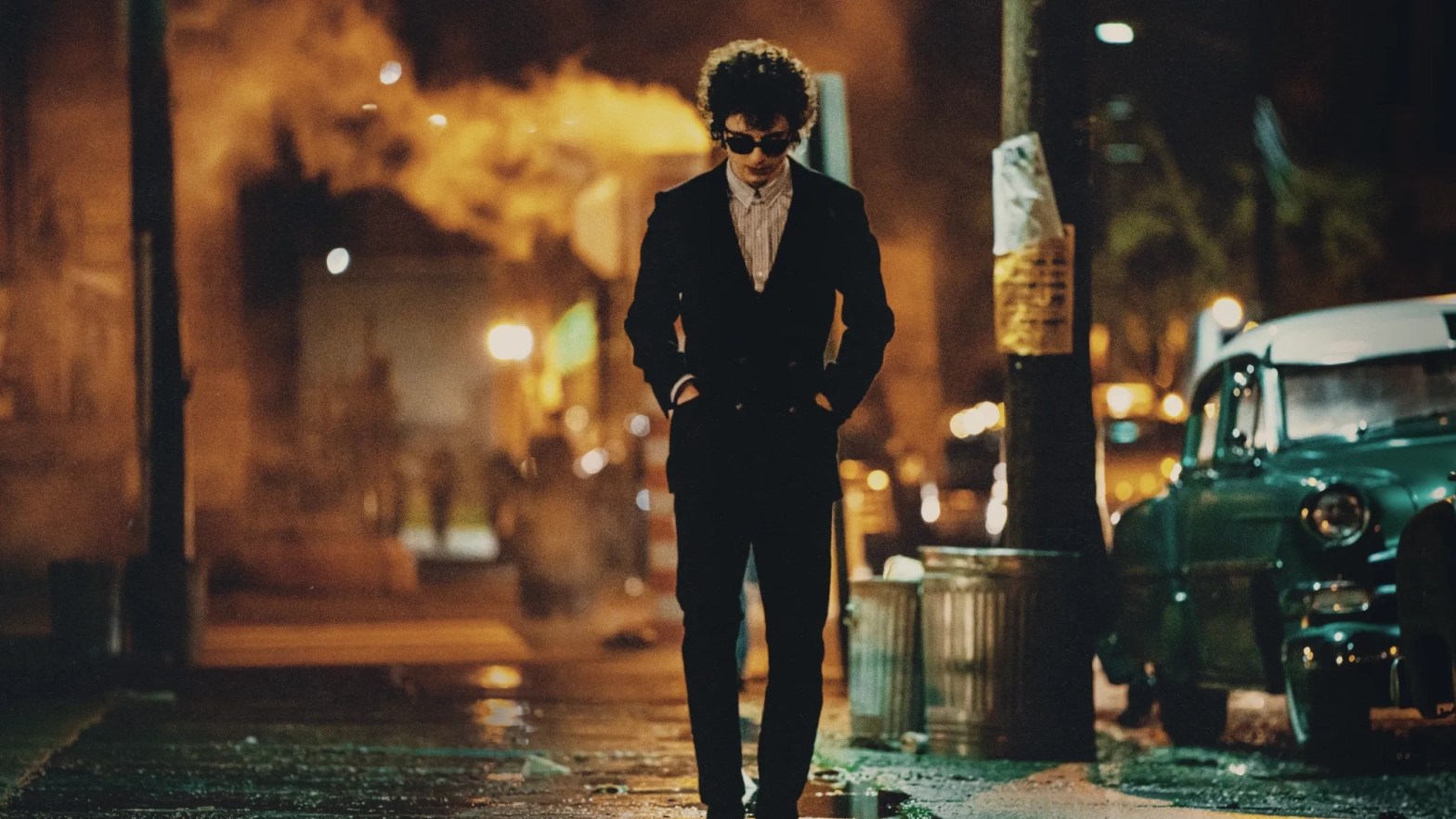
More than any other Bob Dylan lyric, that legendary chorus may come closest to capturing the spirit of its author – a lonesome, mercurial, dissembling spirit that no musical biopic could ever hope to fully represent. Wisely, James Mangold’s new film doesn’t try to resolve Dylan’s enigma. The songwriter’s life was, from the very beginning, for good and for ill, a performance. Rather than analyzing that performance, A Complete Unknown invites us to simply look and listen – to witness the impact of Dylan’s music on the 1960s folk scene and on the people whose lives and longings swirled in its powerful orbit.
I’ve spent the past year listening through Dylan’s discography and studying his cultural impact. I’m also a huge fan of Timothée Chalamet’s acting. So I was stoked when this picture was announced. If anyone could capture Dylan’s elusive persona, I believed it was Chalamet, whose portrayals of creative, restless, introspective characters have wowed me time and time again (Have you seen his work in Call Me By Your Name? Beautiful Boy? Little Women?). I’m happy to say that he nails the part. While (thankfully) it’s not an impression, the accent and physicality are so good that you gradually forget you’re watching an actor. Add to that his live performances of Dylan’s songs, which feature guitars and harmonica and conjure Dylan’s nasal voice like a ghost, and you’ve got an award-worthy performance. The movie’s well worth watching for the concert scenes alone.
The bad: Mangold focuses so heavily on the “important” scenes of Dylan’s rise to fame, including trivia from his recording sessions, that he neglects the psychology of his supporting cast. While marveling at the fidelity of Elle Fanning’s, Monica Barbaro’s, and Edward Norton’s performances, I found myself wondering why they were drawn to Dylan and what specifically his music meant to them. Mangold gives us many scenes of characters staring at Dylan in awe (too many, by my lights), but he fails to probe beneath the surface of their attraction to Dylan. Thus, several of the story’s emotional beats fall flat.
Similarly, while the Greenwhich village folk scene is beautifully imagined, I wish Mangold had dedicated more time to exploring the social issues that inspired Dylan’s songs. Seismic events like Civil Rights marches, the Cuban missile crisis, and JFK’s assassination are all depicted, but each is too fleeting and peripheral to drive home the cultural force of Dylan’s lyrics.
The good: You could criticize this movie for making Dylan’s ascent to stardom seem too prosaic, too mundane. Where is the muse quickening his pen? Where are all the scenes of heroic vindication? What resolution or meaning to be found for the women whose hearts were broken along the way? Was all this, after all, really just about a hungry, insecure, self-absorbed dude and his songs?
Bravely, Mangold presents us with a portrait of America’s greatest troubadour that is at once reverent and brutally honest, daring to depict him as (dare we say it?) a human being like the rest of us, caught up in a myth of his own and others’ making. Idols, for all their shine, are human constructions. Dylan’s magic trick of concealment is also his greatest curse. Look closer, and all you’ll see is what he wanted you to see (and what, ultimately, he couldn’t help but become): a complete unknown.
 Words for Wayfarers