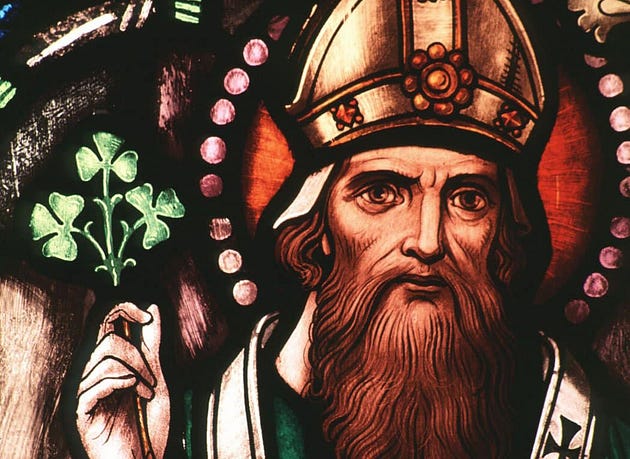
“They say,” quips late-night comedian Conan O’Brien, “there are only two kinds of people on St. Patrick’s Day: the Irish, and the people that drive them home.” He’s not wrong. If March 17 is an opportunity to celebrate a famous saint, it’s also a chance for thousands of Americans to proclaim their dubious Irish lineage… with lots and lots of booze. As much as it pains me to admit it, I’m likely a member of this wannabe-Irish fan club (minus the inebriation). Tradition tells me that my family tree is mostly Irish, and I’ve been deeply fascinated by Celtic history, music, literature, and folklore since I was a teenager. However, my family never practiced any Irish customs, and I’ve also never taken a DNA test to check. Like most White Americans, our ancestry is probably a tangled mess of diverse European roots. But will that stop me from belting out Dubliners songs on St. Patrick’s day like I was born and raised on the Emerald Isle myself? Absolutely not.
As a kid raised in the evangelical church, I first heard the story of St. Patrick in an episode of the radio drama series Adventures in Odyssey (If you know, you know). Sold into slavery by Irish pirates, Patrick escaped six years later and returned home to Britain, only to receive a vision of pagan souls crying out for salvation. This mystical message inspired his quest to share the Christian gospel with the people of Ireland. I had grown up on the mission field myself, and I marveled at Patrick’s commitment to carry the truth of Christ into a culture of resistant non-believers. The idea that Christianity redeemed Erin’s Isle — that it was a divine light banishing spiritual darkness and exposing moral depravity, a la the famous prologue to the Gospel of John — resonated with everything I’d been taught about the inherent superiority of my religion. This notion is also widely accepted within the Christian church — Eastern Orthodox tradition, for example, still refers to St. Patrick as the “Enlightener of Ireland.” Only when my faith collapsed, two decades later, did I start second-guessing it. Such doubt might seem like a no-brainer to those outside the fold, given the church’s thorny relationship with Western colonialism. But the idea of Christianity’s civilizing influence hasn’t dissipated. If anything, it’s on the upswing.

Three weeks ago, the YouTube channel Uncommon Ground (hosted by Justin Brierley) posted a debate on the following question: “Did Christian faith give us our belief in kindness, equality, freedom and consent?” Taking the affirmative position was Glen Scrivener, a Christian apologist and author of The Air We Breathe: How We All Came to Believe in Freedom, Kindness, Progress, and Equality. Scrivener believes that liberal values of freedom and compassion for the underprivileged — which blossomed during the Enlightenment of the 17th and 18th centuries, and which are largely taken for granted in our modern societies (a.k.a. “the air we breathe”) — were “unthinkable” without the influence of Christianity. Heavily inspired by historian Tom Holland’s 2019 book Dominion: How the Christian Revolution Remade the World, Scrivener contends that we wouldn’t hold these truths to be self-evident (to borrow Thomas Jefferson’s phrase) without the legacy of Jesus of Nazareth. Agnostic podcaster and YouTuber Alex O’Connor attempted to call Scrivener’s bluff. He claimed that the apologist’s position commits a “sin of overemphasis” by ignoring non-Christian contributions to Enlightenment values. Both men agreed that Christianity has shaped Western thought in profound ways. Both agreed that Holland’s conception of Christianity as cultural bedrock — an intellectual foundation that we discard to our peril — is increasingly popular, especially as people reckon with the decline of churches in the West. Both have delightful British accents. So, who’s right? What, if anything, did their debate overlook? And what the feck does all this scholarly wrangling have to do with Ireland?
According to Scrivener, Enlightenment convictions about the dignity of all people are traceable back to the 1st century CE. The claim of the first Christians — that their messiah had voluntarily suffered and died on a cross because “God so loved the world” (John 3:16) — wasn’t your average marketplace gossip. Its emphasis on redemption through vulnerability also didn’t jive with imperial Rome’s instinct to crush any sign of weakness like a grape. Yet it did inspire those who preached it to adopt infants left to die on Rome’s streets, to protest the abuse of children, and to establish the first hospitals. Medieval theologians kept this flame of Christian charity to the poor and destitute alive and, many centuries later, America’s founders enshrined it in the Declaration of Independence. This emphasis on radical humanitarianism is, in Scrivener’s mind, unprecedented in the history of humanity. When Paine, Jefferson, and Franklin waxed eloquent on “inalienable rights,” perspiring in their powdered wigs, Scrivener says they were drawing on the “intellectual genealogy” of a revolutionary social movement that “runs right through the heart of Christendom.”
“Nope,” says Alex O’Connor (my translation). Christians have certainly left positive impacts on many parts of the world. But if our modern ideals of racial justice, gender equality, and freedom of speech were inherited from Christianity, then why did they take thousands of years to become mainstream in Christian churches? Don’t parts of the Bible — in Old and New Testaments alike — oppose these ideals? Furthermore, weren’t some of these Enlightenment values fought for by people (Paine, Jefferson, and Franklin among them) who fiercely opposed religious dogma? Compassion for the vulnerable, O’Connor strenuously maintains, isn’t a purely Christian innovation. It crops up elsewhere in history — in the prologue to Hammurabi’s code, and in the Hippocratic Oath. Unfortunately, Scrivener’s rebuttal — “The fact that we notice examples of compassion in other cultures is a profoundly Christian thing itself” — simply begs the question.
If it seems like I side with O’Connor here, that’s because I do. However, as I listened to his debate with Scrivener, I realized that neither participant’s case made reference to something that is absolutely central to the history of Enlightenment thought: the contributions of indigenous populations.
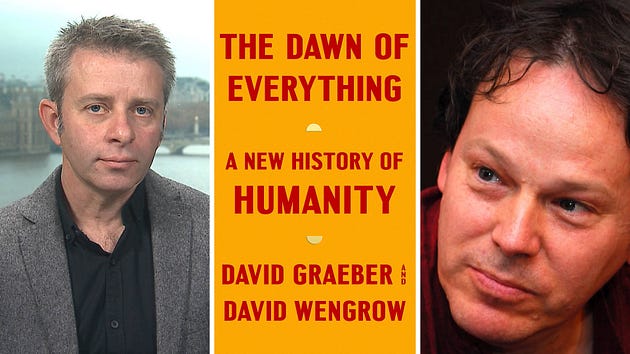
Enter more Brits: anthropologist David Graeber and archaeologist David Wengrow. Their 2021 book The Dawn of Everything: A New History of Humanity argues that most people in the Middle Ages who knew about northern Europe saw it as “an obscure and uninviting backwater full of religious fanatics who, aside from occasional attacks on their neighbors (‘the Crusades’) were largely irrelevant to global trade and politics.” Ouch. But colonial exploration of the Americas in the late 15th century exposed Europeans to a host of new cultures and ideas. As they dialogued with Native Americans, observed indigenous societies, and wrote travelogues about overseas adventures, colonists began seeing their own societies in a new light. This cultural exchange was the catalyst for the Enlightenment. It wasn’t just that many famous Enlightenment writers — Leibniz, Voltaire, Montesquieu, Diderot, Locke, and Rousseau among them — based their writings about liberty and equality on Native American sources (often explicitly saying they were doing so); these ideals had never been seriously championed by European thinkers prior to American colonization:
The idea that our current ideals of freedom, equality and democracy are somehow products of the ‘Western tradition’ would in fact have come as an enormous surprise to someone like Voltaire. As we’ll soon see, the Enlightenment thinkers who propounded such ideals almost invariably put them in the mouths of foreigners, even ‘savages’ like the Yanomami [an indigenous population in the Amazon rainforest]. This is hardly surprising, since it’s almost impossible to find a single author in that Western tradition, from Plato to Marcus Aurelius to Erasmus, who did not make it clear that they would have been opposed to such ideas. The word ‘democracy’ might have been invented in Europe (barely, since Greece at the time was much closer culturally to North Africa and the Middle East than it was to, say, England), but it’s almost impossible to find a single European author before the nineteenth century who suggested it would be anything other than a terrible form of government.
Why hadn’t democratic ideals taken root in European soil? While there’s no single answer, a big and undeniable one is the church of the Middle Ages. “Ranks and hierarchies,” Graeber and Wengrow tell us, “were assumed to have existed from the very beginning,” as far back as the Garden of Eden (Remember God’s punishment of Eve — “your desire shall be for your husband, and he shall rule over you” — in Genesis 3:16). In fact, if you search for the words “equality” and “inequality” in medieval literature before the time of Christopher Colombus (which we’ve all done at some time or other, I assume…), they don’t show up. These concepts only sparked intellectual debate when Europeans started pondering indigenous societies, and when indigenous people started critiquing European ones. And before we demand credit for the debates themselves, we should reckon with Graeber and Wengrow’s claim that the “rational, sceptical, empirical, conversational” style of Enlightenment exchanges was inspired by observations of Native American debaters — one of them in particular.
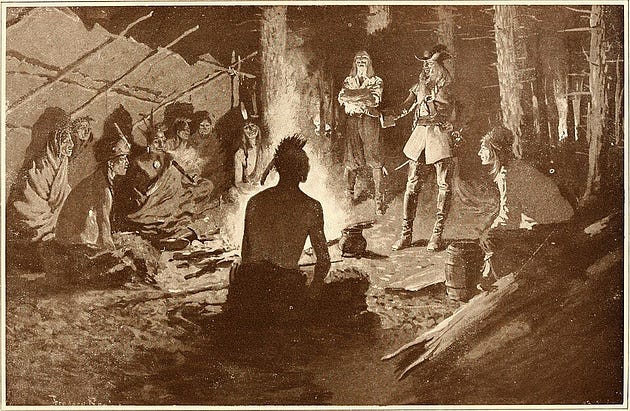
Ever heard of Kandiaronk? Me neither… at least, not before I read The Dawn of Everything. This ignorance is surprising, given that so many of the great Enlightenment thinkers we studied in our history classes knew of him and were inspired by his ideas. A leader of the Wendat Nation in what is now Ontario, Canada, Kandiaronk was renowned as a brilliant speaker, among both his people and European settlers. He was also a vocal critic of Christianity. In the patronizingly-titled 1703 memoir Curious Dialogues with a Savage of Good Sense Who Has Travelled, the French aristocrat Louis-Armand de Lom d’Arce, Baron de la Hontan, described extended conversations with Kandiaronk. In them, the Native American orator shares many of his qualms with the social structures and value systems of European states. He challenges the doctrines of hell, original sin, and salvation through blood sacrifice. He expresses disbelief that European monarchs wield arbitrary (God-given?) power and enforce submission with punitive laws. He also rails against the European economy’s dependence on money. The following passage of Lahontan’s book, containing the author’s own reflections on Kandiaronk, echoes many critiques of 17th-century Europe made by indigenous thinkers who Europe sought to “enlighten”:
Those Native Americans who had been to France, [Lahontan] wrote, “were continually teasing us with the faults and disorders they observed in our towns, as being occasioned by money. There’s no point in trying to remonstrate with them about how useful the distinction of property is for the support of society: they make a joke out of anything you say on that account. In short, they neither quarrel nor fight, nor slander one another; they scoff at arts and sciences, and laugh at the difference of ranks which is observed with us. They brand us for slaves, and call us miserable souls, whose life is not worth having, alleging that we degrade ourselves in subjecting ourselves to one man [the king] who possesses all the power, and is bound by no law but his own will.
In relating these oft-ignored facts, Graeber and Wengrow don’t mean to imply that European societies had no upsides, or that Native American societies had no flaws. The point is that Enlightenment ideals of freedom and equality didn’t rise organically from the compost of Christianity and Western philosophy. If they had, we might wonder (with Alex O’Connor) why the process took so damned long. Rather, these ideals came to the surface through cross-cultural dialogue — specifically, the objections of indigenous critics who weren’t buying what colonial Europe was selling.
Against this historical backdrop, Scrivener’s case for Christianity’s civilizing influence on the West starts to sound absurd. When he claims that modern rights discourse is a “flourishing of religious tradition,” he ignores the fact that debates on human rights and natural law started after conquest of the Americas had already begun, when Europeans were trying to decide if people without written philosophy, systematized laws, or access to the Bible were fully human. When he attributes values like individual liberty to Enlightenment-era Christians, he contradicts the widespread 17th-century religious view that such liberty was “animalistic.” And when he asks, “Who has overturned patriarchy more than Western societies?”, he might want to run that by the Jesuits (Europe’s 17th-century intellectual elite) who were outraged that Native American women had full control of their bodies, that they could have sex when and with whom they pleased, and that they could divorce their spouses at will. Graeber and Wengrow drive the point home:
This is one area in which early missionary or travellers’ accounts of the Americas pose a genuine conceptual challenge to most readers today. Most of us simply take it for granted that “Western” observers, even seventh-century ones, are simply an earlier version of ourselves; unlike indigenous Americans, who represent an essentially alien, perhaps even unknowable Other. But in fact, in many ways, the authors of these texts were nothing like us. When it came to questions of personal freedom, the equality of men and women, sexual mores or popular sovereignty… indigenous American attitudes are likely to be far closer to the reader’s own than seventeenth-century American ones.
Scrivener’s apologetic case for Christianity might seem benign, until you look at it closely. When you do, it begins to resemble a tired rehashing of views which were championed by European colonialists… to tragic effect. Our beliefs, traditions, and way of life are inherently superior. The world owes its greatest achievements to us. You’d be better off accepting what we have to offer. This attitude was no historical accident. It’s rooted in ancient scriptures that consistently portray unbelievers as lost (Luke 19:10), condemned (John 3:18), deserving of the wrath of God (John 3:36), blind (2 Corinthians 4:4), lawless (2 Corinthians 6:14), and spiritually dead (Ephesians 2:1–5). Such dehumanizing theology inevitably spawns oppression, as history attests. Graeber and Wengrow agree, writing that the indigenous critiques of the West cited by Enlightenment authors were ways of challenging “that medieval certainty which maintained that the judgements of the Church and the establishment it upheld, having embraced the correct version of Christianity, were necessarily superior to those of anyone else on earth.”
I still celebrate St. Paddy’s Day like I’m actually Irish. Guinness, green outfit, Celtic folk playlists — the whole shebang. However, I no longer neglect the darker side of the holiday’s origins, nor the history of colonial violence suffered by the Irish. I think about Irish singer-songwriter Hozier’s lyrics: “Screaming the name of a foreigner’s god / The purest expression of grief.” I recall St. Patrick’s description of native Irish people: “Never before did they know of God except to serve idols and unclean things. But now, they have become people of the Lord, and are called children of God.” I ponder the legend claiming that Patrick miraculously drove all the snakes from Ireland, which many scholars interpret as an allegory for the saint’s obliteration of pagan spirituality (Ireland didn’t have snakes to begin with). And I consider the centuries upon centuries of indigenous culture and language and religion that such grandiose claims always obscure. If I’ve learned anything from St. Patrick, it’s that truth, beauty, and goodness can’t be cloistered within the walls of our sacred institutions. They grow like shamrocks in the spaces between the stones, dance outside on our city streets, and shine in the faces of our neighbors.

Thanks for reading! I work very hard to craft these articles, and I really appreciate your time. If you’d like to read more of my reflections on life after religion, you can subscribe to this blog or follow me on Medium.
 Words for Wayfarers
I don’t think I’ll ever fully understand how any one culture can make a claim that their traditions are the mouth of the river from which all good things flow. At my most gracious, I see it as a home-team pep rally gone horribly out of control. You know as well as I do all the trappings that keep people locked in that paradigm, but I think it’s even baked into our language learning, by which I mean, the religious symbols are so inextricable from the transcendent abstract concepts that I think it’s not possible to enter the conversation without several foundational assumptions that almost guarantee a circular reasoning. I guess that’s a whole lotta words to say we could use better education around our ethnocentric bias.
One of my all-time favorite MCs, Brother Ali, has a great song called “Before They Called You White”. I can’t believe it’s almost 10 years old because I remember when it released and I felt old back then! 😂 Much of your article made me think of this line: “The eye can’t see itself“
LikeLike