This essay contains spoilers from The Tree of Life, directed by Terrence Malick.
Back in high school, when I was still a devout Christian, I scribbled a quote from Marilynne Robinson’s novel Gilead in the front cover of my Bible:
I have been thinking about existence lately. In fact, I have been so full of admiration for existence that I have hardly been able to enjoy it properly… I feel sometimes as if I were a child who opens its eyes on the world once and sees amazing things it will never know any names for and then has to close its eyes again. I know this is all mere apparition compared to what awaits us, but it is only lovelier for that. There is a human beauty in it. And I can’t believe that, when we have all been changed and put on incorruptibility, we will forget our fantastic condition of mortality and impermanence, the great bright dream of procreating and perishing that meant the whole world to us. In eternity this world will be Troy, I believe, and all that has passed here will be the epic of the universe, the ballad they sing in the streets. Because I don’t imagine any reality putting this one in the shade entirely, and I think piety forbids me to try.
If you’d asked me then why I copied this quote down, I might’ve struggled to answer. Robinson’s reverence for secular things — in the old sense of that word, meaning “worldly” or “temporal” — struck a chord with me. But it also looked pretty subversive against the backdrop of my evangelical upbringing. How could the world to come — healed, everlasting, and full of God’s presence — not put this broken world in the shade? Shouldn’t our focus as Christians be on God’s future reality, not on an existence that merely foreshadowed it and which was ultimately doomed to disappear?
The Bible seemed to say so — pretty darn emphatically, in fact. Reading through the scriptures, I learned that I shouldn’t be conformed to this world (Romans 12:12); that those who deal with the world should do so “as though they had no dealings with it,” since “the present form of this world is passing away” (1 Corinthians 7:31); that “what can be seen is temporary, but what cannot be seen is eternal” (2 Corinthians 4:18); that “friendship with the world is enmity with God” (James 4:4); and that anyone who loves the world or the things in the world doesn’t have the Father’s love in them (1 John 2:15–17). I believed that earthly life was God’s good creation, and it still reflected certain aspects of his glory. Yet it was also fleeting, fallen, and fuel for a coming apocalyptic fire (2 Peter 3:7, 10–13). What really mattered, and what deserved my awe, was what lay beyond this material world — the invisible, intangible, and supernatural realities that existed before it was formed and that would outlast its demise. I knew that Robinson’s quote challenged this traditional Christian view somewhat, and that was part of why I’d penned it in my Bible. Deep down, something about the Bible’s emphasis on a higher, truer world beyond the veil didn’t sit right with me.
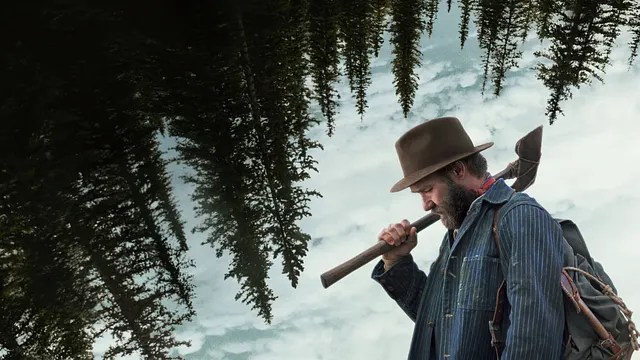
Recently, this unease resurfaced while I was listening to the Filmspotting podcast’s review of Train Dreams, the new Netflix film directed by Clint Bentley (based on Denis Johnson’s novel of the same name). If you’re a movie junkie like me, then you’re probably familiar with Terrence Malick, the legendary, enigmatic filmmaker responsible for movies like The New World, The Thin Red Line, and The Tree of Life — stories that explore life’s biggest questions through the lens of Christian doctrine. Bentley’s film has been widely compared to Malick’s work, due to similar subject matter and filming techniques. Usually, when the comparison is made, it tilts in Malick’s favor. This podcast episode was no exception, as film critic Josh Larsen said the following to his co-host, Adam Kempenaar:
I would consider Train Dreams to be — and I do not mean this as a slight at all, I mean it as a distinction — good starter Malick. The Christian concerns are just far more slight, if they’re here at all. And that is not good or bad, but I think it does add a level of complication and consideration that Train Dreams might not have. It goes back to the opening narration… you know, it’s gesturing to these ideas of things beyond this world. But yet, at the end of the movie, it’s all about: “This is where things end up,” is how I took it, right? And I want to be clear, I’m not criticizing the movie on this, but I do mean it’s operating at a level of somehow less mystery than… Malick [is] interested in plunging us into.
I’m a huge fan of Josh and Adam and their rich discussions of modern movies (You should check out their podcast if you haven’t already!). Larsen was careful to say that his opinions on Train Dreams’ lack of depth aren’t intended as criticisms, and I respect him for that. His belief that Bentley’s film is “starter Malick” or “Malick lite” — a B-version of weightier work — is also shared by many film critics. However, I think it’s too simplistic. Not only does it obscure the movie’s resonances with other great works of art (the playful cinematography of Wes Anderson, the quirky dialogue of the Coen brothers, and the writings of Wendell Berry, to name a few), but it also does a disservice to the film’s themes. Larsen’s comments draw some of their force from Christian theology that I was taught growing up, and I probably would’ve agreed with him prior to leaving the church a couple years ago. Don’t get me wrong, I also love Terrence Malick’s movies. Yet, while it may sound heretical for a cinephile to say so, I personally think Train Dreams is more moving and thought-provoking than anything Malick has produced. The reasons why have everything to do with the Biblical claim — espoused by Malick and intimated by Larsen — that true profundity lies outside of the mortal plane, not smack-dab in the midst of earthly life.

A disclaimer before I make my case: This essay expresses my personal opinions on what makes a story more or less profound, just as Larsen’s comment expressed his own opinions. Our definitions of “depth” and “significance” depend, of course, on the particular worldviews we hold. If, whether because of your religious background or your cinematic tastes, you find lots of beauty and philosophical depth in Terrence Malick’s movies, I respect that — and I do, too! Nevertheless, I do have reasons for preferring Train Dreams over Malick classics like The Tree of Life. I fear that the greatness of Clint Bentley’s achievement is being overlooked this year, and his film deserves a plug. As stated above, I also want to invite people to reconsider their assumptions of what makes a work of art profound. So, in the spirit of lively and constructive dialogue, here’s why I think film critics are missing the boat by relegating Train Dreams to “starter Malick” status…
Train Dreams opens with narration that, as Larsen puts it, seems to hint at something beyond the ordinary and familiar. Faced by trees, we hear actor Will Patton’s narration, delivered in a melodious South Carolina drawl:
There were once passageways to the old world; strange trails, hidden paths. You’d turn a corner and suddenly find yourself face-to-face with the great mystery, the foundation of all things. And even though that old world is gone now, even though it’s been rolled up like a scroll and put somewhere, you can still feel the echo of it.
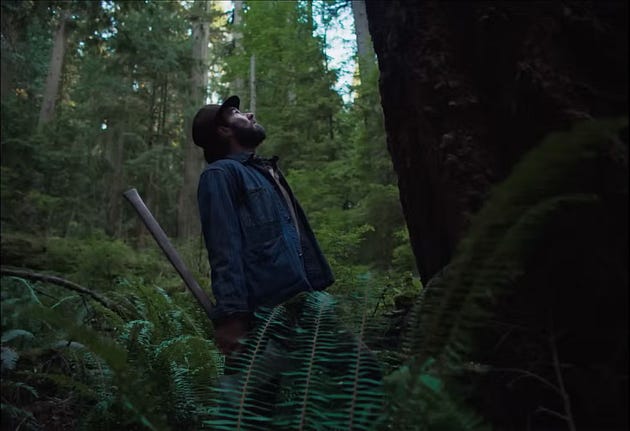
These lines introduce the movie’s central theme: the passage of time. Moments later, we’re introduced to Robert Grainier (Joel Edgerton in a career-best performance). He’s a shy railroad worker and seasonal lumberjack working to support his family in the Pacific Northwest. As the story progresses, it covers 80 years of Grainier’s life, and we witness the many changes sweeping across the United States in the 20th century through his eyes. New technologies. Hostility toward immigrants. Natural disasters. The plundering of environmental resources. Does all that sound epic? It might seem like smaller potatoes when compared with Malick’s masterpiece The Tree of Life — a story about a family in 1950s Texas that depicts the origin and evolution of the entire universe. According to Merriam-Webster’s dictionary, the word “profound” can be defined as “having intellectual depth and insight,” “difficult to fathom or understand,” or “very great or significant.” Whereas Malick’s film swoops between earth and heaven, blending cosmic and religious imagery, Train Dreams remains firmly planted in the soil of everyday work, rest, and family life. How, you may be wondering, could the latter possibly be more profound?
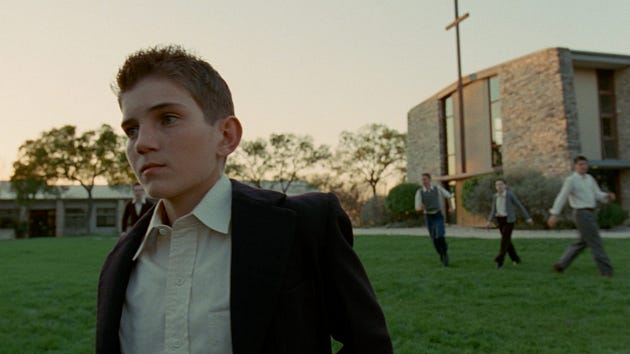
The Tree of Life’s protagonist, 12-year-old Jack O’Brien (Hunter McCracken), ponders many of life’s biggest mysteries: Where do we come from? Why are we here? What’s the meaning of everything? What comes after death? Most poignantly, he questions why God expects moral behavior and then allows terrible suffering: “Why should I be good if you ain’t?” Yet, throughout his film, Malick hands us many answers to these questions which are drawn from traditional religion. The film’s opening monologue — delivered by Jack’s mom, Mrs. O’Brien (Jessica Chastain) — tells us that there are two ways to live: the way of fallen “nature” and the way of God-given “grace.” Not only are we told these categories, but they’re also symbolized by Jack’s gentle mother, who represents divine love and forgiveness, and his domineering father (Brad Pitt), who represents worldly, dog-eat-dog ambition. By the story’s finale, grace is shown to be the superior path, and Jack’s father repents of his ignorance. Mrs. O’Brien’s claim that “no one who loves the way of grace ever comes to a bad end” is proved true.
This narrative arc, which mirrors the Christian story of sin and salvation, is reinforced by whispered prayers that grant us insight into the characters’ spiritual journeys. We were created to know and serve God: “I didn’t know how to name you then. But I see it was you. You were always calling me.” Human nature and the natural world have been corrupted by sin: “Nature only wants to please itself. Get others to please it, too. Likes to lord it over them. To have its own way.” And our problems arise from wandering away from God’s prescribed path: “How did I lose you? Wandered. Forgot you.” Jack’s younger brother, R.L. (Laramie Eppler), is widely understood as a Christ figure, and Jack’s enlightenment comes from receiving his brother’s forgiveness and acknowledging his brother’s innocence. Ultimately, the film’s surreal coda portrays the final harmony of redeemed humanity.
For all its mystery, then, The Tree of Life is largely a repackaging of Christian doctrine. Over and over again, we’re told what to think about the events we’re presented with. Characters act as stand-ins for theological concepts, and tough questions give way to well-traveled religious explanations for the world’s ills — answers that’ve been passed down to us for millennia.
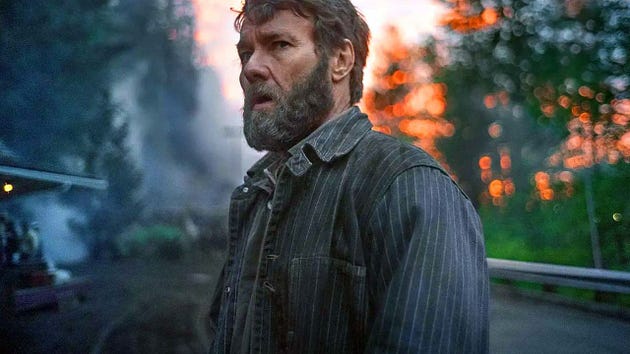
By contrast, Train Dreams immerses viewers in mystery without ever attempting to interpret or resolve that mystery. Robert Grainier is a man of few words, but that doesn’t mean that he isn’t asking questions; we can see them in his eyes, in the way he carries himself, and in how he observes the natural world around him. On the rare occasions when Grainier’s questions get verbalized, the people he shares them with consistently refuse to respond with clichés or inherited doctrine. On a logging job, mulling over a violent scene that has caused him deep regret, he inquires of an elderly demolition expert (William H. Macy): “Do you think that the bad things we do follow us through life?” The old man replies: “I don’t know. I’ve seen bad men raised up and good men brought to their knees. I reckon if I could figure it out, I’d be sleeping next to someone a lot better looking than you.”
Years later, in the glow of a campfire, Grainier asks another old-timer (John Diehl) about the changing values of his fellow workers. “I don’t know if it’s different or if it’s always been this way,” he muses. The grizzled lumberjack nods and says: “Well, that’s the age-old question, ain’t it friend?” Between these two queries, in the aftermath of a terrible tragedy, Grainier stares at a ghostly figure (We never learn whether this specter is real or imagined) and murmurs a question that echoes Jack O’Brien’s in The Tree of Life: “Don’t you think it’s all too much? Why? Why?” As usual, he receives no answers. Rather than snuffing out his questions, though, this silence allows them to hang in the air, turning them back upon the film’s audience. It’s as if the director is saying to us: People have wondered these things for spans of time that we can’t fathom, and we’re still wondering. What do you make of them?
Like many of us, Grainier struggles to perceive any meaningful narrative shape in the fabric of his life. “The last few years he expected some great revelation about his life would descend upon him,” the narrator tells us. “But as of yet, none had.” A comet — one that Grainier’s religious neighbors believe portends the end of days — blazes into view and then passes without incident. Grainier studies the heavenly object through his cabin window, silent but intent. Late in the film, we learn that the aging workman “felt he was only just beginning to have some faint understanding of his life, even though it was now slipping away from him.” Rather than clearing up our deepest questions, Train Dreams plunges us into the existential experience of carrying these questions over a lifetime — with no dogma to provide assurances, to guide our decisions, or to resolve ancient paradoxes.
On the Filmspotting podcast, Josh Larsen suggests that Train Dreams is less mysterious than Malick’s films because “the Christian concerns are just far more slight, if they’re here at all.” Hopefully, the flaw in that logic is now evident. The Tree of Life is justly revered as a classic of Christian cinema. Nevertheless, I’m convinced that Bentley’s new film will resonate with atheists, agnostics, skeptics, humanists, and spiritual “nones” who find religious categories of “sin” and “redemption” too neat and tidy — whose experience of the world makes belief in an all-knowing, all-powerful, and all-loving deity more difficult to hold. Where The Tree of Life shrinks its questions down until they fit within the boundaries of the Biblical canon, Train Dreams emphasizes their irresolvability, stepping back from them until they loom as large as the trees and mountains that surround Grainier.

The first time I watched The Tree of Life, I was gobsmacked. Few filmmakers have ever tried or managed to put such vibrant, poetic images on screen. Many of Malick’s frames are drawn from daily life; Mrs. O’Brien’s narration reminds us that the world is shining around us, if only we have eyes to see. Yet, as the operatic soundtrack swelled and that grand finale came into view, I was surprised to find myself strangely cold. The closing minutes of the film depict a grown-up Jack (Sean Penn) leaving the mundane world and stepping through a portal to another plane, still in his suit and tie. He eventually reaches the seaside. There, he meets a crowd of rejoicing strangers and reunites with deceased family members. The landscape is stark and barren, with no signs of civilization visible. As the scene unfolds, Malick’s imagery becomes increasingly ethereal — blinding light, praying hands and closed eyes, gestures that mimic the poses of religious icons, and Mrs. O’Brien’s climactic prayer of surrender to God. It’s a bold vision of paradise, and it’s exactly what the churches that raised me had taught me to long for — the ecstatic culmination of history, in comparison with which my earthly life was a mere vapor, a prelude, a shadow. Why, then, didn’t it hit?
The Tree of Life’s ending moves many people deeply, and I have no wish to downplay their emotional experiences. Each of us brings our own unique history to the art we encounter, and also takes something unique away. I speak from my own experience when I say that Malick’s masterpiece concludes with what feels, to me, like a disavowal of mundane life. This is evident in camera shots that repeatedly swing upward and away from his characters, focusing instead on the heavens; in the pious movements of men and women that assume rigid, statuesque qualities; and in the final prayer of a Jack’s mother: “I give him to you. I give you my son.” Malick has celebrated earthly things earlier in the film, but here he plants his thematic flag in the sand; true profundity, he maintains, lies outside of our current material world — in God, eternity, and the supernatural realm. Attachment to things that will pass away — the “way of nature” — holds us back from experiencing communion with the divine. It is only when Jack releases these things, leaving the familiar behind, that he finally finds peace.
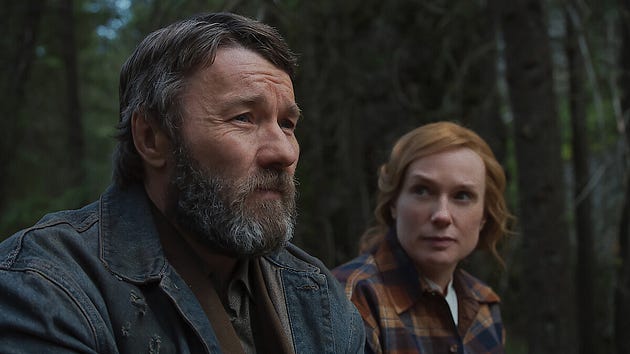
Bentley is just as eager as Malick to meditate on vast, awe-inspiring scenes. However, his story takes a sharp left turn by suggesting that transcendence isn’t simply something that exists beyond the bounds of our world; rather, it inhabits our sense of being inseparable from that world — small parts of an interconnected whole. The characters of Train Dreams repeatedly marvel at humanity’s place in the natural world: our origin in nature, our impact on its survival, our dependence on its resources, and the toll and gifts of its changing seasons (the “peace of wild things,” as Wendell Berry once put it). Midway through Train Dreams, a woman named Claire (Kerry Condon) tells Grainier: “In the forest, every least thing’s important. It’s all threaded together so you can’t tell where one thing ends and another begins… The dead tree is as important as the living one. There must be something for us to learn in that.” True to form, Bentley refrains from spelling out what.
Where did we get the idea that the “profound” — that which possesses true significance, is difficult to grasp, and should compel intellectual inquiry — is more the provenance of heaven than the stuff of earth? That our current planet isn’t as worthy of awe as what awaits us? That a life spent staring hard (Grainier-style) at the stuff of this world — rather than looking past it — is less noble than the religious contemplation of artists like Malick? Sadly, we needn’t grasp for the answer: It’s because religious texts and institutions have told us, for thousands of years, that the essence of reality — the real deal — must be something other than what already stands before us. Train Dreams gently dismantles this assumption with another line from Claire, offered to a confused and despairing Grainier: “The world needs a hermit in the woods as much as a preacher in the pulpit.” To her, nature isn’t fallen, inadequate, or in need of divine intervention — something opposed to the “way of grace.” It’s as full of grace and mystery as any human scriptures could ever hope to hold. It’s all we’ve got. And it’s enough.
Returning to Larsen’s review of Train Dreams for Filmspotting, I’ve realized that he misunderstands the film’s introduction. Will Patton’s narration about “the great mystery, the foundation of all things” is interpreted by Larsen as gesturing toward things beyond this world. However, the phrase in question is immediately followed by these words: “And even though that old world is gone now…” (emphasis mine). Larsen’s reading of these lines is understandable, because he assumes that “great mystery” and “foundation of all things” must have religious connotations. They don’t. Bentley has planted his own flag in the soil: His great mystery is the world we already inhabit — the foundation that gave our ancestors life and that enlivens us still. Like Fionn mac Cumhaill, that great hero of Irish folklore, Bentley’s story suggests that the greatest music of all is “the music of what happens.”
I won’t spoil how Train Dreams ends. I will tell you that the ending is quite different from that of The Tree of Life (as you might expect) and also that it perfectly encapsulates the movie’s themes. Where the close of Malick’s film left me somewhat cold, the final scene of Bentley’s film had me sobbing on my couch (As context, I rarely cry during movies). It wasn’t from sadness, although parts of Train Dreams are deeply sad. No, it was from sheer beauty — “All of it,” as a character says in the middle of the film. “Every bit of it.”
Marcel Proust, the great French novelist and chronicler of ordinary magic, once wrote: “The greatness of true art lies in rediscovering, grasping hold of, and making us recognize… this reality which we run a real risk of dying without having known, and which is quite simply our life.” If that’s so, then Train Dreams deserves to be recognized as much more than “Malick lite.”
 Words for Wayfarers