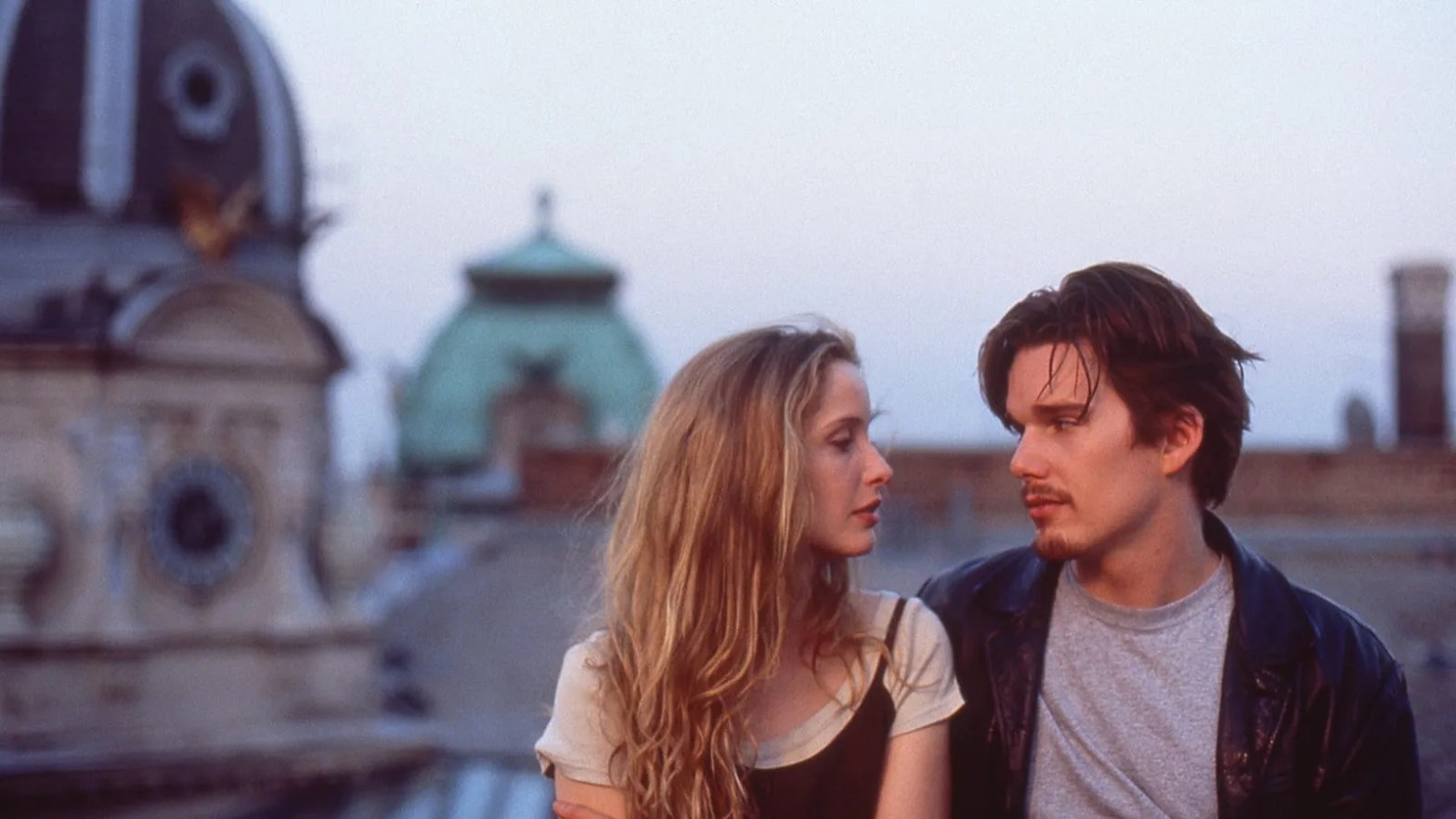
It might be the greatest pickup line of all time.
For twenty minutes, two young adults have been talking on a train. She’s French and he’s American. They met by happenstance, after the German couple in front of them began loudly bickering and a move to a quieter car became necessary. But now they’ve covered travel, literature, family, childhood, death, loneliness, and belonging, and the conversation shows no signs of slowing down. Which is a problem, because the train itself has come to a screeching halt in Vienna, where he’s supposed to catch a flight while she continues on to Paris. The young man knows that he’s got to act fast, so he invites her to get off the train with him, suggesting that they spend a day exploring Vienna together. After awkwardly reassuring her that he isn’t a “psycho,” he unfurls an elevator pitch for the ages:
Alright, alright. Think of it like this. Jump ahead, ten, twenty years, okay, and you’re married. Only your marriage doesn’t have that same energy that it used to have, you know? You start to blame your husband. You start to think about all those guys you’ve met in your life and what might have happened if you’d picked up with one of them, right? Well, I’m one of those guys! That’s me, you know. So think of this as time travel, from then to now, to find out what you’re missing out on. See, what this really could be is a gigantic favor to both you and your future husband to find out that you’re not missing out on anything. I’m just as big a loser as he is, totally unmotivated, totally boring, and, uh, you made the right choice, and you’re really happy.
A bold move if ever there was one. He waits, wide-eyed, for a reply. Did he blow it? She smiles bashfully, considers, then says, “Let me get my bag.” And so begins one of the greatest romances in cinematic history.
As many of you know, I’m referring to Jesse (played by Ethan Hawke) and Celine (played by Julie Delpy) in Richard Linklater’s 1995 film Before Sunrise. If you haven’t seen the film, then you might imagine that Jesse’s time-travel speech is a one-off… and a pretty weird one, at that. However, Linklater’s story is steeped in references to the passing of time. There’s the opening shot of train tracks receding into the distance; Jesse and Celine’s rambling discussions of youth and memory and growing old; the Friedhof der Namenlosen (“Cemetery of the Nameless”) where the two lovers pause to examine a child’s grave; a wrinkled fortune-teller who calls them both “stardust”; an exhibit by the painter Georges Seurat, in which mournful figures seem to dissipate into the background like ghosts; and Dylan Thomas’ poem “As I Walked Out One Evening,” which Jesse quotes late in the film and which contains the ominous refrain: “O let not Time deceive you, / You cannot conquer Time.” We know that Jesse has to catch a flight home the following morning. So, from the start of his impromptu adventure with Celine, we’re conscious of the fact that the clock is ticking.

Back in March, my wife and I traveled to Chicago’s Music Box Theatre (by train, of course) to see Before Sunrise on the final day of Filmspotting Fest. It was a very special experience for us. Like the movie, I was turning thirty — pondering my own circuitous journey through spacetime — and we’d both grown up in Europe, visiting cities like Budapest and Vienna on weekends. Since I can’t help but over-analyze great art, the film also got me thinking about the concept of eternal life — that holy grail of religions across the globe — and why, after seeking it for most of my life, I no longer want it.
I never fretted about death prior to my twenty-seventh birthday, when I abandoned the Christian faith of my upbringing. The Baptist churches that raised me had done their job far too well for that. After listening to dozens of sermons on Paul’s mockery of mortality in 1 Corinthians 15:55— “Where, O death, is your victory? Where, O death, is your sting?” — and singing countless hymns about heavenly glories to come, I was fully convinced that I’d survive my final breath. Jesus’ crucifixion, and the atonement for sins that accompanied it, had rendered my own demise irrelevant. No, what worried me was boredom and missed opportunity. I knew the idea of praising God endlessly was supposed to thrill me, but it didn’t (Believe it or not, those verses in Revelation about the “four living creatures,” with their six wings and eyes all over their bodies, who chant “Holy, holy, holy” day and night, night and day, without ever taking bathroom breaks… didn’t do it for me, either). Earthly life itself was more inviting. At church, where we studied the apocalyptic trials that would soon befall humanity, I dreamed of playing soccer and writing novels and traveling to China. I found myself resonating with the second verse of Noah Gundersen’s song “Jesus, Jesus”:
Jesus, Jesus, it’s such a pretty place we live in
And I know we fucked it up, but please be kind
Don’t let us go out like the dinosaurs
Or blown to bits in a third World War
There are a hundred different things I’d still like to do
I’d like to climb to the top of the Eiffel Tower
Look up from the ground at a meteor shower
And maybe even raise a family
According to Jesus, there wouldn’t be any marriage in heaven (Matthew 22:30), and gosh-darn it, I really, really wanted to get married. Thus, I joined the ranks of believers who pray “Even so, come, Lord Jesus” while secretly hoping the end isn’t as nigh as their pastors claim.
Then, in college, I discovered N.T. Wright.

Looking back, I can see that some of Wright’s appeal for me was rooted in his mellifluous British accent, but that was just icing on the cake. He’s an English theologian, New Testament scholar, and former bishop who has challenged many traditional Christian assumptions about the world to come. According to him, God’s future paradise won’t be the disembodied and cloud-filled “heaven” where many believers expect their souls to end up; rather, it’ll be a “new heaven and new earth” — a continuation and enhancement of our current physical life, purged of all sin and sorrow and death (Revelation 21:1- 4). Our life on Earth matters, Wright says, because everything that we do for Christ will, in some mysterious way, find its way into God’s New Jerusalem. He expounds this idea in Surprised by Hope:
The point of the resurrection… is that the present bodily life is not valueless just because it will die… What you do in the present — by painting, preaching, singing, sewing, praying, teaching, building hospitals, digging wells, campaigning for justice, writing poems, caring for the needy, loving your neighbor as yourself — will last into God’s future. These activities are not simply ways of making the present life a little less beastly, a little more bearable, until the day when we leave it behind altogether… They are part of what we may call building for God’s kingdom.
Wright’s writings (sorry, no pun intended) made Christianity’s vision of the afterlife attractive again. This world, only better? I could get behind that. It certainly sounds wonderful — an eternal adventure in a utopian cityscape. We might imagine Jesse and Celine in Before Sunrise, chatting excitedly and roving through the lamplit streets of Vienna on an evening that never ends. Yet I must admit that the more I consider this possibility, the less it appeals to me. In fact, I now believe that the Bible’s ideal of redeemed creation would rob life of everything that makes it worth living. And I got this idea from a Swedish philosopher whose accent is almost as cool as Wright’s.

Throughout his provocatively titled book This Life: Secular Faith and Spiritual Freedom, Martin Hägglund builds a case that the religious notion of eternal life is inherently undesirable. He begins by critiquing the idea that our mortality is a problem to be fixed. “To be religious,” he writes, “is to regard our finitude as a lack, an illusion, or a fallen state of being.” Hägglund understands the appeal of this view: “The thought of my own death, and the death of everything I love, is utterly painful. I do not want to die, since I want to sustain my life and the life of what I love.” Nevertheless, he claims that an endless existence would eliminate our impetus to care for the people, places, and projects around us, since our drive to sustain these things in the here and now depends upon a recognition of their finitude:
An eternal life is not only unattainable but also undesirable, since it would eliminate the care and passion that animate my life. This problem can be traced even within religious traditions that espouse faith in eternal life. An article in U.S. Catholic asks: “Heaven: Will it be Boring?” The article answers no, for in heaven souls are called “not to eternal rest but to eternal activity — eternal social concern.” Yet this answer only underlines the problem, since there is nothing to be concerned about in heaven. Concern presupposes that something can go wrong or can be lost; otherwise we would not care… The problem is not that an eternal activity would be “boring” but that it would be unintelligible as my activity.
The Catholic article cited by Hägglund echoes my own childhood fears that heaven would rob life of its momentum and variety. Yet you might find yourself asking: “Hold on… Why would eternal activity done for the good of redeemed humanity be nonsensical? Why assume that my care for family and friends depends on their vulnerability to death?” Hägglund elaborates:
Far from making my life meaningful, eternity would make it meaningless, since my actions would have no purpose. What I do and what I love can matter to me only because I understand myself as mortal… The question of what I ought to do with my life — a question that is at issue in everything I do — presupposes that I understand my time to be finite… If I believed that my life would last forever, I could never take my life to be at stake and I would never be seized by the need to do anything with my time. I would not even be able to understand what it means to do something sooner rather than later in my life, since I would have no sense of a finite lifetime that gives urgency to any project or activity.
The sense of my own irreplaceable life, then, is inseparable from my sense that it will end. When I return to the same landscape every summer, part of what makes it so poignant is that I may never see it again. Moreover, I care for the preservation of the landscape because I am aware that even the duration of the natural environment is not guaranteed. Likewise, my devotion to the ones I love is inseparable from the sense that they cannot be taken for granted. My time with family and friends is precious because we have to make the most of it. Our time together is illuminated by the sense that it will not last forever and we need to take care of one another because our lives are fragile.
Hägglund’s argument draws its power from experience. Why do you till your garden, undertake projects at work, play with your kids, repair your house, or deliver casserole to an ailing neighbor? It’s because you realize, consciously or unconsciously, that these things will collapse or become unwell without your intervention. If you neglect these tasks, then the plants in your garden will wither, your job will be lost, your kids will feel resentful, your house will fall apart, and your ailing neighbor will suffer alone… with no casserole. The fragility of these things — their susceptibility to decay — is what motivates you to nurture them in the first place, just as your knowledge that spring flowers and autumn leaves won’t last inspires you to turn off your TV, get off your couch, and savor each passing season.

Likewise, our decision to embark on romantic relationships is animated by the risks that accompany them — the breathless uncertainty as to whether our affections will be reciprocated. Anyone who has ever psyched themself up to ask out their crush knows that the world-expanding thrill of a “Yes” depends upon the world-crumbling prospect of a “No”:
The risk of being shattered is not a weakness to be overcome but remains in the fulfillment of love itself. The possibility of being touched is inseparable from the peril of being wounded and the exposure to loss is part of the experience of rapture.
These considerations stem from the nature of life itself. Hägglund reminds us that all living organisms are “characterized by self-maintenance. A living being cannot simply exist but must sustain and reproduce itself through its own activity.” The ever-present possibility of breakdown and death is what keeps our hearts and our brains, our nervous and digestive systems, pumping along in the first place. If the looming specter of our mortality was removed, then these organs would serve no purpose (Except, perhaps, for our spleens… Do any of us really know what those things do?). Building on these points, Hägglund states his thesis in the strongest possible terms:
A religious redemption from loss… is not a solution to any of our problems. Rather than making our dreams come true, it would obliterate who we are. To be invulnerable to grief is not to be consummated; it is to be deprived of the capacity to care. And to rest in peace is not to be fulfilled; it is to be dead.
With these considerations in mind, let’s revisit N.T. Wright’s words from Surprised by Hope, quoted above. Wright suggests that our present life would be “valueless” if it ended at the grave, since it only matters “because God has a great future in store for it.” This perspective is profoundly utilitarian. It treats all our earthly joys, strivings, and heartbreaks as means to an end — as setup for an infinite party that will, ultimately, eclipse them like sparks thrown out by the sun — rather than as realities meaningful in and of themselves. In sharp contrast, Hägglund maintains that the grave itself is what imbues our present with significance. Against the backdrop of the void, each moment of wonder that we experience is incalculably precious — a miracle, to borrow religious language, that’s worth cherishing for its own sake. I think Hägglund would agree with the Sorcerer Supreme (played by Tilda Swinton) in Marvel’s Doctor Strange, when she gazes at falling snow through a hospital window and intones that “Death is what gives life meaning. To know your days are numbered, your time is short.”
Hägglund’s philosophy illuminates a big part of what makes Before Sunrise resonate with audiences, even after thirty years. Midway through the film, Jesse says to Celine: “I feel like this is some dream world we’re in, you know?” She replies: “Yeah, it’s so weird. It’s like our time together is just ours. It’s our own creation.” Instead of sucking the joy out of their Vienna experience, the time constraint imposed upon the couple’s adventure has transfigured it, lending it a vivid, almost mystical shine. The time they spend together isn’t valuable because it foreshadows some grand finale, some distant hereafter. It’s valuable because it’s their time — here and now.
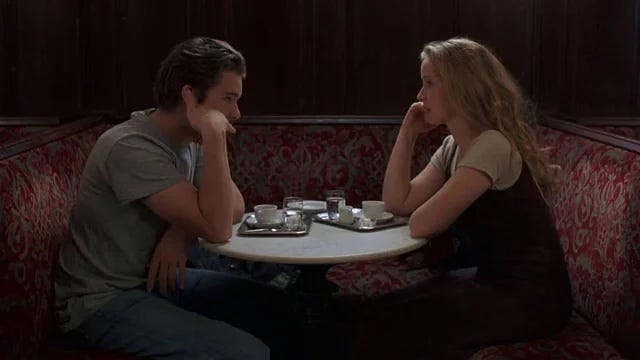
Later, at a dinner table, Jesse describes a friend of his who, on witnessing the birth of his first child, couldn’t stop thinking that this newborn would die someday. “Everything is so finite,” he concludes. “But don’t you think that’s what makes our time and specific moments so important?” In response, Celine says softly: “Yeah, I know. It’s the same for us tonight, though. After tomorrow morning, we’re probably never going to see each other again, right?” With those words, the conversation shifts. We watch as both characters reckon with the scarcity of their remaining hours, as they ponder the possibility of exchanging phone numbers or traveling to see each other overseas. Celine’s question isn’t just about their time in Vienna; it’s just as applicable to our brief existence on planet Earth. Why throw our whole selves — our beating hearts and fragile bodies — into something that won’t last? If one night isn’t enough, then what about one life?
After a long pause, Jesse looks up. Candlelight and shadow bleed together and flicker across his face. “Well, all right,” he says. “Let’s do it. No delusions, no projections. We’ll just make tonight great.” A band begins playing music as he reaches for Celine’s hand. She hesitates: “It’s just — it’s depressing, no? Now that the only thing we’re going to think of is that we have to say goodbye tomorrow.” Jesse thinks for a moment, then suggests that they both say goodbye now. “That way,” he explains, “we won’t have to worry about it in the morning.” So they do.
“Goodbye.”
“Goodbye.”
“Au revoir.”
“Later.”
Watching Jesse and Celine as they clasp hands and gaze silently into each other’s eyes, I consider the wonders that I’ve said farewell to over the years — the people, landscapes, memories, and past versions of myself. Time takes a heavy toll. Yet the ticking clock that made Jesse invite Celine into Vienna (How could he have done so if their train never stopped moving?), and that made them savor each step of their pilgrimage, is the same clock that compelled me to step onto a train to Chicago, to experience a film festival and a film anniversary that would only happen once, and — four years earlier, almost to the day — to ask out the woman who accompanied me on that train. Staring at the clock on my apartment wall now, I recall the closing stanzas of Ben Shive’s song “Wear Your Wedding Dress,” which sensitized my soul to the aching, transient beauty of a single day, back when I was still a Christian and believed my days would never end.
Time is short
And we both know it is
Today may be my only chance
To thank you for your love
So grieve for me, my darling, grieve for me
Think of me in death and close your eyes
Then weep for me, my darling, weep for me
Every day is the day to say goodbye
I could tell you how Before Sunrise ends — assure you that everything will be well for Jesse and Celine and all lovers who bare their souls in the fierce onslaught of time. But, dear reader, don’t you want to find out for yourself?

 Words for Wayfarers
To set limits is essentially the act of creativity. If you accept impermanence, you are confronted with the realization that everything is constructed and therefore changeable–liberating for some, indicting and overwhelming for others. By preemptively accepting the end, Jesse and Celine are able to create a sandbox-style relationship, which is a state most relationships would only hope to achieve. When I was a Christian, I believed everything was “fake” if not eternal. It’s an authoritarian appendage that denies tools for processing grief and–in my case–obstructs the development of executive function. I appreciate your words as always! Thanks for making me reflect. I’m going to look up the other works your referenced too!
Ironically when I first submitted this comment, I lost everything I had typed because I had to make a new password, so I had to accept the loss of my beautiful first comment and type something new lol
LikeLike
Thanks so much for reading, Nathan! Those are great thoughts. I don’t usually think of limits as something that enable creativity, but I think you’re spot on. The knowledge that we can change things is a source of great hope. And I love that life imitated art with your first comment, haha! 🙂
LikeLiked by 1 person