
“Wow, that sounds a lot like coming out!”
Recently, while sharing the story of my deconversion from Christianity, I received this same response from two friends – one straight, the other queer. Both of them recognized similarities between the struggles I faced as an apostate and the hardships encountered by queer people embracing their sexuality. As I’ve pondered my friends’ remarks, I’ve realized that the parallels run far deeper than I could have imagined. Additionally, I’ve been challenged to reexamine the LGBT rights movement with fresh eyes, to repent of my own complicity in systems of inequality, and to advocate for constructive dialogue between affirming and non-affirming communities. This post is an account of that journey.
Before I launch into this post, a few disclaimers and clarifications are in order. I’m no expert in gender studies or contemporary literature on sexual orientation. On the contrary, I’ve only just begun to realize how much I still have to learn from my queer neighbors. Additionally, as a straight, cisgender man, I make no attempt to speak for members of the LGBT community, who must tell their own stories. My experience of spiritual deconstruction may resonate with their coming-out experiences to an extent, but it’s also of a fundamentally different type, and so there will be many aspects of their experiences which I simply can’t understand. Finally, I don’t expect this post to change many people’s opinions on gender and sexuality issues in the United States. Others are better-equipped to accomplish that task. What follows is merely a snapshot of my own thinking, learning, and becoming. However, I do hope that my story can make a positive difference, even if that difference is a small one.
If you’re non-affirming, I hope this post inspires you to reexamine your beliefs about your LGBT neighbors, to listen attentively to their stories, and to approach uncomfortable conversations with greater sensitivity and respect. As someone who only very recently left the conservative fold, I have zero right to judge those who remain within it. Yet, as someone who believes that disregard for queer narratives within religious communities is harmful, I feel compelled to speak out.
If you’re a member or ally of the LGBT community, I hope this post encourages you to be patient with your non-affirming neighbors, many of whom are grappling with difficult questions of religious faith and practice. I know from personal experience that interrogating deeply-held religious convictions can be an incredibly unsettling experience. In this bizarre and befuddling world that we inhabit, perhaps we all could use a little grace.
All right. Now that we’ve got those things out of the way, let’s dive in!
More to the Story

Over the past eight months, I’ve discussed my deconversion from Christianity with many people, most of whom identify as Christians. By and large, these conversations have been very warm, respectful, and supportive. I was fortunate to be raised within Christian communities that emphasized self-giving love and Christlike compassion over ideological division. Nevertheless, as I’ve shared my story with members of the evangelical church (by which I mean the evangelical community at large, not one particular institution), I’ve been confronted with many assumptions about my departure from that church.
People sometimes assume that I left Christianity because of hypocrisy in Christian communities, cultural pressures, mental health struggles, or an experience of God’s silence amidst suffering. These assumptions are relatively easy to correct. Although similar concerns have led many young people to abandon organized religion, my own deconversion wasn’t motivated by these things. First and foremost, my departure from the church was prompted by concerns about the reliability of the Bible. If I hadn’t lost my faith in the historical accuracy of the Old and New Testaments, then I wouldn’t have renounced my commitment to Jesus.
Other assumptions are much more painful and tricky to untangle. I’ve been told multiple times that my deconstruction was my own fault, caused by inadequate love for Jesus, an arrogant thirst for godlike knowledge, an insufficient grasp of scripture, rebellion against God’s will, satanic or demonic influence, or all of the above. Often, those who make such claims have made little effort to understand what my deconversion process actually entailed. They rarely seem open to reconsidering their diagnoses of my situation. Consequently, while I could present a host of evidence that undermines each of these assumptions, I sometimes feel like I’m fighting a losing battle, and I clam up. There are few things more disheartening than realizing that people have already made up their minds about you, regardless of what you might say in your defense.
As I’ve grappled with biased assessments of my deconversion, I’ve been convicted about my own former biases. Growing up within an evangelical culture, I inherited a number of flawed assumptions about the LGBT community which have collapsed through subsequent study and conversations with queer friends. I regularly heard (and believed some of) the following claims:
- “No one is born gay.” (In fact, there is no scientific consensus on what causes homosexual attraction. Most scholars believe it results from a complex interplay of nature and nurture, genetic predisposition and environmental factors.)
- “Homosexuality is a choice, not an identity.” (In fact, most queer people report little to no sense of choice or control over their sexual orientations.)
- “Same-sex partnerships are mostly a modern, western phenomenon.” (In fact, romantic same-sex partnerships are well-documented throughout history and around the globe, including in every major sector of the animal kingdom.)
- “Homosexual behavior may be exacerbated by family dysfunction or psychological struggles.” (In fact, there’s no link between homosexuality and psychopathology. It’s a normative, widespread disposition that has no detrimental mental health consequences. Additionally, many queer people come from stable, healthy families.)
- “Gay and lesbian people can change their attractions and enjoy fulfilling, heterosexual marriages.” (In fact, while this may be true in rare cases, suppression of one’s sexual orientation can be deeply damaging. Conversely, acceptance and integration of one’s orientation increases health and well-being.)
- “Queer people are only coming out because they want cultural sway and social acceptance.” (In fact, fear of rejection or reprisal prevents many people from coming out for long periods of time, especially those raised in conservative communities. Verbal harassment and abuse are nearly universal experiences for queer people, who still face significant social, employment, and housing discrimination in the United States.)
- “Same-sex marriages are inherently unhappy and unstable.” (In fact, gay couples report equivalent levels of marriage satisfaction as straight couples. Many of them also form durable, lasting attachments.)
- “Children raised in households with gay or lesbian parents will experience developmental struggles.” (In fact, children raised in gay households are no more likely than other children to experience developmental difficulties. They are just as happy and healthy as other children.)
Why do we make so many unfounded assumptions about people who are different from us? These beliefs don’t emerge from a vacuum. They’re the product of universal tendencies. We all tend to adopt the worldviews of the communities that raised us, to trust those who look and think like us, and to filter unfamiliar data through familiar categories. These tendencies make us shortsighted, but they also enabled our ancestors to recognize threats and to maintain social cohesion in dangerous environments. Faced with evidence that doesn’t fit our paradigms, we’re much more likely to force a fit than to allow that evidence to reshape those paradigms. This kind of behavior isn’t evil or dishonest. It’s a deeply human response, generated and reinforced by an unpredictable world.
Reflecting on the assumptions made about my deconversion and the hurt that some of those assumptions have caused, I’m saddened and humbled by my own mistaken assumptions about the LGBT community. Sure, I didn’t actively seek these opinions out. But I didn’t actively question them, either. My deconversion experience has taught me that there’s always more to the story than what fits neatly within our boxes. Life is incredibly complex, and our perspectives on it are far more limited than we usually like to admit. Each and every human being is a unique expression of that life – a walking mystery. Whatever beliefs we hold about queer partnerships, whether for or against, we would do well to set our preconceptions aside when engaging with the “other,” to strive to see and understand them as they are, to be “quick to listen, slow to speak” (James 1:19). We would do well to ask ourselves: Do I really know what makes this person tick? Am I open to the possibility that I could be wrong about them? Have I considered that they might have something valuable to teach me? The words of theologian and author Frederick Buechner are applicable here:
If we are to love our neighbors, before doing anything else we must see our neighbors. With our imagination as well as our eyes, that is to say like artists, we must see not just their faces but the life behind and within their faces. Here it is love that is the frame we see them in.
Crossing the Gap
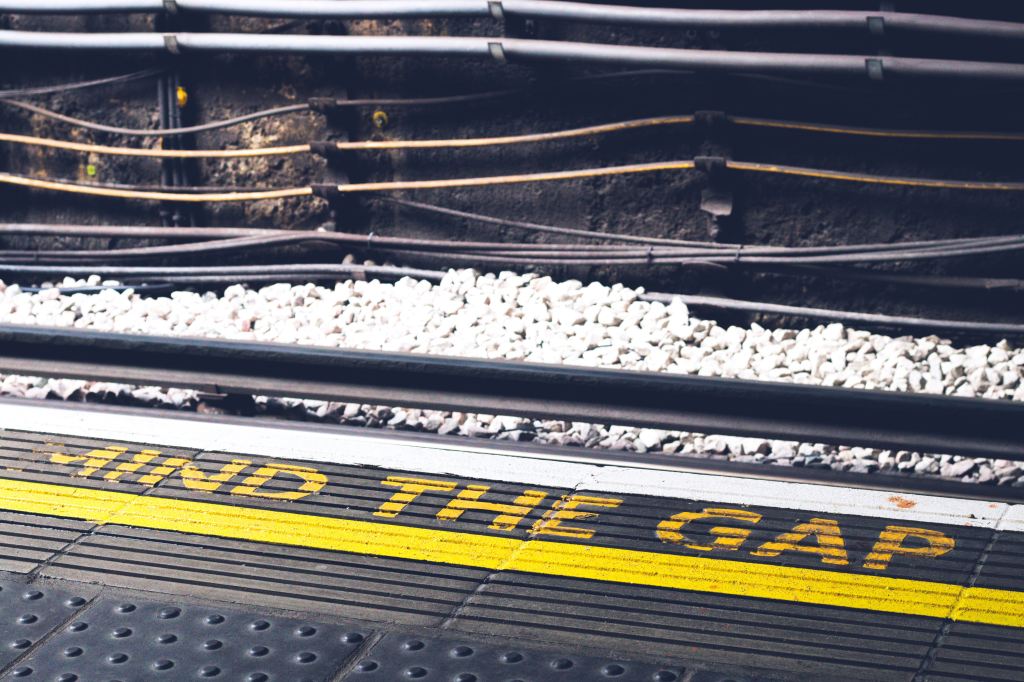
One of the most difficult things about leaving organized religion was the profound sense of isolation. Immediately, I started seeking commiseration. I didn’t want sympathy – people feeling sorry for me and my situation. I wanted empathy – the assurance that I wasn’t alone in my struggle. The problem was, I didn’t know anyone who had left the faith or who was even seriously considering leaving the faith. My community was made up almost entirely of born-again, evangelical Christians. That isn’t to say that no one around me struggled with doubts. I knew I wasn’t the first person in history to grapple with skepticism or the only person at my church wrestling with hard passages of scripture. Yet, no one around me seemed as bothered or burdened by these issues as I was.
In those early months, the deepest comfort that I found came from online testimonies of deconstruction. The people sharing these testimonies were total strangers, but they also showed me that I wasn’t alone – that others had walked the same road for very similar reasons. Eventually, after publicizing my own deconversion story on this blog, I discovered that a number of friends in other parts of the country were navigating similar situations. Several of them reached out to me, thanking me for sharing my story and explaining that they, too, felt isolated in their struggles with doubt.
Why is it so difficult for those deconstructing religious faith to find community? While I can’t speak for others, I know that I played a role in my own isolation. Growing up within evangelical churches, I was taught that God loved nonbelievers. As a result, I needed to love nonbelievers, too. I believed that God wanted me to evangelize – to share the good news of Christ with neighbors through word and deed. Yet, from childhood through adolescence into adulthood, I had exactly one non-Christian friend who I actively did life with (looking at you, Aaron!). I interacted with non-Christians at work, at school, and across the street, but rarely did my relationships with them amount to more than casual acquaintance. Ninety-nine percent of my closest friends and companions were believers. I sincerely wanted to broaden my social circle, to break out of the “Christian bubble.” So, why didn’t I? Because life was easier with those in the bubble. We had more in common. We spoke the same language. There was less chance of awkwardness or discomfort.
My attitudes toward queer people were influenced by a similar lack of contact. Prior to entering college, I had no queer friends. Even after graduation, after many of my assumptions about the LGBT community had been challenged and replaced with more nuanced views, my contact with queer people was extremely limited. My Christian community had taught me what to think about members of the LGBT community. But I didn’t know anyone in that community, not really. That being the case, how could I be sure that my assessment of them was correct?
In his famous chapel address at Cornell College on October 15, 1962, the Reverend Dr. Martin Luther King, Jr. traced the roots of racial injustice to a surprising source. The catalyst of violence and oppression, he argued, wasn’t innate bigotry, mere simple-mindedness, or irredeemable evil. It was distance. King wrote:
I am convinced that men hate each other because they fear each other. They fear each other because they don’t know each other, and they don’t know each other because they don’t communicate with each other, and they don’t communicate with each other because they are separated from each other.
Why was it so hard to find non-Christian community after leaving the faith? Why did I harbor so many false assumptions about queer individuals? The answer to these questions is simple: I was afraid. I feared meaningful engagement – up-close-and-personal contact – with those beyond the walls of the church. Why did I fear interacting with people who believed and behaved differently than me? Because I didn’t know them. My knowledge of non-Christians and queer people was largely secondhand, founded on the opinions of others. I’d been taught to see those outside the faith as targets for evangelism, as lost souls in need of salvation, not as conversation partners to dialogue with, companions to journey alongside of, or friends to be shaped by. They were living on the other side of the tracks, and I’d been exhorted to mind the gap, not to cross it. When I finally did cross over, seriously engaging with non-Christian scholarship on the Bible and building relationships with members of the LGBT community, my assumptions about why people leave the church and who queer people are were exposed as shallow, simplistic prejudices.
A word to Christian readers: You may believe that Jesus loves gay people, bisexual people, and transgender people. You may believe that you love them yourself. You may even know some members of the LGBT community. But I invite you to ask yourself: How many queer people do you maintain close, committed, mutually enriching friendships with? How much time do you dedicate to hearing queer stories, to reading books by queer authors, or to reaching out to queer neighbors? Please don’t hear judgement in those questions. I speak as one who has failed miserably at practicing what he now preaches. Yet, I’m convinced that the barriers erected between conservative Christians and queer people – the barriers that have spawned misunderstanding, hatred, and discrimination for generations – will remain firmly in place, and will grow thicker with time, until we actually do the hard work of tunneling through them and getting to know those we disagree with.
No More Fear

Two weeks ago, I headed to downtown Grand Rapids to participate in the city’s annual Pride Festival. Several streets had been blocked off for the event, and the sidewalks were lined with tents, booths, and food trucks. Rap music thumped from speakers adjacent to a stage. As I slipped into the crowds milling about on the roads, I didn’t know what to expect. I had never attended an LGBT-themed event before. This was foreign territory. Yet, after twenty-seven years of making assumptions and watching from a safe distance, I had decided that it was high time to cross the gap. I felt compelled to acknowledge and repent of my former prejudices toward queer people, and I wanted to add my voice to the masses calling for equality.
Prior to leaving the Christian faith, I would’ve made certain assumptions about Pride gatherings: lots of young people, mostly LGBT, waving signs and placards in angry protest of heteronormative culture. Yet, what I saw that day challenged my paradigms, just as Biblical evidence had challenged my religious convictions. I saw thousands of people in brightly colored clothing – people of all different ages, races, sexual orientations, and religious backgrounds, walking and talking and laughing and singing together. I saw churches offering welcome, support, and resources to queer people in need. I saw people hugging, holding hands, and throwing their arms around each other’s shoulders, celebrating the gift of affection without any fear of judgement. As I watched the festivities, I was reminded that this world is full of stories – uniquely beautiful and three-dimensional stories – which can’t be reduced to labels or stuffed into boxes. I was reminded that the joys and heartaches which connect us are far stronger than the lines we draw in the sand. No longer separated from my queer neighbors, I realized that MLK was right after all. The fear was gone.
To my lesbian, gay, bisexual, and transgender friends and neighbors: I’m sorry. I’m sorry for making so many assumptions about who you were, for refusing to question the dogmas inherited from my faith community, and for never making the effort to cross the street and hear your stories. I know that I have a lot to learn. But I’m finally listening. Your road is an incredibly difficult one, and I never would’ve expected to walk a similar path. Yet, despite all the pain involved, I’m glad that I did. It’s so nice to have company, and the scenery is just more colorful here.
 Words for Wayfarers