
In the opening shots of Martin McDonagh’s film The Banshees of Inisherin, we’re introduced to a fictional Irish town that, at first glance, seems totally idyllic. We descend from the sky, taking in the emerald sweep of pastureland. As the camera drifts along the seaside, we hear strains of an ethereal chorus sung in Gaelic. Next, we glimpse a lone figure striding through the town’s harbor. Gulls wheel in the air above Pádraic Súilleabháin, and a rainbow is visible behind him. He smiles and waves at passerby with easy familiarity. Reaching a fork in the road, the farmer turns toward the home of his friend, Colm Doherty, eager to invite Colm to the local pub for a pint or two. For one brief minute, the world seems at rights. Nothing in these images augurs the chaos that is about to break loose on the isle of Inisherin.
Much to Pádraic’s surprise, Colm doesn’t want to share a pint. In fact, he doesn’t want to continue his friendship with Pádraic at all. When the farmer finally corners his evasive drinking buddy at the pub, Colm heaves a sigh and confesses: “I just don’t like you no more.” The blunt declaration bewilders Pádraic, who can only blink and stammer in reply: “But you liked me yesterday.” The rationale for Colm’s change of heart soon becomes clear: he’s waist-deep in an existential crisis. Cognizant of his dwindling lifespan, he yearns to compose music that will outlast him. He can’t spare any more time for Pádraic’s dull chatter, which regularly centers on topics like the ingredients of “pony shite.”
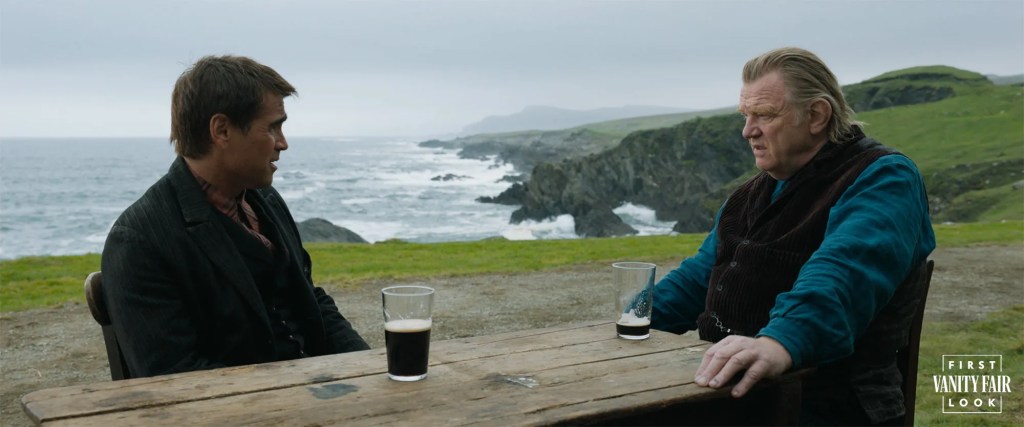
To Pádraic, Colm’s decision to cut ties is incomprehensible. Unwilling to let the matter go, Pádraic hounds and harangues his fiddle-playing friend until the latter issues a grisly ultimatum: every time that Pádraic talks to him, Colm will chop off one of his own fingers. Pádraic is horrified, and you might expect the dispute to end there. But this is an Irish film, and a Martin McDonagh picture to boot – equal parts black comedy and Shakespearean tragedy. By the time the credits roll, fingers will be severed, deaths will be suffered, and Inisherin’s tranquility will be shattered. Explaining his new tune – “The Banshees of Inisherin” – at the midpoint of the film, Colm conjectures that the island’s fragile peace may never have existed at all. “Maybe there are banshees [on Inisherin]… I just don’t think that they scream to portend death anymore. I think they just sit back, amused, and observe.”
If you haven’t seen The Banshees of Inisherin yet (and if you can stomach a few dismemberments), consider this your recommendation. It’s a cinematic masterclass that was nominated for nine Oscars, and it features career-best performances from acting legends Colin Farrell and Brendan Gleeson. It’s also laugh-out-loud funny. Like all great stories, the film holds layers of meaning that require time and patience to unravel. Banshees blew me away when I saw it in theaters in 2022, and I was eager to see what I might glean from a second viewing. Braced for a fresh round of Irish spirits (both alcoholic and mystical), I discovered that Martin McDonagh’s tale of fractured friendship had instead conjured up ghosts from my own past – specifically, my long history as a member of the American evangelical church.
In retrospect, this shouldn’t have been surprising. I rewatched Banshees in early November, as the tidal wave of anxiety and animosity surrounding the U.S. presidential election reached its crest. Eight years ago, eighty percent of White evangelical Christians voted for Donald Trump, igniting fierce debates about the church’s influence on American politics. This year, the same percentage cast their vote for the controversial candidate. For many Americans, Trump’s ascendancy is a divinely orchestrated triumph (“Jesus is our Savior, and Trump is our president,” proclaims a new deluge of Republican merchandise). For others, Trump’s win is deeply distressing – a harbinger of doom akin to Martin McDonagh’s banshees. The run-up to November 5 unfurled a litany of distressing headlines: widespread fear, assassination attempts, incendiary rhetoric, misinformation campaigns, promises of retribution, natural disasters, bomb threats at polling stations, and much more. Debates about public policy rage not only in government offices but also in homes and schools and churches across the country. Many of us, if we’re honest, feel more vulnerable than ever. No matter where you stand in America’s political landscape, the widening fault lines are impossible to miss.
In the wake of current events, it’s no wonder that Banshees‘ tale of simmering grievances brought religion and politics to mind. The story asks questions that are at once timely and timeless: Where do conflict and bigotry originate? What prevents us from truly seeing and understanding each other? Can worldview differences be overcome, and if so, how? McDonagh’s film may be set in 1920s Ireland, and it may focus on the intimate details of a particular friendship. Yet, for those with eyes to see and ears to hear, it also has profound things to say about our modern culture wars – specifically, about the perception, the peril, and the power of human vulnerability.
The following essay combines cinematic analysis with thoughts on White evangelicalism and its political legacy in the United States. A few disclaimers are in order before we begin. This is the first overtly political piece I’ve ever written for my blog. My content explores intersections between contemporary art, culture, and spirituality, and my ultimate goal is the celebration of beauty, not social critique. Consequently, I’ve wondered whether to publish this post at all. I worry that it might sound patronizing, that it’ll almost certainly be misunderstood by some, and that it may ignite outrage. Yet I’ve decided to publish anyway, compelled to do so by my conscience. To quote Albus Dumbledore in Harry Potter and The Goblet of Fire: “Dark times lie ahead of us, and there will be a time when we must choose between what is easy and what is right.” Silence on political matters will no longer do, and I find that the risk of controversy is, after all, one that I must take. I hope this essay will provoke thought, encourage discussion, and bridge deepening social divides. In pursuit of those aims, I’ve taken care to write as clearly and compassionately as I can, aware that I’ll inevitably fall short of my aspirations. If the views that I express here run counter to yours, I hope you’ll grant me the charity of a fair hearing (at the very least, please don’t threaten to chop off any of your fingers).
The following reflections arise from a place of love. I was once an earnest follower of Jesus Christ, committed wholeheartedly to the work of evangelism and discipleship. Two years ago, after a prolonged and painful crisis of faith, I made the difficult decision to leave the Christian church, unable to believe its core tenets anymore. I now stand outside that church’s walls, but I’m not distant from it. For twenty-seven years, it was my entire world. Most of my friends and family members still call it home. I hold deep respect for evangelicals, many of whom lead lives of generous, self-sacrificial love. Evangelicalism is no monolith, and many of its adherents would agree with the concerns and critiques that I’ll share below. This essay muses on troubling trends in the White evangelical church as a whole – actions and attitudes in which I myself have been complicit – and makes no claims about the moral status of particular evangelicals. I’ve discarded many of my former convictions, but I think Jesus was right when he taught that truth sets us free (John 8:32). Honest self-examination is often uncomfortable, but it’s the only way to expose our blind spots and broken places – to prevent destructive patterns from becoming malignant. I’m as susceptible to these patterns as anyone, and the mirror that I hold up to Jesus’ American followers is, in the end, one that I must also hold up to myself.
One final note: This essay contains spoilers. Without any further ado, what might a film about two squabbling Irishmen teach us about the fraught world we inhabit?
I. “What’s the matter with everybody?”: The perception of vulnerability

If there’s anything the characters of Banshees have in common, it’s their struggle to understand the sufferings of others. McDonagh’s film suggests emotional distance through physical blocking: characters duck behind walls to escape awkward conversations, stare at neighbors through windowpanes and spyglasses, and frequently fail to meet each other’s gaze. Misunderstandings abound on Inisherin. Early in the film, Pádraic’s sister Siobhán (played by Kerry Condon) suggests that Colm’s behavior may be a symptom of depression. Pádraic is quick to agree: “That’s what I was thinking, that he’s depressed!” However, the farmer repeatedly fails to grasp how his impulsive pleas and outbursts may be affecting Colm, even after the musician’s digits begin to disappear. Colm, for his part, seems blind to the emotional toll his absence has inflicted on Pádraic. During a tense run-in at the pub, Colm laments that he and Pádraic “were doing so well” with their pact of silence, to which an inebriated Pádraic retorts: “I wasn’t doing so well!”
Again and again, the sorrows voiced by Inisherin’s townsfolk fall on deaf ears. “Do you never got lonely, Pádraic?” Siobhán asks early in the movie, exposing her inner world in a rare moment of candor. Pádraic responds to her with the same dismissiveness that he shows Colm: “What’s the matter with everybody? Jesus!” Later in the film, Pádraic asks the same question – “What’s the matter?” – when he hears Siobhán weeping in her bed. This time, his tone is filled with concern, but his sister can only whisper in reply: “Nothing.” Siobhán feels starved for companionship. However, she fails to spot this same hunger in the town fool, Dominic (played by Barry Keoghan), whose desperate need for kindness she continually rebuffs. When Dominic confesses his love for her, Siobhán turns him down gently. Yet her melancholy prevents her from extending comfort to the ragged victim of domestic abuse, who stares into the distance and murmurs: “Well, there goes that dream.”

The Banshees of Inisherin reminds me that it’s often difficult to accurately perceive vulnerabilities, whether those vulnerabilities belong to us or to others. We’ve all experienced situations where we felt more endangered than we actually were, fears that people judged or disliked us more than they actually did, and the sinking feeling that everyone around us had it all together. Likewise, we’ve all made assumptions about the struggles faced by others, and we’ve all become fixated on our own problems to the neglect of other people’s. I know how tempting it can be, when I’m fearful or frustrated, to withdraw into my proverbial shell, lick my wounds, and ignore the burdens my wife is carrying (just ask her, she’ll verify). This tendency to exaggerate our own hardships while disregarding those faced by others is deeply human. It also serves a practical purpose: self-preservation. Like the moat or rampart surrounding a castle, our self-focus guards our sensitive spots from scrutiny and attack. However, it also distances us from others, making it harder to glimpse the suffering that our neighbors might be experiencing.
Our myopia isn’t just fortified by internal barriers; it’s also the product of external divides. Encounters with marginalized people groups, whether they take place on a short-term missions trip, at a homeless shelter, or through the screen of a cinema, have a way of placing our struggles into perspective. Conversely, separation from racial, cultural, or religious outsiders makes it much easier to underestimate their vulnerabilities and, in doing so, to overestimate the threat they pose to our welfare.
Growing up in American evangelical churches, I was told many things about the secular world, and few of them were rosy. My fellow congregants and I believed that God loved everyone, no matter where they came from or how many poor choices they’d made. At our best, we sought to embody God’s unconditional welcome through acts of charity and hospitality. Yet we also believed that we were profoundly vulnerable. Persecution was inevitable for those who followed Christ – hadn’t Jesus himself taught this to his disciples (Mark 10:29-30, Matthew 5:10-12, Luke 21:10-19, John 15:19-20)? Our lives might appear stable, but this was an illusion; clearly, we were living in the last days, and society was a runaway train bound for ruin. Immorality was rampant, Jesus’ return was imminent, and the holy horrors depicted in the Book of Revelation might break loose at any time (I remember binge-reading the Left Behind: The Kids series in middle school – all forty volumes! – and gulping as Jerry B. Jenkins and Tim LaHaye described the pursuit, imprisonment, and execution of American believers by non-Christians). Missionary tales of overseas persecution amplified our fears, reminding us that the people whom we were called to love might turn on us at any time, just as they had once turned on Christ. When we exited our churches on Sunday mornings, we were soldiers plunging into a spiritual battleground.
Persecution was discussed not only as a future prospect but also as a present reality. Again and again, I heard White evangelicals speak of a secular “agenda” to undermine religious values and bar American Christians from the public sphere. This plot, I learned, was spearheaded by liberals, Democrats, atheists, socialists, and members of the LGBTQIA+ community. Besides government halls and the entertainment industry, their main target was classrooms. Purported evidence of educational discrimination was sketchy, most of it concerning the teaching of evolution, the ban on corporate prayer, and the affirmation of queer relationships in public schools. These things might seem harmless, but they were just the tip of the secular iceberg. Propaganda films like God’s Not Dead and Expelled: No Intelligence Allowed portrayed universities as hotbeds of censorship, and the latter linked the teaching of Darwinism to such far-flung woes as apostasy, nihilism, fascism, eugenics, warfare, and (you guessed it) the Holocaust. Pastors trained students in apologetics – the reasoned defense of Christian doctrine – to brace them for colleges that would inevitably seek to squelch their faith. If atheist professors didn’t curb-stomp students’ morals, then binge-drinking and casual sex probably would. American colleges weren’t irredeemably evil, but they weren’t safe either. Here, as elsewhere, God’s truth and God’s people were under fire.
Looking back, I’m struck by how readily I swallowed these claims. In my twenty-seven years as an evangelical, I never once experienced persecution from nonbelievers, nor did I witness a single instance of a fellow Christian being mistreated because of their faith. Alleged examples of persecution usually concerned the right of non-Christians to practice morality outside the bounds of traditional religion, like the legalization of same-sex marriage in 2015. Inconvenient facts whizzed overhead: the fact that most Americans, including almost all congresspeople, identified as Christians; the fact that Jesus and the Bible were regularly invoked in political discourse; the fact that Christians were the only religious group campaigning for prayer in public schools (can you imagine how people would react if Muslims made the same appeal?); the fact that Christian churches, and many Christian schools, enjoyed tax-exempt status. The historical record is clear: Christians in America have always held the reins of social and political power. If Donald Trump’s landslide victory in 2024 reveals anything, it’s that White evangelical fears of a covert liberal takeover (including claims that Democrats rigged the 2020 election) have always been bogus, as flimsy and unfounded as Flat Earth science. Given these realities, how could I have ever thought that Christians in America were a persecuted minority?
Sadly, the answer is simple: I hadn’t spent time listening to non-Christians and other cultural outsiders. During and after college, when I finally befriended Muslims and atheists and members of the queer community, I realized just how little I understood about what legitimate persecution entailed. Consider these stunning statistics about the discrimination faced by America’s LGBTQIA+ population, compiled by the National Sexual Violence Research Center:
- Queer people are 4x as likely to experience violence as straight people.
- 50% of trans people have been sexually assaulted.
- In 2020, murders of trans people were at an all-time high, and most victims were women of color.
- Trans people are 7x as likely to experience police brutality as straight people.
- 53% of trans people have been publicly harassed, 90% at their workplace.
- More than 50% of queer workers reported concealing their romantic relationships to prevent workplace hostility.
- 46% of homeless LGBTQIA+ youth were disowned by their families due to their sexual orientation or gender identity, 43% were expelled from their houses by parents, and 32% were physically, sexually, or emotionally abused.
- Queer youth are 5x as likely to die by suicide as straight youth.
- Queer people are more likely than straight people to experience unemployment, housing discrimination, poverty, and denial of health services due to their sexual orientation or gender identity.
These aren’t just statistics. They’re stories painfully familiar to my queer friends. Suffering isn’t a contest (not one that I want to partake in, anyway), but the discrimination faced by members of the LGBTQIA+ community far exceeds any persecution faced by White evangelicals in America. I don’t list these facts to minimize real hardships that particular evangelicals might experience. Rather, I share them to highlight the widening chasm between evangelical perceptions of discrimination (what is pejoratively referred to as “the Christian persecution complex”) and the harsh realities faced by genuinely oppressed people groups. Daniel Cox, director of the Survey Center on American Life, describes this worrying trend in his article “Why Most Evangelicals Say They Face ‘A Lot’ of Discrimination.” According to Cox, the past fourteen years have evinced “a profound reversal in who white evangelicals believe faces discrimination in American society.” While most White evangelicals rejected the idea that they were discriminated against in 2009, sixty percent now report that they face “a lot of discrimination.” During the same period, the percentage of White evangelicals who perceived gay and lesbian people as targets of discrimination fell from sixty percent to thirty-nine percent. The question facing us in today’s America isn’t whether queer people are vulnerable. They are, and they always have been. The question is whether we’re still able to see those vulnerabilities for what they are.
Have you ever visited a foreign country? If you have, then you know that international travel isn’t easy (unless, of course, you’re a dashing secret agent with the last name Bond). Passports and visas are required for entry, along with immunizations and round-trip flight tickets. Hotel reservations must be secured, a new system of public transportation navigated, fragments of an unfamiliar language rehearsed. Once these barriers are crossed, others remain. Even if you move to the country, apply for citizenship, and dedicate your life to the task of cultural immersion, you’ll never experience the place in the same way that native inhabitants do. Some elements of its life, its language, and its landscape will always remain a mystery.
Whether we realize it or not, every person we’ll ever meet is a foreign country. Your interior world – the product of your unique parentage, biology, upbringing, and experience – is literally one-of-a-kind, unparalleled in the history of the universe. Consequently, your hardships and heartbreaks are unique, too. The author of the Book of Proverbs put it succinctly: “Each heart knows its own bitterness, and no one else can share its joy” (14:10). Like a trip to a foreign country, the quest to understand another person – to really see them as they are, with all their vulnerabilities – can’t be taken lightly. It requires time, patience, and steadfast resolve. We can choose to overlook the vulnerabilities of others, but like an ill-equipped stowaway to a foreign nation, or like Pádraic, Colm, and Siobhán, we do so at great peril. If banshees wail in mourning, it is for sorrows yet to come.
II. “To our graves we’re taking this”: The peril of vulnerability

When we first meet Colm and Padráic, their feud seems extraordinarily petty, and we can’t help but laugh as Inisherin’s townsfolk struggle to make sense of it. As the story progresses, however, humor gives way to horror. Colm’s withdrawal from community deepens his loneliness, and it also leads to self-harm. Rather than quelling Padráic’s anger, Colm’s disappearance inflames it, prompting the farmer to commit uncharacteristic acts of cruelty. Dominic marvels at the change in his friend’s behavior: “I used to think you were the nicest of them.” Padráic’s protest – “I am the nicest of them!” – rings hollow. His scrawny companion knows malice when he sees it. Farrell and Gleeson deliver masterful performances here, charting their characters’ emotional spirals with subtle shifts of posture, voice, and expression.
The longer this battle of wills continues, the harder it is to stop. Pádraic ignores the warnings of Mrs. McCormick (played by Sheila Flitton), the wizened soothsayer who haunts his steps like a shadow: “A death shall come to Inisherin afore the month is out. Maybe even two deaths.” He also ignores his sister, Siobhán, who urges him to bury his resentment and accompany her to the mainland. Siobhán’s letter to Pádraic references the Irish Civil War of 1922-1923, a bloodbath that rumbles like thunder in the background of Banshees. McDonagh never shows us war footage (a brilliant directorial choice), but he evokes it with subtle touches – the drumbeat of distant cannon fire, rumors of public executions, a whispered prayer for endangered soldiers – that invite us to draw connections between Inisherin’s localized tensions and broader historical trends. Whether they occur between neighbors or nations, all wars start small. The conflicts that ravage Ireland might once have seemed as trivial as the chip on Pádraic’s shoulder. Yet resolving them now seems like a herculean task. Just before the film’s climax, Pádraic confronts Colm at the pub, and his words leave no room for reconciliation: “To our graves we’re taking this. To one of our graves, anyways.”
Reverend Dr. Martin Luther King Jr. once framed hatred as an outcome of social distance: “I am convinced that men hate each other because they fear each other. They fear each other because they don’t know each other, and they don’t know each other because they don’t communicate with each other, and they don’t communicate with each other because they are separated from each other.”3 Martin McDonagh would seem to agree. The Banshees of Inisherin traces an arc that recurs with sickening reliability throughout human history: isolation spawns suspicion of ethnic, religious, or cultural “others,” which in turn stokes hostility that eventually erupts into violence. This is the peril of vulnerability. We might see nothing wrong with burying our heads, ostrich-like, in the sand. What harm could possibly come from minding our own business, sticking to our own kind, and ignoring those pesky neighbors? A lot of harm, it turns out. Oppression thrives on distance, and it dehumanizes targets and instigators alike. Likewise, indifference to the vulnerabilities of others renders everyone, including ourselves, more vulnerable.
In his book Radical Hope: Ethics in the Face of Cultural Devastation, philosopher Jonathan Lear explores the social and psychological upheaval faced by members of the Crow nation whose tribal lands were stolen by the U.S. government. Before they were forced onto reservations in Montana, the Crow people lived alongside White settlers, trading goods and forging alliances with those they struggled to understand. Eventually, White greed and distrust of indigenous folk short-circuited this cultural exchange. Lear describes this situation as the “closing of a middle ground” that had once given rise to unique cultural forms:
The middle ground is the place in-between – in-between cultures, peoples, and in-between empires and the non-state world of villages. On the middle ground, diverse peoples adjust their differences through what amounts to a process of creative – and often expedient – misunderstandings. They often misrepresent and distort both the values and the practices of those they deal with. But from these misunderstandings arise new meanings and, through them, new practices – the shared meanings and practices of the middle ground.
According to Lear, the middle ground is both uncomfortable and generative. Dialogue with those who differ from us isn’t easy. It compels us to examine our biases, to expose our convictions to critique, and to reevaluate our understandings of ourselves. Yet it also opens up new ways of being in the world that we may never have considered otherwise. Like a vaccine that appears to threaten our immune system while producing vital antibodies (yep, I’m going there), tough conversations strengthen our resistance to forces that might threaten to tear us apart. The closing of a middle ground might seem like the safer route. Why risk misunderstandings if you don’t have to? But the dismissal of dialogue breeds fear and enmity just as certainly as the rejection of medical treatment breeds vulnerability to infection. Once their lines of communication with White settlers were closed, the Crow people were decimated, and the possibility of ongoing, egalitarian cultural exchange was lost.
In the lead-up to the 2024 election, my heart broke as I witnessed a Republican campaign that was far more hateful than any in recent memory. Attacks on immigrants, racial and ethnic slurs, sexist tirades, and homophobic remarks weren’t slips of the tongue that necessitated hasty apologies; they were the movement’s stock-in-trade. I don’t want or need to cite the evidence here. It’s available in dozens of public rallies, debates, and interviews, as flagrant as a MAGA banner. To quote the apostle Paul’s speech to King Agrippa in Acts 26:26, these things were “not done in a corner.” Donald Trump’s admiration for dictators living and dead is similarly undisguised, and (need I say it?) that shouldn’t surprise us at this point. The demonization of minorities has been a central feature in totalitarian playbooks for thousands of years. It also preys on fears kindled by religious fundamentalism. Daniel Cox writes:
Stoking the specter of persecution can pay large dividends. It keeps people tuned in and paying attention, providing a strong incentive to donate, vote, and volunteer. If an elected official can convince you that they are the only thing standing between you and oblivion, they do not have to do anything else to win your vote. Character flaws, sexual misbehavior, or financial misdeeds are easily overlooked. Trump doesn’t have to be a good guy, so long as he’s “our” guy.
This concession of moral ground for political clout comes at a high price. Cox’s article goes on to describe the well-attested link between fundamentalist beliefs and acceptance of misinformation. According to Cox,
…adopting a worldview in which powerful and nefarious forces are arrayed against you, your children, and your way of life makes all types of conspiracies seem more plausible. And here again, we see white evangelical Christians are far more prone to believe in political conspiracies than others.
During my years as an evangelical, I regularly heard the following passage preached as a warning of impending persecution:
But mark this: There will be terrible times in the last days. People will be lovers of themselves, lovers of money, boastful, proud, abusive, disobedient to their parents, ungrateful, unholy, without love, unforgiving, slanderous, without self-control, brutal, not lovers of the good, treacherous, rash, conceited, lovers of pleasure rather than lovers of god – having a form of godliness but denying its power. Have nothing to do with such people... They are men of depraved minds, who, as far as the faith is concerned, are rejected. But they will not get very far because, as in the case of those men, their folly will be clear to everyone (2 Timothy 3:1-9).
Sadly, the author of 2 Timothy was mistaken. It seems that the folly he described isn’t clear to everyone; some of these men get very far, indeed. The recent marriage of American evangelicalism with Republican politics has spawned a sinister irony. In their quest to escape persecution by imagined “antichrists,” White evangelicals have elected one themselves, aligning their ranks with a leader who unashamedly embodies the very “last day” qualities their scriptures warned them against. Here, we glimpse the peril of vulnerability on full display. Left unchallenged, our misplaced fears sometimes create the very chaos we dread. Insecurity gives way to hostility, long-held values are compromised, and minor feuds swell into major conflicts. Pretty soon, like Pádraic in a late scene from The Banshees of Inisherin, we find ourselves scowling into the mirror, unable to recognize the people we’ve become.
Near the end of his article, Daniel Cox shares this quote by an influential evangelical pastor named Robert Jeffress: “I don’t want some meek and mild leader or somebody who’s going to turn the other cheek. I’ve said I want the meanest, toughest SOB I can find to protect this nation.” While they might not agree with Jeffress’ sentiment, millions of American evangelicals have now endorsed it (twice) with their ballots, and the irony deepens. If a “meek and mild” president is no longer a viable option, what, I wonder, would modern evangelicals make of “gentle and lowly” Jesus Christ – the leader who once commanded them to “turn the other cheek” (Matthew 5:39, 11:29)? Might the humble carpenter from Nazareth have something to teach us about the power of vulnerability? It’s to that question that we now turn.
III. “Does God give a damn about miniature donkeys?”: The power of vulnerability

If you haven’t picked up on this already, let me tell you that The Banshees of Inisherin isn’t a cheery movie. Comic relief aside, the events depicted are about as uplifting as a rainy-day funeral procession, and the film’s conclusion offers little in the way of redemption. That said, hope still flickers on the shores of Inisherin, particularly in a brief scene that I’d forgotten about after my first viewing. Pondering that scene now, I find it offers a way forward – an answer to the problem and peril of human vulnerability that also bears deep resonances with the Christian story.
Near the end of Banshees, Colm sits in a confessional booth, talking with Inisherin’s priest about his despair. During the conversation, the musician admits that he feels guilty for inadvertently causing the death of Padráic’s beloved donkey, Jenny (the poor beast choked to death on one of his mangled fingers). Bemused, the priest asks: “Do you think God gives a damn about miniature donkeys, Colm?” Colm thinks for a moment, and then he replies: “I fear he doesn’t. And I fear that’s where it’s all gone wrong.”
Sounds hopeful, right? Stay with me. Following this cryptic exchange, Padráic meets Colm at the pub, delivering an ultimatum that recalls Colm’s earlier speech in the same location: “So tomorrow, Sunday, God’s day, around two o’clock, I’m going to call up to your house and I’m gonna set fire to it, and hopefully you’ll still be inside it. But I won’t be checking either way. Just be sure and leave your dog outside.” The next day, Padráic executes his plan with cold efficiency. He stacks firewood around the edge of Colm’s house. He finds Colm’s dog and hefts it into his wagon. Finally, he smashes a lantern against the wood, igniting a blaze that reduces the house to rubble. Colm sits inside, as motionless as a statue, and it seems that his fate is sealed.
But the story doesn’t end there. In the closing scene of Banshees, Padráic returns to the beach beside Colm’s ruined home and finds his old friend standing on the shore. Colm’s dog races to its master, who is overjoyed to see it. Padráic’s greeting is far chillier. When Colm muses that their feud may have run its course, the farmer retorts: “Some things there’s no moving on from. And I think that’s a good thing.” Yet Colm’s expression of gratitude – “Thanks for looking after me dog for me” – receives a different reply: “Anytime.”
The Banshees of Inisherin spends most of its two-hour runtime depicting the tendency for vulnerabilities – both actual and misperceived – to divide people. Yet it also highlights the potential for those same vulnerabilities to bridge divides. Colm’s confession to the priest reveals his dawning awareness that Padráic’s grief may not be so different from his own despair, after all. Likewise, Padráic’s refusal to hurt Colm’s dog evinces a surprising spark of empathy, especially when you consider the suffering endured by his own donkey. Padráic knows what it’s like to lose a pet amidst terrible loneliness, and that sorrow motivates mercy – a twisted sort of mercy, to be sure, but mercy nonetheless.
Christmastide feels different in the wake of my departure from Christianity. Songs and rituals that once filled my heart with joy now make me wistful. For those who grieve departed friends and family, and for those who mourn the collapse of a religious worldview and community, the holidays can be a very painful time. However, I still find myself drawn to the nativity. The opening chapters of the New Testament contain one of the greatest plot twists in world literature. Desiring to draw near to human beings, Yahweh, the creator and sustainer of the universe, chooses to be born as a helpless infant. Jesus’ birth takes place at a time of great turmoil. His people are oppressed, his society is riven by political squabbles, and his land is ruled by a murderous tyrant. Understandably, many Jews long for a military Messiah who can rescue them from Roman occupation. Yet the promised Savior arrives on the outskirts of town, unnoticed by royalty and peasants alike, kicking and wailing and soiling himself in a manger. It’s a risky move on God’s part. What could be more vulnerable than a baby?
As his story unfolds, Jesus continues to choose the way of vulnerability. He roves Judea as a homeless, itinerant preacher, mentoring a crew of foolish and fractious disciples. He shuns the political spotlight and rebuffs offers of kingship, spending most of his time with those on society’s margins. Eventually, when he’s arrested and framed by Jerusalem’s authorities, he refuses to defend himself, extending grace to the very people who crucify him. By almost any measure, Jesus’ ministry seems foolhardy. Why would the Lord of the cosmos adopt such a wimpy game plan? The answer, scripture tells us, is a longing for relationship: “For God so loved the world that he gave his one and only Son, that whoever believes in him shall not perish but have eternal life” (John 3:16).
This, at last, is the power of vulnerability. Societal fault lines don’t emerge from a vacuum; they mirror the fractures that run through each of our hearts. Yet those very wounds – our crippling insecurities, our suffocating fears, the bruised and busted-up parts of ourselves that we try desperately to hide – are the key to meaningful connection with others. The playwright and novelist Thornton Wilder captured this idea perfectly when he wrote: “The very angels themselves cannot persuade the wretched and blundering children on earth as can one human being broken on the wheels of living. In Love’s service, only wounded soldiers can serve.” We can always decide to suppress our vulnerabilities – to swap the discomfort of honest dialogue for the security of political power and, by doing so, to insulate ourselves against the possibility of suffering. However, this Faustian bargain takes its toll. Philosopher Martin Hägglund elaborates this point in his magnificent book This Life: Secular Faith and Spiritual Freedom:
Your love may lead to anger when there is harm, grief when there is death, despair when hope is crushed. But the same vulnerability is also what makes you receptive to the world, to yourself, and to others. You cannot shut down your sense of uncertainty and risk without also shutting down your capacity to feel joy, connection, and love. Only by acknowledging the importance of something beyond your control – that is: only through vulnerability – can you be moved by what happens. The precious quality of joy is inseparable from a sense of its precariousness, and the value of connecting to another person would not be felt without the risk of disconnection.
In a similarly insightful passage from Radical Hope, Jonathan Lear suggests that modern political rifts may be symptomatic of a refusal to seriously reckon with our shared vulnerabilities:
We live at a time of a heightened sense that civilizations are themselves vulnerable. Events around the world – terrorist attacks, violent social upheavals, and even natural catastrophes – have left us with an uncanny sense of menace. We seem to be aware of a shared vulnerability that we cannot quite name. I suspect that this feeling has provoked the widespread intolerance that we see around us today, from all points on the political spectrum. It is as though, without our insistence that our outlook is correct, the outlook itself might collapse. Perhaps, if we could give a name to our shared sense of vulnerability, we could find better ways to live with it.
Like Lear, I’m well aware that bigotry isn’t the exclusive property of Republicans. Those on the left are equally susceptible to the vices that accompany power. Yet I speak here to conservatives, especially evangelical Christians, because their dominance in American politics is no longer refutable. There’s no question that Trump’s regime will hurt people; the president’s own promises of retribution, censorship, and deportation have made this fact abundantly clear. I may disagree with your decision to vote for him (I could write a whole essay about the moral bankruptcy of the “lesser of two evils” argument), but if your views on issues like abortion compelled you to do so regretfully, then I can’t presume to judge you. There was a time when my own religious beliefs made voting for Democrats inconceivable. What I can do is ask you, with all the sincerity that I can muster: What will you do for those whose lives will be upended by the men you put in power? How will you speak up for the vulnerable – the really, truly, desperately vulnerable? Will you remember your Savior’s teachings about defending those on the margins of society (Matthew 5:43-48, 25:31-46; Luke 10:25-37)? Or will you be judged as one who neglected them when it mattered most?
Faced with the priest’s query to Colm – “Do you think God gives a damn about miniature donkeys?” – evangelicals should respond with a resounding “Yes.” After all, if you accept the veracity of the nativity stories, these shy animals were likely among the first witnesses to Jesus’ birth. The rabbi also rode a donkey into Jerusalem, asserting his claim to Israel’s throne with an act of humility rather than fanfare. Colm’s response to the priest is freighted with sorrow: “I fear he doesn’t. And I fear that’s where it’s all gone wrong.” Surveying the ruptured landscape of Inisherin, the fingerless fiddle-player sees little evidence of God’s heart for the vulnerable. How could he possibly believe in a divine love – a love which stretches from the loftiest height to the smallest, most insignificant creature – when the very people who claim to love him disregard his pain? If (God forbid) nothing changes, and if evangelicals across this nation continue to excuse cruel, greedy, racist, deceptive, misogynistic, and sexually abusive behavior for the sake of their political ends, then I fear that future generations, upon hearing the word “Christian,” won’t picture Jesus Christ. I fear they will picture Donald Trump.
Today – January 20, 2025 – is inauguration day. Many are celebrating the political gains of the Republican party. Many others are lamenting what feels like a giant step back. I wish I could say that I feel hopeful about America’s future. Honestly, I don’t. I feel sad, angry, and frightened. I grieve Trump’s return to the presidency, but more than that, I grieve the Trumpism that is spreading in the church I once called home. I no longer believe in the evangelical God. If I did, I think I’d wonder whether that God really cared for miniature donkeys, for immigrants, for queer people, or for nonbelievers like me. I might draw comfort from the words of Reverend Dr. Martin Luther King, Jr., whose legacy of compassion will endure far beyond the rubble of Trump’s administration: “We must build dikes of courage to hold back the flood of fear. We must accept finite disappointment, but never lose infinite hope.”
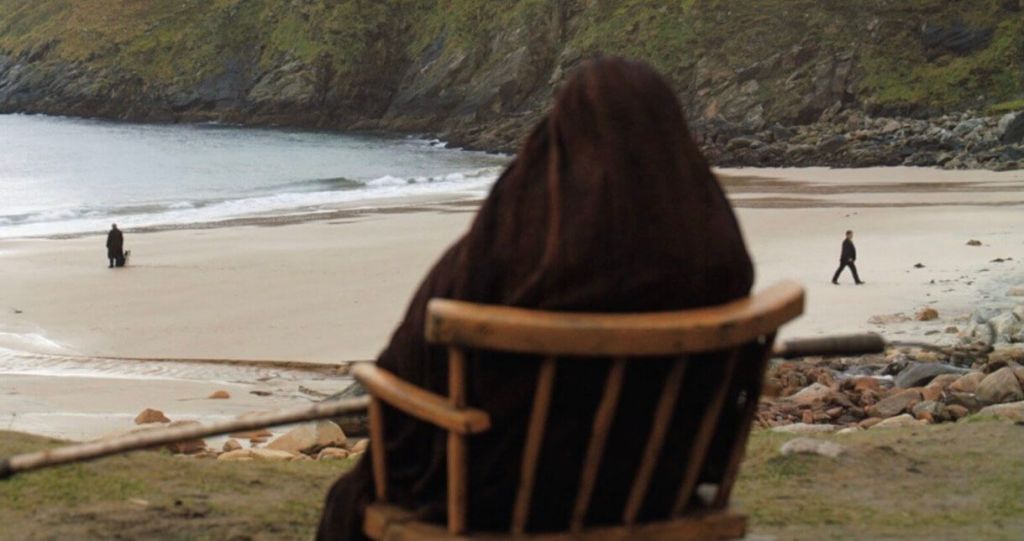
American evangelicals now face a difficult choice. Like Padráic in the final frame of Banshees, they can reach out across the gulf, just as Jesus once did; or they can turn and walk away, leaving vulnerable people alone with their wounds. We’ve already been warned. A banshee sits on the nearby cliff, silently watchful. How will our story end?
Sources Referenced:
1. “Fact Sheet on Injustice in the LGBTQ community” by the National Sexual Violence Resource Center: https://www.nsvrc.org/blogs/fact-sheet-injustice-lgbtq-community
2. “Why Most Evangelicals Say They Face ‘A Lot’ of Discrimination” by Daniel A. Cox: https://www.americansurveycenter.org/newsletter/why-most-evangelicals-say-they-face-a-lot-of-discrimination/#:~:text=There’s%20another%20reason%20white%20evangelicals,being%20fanned%20by%20political%20elites.
3. “Dr. Martin Luther King’s visit to Cornell College”: https://news.cornellcollege.edu/dr-martin-luther-kings-visit-to-cornell-college/
4. “The Mastery of Fear or Antidotes for Fear” by Martin Luther King, Jr: https://kinginstitute.stanford.edu/king-papers/documents/mastery-fear
5. Radical Hope: Ethics in the Face of Cultural Devastation by Jonathan Lear.
6. The Collected Short Plays of Thornton Wilder by Thornton Wilder.
7. This Life: Secular Faith and Spiritual Freedom by Martin Hägglund.
 Words for Wayfarers
Beautifully written, Jesse. Pertinent and thought-provoking. I’m very curious about this, admittedly, strange-sounding movie. It sounds like a powerful story with a touch of the absurd, but one that I would probably enjoy.
LikeLiked by 1 person
Thanks for reading! It’s such a wonderful film. Dark and melancholic, certainly, but also hilarious, compassionate, and full of humanity.
LikeLike