
Greetings!
As a literature teacher, I enjoy few things more than sharing great stories with people. Now, with autumn fast approaching (*pumps fist wildly*), here’s a list of books that I discovered for the first time this summer – some old, some new; some great, some not-so-great… Whether you agree with my reviews or think that I’m hopelessly wrong, I’d love to hear your thoughts in the comments. Here’s to a new season of moving and memorable literary voyages!
#1. My Struggle by Karl Ove Knausgaard
My rating: 4 stars

It was difficult to give this book a star rating, because it’s like nothing else I’ve ever read before. Many of my favorite stories are about finding beauty in the mundane: Marilynne Robinson’s Gilead, Herman Melville’s Moby Dick, Wendell Berry’s Jayber Crow, Amor Towles’ A Gentleman in Moscow, and Leif Enger’s Virgil Wander, to name a few. Yet, I’ve never read a book that so accurately captures the feeling of the mundane, with all its repetition and banality and transience, as the first volume of Karl Ove Knausgaard’s whopping 3,600-page memoir, My Struggle. Reading it, you get the sense that you’re not merely listening to a tale, but witnessing life as it is lived.
It takes some getting used to. Listening to conversations between Knausgaard and his friends and family, you begin to realize just how curated most literary dialogue is. The story rambles forward without chapter breaks, skipping back and forth between past and present. Rather than forcing his narrative into a familiar structure, Knausgaard allows his mind to roam where it will, inviting readers into all his fragmentary impressions, nagging insecurities, and wistful meditations. In doing so, he challenges our notion of what counts as literature. My Struggle is a bold experiment: an attempt to craft a literary epic from the unremittingly ordinary.
Does it work? You’ll have to decide for yourself. This book isn’t for everybody, and I’d be lying if I said that much of Knausgaard’s tale didn’t leave me longing for something more – more drama, more order, more insight into the meaning of various experiences. Yet, doesn’t my own life do the same? Do I read books to escape my life, or to see it with new eyes? If my goal is the latter, then Knausgaard’s book is a worthy companion for the journey. His relentless attention to life’s ebb and flow might bore you to tears, but it also unveils moments of startling, transcendent beauty. The fact that I enjoyed the book from start to finish, coupled with the fact that I’m seriously considering reading the rest of this behemoth (!), means Knausgaard must have done something right.
Plus, I learned lots of interesting stuff about Norway! So that was cool.
#2. So Brave, Young, and Handsome by Leif Enger
My rating: 4-and-1/2 stars

No one writes stories like Leif Enger.
Prior to re-reading this aloud with Kelly, I would have described it as my least favorite of Enger’s novels. That wasn’t a knock in any sense, because I still loved its story, which rambled along with Enger’s lyrical, wonderstruck prose (still my favorite writing in the world – how many authors do you know that make every sentence sing?). I’d burned through the book at high speed during college, so I didn’t remember many of the details. Returning to it was a joy, and taking it slowly helped me appreciate what a beautiful and marvelously quirky story it is.
Like me, Leif Enger was a midwesterner raised on westerns, and it’s delightful to see him leaning further into the western influences that shimmered like a distant sea at the edges of his unforgettable first novel, Peace Like a River. As westerns go, this book is a fascinating anomaly: an outlaw romp that simultaneously romanticizes, interrogates, pokes fun at, and subverts the tropes of American cowboy stories. Enger’s west is far more mundane than the mythic landscape of those earlier tales. His characters are alternately noble and silly, deeply human and all the better for it. And so this novel, which seems like a typical, cross-country cowboy yarn on its surface, ends up being about the stories we tell ourselves, the myths and legends we try to live up to, the cost of our dearly-held fantasies, and the grace we might find unexpectedly in the world before our eyes.
Plus it’s really, really funny (as all of Enger’s books are), best enjoyed aloud with an exaggerated cowboy accent. This man has written three of my favorite novels in the world, and I can’t wait to read his next one (which came out this year!).
#3. The Amber Spyglass by Phillip Pullman
My rating: 2 stars
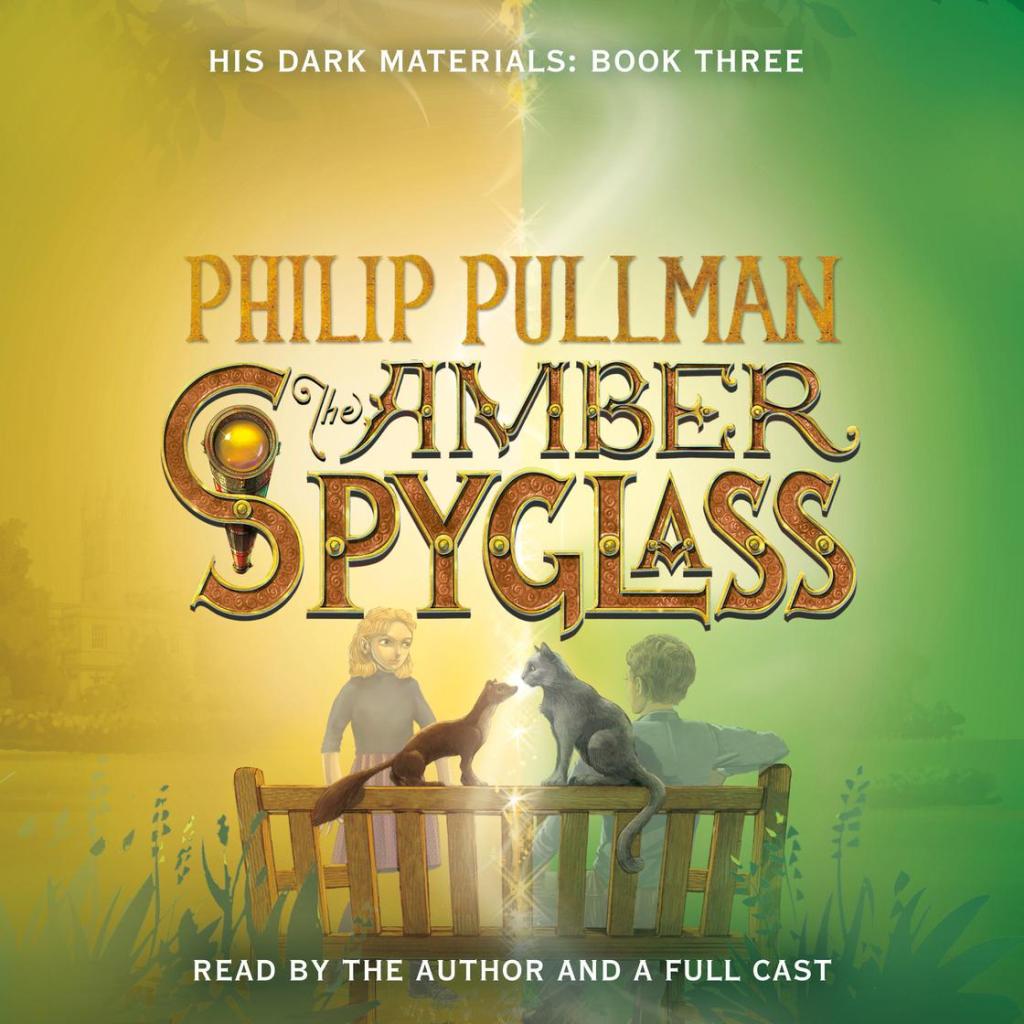
Man, I really, really wanted to like this book – the conclusion to Phillip Pullman’s His Dark Materials trilogy. I had begun to glimpse some big plot holes toward the end of The Subtle Knife, and I had a growing list of bothersome questions, but I was still riding high on the blast of whimsy and magic that was The Golden Compass, and I was holding out hope that the series finale might recapture that energy, getting the train back onto the tracks.
Unfortunately, the finale to the series is a long, slow train wreck, one that just keeps getting worse. It’s a beautifully imagined train, for sure, and Pullman describes it vividly. But nothing about it holds together. Huge questions are left completely unanswered, others answered through long speeches by characters that sound like nothing they would ever actually say. Characters don’t develop; they just change inexplicably, like powered-up Pokémon, sometimes into completely different people. Pullman’s over-reliance on surprises to keep things moving (“Suddenly…” “All of a sudden…” “Without warning…”) reaches an absurd level here, as if the story is playing on fast-forward. Pullman clearly loves the world that he’s created, which makes his lack of care for its mechanics all the more befuddling.
The feat that Pullman is trying to pull off – a subversive retelling of Milton’s Paradise Lost and the Biblical narrative of fall and redemption (Pullman has said he wanted to create an atheist alternative to The Chronicles of Narnia) – is fascinating, and I wish he’d stuck the landing. We need more fantasy that challenges religious dogma, teaching young people to think for themselves and reckoning with the twin evils of authoritarianism and indoctrination.
Yet, sadly, The Amber Spyglass didn’t remind me of Milton or the Bible or Narnia. More than anything, it reminded me of a movie – The Hobbit: The Battle of the Five Armies – a similarly epic, trilogy-ending catastrophe that I’ve tried very, very hard to forget.
#4. Turtles All the Way Down by John Green
My rating: 3 stars
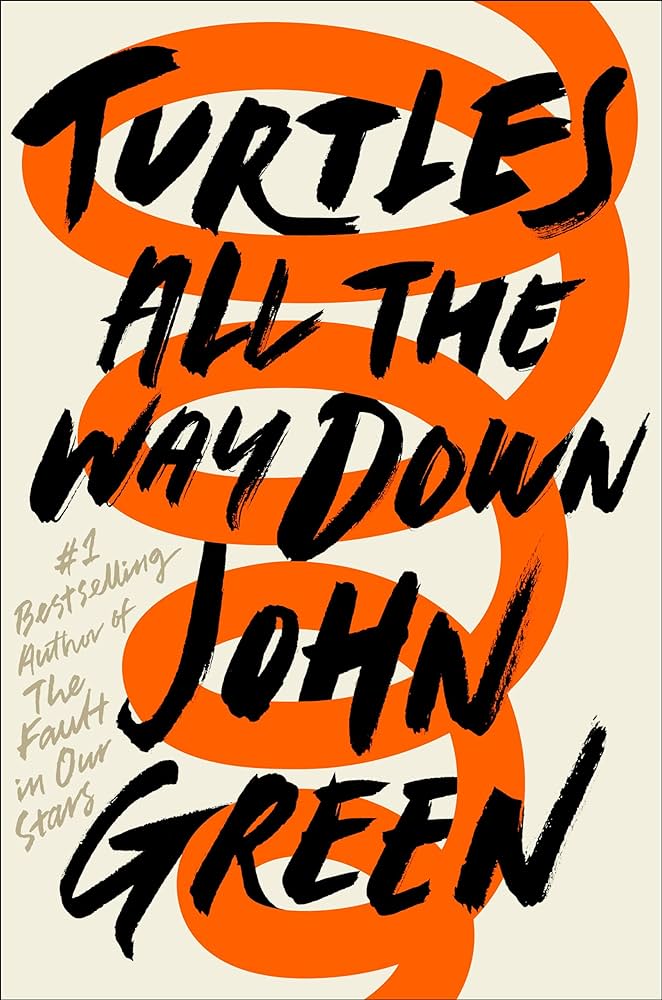
I’m frankly surprised that I enjoyed this book as much as I did. I’ve never read John Green’s previous works (The Fault in Our Stars, Paper Towns, The Anthropocene Reviewed), and I don’t typically go for young adult novels. Honestly, this one doesn’t have a whole lot going for it. It hits various YA rom com tropes hard: the mysterious and seemingly perfect boyfriend; the sidekick buddy who is saying witty, sarcastic things all.the.time; dramatic interior monologues spelling everything out for the audience; stretches of dialogue that sound like nothing any teenager would ever actually say, etc. The mystery arc, which excited me at the beginning, ultimately fades into the background and terminates in an abrupt, clumsily handled attempt at catharsis.
So, why the heck did I like this book? Maybe it was the author’s deep dives into the philosophy of self and consciousness, which frequently felt out of place but remained super interesting. Maybe it was the few plot points in the back half of the novel that took me by surprise, opening space for poignant moments of character development. But most of all, I think it was the author’s raw, unflinching portrayal of life with OCD that resonated with me. My obsessions and compulsions don’t look like Aza’s, but the voices in her head sounded all too familiar, and I was inspired by her struggle to overcome them. She may not have reached the closure that she hoped for, but she won me over in the end.
#5. Star Child by Claire Nivola
My rating: 5 stars
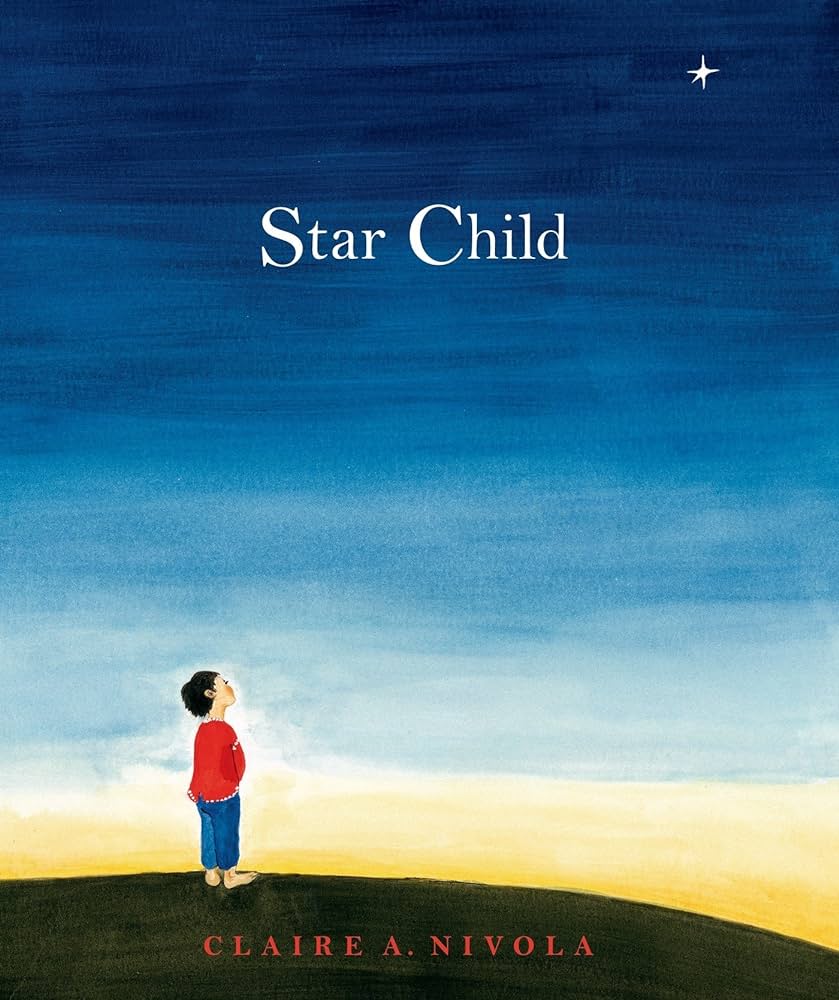
“Over the years you will try to make sense of that happy, sad, full, empty, always-shifting life you are in. And when the time comes to return to your star, it may be hard to say goodbye to that strangely beautiful world. Think well, then, before you go.”
So say the elders to the Star Child, a “flame of vapor, invisible and timeless” who longs to experience life on planet Earth. And so begins one of the most achingly beautiful love letters to the world ever written, cleverly disguised as a children’s book (but really meant for adults). The story is a simple one, but watch out. If you’re anything like me, you may find yourself plunged into a state of existential reflection, tears streaming down your face by the time you reach those bittersweet final pages.
Like many people, I first encountered Star Child through Mike Mills’ gorgeous 2021 film C’mon C’mon, where a weary Joaquin Phoenix cries while reading the book to his nephew at bedtime. Unfathomably (it should already be a classic by now), the book is nigh impossible to find, either cheaply for purchase on Amazon or at local libraries (those near me, anyway). However, you can watch it read aloud on YouTube. The book’s power is as much a product of its illustrations as its words – those whimsical watercolor paintings, effortlessly childlike and vibrant as life itself. Come to think of it, that last phrase sums the book up pretty darn well…
It’s $50 on Amazon, but if you bought it on a whim, that’d be money well spent.
#6. Faith, Hope, and Carnage by Nick Cave and Seán O’Hagan
My rating: 4 stars
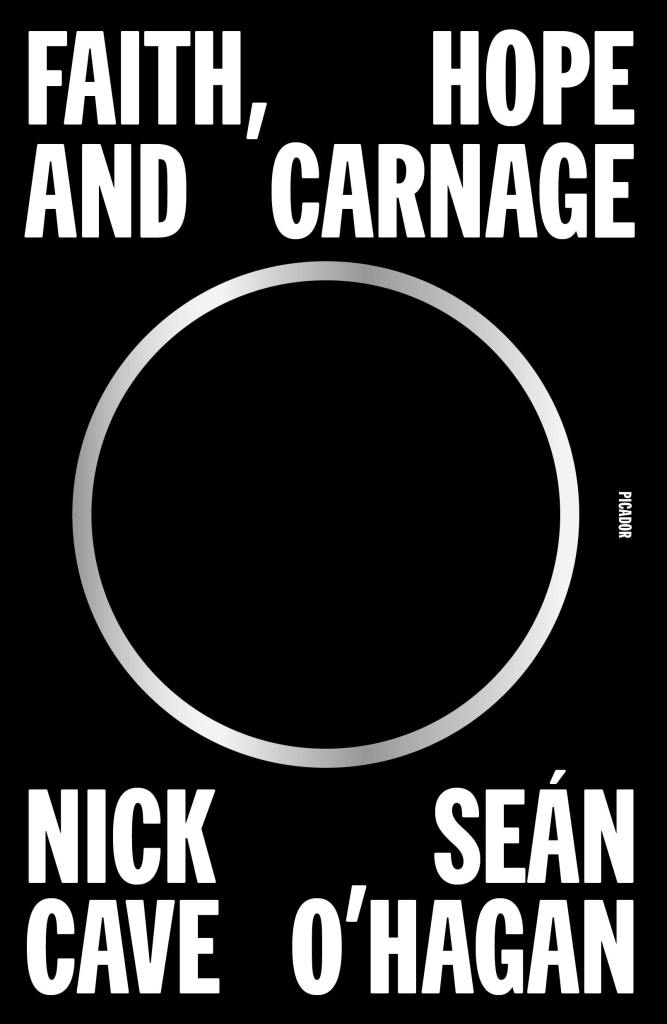
As a certified music nerd, I’ve read, watched, and listened to numerous interviews with bands and songwriters over the years. Yet this strange and beautiful book, pieced together from more than 40 hours of conversation between Australian singer-songwriter Nick Cave and Irish journalist Seán O’Hagan, stands above them all.
I checked the book out after listening through Nick Cave’s album Ghosteen, eager for a glimpse into the making of that remarkable record (it’s my favorite musical find of 2024, and one of the most moving listening experiences I’ve ever had). Faith, Hope, and Carnage delivered that, but it also provided something better: a raw, profound, and wide-ranging conversation on life in all its complexity.
Cave’s vulnerability is astounding. As the book unfolds, he lays bare his creative process, his regrets and insecurities, his struggle to overcome heroin addiction, his marital hardships, his wrestling with God, and the grief he endured after the tragic death of his 15-year-old son. As the interviewer, O’Hagan strikes a graceful balance, alternately pulling back and probing deeper, honoring his friend’s wounds and challenging his perspectives. The depths that these men traverse testify to the strength of their bond – a trust forged from decades of shared joys and sorrows.
Does that all sound heavy? It is, and yet it isn’t. Over and over, Cave bears witness to the fragile beauty of the world, to the deep wonderment available on the far side of devastation. His story inspires me to live boldly, to love hard, to keep my eyes open. And it also makes me want to spin Ghosteen again.
#7. This Life: Secular Faith & Spiritual Freedom by Martin Hägglund
My rating: 5 stars

Hands down the best book of philosophy I’ve ever read, and one of the most inspiring reading experiences I’ve ever had, too. There’s so much I could say about it… where to start?
The most remarkable thing about the book, I think, is its seamlessness. In a little less than 400 pages, Hägglund attempts to prove that human finitude is the source of all true meaning, purpose, morality, and freedom. Along the way, he weaves philosophical exploration with theological reflection, social and economic analysis, and literary critique. He engages with Augustine and Kierkegaard and C.S. Lewis, Marx and Hegel and MLK, Mill and Keynes and Hayek. Yet, incredibly, it all hangs together. Hägglund’s reflections on mortality and his critiques of religious faith flow beautifully into his devastating takedown of capitalism. The book is erudite yet readable, incisive yet heartfelt. I began reading quickly and eventually slowed down and doubled back to take notes, which I’m so glad I did. There’s just so much to take in, in the very best of ways, and I know I’ll be revisiting it often as the years pass.
Some may argue that Hägglund’s writing style is unnecessarily repetitive, which is a valid criticism. Yet I was grateful for the author’s restatement of key points, which helped me grasp his arguments much better. Hägglund is a college professor, and his teacher’s heart really comes through here. So many books written by brilliant people hold you at arm’s length, but this one invites you in, eager to unfold itself to you.
I was predisposed to enjoy This Life, since it explores questions I’ve been mulling over for years: How can we love the world we inhabit when it is so deeply riven by suffering? Can religious faith be reconciled with genuine care and concern for mortal life? Can our current economic systems ever deliver on promises of justice and equality? (I resonated deeply with Marx when I read him in college, but I still had lingering misconceptions about his teachings; after digesting Hägglund’s in-depth analysis of Marx’s work, I’m pretty sold on socialism). Hägglund contends that there are answers to these questions – serious, sobering, and ultimately liberating answers that point us toward the world we dream about but can scarcely bring ourselves to hope for. That world feels a long way off, but who knows? With books like these to guide us, we might just find our way there.
 Words for Wayfarers