
During college, I spent four years living with a guy who loved The Legend of Zelda. Not only did he own the classic Zelda video games, but he enjoyed playing through them all in release order. He would start with Ocarina of Time, follow that up with Majora’s Mask, Wind Waker, and Twilight Princess, and finish with Skyward Sword (this was before Breath of the Wild was released). Sounds like an impressive feat, right? Oh, and I forgot to mention: He completed this marathon every semester.
Now, based on the summary above, you might already be forming a mental image of my roommate: a bleary-eyed hermit, perhaps, huddled over a GameCube console in the shadows, surrounded by Mountain Dew cans and half-eaten bags of Doritos. While that description fit other gamers I knew in college, it wasn’t true of Luke. My roommate was a gregarious human being with great grades, multiple jobs, an active social life, and time to spare. So, how on earth did he manage to trudge through the Zelda canon every semester? Simple. He didn’t trudge. He played it fast. Really fast.
Luke had been playing Zelda games for years, and he knew the tricks to fly through each level. His pace was mesmerizing. Often, my friends and I would settle into the sofa and spend hours watching him play, fascinated by his dexterity and delighted by his goofy commentary. I’ll never forget the night when Luke received a phone call while battling a particularly difficult boss. Without hesitation, he picked up his phone in one hand and completed the level with the other. Those of us watching could only stare, slack-jawed in amazement.
In sharp contrast to my roommate, I knew little about video games and nothing at all about The Legend of Zelda. When the name Zelda came up in conversation, I asked: “Isn’t that the guy in the green hat?” Luke’s slow head-turn and blank stare told me that I’d committed blasphemy (or, at the very least, made a serious mistake). Zelda, it turns out, was a princess, and the green-clad adventurer I’d referred to was named Link. As the years passed, I learned lots more about the kingdom of Hyrule – its geography, wildlife, citizens, and history – and developed an appreciation for the franchise’s unique artistry and storytelling. My roommate’s enthusiasm for the games was contagious, and before I knew it, I had caught the Zelda bug. To this day, while I’ve never played through a Zelda game, I enjoy learning more about the series and revisiting its soundtrack, and I think of the games with immense fondness.
Recently, Luke sent me a YouTube video analyzing elements of Twilight Princess. The video prompted me to ponder why The Legend of Zelda hooked me years ago and why it continues to resonate. I’m a different person than I was in college. My beliefs, goals, and struggles have changed in significant ways. Yet might Link’s adventures in Hyrule have something insightful to say about the adventures I’m currently navigating – about the journeys that all of us find ourselves in? If we take a closer look at the guy in the green hat, what might he have to teach us?
Lesson #1: Adventures Emerge from the Ordinary

At first glance, Link’s exploits in the Zelda franchise are anything but ordinary. He’s a reincarnated warrior, after all, striving to save the life-giving Triforce from the clutches of Ganon, a restless embodiment of evil. As he journeys to face Ganon, Link explores far-flung realms, unearths magical items, wields an ancient sword, befriends a host of fantastical creatures, and wins the heart of a princess. Chances are that you’re not doing the same, unless a mysterious stranger has visited your house recently with a message of great and perilous import (in that case, carry on, and best of luck to you). So, how might Link’s extraordinary adventures relate to our ordinary lives?
Link’s adventures might be remarkable, but they rarely start that way. Usually, when Zelda games introduce us to Link, his surroundings and activities are very mundane. In Twilight Princess, for example, Link spends his days running errands for neighbors in his village, fishing in local ponds, laboring as a ranch hand, and herding perpetually wayward goats. In both Ocarina of Time and Wind Waker, he’s depicted as a sleepy, somewhat lazy youth, and in the former game, he lives with his grandmother (tender, surely, but not so thrilling). Link’s roots are rural, his concerns simple, and his pace of life unhurried. If you weren’t already familiar with Zelda‘s plot, you might not peg him as anyone special.
Unlike many video games, Zelda games accentuate the mundanity of their hero’s quest. Link spends a lot of time walking through nature. He stops often to converse with common folk, helping them with a variety of menial tasks. This emphasis on the ordinary is expanded in later games like Wind Waker and Breath of the Wild, where hefty stretches of time are allotted to sailing the open sea, gathering ingredients for meals, and horseback riding across the countryside. It takes time for Link to get places and to get things done, and there are plenty of literal and figurative rabbit trails along the way.
When I think about Link’s origins and wanderings, I’m reminded that human life is marked by mundanity. No matter who we are, where we come from, or what we accomplish, we’ll spend most of our lives on earth doing simple, unremarkable things. The numbers are startling. According to a 2017 Huffington Post article (see reference list below), the average person spends 26 years of their life sleeping, 7 years trying to get to sleep, 13 years working, 11 years looking at screens, and 4.5 years eating. How much cumulative time do you spend on the toilet? You don’t want to know. Add in things like daily commutes, office visits, paperwork, homework sessions, grocery shopping, household chores, etc., and the hourglass looks nearly empty. Pulitzer Prize-winning poet Annie Dillard was on to something when she wrote: “How we spend our days is, of course, how we spend our lives.”
No matter what adventures we embark on, we can’t seem to escape the ordinary. Humans are wired to seek novelty, experts at wanting to be anywhere else. Our media-saturated culture reinforces this instinct. We post highlight reels on our social media pages, rummaging through the daily grind for what is eye-catching and impressive. Similarly, our movies compress lives into two-hour increments, spotlighting “key events” and filtering out “non-essential details.” This creates the illusion that a life well-lived consists of continuous drama. Comparing our experiences to the carefully curated images flickering on our screens, we start to worry that our lives are dull, static, and uninspired. Arriving at long-awaited destinations, we realize they weren’t as satisfying as we’d hoped, and we struggle to recall the scenery that flashed by our windows en route.
Confucius once said that a journey of a thousand miles begins with a single step. That quote may excite would-be wayfarers, but there’s a deeper truth tucked within the philosopher’s words, one which we routinely forget. The same adventures that begin with a single step also consist of single steps – millions of ordinary, repetitive paces, one footfall following another. Why is there a crap ton of walking in the Lord of the Rings books? Because that’s what J.R.R. Tolkien’s adventurers spend the vast majority of their time doing. No quest is immune from drudgery and monotony (just ask fans of Twilight Princess about iron boots in the Goron mines and watch for the involuntary shiver). Adventures, as thrilling as they may be, remain imbued with the everyday.
Not only do our journeys emerge from and consist of the mundane, but they also draw their meaning from the mundane. If Link’s life was an endless string of hairbreadth escapes, hand-to-hand combat sequences, and death-defying stunts, I’m willing to bet he wouldn’t be as keen on accepting new adventures. He’d probably want some time off (and maybe some melatonin). Without the backdrop of the ordinary, the extraordinary becomes meaningless. The joy is in the juxtaposition. Link’s journeys thrill us precisely because they burst unexpectedly into a previously tranquil life, yanking the protagonist from his comfort zone. They’re wondrous because they aren’t commonplace, and they’re wondrous because other things are.
Why does Link embark on adventures in the first place? Is he dissatisfied with an ordinary existence in Hyrule, sick of herding those pesky goats, antsy for some novelty and monster-punching? Nope. Link’s heroism in extraordinary circumstances is simply an extension of his fidelity in ordinary ones. Our green-capped hero values the rhythms of rural life, the customs of his village, and the eccentricities of his neighbors. He leaves home to defend these things from destruction, not to flee from them. Love is the impetus for his adventures – love for people, love for place, and love or all the beauty wrapped up in those simple words. For Link, the ordinary isn’t a tedious diversion from grand exploits; it’s a treasure to be safeguarded at all costs. His gaze may be set on Ganon, but he never loses sight of the journey, pausing to help strangers all along the way. No good deed is too small to merit his attention, because no good deed is insignificant in the collective struggle to liberate Hyrule from tyranny. Link’s reverence for simple things recalls Gandalf’s words in The Hobbit: An Unexpected Journey:
Saruman believes it is only great power that can hold evil in check, but that is not what I have found. I’ve found it is the small things, everyday deeds of ordinary folk, that keeps the darkness at bay. Simple acts of kindness and love.
Luke and I got into some wild escapades in college (most of them instigated by him). However, when I think back on those years, what I miss most is the quiet river of ordinary moments that ran beneath our friendship – the hours spent walking to and from class together, sharing meals in the cafeteria, making trips to the grocery store, helping each other with homework (or interrupting each other’s homework), and talking late into the night. Unlike Link, we weren’t dueling any goblins or revivified skeletons (Well, there was that one time…). We were just doing life together, laughing and crying and bickering and apologizing and encouraging, trying to figure ourselves out and to love each other well. Those days may have been simple, but they had far-reaching consequences. They inspired me to approach future relationships with greater sensitivity and care, to love my neighborhood well, and to seek out perspectives that differed from my own. Most of all, they challenged me to savor the mundane, showing my the beauty of faithful, generous presence over the long haul. Like Link’s village, they were treasures worth fighting for.
Lesson #2: Adventures Must Be Received
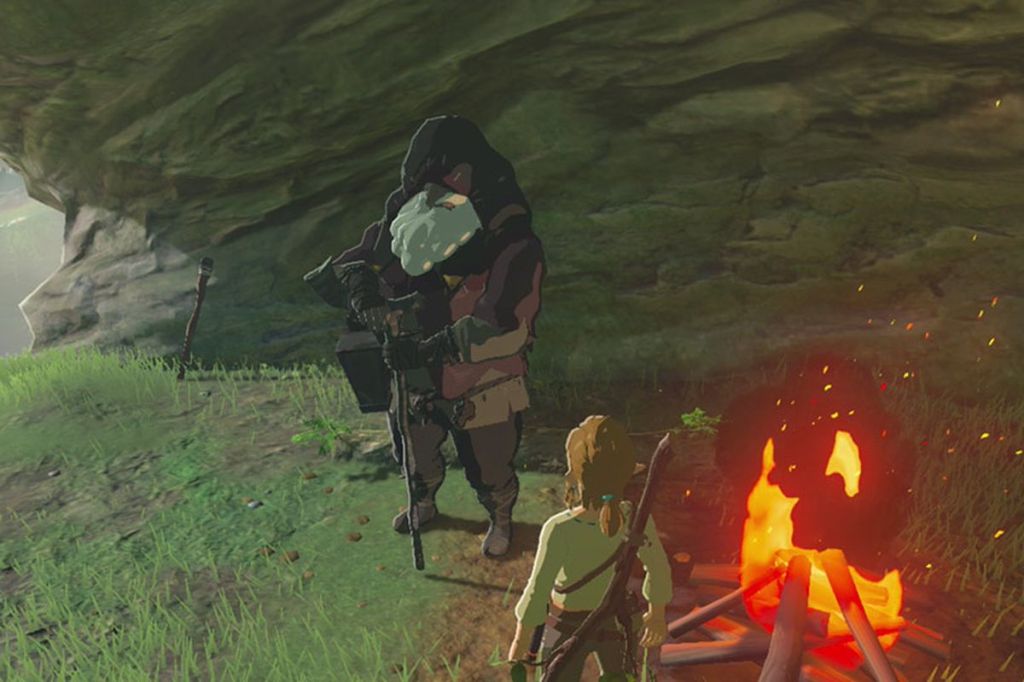
In every Zelda game, Link’s adventures begin unexpectedly. Sometimes, it’s a summons from another character – a message from a fairy in Ocarina of Time or a fireside chat with a hooded stranger in Breath of the Wild. Other times, it’s an inciting event – a skirmish with a forest thief in Majora’s Mask, a kidnapping in Wind Waker, or a mysterious cyclone in Skyward Sword. Link isn’t ready to face Ganon yet. To tell the truth, he’s woefully unprepared for the journey. “Can Hyrule’s destiny really depend on such a lazy boy?” muses the fairy in Ocarina’s opening scene. As his story unfolds, Link will undergo trial by fire, testing his mental and physical limits against a host of unwelcome surprises. Our hero has a lot to learn, and his growth will depend on his ability to roll with the punches.
Link’s lack of preparation underscores a fundamental truth of the universe: Life isn’t something we control. From the moment we enter the world, existence unfolds and reveals itself to us, shaping the very lenses that we’ll use to navigate it. We can try to chisel existence to fit our designs, but reality still sets the rules, and life’s rough edges have a way of asserting themselves when it’s least convenient. Like Link’s summons, most of our adventures will arrive unbidden. Take a moment to reflect: How many of your most cherished experiences, relationships, interests, and discoveries were things that you saw coming? How many, by contrast, swept into your life unexpectedly, beckoning you to places you never expected to go?
It may be misleading, but the siren song of control is hard to resist. Like many people in our world, Ganon chases power with fiery abandon, intent on bending everything and everyone in Hyrule to his will. This single-minded pursuit may enable him to achieve his aims, but it also causes myopia, blinding him to countless blessings available along the way. Inevitably, the tide comes in, and the castles that we’ve built begin to crumble. Surrounded by flotsam, will we breathe a prayer of thanks, surrendering gifts that the sea gave us? Or, like Brad Pitt’s workaholic character in the movie Tree of Life, will we be filled with regret, murmuring that we “dishonored it all and didn’t notice the glory”?
My favorite musical discovery this year was J Lind’s album Alchemy, a work that concludes the trilogy he began with two of my all-time favorite records: 2019’s For What It’s Worth and 2021’s The Land of Canaan. Lind’s third album explores the theme of unexpected detours, asking what unsought and unearned epiphanies (what he calls moments of “alchemy”) might teach us about the human condition. In an essay inspired by the album, Lind quotes an old cliché, “Happiness is a butterfly,” arguing that satisfaction often eludes our pursuit, settling on us when we aren’t chasing or expecting it. Elaborating on this idea, he writes:
Like falling asleep each night, so many of life’s most important ventures are more about grace than grit; they come to us unexpected, unearned, and nevertheless incomparable in their meaning. Try as we might, we can never fully engineer them. Remember that electric ripple down your spine when the tired view from your 5th-floor walkup was painted over with a thin blanket of fresh snow? Remember how that chance encounter with the stranger at 7th and Broadway left you reeling with conviction, youthful once more?… It seems like so many of my most prized seashells are the ones I wasn’t really looking for in the first place: my passions, my friends, my marriage. Maybe I’d woken up early to see a pacific sunrise, but I hadn’t counted on all the beauty lurking in the tidepools.
For fans of the Legend of Zelda franchise, “lurking beauty” is a huge part of the video games’ appeal. Sure, you could beeline straight for Ganon’s fortress, dodging all unnecessary pit stops. But oh, how much magic you’d miss! What would Link’s travels be without Chuchus, Keese, and Pebblits around every corner, without rubies and potions buried in the sand, without hidden passageways to spelunk and colorful vagabonds to befriend? Some of Link’s side-quests have little or no relevance to his journey, but others are pivotal, providing him with items, allies, and skills that will prove invaluable in the war against Ganon’s forces. Link can’t foresee which detours are dead-ends and which might decide his fate. All he can do is take them as they come, gleaning whatever wisdom they have to offer.
As I reflect on Link’s circuitous route through Hyrule, I’m inspired to hold my plans loosely, keeping my eyes peeled for unexpected joys and opportunities. My friend Luke exemplified this openness in his play-throughs of Zelda games, never too fixated on his destination to use items in silly ways, dance around an irritated goblin, or toss an unsuspecting chicken off a cliff. He also exemplified it in his daily life. Everywhere he went, Luke seized opportunities to brighten people’s days with unexpected goofiness – belting out the Penn State University fight song in public, breaking out his dance moves on a whim, raising absurd hypothetical scenarios, firing off endless dad jokes, and laughing himself to tears over verbal mix-ups. Life with Luke was never predictable, and I didn’t want it to be. I’m reminded that we became roommates by happenstance: I had submitted my housing preference form late, and he hadn’t submitted his, so the college stuck us together. Our mutual lack of preparation led to a deep, lasting friendship, one that has shaped both of our trajectories in countless ways. A detour worth taking? You bet.
Lesson #3: Adventures Must Be Pursued

“Hold on a second!” I hear you saying, a bit exasperated. “I thought you just said that adventures must be received, not pursued. You spent a long time expounding that claim, time that I could’ve used to watch a considerable quantity of cat videos. What the heck’s going on?” I won’t deny the apparent contradiction, but I think there’s something to it. Bear with me.
In every Zelda game, Link has an urgent mission. The stakes couldn’t be higher. If he doesn’t strike out into the unknown, if he gives up, or if he gets too distracted along the way, then his story can’t unfold, and all that he loves will be lost. No matter what, he must press onward, doggedly persisting despite the odds. Hyrule as he knows it hangs in the balance.
You’ve probably heard the slogan that life’s about the journey, not the destination. This sounds super cool and Zen, and it’s true to an extent. As we’ve already seen, the majority of our lives is spent on the way, not in the arrival. On the flip side, destinations matter. We need worthy goals to strive for, objectives that call us out of ourselves, connect us to others, and challenge us to work for things that matter. Aimless wandering might be fun for a time, but take it from a guy with no sense of direction: It gets old fast. Without a compass of some kind, your expedition is more likely to founder, and you’re also less likely to venture into the unknown in the first place. Link’s mission to save the Triforce is, after all, what launches him into the wilds of Hyrule, enabling him to experience wonders he never dreamed possible. So… which is it? Should we release control, waiting for adventures to knock at our door? Or should we double down, pursuing our chosen destinations come hell or high water? And even if we choose the latter, how do we know when to push forward and when to pull back?
If there’s anything that I’ve learned from The Legend of Zelda, it’s that there’s no one correct way to play a Zelda game. Some people, like my friend Luke, sprint across Hyrule like a caffeinated gazelle. Others keep a steady pace, tempering forward movement with occasional, necessary detours. Still others meander, leaving the trail to hunt mushrooms and antagonize birds. On planet earth, as in Hyrule, there’s no magic formula for decision-making. Our choices depend on a host of factors, including our goals, personalities, beliefs, histories, circumstances, and relationships. Furthermore, none of these things is static; all of them evolve over time. However black and white our beliefs about the world may be, we will inevitably encounter gray areas – messy, complex situations lying just beyond the edges of our maps. This wilderness is the breeding ground of adventure. How do we find our way within it?
Spoiler alert: I don’t have a foolproof strategy (Adventure for Dummies) to offer. As someone whose worldview recently underwent a seismic shift, I’m grappling with the burden of uncertainty like never before, and decisions can feel paralyzing. However, I’ve become increasingly convinced that danger lies in the extremes – that wisdom is a balancing act. Ganon’s relentless campaign for control is certainly toxic, but so is unchecked passivity (think Toby Flenderson from The Office) that stifles any sparks of risk-taking or experimentation. At times, I’ve fallen headfirst into Ganon’s trap, putting projects before people and missing the beauty of the everyday. At other times, I’ve surveyed my steps with regret, wishing that I’d taken more chances or fought harder for what I believed in. Finding a healthy balance between ambition and openness isn’t easy, but it’s as vital as Link’s Hyrulean quest. Our well-being, like the flourishing of the places and people we love, depends on it.
When I was growing up and struggling to make decisions, my dad would remind me that sailboats need two things to function: wind and forward momentum. If air currents aren’t filling its sails, then a boat is dead in the water. If, on the other hand, that same boat isn’t already moving forward, then the sailor straining at the ropes can’t tack into the wind and harness its power. The point? Drive and patience are equally necessary. We must seek, and we must also receive. Additionally, proper balance isn’t achieved by sitting back and ruminating, but through experience – by hopping into a sailboat, trying and failing and trying again, until each tightening or loosening of the ropes becomes instinct, each sudden surge of seawater an unexpected guest.
Like Link, hurtling across the waters of the Great Sea in Wind Waker, we’ve got to keep a lookout for floating signs and uncharted islands, holding our plans loosely and allowing each discovery to shape our course. Yet we also need a far harbor to propel us forward and a hero’s task to sustain us when storm clouds roll in. As I watch Link’s story unfold, I’m comforted by the knowledge that, like me, he’s figuring things out as he goes along, trusting that the way will become clear as he is faithful to the journey.
When I think about my college self, the images that surface aren’t flattering. I remember a shy, awkward kid, full of inarticulable longing and loneliness, desperately trying to get life right and terrified of making a wrong move. That kid would have loved easy answers to his questions, but that wasn’t what he needed. He needed a friend – a goofy, gregarious, overconfident companion who could show him that life was an adventure to be pursued, all the more beautiful for its unpredictability. He needed someone whose antics could chip away at his own self-consciousness, whose courage to try and fail could dissolve his own fear of screw-ups, and whose loyalty could carry him through some of his darkest moments. He needed a Link to blaze the trail and to show him that it was safe. And he got him.
That, in the end, is why The Legend of Zelda means so much to me, even though I’ve never played through a Zelda game. Link’s adventures remind me to savor the gift of the ordinary, to stay alert for bends in the road, and to chase after what matters. But more than that, they remind me of a person who embodied those lessons when I needed it most, teaching them by example.
I wish I could say that I’ve completely outgrown my college self. Sure, I’m a different person than I was back then (less acne, thankfully), but many of the same insecurities still haunt my steps, drawing near in times of disorientation. When that happens, when the way forward isn’t clear, I’ll remember the guy in the green hat and the friend who made him real. I’ll remember that love beats at the heart of the greatest adventures. And I’ll remember Sheik’s speech to Link in Ocarina of Time: “The passion of friendship will soon blossom into a righteous power and through it, you will know which way to go.”
Thanks a million, Luke.

References:
– “We’ve Broken Down Your Entire Life Into Years Spent Doing Tasks” – HuffPost
– “The Powerful Responsibility of Twilight Princess” – Liam Triforce, YouTube
– “A Word on Alchemy” – J Lind Music (jlindmusic.com)
 Words for Wayfarers