
Recently, my wife and I sat at our kitchen table, trying to recall the books which had most influenced us. The exercise was a tricky one. We weren’t listing our favorite books; we were trying to identify books which had altered our thinking, shaped our ambitions, and redirected the course of our lives. We had a blast, and I decided to share my own list here. Each of these titles comes highly recommended. So, without further ado, happy reading! 🙂
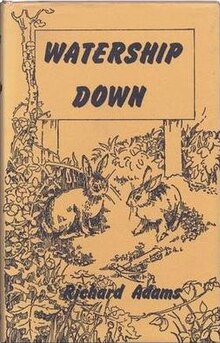
#1. Watership Down by Richard Adams
When I think about Watership Down, I think about the Ikea bunkbeds in the upper bedroom of my family’s old house in Lučenec, Slovakia. It was here that my brothers and I lay awake each night, listening to our dad as he read the story aloud to us. Our parents had introduced us to many stories, but nothing quite like this. Richard Adams’ tale of rabbit refugees on the English Downs was epic and sinister, laced with dread that rumbled like distant storm clouds. Menaced on every side by phantoms and shadows, the heroism of the hunted bunnies flickered with desperate magnificence. We fell in love with each of them: Fiver, Bigwig, Dandelion, Blackberry, Kehaar, and, of course, Hazel-Rah (my brothers and I named our bearded dragon “Hazel” after our childhood hero). Watership Down was one of the first books to sweep me away, plunging me into a world that I didn’t want to leave. It kindled a lifelong passion for stories with talking animals, cross-country quests, ragtag bands of companions, and fierce battles between good and evil. It also inspired me to write more of my own stories. Reading the novel aloud to my wife this year, I was a little kid again, longing with Hazel and his friends for “a high, lonely place with dry soil, where rabbits can see and hear all round and men hardly ever come.”

#2. Lizzie Bright & the Buckminster Boy by Gary Schmidt
This was the first book that I ever purchased. I was a fifth grader and had won some kind of prize at school for reading tons of library books, and that prize allowed me to select one discounted title from Barnes & Noble (just feeding the addiction, I guess). After wandering the aisles in breathless excitement, I picked Lizzie Bright and the Buckminster Boy. I had never heard of the story, but something about the cover image called to me: a boy and girl, laughing together in a rowboat as the gigantic bulk of a humpback whale glided underneath. The novel is set in 1912 and follows Turner Buckminster, a preacher’s son struggling to adapt to a new community in Phippsburg, Maine. It also recounts his relationship with Lizzie Bright, a vivacious Black girl from nearby Malaga Island. As the two kids grow closer, the religious prejudices and political interests of Phippsburg threaten to tear them apart, forcing them to decide how far they’ll to preserve their unlikely friendship. I’ll never forget finishing the book in my family’s basement in Grandville, Michigan. I wept as I read the closing pages, both overcome by sadness and awed by the beautiful way in which it was communicated. Lizzie Bright was my first introduction to the cathartic power of storytelling. It showed me that stories weren’t just entertainment. They could also bring you to tears, inviting you into the emotional experience of another person and opening chambers in your heart that you didn’t know were there.

#3. The Kite Runner by Khaled Hosseini
I picked this novel off a summer reading list for my AP English Literature class. My older brother had read it and liked it, and I trusted his taste. As a third culture kid who was raised overseas, I had seen more of the world than most of my peers. I loved stories set in foreign countries: accounts of missionaries, explorers, and other travelers who immersed themselves in unfamiliar surroundings. But The Kite Runner was different. The Afghanistan that Khaled Hosseini described wasn’t a picturesque travel destination or a proving ground for brave adventurers. It was a glorious nation ravaged by decades of ceaseless war, a place of immense promise devastated by the will of the powerful. Worst of all, the country I now called home had played a major part in cementing its ruin. Hosseini’s unconditional love for his homeland reverberated through every page, and his meditation on the possibilities of redemption stirred something deep inside me. I burned through the book, unable to put it down. After finishing The Kite Runner‘s closing pages, I went for a walk, trying to process one of the greatest endings I’d ever encountered in a story. Through this brave and beautiful book, Hosseini opened my eyes to a world beyond the edges of my maps – to places whose histories were marked by unimaginable suffering, whose citizens were not so different from the people I knew and loved, and whose stories were inextricably linked with my own. I had glimpsed the bleeding heart of the world, felt its blood pumping through my own veins, and I couldn’t go back. What was I going to do now?

#4. Just Mercy by Bryan Stevenson
“Bryan Stevenson is coming to Wheaton College!” My anthropology professor was ecstatic, urging all of his students to attend an upcoming lecture on capital punishment and mass incarceration in the United States. I had never heard of Stevenson. I had no idea how vital his advocacy had been for innocent prisoners on death row, for children tried and sentenced as adults, for intellectually disabled people living their lives behind bars, and for Black people everywhere who were terrorized by a broken criminal justice system. Honestly, the situation was much worse than that. As someone steeped in White, suburban, evangelical Christian culture, I genuinely believed that racial injustice was history. We were past that sort of thing, weren’t we? Hadn’t MLK and the civil rights movement of the 1960s already slain the dragon? That evening at Wheaton College, I sat stunned as Stevenson unspooled his lecture with quiet conviction, sharing stories and statistics that demolished my comfortable worldview in the course of an hour. I read Stevenson’s bestselling memoir later and was devastated anew by more data that hadn’t been included in that fateful talk. Just Mercy challenged me to interrogate the racial assumptions that I had adopted unquestioningly. It spurred me to acknowledge my privilege and to repent of my own complicity in systems of oppression. It changed the way I think about prisons and prisoners. Best of all, it inspired me to seek out other stories by Black artists and activists, opening me to perspectives that were as liberating as they were convicting. I still have much to learn, but I’m so grateful for the role Bryan Stevenson played in provoking that journey of discovery.

#5. The Irresistible Revolution by Shane Claiborne
In the summer and fall of my senior year at Wheaton College, I had an amazing opportunity to spend five months living, learning, and laboring alongside residents of a slum in Jakarta, Indonesia. My neighbors were undocumented Sundanese migrants who made their living as scavengers, sorting through the city’s waste for recyclable materials. They were some of the most generous and hospitable people I’ve ever met, and I learned so much from them. Their joy and resilience in the face of adversity were remarkable. However, their daily struggles were gut-wrenching, and they haunt me to this day. Returning to college in the United States, I found myself navigating reverse culture-shock and grappling with a host of difficult questions: How can I apply what I’ve learned to my everyday life in the United States? What does it look like to fight poverty, systemic injustice, and capitalist greed in the wealthiest country on the planet? Where are the poor in midwestern America, and how can I build meaningful relationships with them? One of my friends in Indonesia recommended that I read The Irresistible Revolution by Shane Claiborne. More than anything else, Claiborne’s book helped me bridge the gap between my experiences in Indonesia and my life at home. Reflecting on decades of service alongside the poor, homeless, and mentally ill residents of Philadelphia, Pennsylvania, Claiborne taught me that the values I wanted to embrace – commitments to live simply, to give generously, to speak out against oppression, and to follow Jesus’ call to love the marginalized – could be practiced anywhere. Opportunities to be an ordinary radical were all around me, if only I had the courage to see them.
#6. Orthodoxy by G.K. Chesterton
I have my dad to thank for this book, which has shaped my personal philosophy more than any other. Dad found a tattered copy of Chesterton’s classic treatise in the used books section of our local Christian bookstore, and he hinted that magic lay within its pages. I read the book in the summer after my college graduation, at a camp nestled in the north woods of Wisconsin. I had never encountered such penetrating wit in a work of writing. Chesterton’s prose sparkled and sang, drawing a smile one moment and cutting to my core the next. The rotund, mustachioed philosopher with the countenance of a bulldog invited me to ponder something which I had felt countless times but rarely consciously considered: the strangeness of ordinary life. Like Chesterton, I had often experienced a sense of “eccentric privilege” when encountering beauty – the feeling that I was an uninvited guest on the Earth, privy to wonders beyond my capacity to understand. Orthodoxy showed me that these wonders weren’t just visible in grand and glorious things; they were just as present in the mundane, in the millions of ordinary miracles that we human beings regularly take for granted. According to Chesterton, the proper response to life’s mysteries was one of humility and gratitude. Revisiting the words of this quirky Catholic sage (as I do often on this blog), I’m humbled by his brilliance and grateful for his perspective. When I’m weary of life’s hardships, in danger of missing the glory that swirls around me each and every moment, his words help me to stop and see: “Here dies another day, during which I have had eyes, ears, hands, and the great world round me, and with tomorrow begins another. Why am I allowed two?”
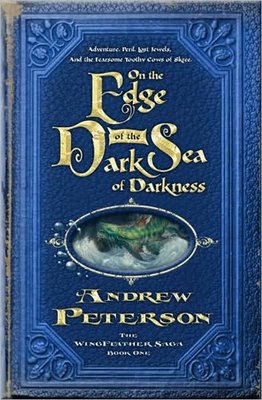
#7. On the Edge of the Dark Sea of Darkness by Andrew Peterson
Looking back, I’m amazed that I didn’t discover this book sooner. I’d been a nerdy fan of Andrew Peterson’s music since high school. His poetry had kindled my imagination countless times, and I knew almost all of his lyrics by heart. So, when I picked up On the Edge of the Dark Sea of Darkness after college, I wasn’t surprised to learn that Peterson was a gifted novelist. The book came at a perfect time. I was aimless and discouraged, navigating a high-stress job in social work and wondering what to do with my life. Initially, the first book in The Wingfeather Saga hit me as a welcome shot of unbridled joy. The book was chock-full of bizarre characters and oddball humor, and I found myself belly-laughing alone in my car as I read chapters before work. However, little by little, the book began probing at things that had lain dormant in me for years. I had wanted to be a writer for as long as I could remember. I went to college as an English major, itching to tell stories that kindled people’s imaginations. Yet, I ultimately abandoned those dreams and gave up writing for years, convinced that my broken and bleeding world already had enough storytellers, that social activism was a far more pressing need than fiction. Reading On the Edge of the Dark Sea of Darkness, I realized that I was wrong. I started to recall the many ways that stories had shaped me into the person I was, the many ways they had opened up my world and inspired me to love that world better. Peterson’s debut novel was exactly the type of story I had dreamed of telling as a kid, as goofy and perilous and magical as the planet I called home. It also prompted me to start writing again. My adult aspiration is now the same as my childhood dream: to tell stories that awaken, comfort, and inspire. And I have Andrew Peterson to thank for that.

#8. Jayber Crow by Wendell Berry
Set in the fictional town of Port William, Kentucky, this novel features one of my all-time favorite narrators. Jayber Crow is an orphan, bachelor, and failed seminary student who returns to the community that raised him and becomes its barber. As decades pass, we witness the changes that wash over Port William through Jayber’s eyes. We also witness his blossoming affection for the land and for the cast of quirky characters that calls it home. When I finished the book, I was still living at home with my family, working hard to pay off college debts. Like Jayber, I frequently found myself tiring of the familiar and longing to hit the road. Yet, his tale of fidelity to place challenged me to take a second look at my surroundings. What was I missing in my rush to be elsewhere? Who were my neighbors, and what might it look like to love them as Jayber did? What might my own place have to teach me? Gradually, just like Jayber, I grew to love the ground I’d been given, in all its messiness and particularity. It wasn’t easy, but it was worth it. Thanks in part to Wendell Berry’s book, my relationship with my parents and siblings is stronger than it was before college. Not only that, but my longing for the kind of close-knit community that Jayber describes led to the formation of an art group which ran for several years, filling my days with joy. Jayber Crow taught me that contentment is possible anywhere, if we keep our eyes open for the gifts, graces, and potential friends that already surround us. As Berry writes elsewhere, “We live the given life, and not the planned.”

#9. Why I Believed: Reflections of a Former Missionary by Kenneth Daniels
When I purchased this book in the winter of 2022, I had just made the decision to abandon the Christian faith of my upbringing. It was an incredibly lonely time. I knew no one who had deconverted from religion as I had; almost the entirety of my community consisted of believing Christians. Online testimonies of spiritual deconstruction were my only solace, and it was in one of those talks (shared by Rhett McLaughlin and Link Neal of Good Mythical Morning) that I first heard about Kenneth Daniels’ book, Why I Believed. I devoured the book, then I went back and read it a second time. Daniels, a former missionary in Niger with Wycliffe Bible Translators, had become an atheist after grappling with faith and doubt for decades. Equal parts memoir and exposé, his book not only portrayed the struggle of apostasy in heartbreaking detail, but also mounted the most devastating critique of Christianity that I had ever read. Reading Daniels’ story, I felt deep assurance that I wasn’t alone. Someone out there had walked the same path, weighed the same evidence, and survived the same heartache. Furthermore, Daniels’ arguments cemented my conviction that I could no longer subscribe to Christian teachings. I can recommend no better volume to skeptics deconstructing their faith or to Christians seeking to understand what the experience of deconstruction entails.

#10. Behind the Beautiful Forevers: Life, Death, and Hope in a Mumbai Undercity – Katherine Boo
Okay, okay. I haven’t technically finished this one yet. However, the fact that I’m still including it on this list says it all. Katherine Boo won the National Book Award for her groundbreaking account of everyday life in the slums of Mumbai. I read the opening pages of her book with astonishment, startled by the numerous similarities between the ramshackle neighborhood of Annawadi and the Jakarta squatter settlement where I lived during 2017. Like my former neighbors, the characters of Boo’s book salvage their living from a city’s waste, founding their homes and hopes on the rubbish. The tales Boo tells are gut-wrenching, unforgettable, and achingly human. More than one billion of the world’s people live in slums, and Boo is convinced that we cannot ignore their stories. Reading her account has allowed me to return to a place and a people I loved, helping me explore the impact of their stories on my own. It has also given me a vision for the specific kind of writing I hope to produce someday: vivid, cross-cultural journalism that invites the privileged into the lived experiences of the marginalized. I’ve spent years wondering how my anthropology training and literary aspirations might be reconciled, and Behind the Beautiful Forevers has blazed a trail for me to follow. If my future work bears any resemblance to Katherine Boo’s, the journey will have been well worth it.
Well, that’s a wrap! Which books have impacted you the most? If you’d like to make a list and share it via email, Facebook, or a comment on this page, I would be honored to read it!
Safe travels,
Jesse
 Words for Wayfarers