
Imagine that you’re about to be stranded on a desert island. You’re allowed to take one fragment of a piece of art from any genre with you – not a complete work of art, but a tiny piece of that work of art, such as a chunk of a painting or sculpture, a chapter from a book, a scene from a movie, a level from a video game, or a song from an album. Which fragment of art would you take?
If you’re an art junkie like me, that question might seem impossible to answer. It’s hard enough picking a favorite work of art within any particular genre, much less from all genres collectively. With so many beautiful and inspiring creations to consider, how on earth could you possibly compare them all and choose a single fragment of a single work of art?
Sure, it’s an absurd scenario. Yet, as crazy as it may sound, I know without hesitation which fragment of art I would pick – the tiny sliver of storytelling that resonates with me more than any other. I know this because, quite simply, that fragment changed my life.
The work of art is Robert Zemeckis’ 2000 film, Cast Away (my favorite film of all time), and the fragment is the final two minutes of the movie. Chuck Noland (played by Tom Hanks) is standing next to a dusty crossroads in rural Texas, peering at a map and trying to get his bearings. A pickup truck pulls over next to him, and an auburn-haired woman leans out of the window.
“Where are you headed?” she asks, grinning.
Chuck looks up. “Well, I was just about to figure that out.”
The woman climbs out of her truck and looks around. “Well, that’s 83 South. And this road here will hook you up with I-40 East. If you turn right, that’ll take you to Amarillo, Flagstaff, California.” She smiles and gestures toward her farm. “And if you head back that direction, you’ll find a whole lot of nothing all the way to Canada.”
Chuck thanks the woman, who wishes him well: “Good luck, Cowboy.” She returns to her truck and drives off. Alone again, Chuck walks into the middle of the crossroads. Slowly, he turns to face each direction. The camera turns with him, showing each road stretching over miles of plains into the horizon. Finally, he turns toward the camera, staring down the road taken by the auburn-haired stranger (and at us). The hint of a smile appears on his lips. And then the credits roll.
It’s a simple, quiet scene. Nothing dramatic happens. The events depicted are thoroughly mundane: an exchange of directions by the roadside. So, why does this scene affect me in such a profound way?
Saved From a Wreck
Let’s rewind to the beginning of the movie. When we first meet Chuck Noland, he’s a high-strung FedEx executive who makes no apologies for his workaholism. He berates employees for their lack of efficiency, checks his pager during Christmas dinner, and struggles to find time for his girlfriend, Kelly. When Chuck looks toward the horizon, he sees a checklist – an endless sequence of predictable tasks and measurable results, stretching as far as his eyes can see. Boarding a plane to resolve a work problem in Malaysia, he knows exactly what he’ll do upon his return: pop the question to Kelly and continue business as usual.
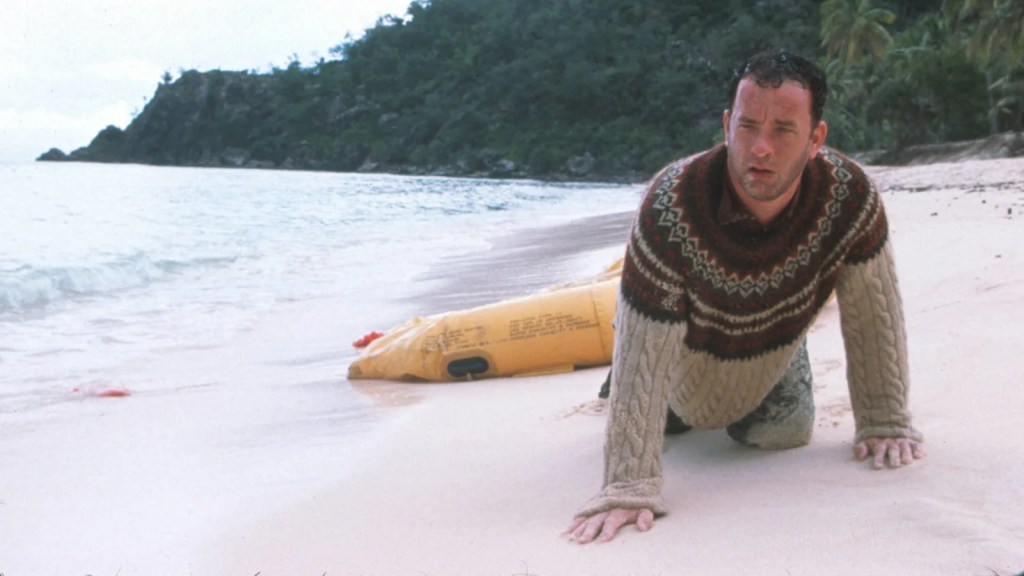
Neither of these things will happen. As his flight nears its destination, it’s buffeted by a violent storm and crash-lands in the Pacific. The next day, Chuck washes ashore on an uninhabited island, the sole survivor of the wreck. He will remain there for four years.
As the story unfolds, we see Chuck struggling to adapt to isolation. He treks across the island, exploring each of its haunts and hideaways. He learns how to crack coconuts, how to spear fish from the tide pools, and how to coax a fire into life. He salvages packages from the sunken plane, repurposing everything from ice skates to fishnet stockings. Eventually, one of these packages divulges an unexpected companion: a volleyball (named “Wilson” after its logo) that will become Chuck’s deadpan conversation partner throughout the film.
Sound boring? It isn’t. Tom Hanks gives a career-best performance, laying bare his character’s emotions with every flick of his eyes, inviting the audience to ponder what we’d do if we were in his shoes. The narrative is consistently riveting, no more so than when, at long last, Chuck finally breaks through the waves that surround the island, using a wall from a portable toilet as a sail. Half dead and adrift, he is once again plucked from the sea, only this time by an ocean liner.
A lesser story would end there, celebrating Chuck’s triumphant return to civilization. Thankfully, Robert Zemeckis knows that life isn’t that simple. Chuck has spent four long years yearning for the familiar rhythms and routines of society. Now, however, he discovers that his old life is anything but familiar. As he begins to reintegrate into a world that believed him dead and gone, he’ll face challenges as difficult as any encountered on the island.
So, returning to my earlier question: Why does the story of Cast Away, particularly its ending, mean so much to me? To answer that question, I need to share a quote from G.K. Chesterton’s 1908 autobiography, Orthodoxy. In this passage, Chesterton reflects on another literary work: Robinson Crusoe, a novel which bears strong resemblances to Chuck Noland’s story. Chesterton writes:
Thus I have said that stories of magic alone can express my sense that life is not only a pleasure but a kind of eccentric privilege. I may express this… by alluding to another book always read in boyhood, “Robinson Crusoe,” which I read about this time, and which owes its eternal vivacity to the fact that it celebrates the poetry of limits, nay, even the wild romance of prudence. Crusoe is a man on a small rock with a few comforts just snatched from the sea: the best thing in the book is simply the list of things saved from the wreck. The greatest of poems is an inventory. Every kitchen tool becomes ideal because Crusoe might have dropped it in the sea. It is a good exercise, in empty or ugly hours of the day, to look at anything, the coal-scuttle or the bookcase, and think how happy one could be to have brought it out of the sinking ship on to the solitary island. But it is a better exercise still to remember that all things have had this hairbreadth escape: everything has been saved from a wreck. Every man has had one horrible adventure: as a hidden untimely birth he had not been, as infants that never see the light. Men spoke much in my boyhood of restricted or ruined men of genius: and it was common to say that many a man was a Great Might-Have-Been. To me it is a more solid and startling fact that any man in the street is a Great Might-Not-Have-Been.
But I really felt (the fancy may seem foolish) as if all the order and number of things were the romantic remnant of Crusoe’s ship…The trees and planets seemed like things saved from the wreck: and when I saw the Matterhorn I was glad it had not been overlooked in the confusion. I felt economical about the stars as if they were sapphires (they are called so in Milton’s Eden): I hoarded the hills. For the universe is a single jewel, and while it is a natural cant to talk of a jewel as peerless and priceless, of this jewel it is literally true. This cosmos is indeed without peer and without price: for there cannot be another one.
What is Chesterton getting at here? Simply put, he wants us to recognize that life is a precious gift – something to be wondered at and never taken for granted. That might sound cliché, but the way that Chesterton describes the “gifted-ness” of life is unique. Furthermore, when placed alongside Cast Away, Chesterton’s words reveal layers of profundity tucked within the film – themes and motifs that help explain why that final roadside scene moves me so deeply.
Beautiful Flotsam

According to Chesterton, every part of our material world is a treasure. You might not feel excited by a coal-scuttle or a bookcase, but Chesterton wants you to be. He argues that if, like Chuck Noland, we were stranded on a desert island and these items washed ashore, we wouldn’t take them for granted. So, why then do we take them for granted in our everyday lives? They didn’t have to exist. Modern cosmologists remind us that the odds of our being here – the chances that far-flung stardust would coalesce into this particular planet of soil, rocks, trees, oceans, clouds, and ecosystems capable of sustaining life – are quite literally astronomical.
Chesterton’s words remind me that there are no “ordinary” things in this life, just extraordinary things that we’ve gotten used to seeing around. When we were too small to walk or speak, everything that our eyes fastened on was a wonder. Does the fact that we can name things, categorize them, and understand their basic parts make them any less wonderful?
As he adjusts to life on the island, Chuck gains a deeper appreciation for ordinary things. Each package salvaged from the sea is useful for something, whether it’s handmade fabric footwear or emergency ice skate dentistry (if you’ve seen the film, then you probably can’t forget the tooth removal scene). After his rescue, Chuck lays on a hotel floor, flicking a light switch on and off over and over again. Watching him do this, we suddenly recall that he has lived without electricity for years, and we realize that he’ll never see it in the same way again. Nothing is too small or simple to kindle Chuck’s wonder. During a late-night talk with an old friend, he pauses to look down at his drink. “I have ice in my glass,” he murmurs, turning those words over like a precious stone.
Included in Chesterton’s treasures are the people with whom we navigate life. Like the raw materials of our planet, human beings didn’t have to exist, and we do so against astronomical odds. Every one of us is a “Great-Might-Not-Have-Been.” In addition to cosmological considerations, there was no guarantee that we’d survive the grisly gauntlet of childbirth, that we wouldn’t join the untold numbers of “infants that never see the light.” We are walking miracles – beautiful flotsam.
Furthermore, none of us emerges from a vacuum. We are all the products of stories that started long before we were born and that included countless people we’ll never meet, billions of accidents and chance encounters and romances and brave decisions that we’ll never know. We exist within social networks – families, communities, societies, and cultures – that have shaped us into the people we are. Our stories are far more entangled with the stories of others than we realize. As a result, we are far more dependent on one another than we can imagine. As songwriter Josh Ritter puts it, “Man wasn’t made to live alone.”
Cast Away‘s volleyball subplot is unarguably odd. Wilson sticks in people’s memories, and he’s often the main thing people recall about the film. As the story progresses, Chuck’s conversations with his mute companion become increasingly elaborate, and we become increasingly concerned about his sanity. The fact that Hanks pulls these scenes off, unsettling us and making us laugh at the same time, is a small miracle. Yet, those who see Wilson as a mere comedic prop are missing the weighty significance of his place in the narrative.
A world away from everyone he knows and loves, Chuck is desperate for connection, for dialogue, for relationship. He can’t survive without it. This is why he scratches portraits of Kelly on the walls of his cave, and it’s also why he traces a smiley face onto Wilson’s surface. When Chuck weeps after losing Wilson to the sea, we don’t laugh. We cry with him (or, at the very least, I do) because we know what that weathered volleyball meant to him. It was the closest thing to a friend that he had for four years. He wasn’t made to live alone.
After returning to civilization, Chuck recognizes that relationships are immeasurably precious gifts. He also reckons with the painful reality that he once squandered those gifts. Catching up with a coworker whose wife recently died of cancer, Chuck apologizes for never offering support. He makes a similar apology to Kelly: “I’m so sorry… I should’ve never gotten on that plane. I should’ve never gotten out of the car.” Through his isolation, Chuck learns the truth that no man (pardon the pun) is an island. He comes to see himself as immersed in a web of relationships that are fragile, fleeting, and sacred.
The Time That is Given to Us

Chesterton’s claim that each person is a “Great-Might-Not-Have-Been” reminds us that we had no say in our emergence into this world. Likewise, we’ll have no say in our exit. Each and every one of us will die. This fact illumines a further truth: none of us knows how long we will exist. Like our birth and our death, time is a mystery that eludes our grasp. We don’t control the clock, and we don’t know when it’ll stop ticking. All we can decide, as a wise old wizard once said, is what to do with the time that is given to us.
At the beginning of Cast Away, Chuck gives an impassioned speech to his FedEx employees: “Time rules over us without mercy… That’s why every FedEx has a clock. Because we live or die by the clock. We never turn our back on it. And we never, ever allow ourselves the sin of losing track of time!” While Chuck might seem to appreciate the value of time, his speech reveals a crucial misunderstanding. He thinks he can control the clock. In his mind, time is a commodity – something that can be hoarded and turned into profit. That’s why he urges his employees to keep their eyes on their watches.
Later in the film, we hear Chuck repeat these same words in his island cave. This time, however, he speaks them with bitter cynicism, chastened by the crash that blew his carefully constructed schedule to bits. On the island, Chuck has all the time he could ever want… and no work projects to fill it with. We watch his hurry and bluster dissolve over time, settling into a patience that mirrors the natural rhythms of sea, land, and sky.
After his rescue, Chuck is slower to speak and quicker to listen. He sits and talks with an old friend late into the night, making a formerly uncharacteristic effort to be fully present. He travels to rural Texas to perform an act of kindness for a stranger. When he stands at the crossroads at the end of the film, Chuck takes his time looking around, and he isn’t checking his watch. Time matters just as much to him as it ever did, but it isn’t a commodity anymore. It never was. It’s a gift. Like all gifts, it doesn’t demand to be hoarded; it only asks to be received.
The reality that we don’t control the clock challenges us to reckon with the inevitability of changes brought by time. Early in the film, we watch Chuck as he eavesdrops on a friend who is describing his wife’s cancer. Chuck’s eyes say it all: he would rather be anywhere else. Perhaps some small part of him still thinks that he’s the exception to the rule, that mortality will work around his plans. Later in the film, Chuck doesn’t flinch while consoling his bereaved friend. He knows that grief and loss are unavoidable, that they often blindside us with all the ferocity of a plane crash, and that they must be reckoned with.
Chuck’s wisdom is hard-won. In one of the film’s climactic scenes, he reunites with Kelly, the woman whose memory kept him going during those four long years on the island. He stands in her kitchen, listens to her stories, stares at the photographs of her new husband and children. And then, in the pouring rain, he lets her go again – this time for good. It’s a gut-wrenching scene. Yet, it’s also full of grace. Chuck recognizes that loss is inevitable. He can’t control Kelly, any more than he can control the clock or the changing tides. By letting her go and allowing her to let him go, he frees Kelly to move forward in her story, just as his rescue freed him to move forward in his.
What the Tide Could Bring

In the wake of profound and unexpected loss, a question surfaces: Are the gifts that we experience in this life worth the hardships that accompany them? The material world and the relationships that we experience may have been salvaged from a wreck, as Chesterton argues. But how can we treasure that precious flotsam when it keeps slipping back into the sea? We may be able to make peace with the plot twists and tragedies brought by time. But how can we go beyond simply making peace to loving life again when all that was familiar has washed away in the tide?
Near the end of Cast Away, while talking with an old friend, Chuck opens up about a particularly dark moment on the island. Director Robert Zemeckis films Noland’s description of the event as a single continuous shot, keeping his camera on Tom Hanks. As Hanks delivers Chuck’s monologue (one of the greatest ever written), his eyes reflect the glow of firelight, staring at scenes that are as vivid to him now as when they first occurred:
We both had done the math. Kelly added it all up and knew she had to let me go. I added it up and knew that I had lost her. ‘Cause I was never gonna get off that island. I was gonna die there, totally alone. I was gonna get sick, or get injured or something. The only choice I had, the only thing I could control, was when and how and where it was going to happen. So, I made a rope, and I went up to the summit to hang myself. I had to test it, you know? Of course. You know me. And the weight of the log snapped the limb of the tree, so I couldn’t even kill myself the way I wanted to. I had power over nothing.
And that’s when this feeling came over me like a warm blanket. I knew, somehow, that I had to stay alive. Somehow. I had to keep breathing, even though there was no reason to hope, and all my logic said that I would never see this place again. So that’s what I did. I stayed alive. I kept breathing. And one day my logic was proven all wrong because the tide came in and gave me a sail. And now, here I am. I’m back. In Memphis, talking to you. I have ice in my glass… And I’ve lost her all over again… I’m so sad that I don’t have Kelly. But I’m so grateful that she was with me on that island. And I know what I have to do now. Gotta keep breathing. Because tomorrow the sun will rise. Who knows what the tide could bring?
Chuck never expected to crash-land in the Pacific. But he also never expected that the tide would bring him a sail, enabling him to escape the island. His logic said that there was no hope, that life couldn’t be salvaged from the wreckage. But life confounded his logic, just as surely as it confounded his flight to Malaysia. The wreck of that very flight (more specifically, the wrecked wall of its portable toilet) is what made Chuck’s return to civilization possible. Alone on a desert island, Chuck came face to face with his greatest fear: the reality that life can’t be controlled. Yet, as he talks with his friend, we witness his dawning realization that this very lack of control might, after all, be life’s truest gift.
Existence doesn’t bow to our desires. Life can change without warning, in an instant, laying waste to everything that we loved or thought we knew. Yet, at his lowest point, Chuck discovers a paradoxical truth: the very unpredictability that occasions life’s deepest sorrows also generates life’s greatest joys (or, as a pastor I knew once said, “We don’t know what will happen tomorrow, and that is the worst and best thing about life”). How much of the beauty and goodness that you’ve experienced in your life was a product of your own efforts? Haven’t most of your cherished memories, your closest friendships, your wildest encounters with awe, your richest insights, and your deepest experiences of love come to you by surprise?
This is why that closing scene of Cast Away moves me so deeply. As he stands in the center of the crossroads, Chuck isn’t just deciding which direction to drive. He’s pondering the countless directions his life can take, recognizing that each open road is an invitation. He can choose to go anywhere. The film doesn’t show us which path he takes in the end. Will he strike off into the unknown, chasing a new future to the south or east or west? Perhaps. Will he backtrack north, following the trail of the auburn-haired woman and seeking the possibility of new relationship? This seems more likely. Either way, he’s in no rush. As he stares through the camera at us, we might sense a feeling coming over us “like a warm blanket,” just like it did for Chuck on the island, when he was tempted to believe that his story was over: You’re still here. You’re still breathing. What will you choose to do today?
In his one-man broadway show, legendary songwriter Bruce Springsteen laments the loss of innocence brought by time: ““The one thing I miss in getting older is the beauty of the blank page – so much of life in front of you, its promise, its possibility, its mysteries, its adventures – that blank page just lying there daring you to write on it.” While I sympathize with Springsteen’s sentiment, Cast Away tells a different story. Life isn’t a blank page that gets increasingly filled up as our stories are written, so that our potential for growth and change and new beginnings continually recedes. It’s a stack of innumerable blank pages – one for each day, each minute, each second of our lives on Earth. No matter what we’ve done or failed to do, tomorrow is a tale that’s yet to be written. It’s not as if we have a select few “crossroads” moments where the future is wide open and our life can take different trajectories. The future is always wide open. Each and every moment of our lives is a crossroads – the gift of a fresh start, if only we have eyes to see it. As indie rock band Colony House sings in their song “The Hope Inside”:
Maybe there’s a reason why this world spins around in circles
Like it’s giving us another try every sunrise to find purpose
Has it been going on all this time, like another breath that goes unnoticed?
I’m leaving what is lost behind to find the light
Whenever I’m walking in the countryside and I come across a fork in the road, I head to the middle of that crossroads. Slowly, I turn to face each direction, gazing at the point where each road meets the skyline. As I practice this small ritual, I’m overwhelmed by gratitude. Thanks to Tom Hanks, Robert Zemeckis, and Cast Away, I look at the world differently. “Ordinary” objects like volleyballs, ice cubes, and light switches look a little less humdrum, a little more bizarre. Conversations with friends and family members become spaces of sacred communion – transcendent mysteries demanding my full attention. And, while still painful, heartbreaks feel a bit more bearable when viewed as the inevitable outcome of life’s ceaselessly shifting tides.
This past year has been an incredibly difficult one, full of grief and losses I could never have anticipated. Many familiar comforts have been washed away by the waves. Like a certain FedEx executive, I have no idea what the future holds. I struggle to see how new chapters can unfold from the wreckage. But I’m so thankful to be here, and I’m willing to wait. Who knows what the tide could bring?
 Words for Wayfarers